
Welcome to Blogs
Discover actionable insights, in-depth research, and expert perspectives, all in one place.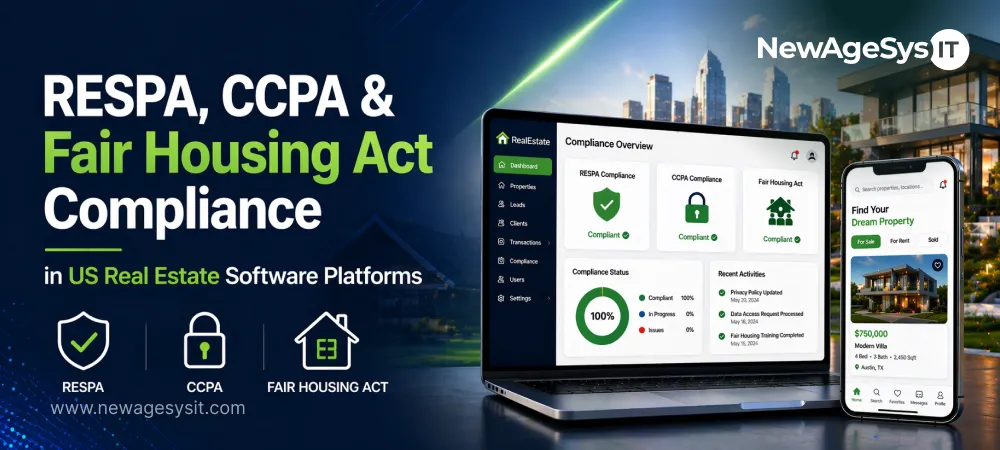
Real Estate 11 min read
RESPA, CCPA & Fair Housing Act Compliance in US Real Estate Software Platforms

| This article is part of our series on Real Estate Software Compliance, Security & Regulatory Strategy for US Developers. |
RESPA, CCPA, and the Fair Housing Act define three core compliance obligations that most US real estate software must address simultaneously. These are not sequential requirements. They must be evaluated together at the architecture stage, as each introduces specific engineering requirements into the product, not just policy-level documentation. This applies to platforms handling property search and listing display, transaction coordination workflows, and client relationship systems, where regulatory requirements must be embedded into core system design.
For teams developing real estate mobile and web app development services that manage listings, transactions, and client interactions, these considerations must be incorporated early. RESPA requires audit-ready infrastructure for referral tracking and disclosures, the Fair Housing Act requires algorithmic controls to prevent discriminatory outcomes, and CCPA requires automated workflows for data access, deletion, and consent management.
When these requirements are not addressed during system design, platforms can face material operational and regulatory exposure. RESPA violations can lead to civil and criminal penalties, Fair Housing enforcement can result in consent decrees and forced system redesign, and CCPA non-compliance exposes platforms to regulatory fines and consumer litigation.
Platforms that handle referrals, automate decision-making, and process user data must treat compliance as a core system function rather than a post-launch adjustment, especially when operating real estate software and CRM development services that involve complex data handling and client lifecycle workflows.
Addressing these requirements during architecture design is significantly more efficient than attempting to correct them after launch. This article presents strategic and technical guidance on US real estate compliance requirements. It is not legal advice. Real estate software developers should consult qualified real estate and technology legal counsel for specific compliance guidance.
Together, RESPA, CCPA, and the Fair Housing Act form the core compliance triad within the broader US real estate software compliance framework, which is explored in detail in our pillar guide.
RESPA: What Real Estate Software Developers Must Know
RESPA Section 8 introduces direct engineering constraints for real estate platforms that manage referral routing, vendor relationships, and settlement service integrations. It is illegal to give or receive anything of value for referrals of settlement services in connection with federally related mortgage loans. As a result, systems connecting brokerages, lenders, title companies, and insurance providers must be designed to prevent prohibited fee structures while maintaining transparent referral logic. In practice, RESPA compliance in real estate software requires architecture that governs how referrals are routed and how partner relationships are structured.
Preferred vendor programs within CRM and lead management systems must ensure that routing logic does not prioritize affiliated or paying providers without compliant disclosures. Where affiliated business arrangements exist, platforms must support delivery, acknowledgment, and logging of AfBA disclosures at or before the point of referral. Marketing services agreements also require careful handling, as systems must document the genuine marketing services provided in exchange for any fees to withstand regulatory scrutiny.
In addition, RESPA-compliant software systems must maintain audit trails of referral decisions, fee arrangements, and disclosure delivery, ensuring records can be produced during regulatory examination.
RESPA requirements are interpreted through guidance from the Consumer Financial Protection Bureau that evolves over time. Real estate software developers should consult qualified legal counsel before designing referral routing, preferred vendor programs, or settlement service integration features.
The Fair Housing Act: Technology’s Role in Anti-Discrimination Compliance
The Fair Housing Act (FHA) prohibits discrimination in housing based on race, color, national origin, religion, sex, familial status, and disability, and these protections apply fully to technology-mediated processes. For real estate platforms, this creates direct engineering requirements across algorithmic systems, AI features, geographic marketing, and property search. Achieving Fair Housing software compliance requires designing systems that prevent both intentional discrimination and unintended disparate impact.
Algorithmic advertising is a key risk area. Geographically targeted housing advertising that systematically excludes areas with higher concentrations of protected class demographics has been found to violate the FHA, requiring controls within marketing automation systems.
AI recommendation engine compliance is equally critical, as recommendation algorithms that surface different property sets based on characteristics correlated with protected class demographics can create enforcement exposure even without discriminatory intent. Geographic search filter design must also be carefully evaluated, particularly when filters allow queries based on neighborhood demographic data or school-related characteristics.
From an engineering standpoint, systems must implement disparate impact testing across recommendation algorithms, lead routing systems, and marketing automation tools to ensure outcomes are not skewed across protected class demographics. In addition, maintaining audit trails for algorithmic decisions is essential to document how routing, recommendation, and marketing logic operate in custom software development for regulated real estate platforms.
CCPA/CPRA and State Privacy Laws for Real Estate Platforms Across United States
CCPA/CPRA applies to real estate platforms that collect personal information from California residents, making privacy engineering a core requirement for any CCPA-compliant real estate platform. Data such as property search history, saved listings, user location data, behavioral analytics, and client records are all in scope.
In addition, sensitive personal information, including financial capacity data, credit information collected for pre-qualification, and precise geolocation used for property navigation, is subject to enhanced protection requirements.
From an engineering perspective, consumer data rights must be operationalized through automated workflows. This includes enabling the right of access through machine-readable data exports within defined regulatory response timelines, commonly fulfilled within 45 days, supporting deletion requests with data purging across systems, including propagation to downstream service providers, and implementing mechanisms to allow users to opt out of the sale or sharing of personal data.
These capabilities must be embedded into system design rather than handled manually, with integrated data protection controls that align with cybersecurity best practices for US real estate platforms and client data protection.
Beyond California, states such as Virginia, Colorado, Connecticut, and Texas have enacted comprehensive privacy laws, requiring real estate platforms to manage compliance across multiple jurisdictions. As real estate platforms expand across multiple state jurisdictions, managing compliance becomes more complex for systems that process user interactions and location data, where data flows extend across multiple systems.
Real estate platforms designed for mobile-driven user interactions and data collection workflows must account for these expanding data flows. Real estate platforms face a specific data retention tension where state privacy law deletion rights can conflict with state licensing board transaction record retention requirements, requiring system architecture that can support both simultaneously.
How RESPA, Fair Housing, and CCPA Interact in Real Estate Software
RESPA, the Fair Housing Act, and CCPA do not operate in isolation. In real estate platforms, they intersect through shared system requirements that are best addressed through a unified compliance architecture. A common example is audit infrastructure. RESPA requires logs of referral and disclosure decisions, the Fair Housing Act requires records of algorithmic decision-making, and CCPA requires tracking of data access and deletion requests. A single audit layer can support all three simultaneously.
Similarly, consent and disclosure workflows can be centralized. AfBA disclosures under RESPA, Fair Housing compliance statements, and privacy notices under CCPA must all be presented at defined user interaction points, making a unified consent management layer more efficient. This becomes especially relevant for US real estate applications managing CCPA-driven data workflows, where user actions trigger multiple compliance obligations.
Data minimization further connects these frameworks. Reducing personal data collected under CCPA also limits the risk of biased outcomes in algorithmic systems governed by Fair Housing requirements. At the same time, systems must address the tension between CCPA deletion rights and RESPA record retention rules through exception-based workflows. This level of integration is typically built into real estate applications designed for cross-platform environments, including custom iOS app development for real estate platforms that require consistent compliance behaviour across user interfaces..
Implementation Priorities: Where to Start With Real Estate Compliance
A structured implementation approach helps real estate platforms align compliance with product development stages. In the pre-build phase, teams must conduct RESPA analysis of planned features, assess Fair Housing algorithm compliance for any algorithmic systems, map CCPA data flows, and complete MLS data use agreement review, as these define architecture requirements before code is written.
At the MVP stage, compliance becomes non-negotiable. Any deployed algorithmic feature must meet Fair Housing requirements, CCPA consent and notice mechanisms must be implemented for platforms collecting California user data, and settlement service integrations must follow RESPA-compliant design. Post-MVP, platforms must complete CCPA consumer rights automation, establish RESPA audit trails for all live settlement service relationships, and implement ongoing disparate impact monitoring.
As platforms scale, compliance programs must expand across state privacy laws, support RESPA examination readiness, and enable Fair Housing certification for AI systems. The sequencing principle is clear: compliance requirements must be designed into the architecture before product code is written, as retroactive compliance is consistently more complex and costly than proactive implementation, particularly when considering the cost of compliance and security integration in real estate software projects.
Common Compliance Engineering Mistakes in US Real Estate Software
Several recurring compliance engineering mistakes in US real estate software development create avoidable risk when not addressed early. One common issue is building RESPA-violating features before legal review, including preferred vendor routing, referral fee tracking, and settlement service partner programs designed without RESPA counsel review, which often require expensive redesign once compliance issues are identified. Another frequent mistake is Fair Housing algorithm deployment without testing, where recommendation engines or lead routing systems are launched without disparate impact analysis, creating enforcement exposure that may only surface after a complaint is investigated.
CCPA non-compliance is also common in US-only real estate apps that assume they are exempt because they are not California-based, even though any platform handling California user data is subject to CCPA obligations related to real estate data privacy. MLS attribution violations occur when an IDX listing display is implemented without the correct broker attribution format, triggering MLS enforcement. Finally, the absence of a transaction record retention architecture, including defined retention periods and automated archival, creates challenges during compliance audit response.
Final Thoughts
RESPA, the Fair Housing Act, and CCPA collectively define the compliance baseline for US real estate software and must be addressed simultaneously at the architecture design stage. Platforms that embed RESPA audit infrastructure, Fair Housing algorithm controls, and CCPA data rights automation from the outset are better positioned to pass enterprise brokerage due diligence, maintain MLS relationships, and withstand regulatory examination. This level of readiness is typically achieved through real estate software architecture aligned with compliance-first system design.
If your team is building US real estate software, designing RESPA audit trails, Fair Housing algorithmic compliance controls, and CCPA data subject rights into the architecture before product code is written is the most cost-effective compliance strategy available. NewAgeSysIT builds RESPA audit infrastructure, Fair Housing algorithmic compliance controls, and CCPA data rights automation into US real estate platforms as foundational engineering requirements from the start.
FAQ
What compliance laws should US real estate software platforms consider?
Depending on the product, real estate software may need to consider RESPA, the Fair Housing Act, CCPA and CPRA, other state privacy laws, MLS rules, mortgage regulations, and advertising requirements. The exact compliance surface depends on the platform’s users and workflows. A property search app may face different obligations from software handling mortgage referrals, settlement providers, tenant screening, or consumer financial information.
When does RESPA apply to a real estate software platform?
RESPA becomes particularly relevant when software facilitates referrals for settlement services connected with federally related mortgage loans. Examples can include mortgage lending, title services, settlement services, and certain related provider relationships. Section 8 prohibits giving or accepting a fee, kickback, or other thing of value for covered referrals. Platforms should therefore review referral and compensation logic before implementation.
Can a real estate platform charge providers for preferred placement?
The structure requires careful RESPA review when settlement service providers are involved. CFPB guidance states that a digital mortgage comparison-shopping platform can violate RESPA when it non-neutrally presents providers, steers consumers based on compensation, and receives payment for that referral activity. Charging different amounts can also be evidence of an unlawful referral arrangement depending on the facts.
What is an affiliated business arrangement under RESPA?
An affiliated business arrangement can exist when a person referring settlement-service business has an ownership or affiliate relationship with the provider. Regulation X provides an exemption when specified conditions are satisfied. Required disclosures generally must explain the relationship and estimated charges and be provided no later than the referral. Consumers generally cannot be required to use the affiliated provider.
What should real estate software log for RESPA-sensitive referrals?
A platform can maintain records of referral decisions, provider relationships, compensation arrangements, disclosure delivery, timestamps, user acknowledgments, and the criteria used for provider presentation. These records can help organizations demonstrate how workflows operated during a compliance review. Software should not attempt to determine legality automatically. Referral and compensation structures should be approved by qualified RESPA counsel before being encoded into business rules.
How does the Fair Housing Act affect real estate software?
The Fair Housing Act prohibits housing discrimination based on race, color, national origin, religion, sex, familial status, and disability. These protections can affect property advertising, housing availability, brokerage services, mortgage activity, and other residential real estate transactions. Software should therefore avoid workflows that intentionally restrict, prioritize, or present housing opportunities differently because of protected characteristics.
Can AI recommendation algorithms create Fair Housing Act risk?
Yes. Recommendation, ranking, advertising, or routing systems can create compliance risk when housing opportunities are intentionally handled differently because of protected characteristics. Current federal regulations also recognize discriminatory-effect claims in certain circumstances even without discriminatory intent. However, HUD withdrew its specific 2024 AI advertising guidance, so developers should rely on current law, regulations, and qualified legal advice rather than that withdrawn guidance.
Is disparate impact still recognized under the Fair Housing Act in 2026?
Yes, but treat this as unsettled rather than stable. 24 CFR 100.500 is still on the books and currently states that liability may be established when a practice causes or predictably causes a discriminatory effect, even without discriminatory intent, subject to the regulation’s burden-shifting framework and legally sufficient justification standard. But following an April 2025 executive order directing federal agencies to eliminate disparate-impact liability wherever possible, HUD published a proposed rule in January 2026 to remove § 100.500 entirely and leave disparate-impact interpretation to the courts; the comment period has already closed. Separately, current HUD enforcement guidance states that the agency is prioritizing cases with strong evidence of intentional discrimination. Build with the expectation that the regulatory text could disappear even though courts, including the Supreme Court in Inclusive Communities, have recognized disparate-impact claims under the statute itself.
Core Development
Keep exploring the custom services.

AI Software Development
Custom AI Software Development
Build intelligent, production-ready software from machine-learning models to AI-driven automation designed around your business goals.
Learn more
Mobile App Development
Custom Mobile Application Development
Native and cross-platform mobile apps that are fast, secure, and built to scale across iOS and Android.
Learn more
Web App Development
Custom Web Application Development
Scalable, secure web applications, from customer portals to complex dashboards, tailored to how your business actually works.
Learn more



