
Welcome to Blogs
Discover actionable insights, in-depth research, and expert perspectives, all in one place.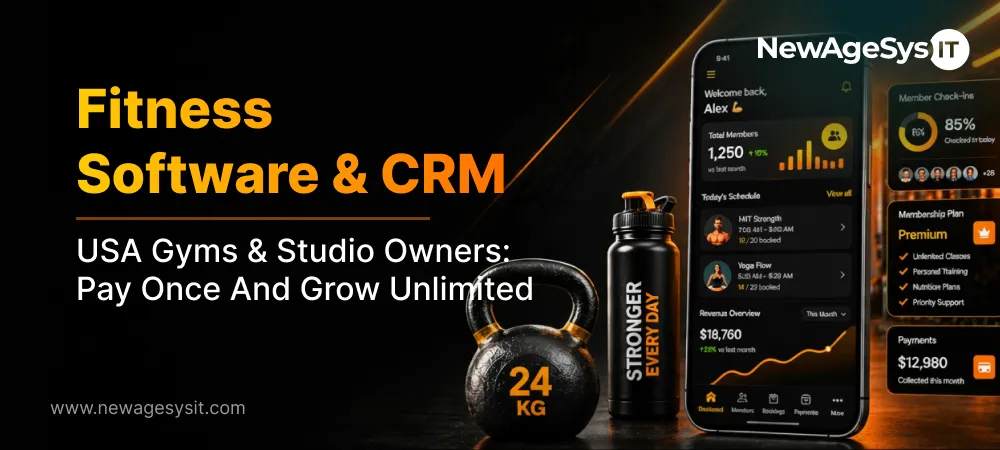
Fitness 12 min read
Fitness Software & CRM for USA Gyms & Studio Owners: Pay Once And Grow Unlimited

The US fitness industry crossed a threshold where choosing a fitness software USA gym operators invest in is no longer a back-office convenience. It is the primary competitive differentiator between gyms that grow and gyms that stagnate. When a member can book a Peloton class in two taps, your front-desk sign-up clipboard is actively costing you members.
Boutique studios like Orangetheory and Barry’s have built their entire acquisition and retention models around proprietary technology: real-time heart rate displays, app-based booking with waitlist automation, performance tracking that emails results before members reach the parking lot.
Independent gym owners relying on generic business tools (Salesforce jerry-rigged for class scheduling, QuickBooks forced to handle tiered membership billing, Google Sheets tracking trainer commissions and waivers) are spending more on workarounds than purpose-built fitness mobile and web app development services would cost. What they need instead:
- Fitness CRM that tracks the member lifecycle from trial to win-back
- Gym management platforms connecting scheduling, access control, and operations
- Retention and loyalty tools that cut churn before members decide to cancel
- Compliance frameworks for HIPAA, CCPA, and state biometric privacy laws like BIPA
- Cost planning to prevent $40,000-$200,000 in mid-development architecture mistakes
- Pre-build consulting with specialists who understand fitness workflows and regulatory exposure
This guide maps the full landscape of fitness software and CRM development services, from CRM features and gym management platforms to member retention tools, data security and compliance frameworks, development cost planning, and the value of independent technology consulting. The goal: helping US fitness businesses make informed decisions about the technology that will define their next five years of growth.
The US Fitness Technology Landscape
Fitness technology is an ecosystem of interconnected systems. Understanding the categories and their dependencies is the first step toward making the right build-versus-buy decision for your fitness center software investment.
The core fitness software categories US gyms and studios need:
| Category | What it covers |
|---|---|
| Fitness CRM | Lead management, member communication, attendance tracking, renewal pipeline, trainer assignment, family/corporate account management. The most impactful single technology investment for a US fitness business. |
| Class scheduling & booking | Real-time class calendars, capacity management, waitlist automation, cancellation workflows, calendar sync, and mobile booking. Poor scheduling UX directly causes member churn. |
| Gym management | Door access control (RFID, app, biometric), equipment maintenance tracking, facility management, and staff scheduling. The operational backbone of a physical fitness facility. |
| Retention & loyalty | Churn prediction analytics, loyalty point systems, fitness challenges, win-back automation, and engagement scoring that convert passive members into retained revenue. |
| Billing & payments | Recurring membership billing, proration, freeze/resume, family billing, failed payment recovery, and PCI compliance. |
| Wearable integration | Apple Health, Google Fit, Garmin, Whoop, and Fitbit APIs. Real-time fitness data syncs into the gym platform. |
| Compliance & waivers | HIPAA-sensitive health forms, digital liability waivers (ESIGN/UETA), biometric consent, minor member consent, CCPA data rights. The legal infrastructure every US fitness business must maintain. |
These categories are deeply interdependent. A CRM that cannot read attendance data cannot flag at-risk members. A booking system disconnected from billing cannot enforce tier restrictions. Access control that does not sync with membership status lets cancelled members through the door. Every disconnected point solution creates gaps where revenue leaks or compliance breaks.
This is exactly why the build-versus-buy decision matters so much in fitness. Off-the-shelf studio management software, like Mindbody or Zen Planner, offer breadth but impose their workflow assumptions on your business. When your studio runs a hybrid model (in-person classes, livestream sessions, on-demand content library, and personal training all under one membership structure), cookie-cutter platform limitations become expensive constraints. Custom gym management software USA operators who build around their actual workflows eliminate the gap between how the business operates and how the software forces it to operate.
US Fitness CRM: The Member Relationship Core
If you invest in only one system, make it the CRM. Fitness businesses manage the following contact types that Salesforce, HubSpot, and Zoho were never designed to handle:
- Trial members needing conversion sequences triggered by visit behavior
- Active members across multiple tiers with different access permissions and billing
- Frozen accounts requiring automatic billing suspension and reactivation with proration
- Corporate and family memberships with shared payment but independent booking
- Expired memberships needing segmented win-back based on cancellation reason and tenure
The member lifecycle in fitness is specific and measurable:
Lead → Trial → New Member → Active Engaged → At-Risk → Churned → Win-Back
A purpose-built fitness CRM tracks movement through every stage and fires the right action at each transition. When a trial member finishes day three of a seven-day pass without booking a second visit, the CRM triggers a personalized follow-up. Industry data commonly shows conversion lift in the 30-40% range when trial members receive automated follow-up versus no contact until expiry.
The features that separate fitness CRM from generic CRM:
1. Attendance-based churn detection: A member dropping from 4x/week to 1x/week is at churn risk weeks before they decide to cancel. The CRM surfaces these patterns daily so staff can intervene.
2. Trainer relationship management: When a trainer leaves, member churn spikes unless the CRM facilitates a managed handoff with training history and preferences intact. This is where personal trainer software USA gym owners invest in pays for itself: preserving the member-trainer relationship even when staff changes.
3. Renewal pipeline automation: Triggering renewal outreach at 60-day, 30-day, and 7-day intervals, including payment method update prompts that prevent involuntary churn from expired cards.
US Based Gym Management Software: The Operational Platform
CRM manages the member relationship. Gym management software manages the building. Together, they form the operational backbone connecting member experience to facility operations. Class scheduling and booking is the touchpoint where poor technology costs you members the fastest.
The baseline expectation set by ClassPass, Mindbody, and every major boutique chain now includes mobile-first booking with real-time class availability and instant confirmation, automatic waitlist promotion with push notification when a spot opens, and one-tap cancellation within the cancellation window with late-cancel fee enforcement.
Members also expect calendar sync with Google Calendar, Apple Calendar, and Outlook so classes appear on their personal schedule, along with instructor profile visibility showing ratings, specialties, and upcoming schedule.
Facility access control integration solves a universal problem: cancelled or expired members using the facility. Keyless check-in options (member app QR code, RFID fob, barcode scan) integrated with real-time membership status prevent unauthorized access automatically.
Additional capabilities that separate purpose-built platforms from generic tools:
- Equipment maintenance tracking: Preventive maintenance scheduling, repair ticket workflows, and equipment retirement records. This is the operational record that protects the facility from liability claims and ensures member safety.
- Staff scheduling and payroll integration: Trainer session tracking for commission calculation, front desk scheduling, and class instructor management. This connects the HR operational layer directly to the member service layer.
- Operational dashboards: Monitor daily check-in counts, class utilization rates, revenue per member, new member acquisition, and churn rate. These KPIs actually drive fitness business decisions.
Member Retention and Loyalty: The Revenue Protection Layer
Member retention is the single highest-ROI investment a US fitness business can make, and most gyms dramatically underinvest in it relative to acquisition spending.
Across the US fitness industry, acquisition costs consistently outweigh retention costs, with estimates frequently citing a 5-7x ratio between the two. Even modest improvements in retention rates translate into substantial profitability gains over time. Retained members continue paying monthly, refer friends, upgrade to premium tiers, and buy personal training, compounding the revenue impact of every percentage point of churn prevented.
The retention technology stack that drives measurable results:
1. Churn prediction analytics: ML models trained on your facility’s historical data identify at-risk members 30-60 days before they decide to cancel. This is based on visit frequency decline, class booking drop-off, and payment method expiration patterns.
2. Loyalty and rewards programs: Point-based systems reward class attendance, referrals, merchandise purchases, and challenge completions, redeemable for free classes, personal training sessions, or membership discounts. This builds behavioral commitment to the gym.
3. Fitness challenges and goal tracking: Monthly attendance challenges, community step-count competitions, and strength milestones. Fitness operators consistently report that members actively participating in challenges show lower cancellation rates during the program period, making this one of the highest-engagement retention mechanisms available.
4. Win-back automation: Triggered re-engagement sequences for cancelled and expired members, segmented by cancellation reason, tenure, and original membership type. Former members are the highest-quality leads because they already know the facility, the trainers, and the community.
Fitness Data Security and Compliance
Compliance in fitness software defines specific engineering requirements for how your platform collects, stores, processes, and shares member data. Getting this wrong creates regulatory exposure, litigation risk, and member trust damage that no marketing budget can repair.
Key compliance domains for US fitness platforms include:
1. HIPAA (Health Insurance Portability and Accountability Act)
Fitness businesses collecting protected health information (injury history, medical conditions, physician clearance notes) may qualify as HIPAA-covered entities.
This is a fact-specific legal determination that only qualified healthcare legal counsel can resolve. Without it, you either over-engineer compliance ($50,000-$150,000 in unnecessary cost) or under-engineer it (fines of $100-$50,000 per violation).
2. CCPA/CPRA (California Consumer Privacy Act / California Privacy Rights Act)
Fitness platforms with California members meeting thresholds must comply with consumer data rights. In-scope categories include member health data from intake forms, behavioral analytics from app usage, biometric data from wearable integrations (heart rate, sleep, activity metrics), and location data from check-in systems. Each requires specific consent mechanisms, access/deletion workflows, and breach notification procedures.
3. BIPA, CUBI, MHMDA (Biometric Privacy Laws)
Illinois BIPA carries $1,000-$5,000 per violation, with no proof of harm required. Texas CUBI allows penalties up to $25,000 per violation. Washington MHMDA imposes additional requirements.
Biometric access systems must engineer state-specific consent, storage, and destruction policies at the architecture level.
4. Digital Waiver Enforceability (ESIGN Act / UETA)
Electronic waivers must meet ESIGN (Electronic Signatures in Global and National Commerce Act) and UETA (Uniform Electronic Transactions Act) standards: proper digital signature capture, clear disclosure before signing, consent verification, and secure storage with retrieval capability. Non-compliant collection may render waivers unenforceable in court.
5. Minor Member Consent (COPPA)
Facilities serving members under 18 must obtain verifiable parental consent with age-appropriate data limitations and protections under COPPA (Children’s Online Privacy Protection Act) for members under 13.
Fitness Software Development Cost in the USA
Cost planning is where fitness software projects either stay disciplined or go off the rails. The cost of fitness software USA businesses invest in varies significantly based on feature scope and compliance requirements.
| Project scope | Planning range | Key cost drivers |
|---|---|---|
| Custom Fitness CRM (member management, booking, basic retention) | $60K-$250K | Facility count, tier complexity, reporting depth |
| Full Gym Management Platform (CRM + booking + billing + access control + mobile app) | $200K-$700K+ | Scale, integrations, multi-location architecture |
| Wearable Integration (per platform: Apple Health, Google Fit, Garmin, Fitbit) | $20K-$80K each | API complexity, data normalization, real-time sync |
| HIPAA-Compliant Architecture (when required) | +15-25% | Encryption, audit trails, access controls, BAAs |
| Annual Maintenance & Ops (payment processing, SMS/email, API subs, updates) | 15-25% of initial cost/year | Transaction volume, notification volume, platform updates |
Cost drivers that fitness businesses consistently underestimate:
- Wearable integration complexity: Each platform has a different API, different data formats, different rate limits, and different approval processes. Budgeting “wearable integration” as a single line item is a common planning mistake.
- Billing system edge cases: Membership freezes with prorated credits, family accounts billing splits, corporate discount structures, failed payment retry logic, and annual vs. monthly transitions.
- Compliance architecture: HIPAA-compliant architecture adds 15-25% to development cost, not because of encryption (which is straightforward) but because of audit trail engineering, role-based access control granularity, business associate agreement management, and breach notification workflow automation.
The Value of a USA Based Fitness Technology Consultant Before Building
The most expensive fitness software mistakes happen before a single line of code is written. It starts with choosing a technology stack that cannot scale past 3 locations because the database architecture assumes single-facility operation. Then HIPAA gets scoped incorrectly, either over-engineered at $50K-$150K in unnecessary cost or ignored entirely, leaving unmanaged regulatory exposure.
Access control gets built with fingerprint scanning but without Illinois BIPA consent workflows, exposing the business to statutory damages before launch. And the billing system handles monthly subscriptions fine until it hits family accounts, corporate group rates, seasonal freezes, and proration, which is what fitness businesses actually process daily.
These are architecture-level mistakes that cost $40,000-$200,000 to correct mid-development, when the system has to be partially rebuilt rather than patched.
A fitness technology consultant, distinct from a general software consultant, brings domain expertise that directly prevents these failures:
- HIPAA applicability assessment: Guiding you to qualified healthcare legal counsel for the covered-entity determination, then translating the legal conclusion into engineering requirements.
- Fitness workflow mapping: Translating how your front desk, trainers, sales team, and members actually operate into software requirements that developers can build against, not generic user stories.
- Payment processing compliance: Ensuring the billing architecture handles PCI compliance, recurring fitness billing edge cases, and payment method update workflows.
- Biometric privacy law navigation: Determining which state laws apply based on facility locations and engineering consent, storage, and destruction policies accordingly.
Pre-build consultation typically runs $8,000-$30,000. A fraction of correcting architecture-level mistakes once development is underway.
Key Technology Trends Shaping US Fitness Software
AI-powered workout personalization is moving US fitness platforms from generic programming to individualized member experiences at scale, with ML models adapting recommendations based on member progress, fitness history, and real-time wearable feedback. For gyms building custom mobile app development platforms, AI personalization directly improves engagement. Members who feel their program is individually tailored train more consistently and churn less.
Wearable and fitness tracker integration through Apple Health, Google Fit, Garmin, Whoop, and Fitbit APIs enables real-time data flow from member devices into the gym platform. This powers both personalization engines and retention analytics. A member whose wearable shows declining workout frequency outside the gym is at churn risk before in-gym attendance drops.
Hybrid and virtual fitness delivery combines in-person class booking with livestream and on-demand video under a single membership. Serving the member who trains in-studio three days a week and follows along from a hotel room the other two. Premium brands, including Equinox and Life Time Fitness, have made hybrid delivery a standard membership component, and the expectation is spreading to independent studios serving premium market segments.
Predictive churn analytics use ML models to identify at-risk members 30–60 days before cancellation. The retention technology with the clearest, most measurable ROI in the fitness technology stack.
A fitness app for gyms is no longer optional. Members manage their entire gym relationship from their phone: booking, progress tracking, challenges, trainer communication, and billing updates. Custom software development platforms spanning both iOS and Android are the expectation, not the exception.
Conclusion
US gym software and CRM investment is a competitive necessity that defines member experience, retention economics, compliance posture, and operational capability for years to come.
Purpose-built fitness software designed around your specific member lifecycle, class and training workflows, compliance obligations, and growth trajectory outperforms generic platforms on every operational dimension. The gap between gyms running purpose-built technology and those patching together generic tools widens every year as member expectations and regulatory complexity both increase.
If your organization is planning fitness software or CRM development, aligning technology decisions with your member lifecycle requirements, compliance obligations, and long-term growth strategy before development begins significantly improves outcomes. That’s exactly how NewAgeSysIT approaches fitness technology.
Core Development
Keep exploring the custom services.

AI Software Development
Custom AI Software Development
Build intelligent, production-ready software from machine-learning models to AI-driven automation designed around your business goals.
Learn more
Mobile App Development
Custom Mobile Application Development
Native and cross-platform mobile apps that are fast, secure, and built to scale across iOS and Android.
Learn more
Web App Development
Custom Web Application Development
Scalable, secure web applications, from customer portals to complex dashboards, tailored to how your business actually works.
Learn more



