
Welcome to Blogs
Discover actionable insights, in-depth research, and expert perspectives, all in one place.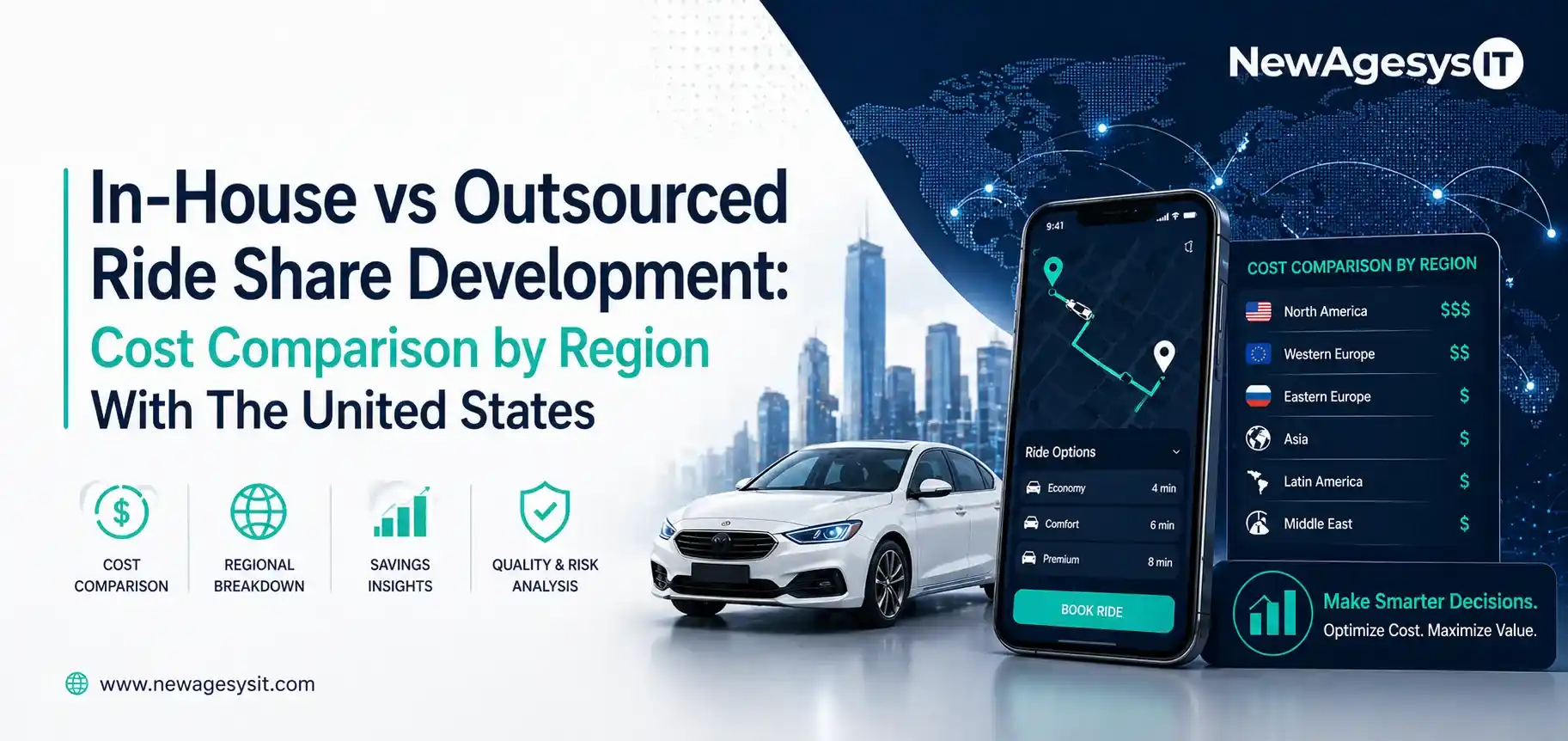
Application Development 5 min read
In-House vs Outsourced Ride Share Development: Cost Comparison by Region With The United States

| This article is part of our series on Ride-Sharing App Cost in the USA: Full Breakdown, MVP to Enterprise. |
For US founders building a ride-sharing platform, the in-house vs outsourced rideshare development decision is one of the most important cost calls after finalizing product features.
The decision affects total capital committed to the build, time to first launch, and the ease of scaling engineering capacity as the platform grows. At this stage, understanding ride-sharing app development outsourcing costs helps set a realistic budget.
In the US, an in-house team for an MVP usually costs around $800,000 to $1,500,000 per year. Outsourcing the same build typically falls between $80,000 and $350,000 as a total project cost. The difference is large enough to change the entire early-stage plan.
That’s why many founders compare options like web application development, custom software development, and custom mobile app development before deciding their build approach.
In-House Development: True Cost for a US Ride Sharing Startup
Building an in-house ride-sharing engineering team in the US is a major upfront cost that goes beyond salaries. A minimum viable setup includes five core roles: backend engineer for real-time systems, iOS engineer, Android engineer, frontend engineer for admin dashboards, and a DevOps engineer.
Here’s the breakdown:
- Backend engineer (real-time systems): $140,000–$180,000
- iOS engineer: $130,000–$165,000
- Android engineer: $125,000–$160,000
- Frontend engineer (admin dashboard): $110,000–$145,000
- DevOps engineer: $130,000–$165,000
- Total base salary cost: $635,000–$815,000/year
- Total with benefits (25–30%): $790,000–$1,060,000/year
- Recruiting cost per engineer: $15,000–$30,000
- Hiring timeline per role: 2–4 months
- Time to first development output: 6–9 months
Together, this team handles dispatch logic, live tracking, payments, and system stability. High salaries, hiring delays, and onboarding cycles make this a slow and expensive path before any usable product is built.
Because of this delay, founders often wait months before launch, which is why many compare this model with faster setup options during early-stage planning.
Ongoing maintenance team costs are part of the operational cost picture in “The Hidden Costs of Running a Ride Sharing App (Beyond Development).”
Outsourced Development: Cost by Region
Outsourced ride-sharing costs vary by region, based on budget, communication, and US product alignment. This comparison of ride-sharing app development outsourcing costs helps balance speed, quality, and collaboration.
1. USA-Based Development Agency
US-based agencies are the most expensive option, with hourly rates of $120–$220 and full ride-sharing builds typically ranging from $250,000–$450,000. They offer smooth communication, full timezone overlap, strong IP protection, and deep familiarity with US compliance needs.
2. Eastern Europe
Teams in Eastern Europe usually charge $50–$95 per hour, with total project costs between $110,000–$200,000. They are known for strong engineering depth, good English communication, and partial US timezone overlap, making collaboration easier while keeping costs moderate.
3. South & Southeast Asia
Development costs here are the lowest, with hourly rates of $20–$50 and full projects ranging from $50,000–$120,000. While cost-efficient with large talent availability, success depends heavily on strong founder involvement due to major timezone differences and overall ride-sharing app development team cost efficiency priorities.
4. Latin America
With rates between $45–$85 per hour and project costs of $100,000–$185,000, Latin America offers strong US timezone alignment. This makes communication faster, feedback cycles smoother, and daily collaboration more efficient for active product development.
For a detailed feature-level cost breakdown, see “How Much Does It Cost to Build a Ride Sharing App in 2026?”
What Outsourcing Gets Wrong: The Risks US Founders Should Manage
Outsourcing ride-sharing development can reduce costs, but it introduces risks that directly impact product quality and delivery if not managed properly. Most issues come from gaps in legal protection, technical depth, and execution control rather than coding itself.
- IP ownership risk: Many offshore contracts do not automatically transfer intellectual property. Founders must ensure agreements explicitly assign all IP created during development to the US company to avoid ownership disputes later.
- Real-time system limitations: Not all teams are experienced in WebSocket-based GPS tracking or live dispatch systems. Capability should be validated through a live working demo rather than portfolio screenshots.
- Fixed-price trap: Poorly defined fixed-price contracts often lead to low-quality builds and costly revisions. A milestone-based, time-and-material approach with clear acceptance criteria is safer for ride-sharing app development.
- Team continuity issues: Offshore teams may replace engineers mid-project. Contracts should include notice periods and mandatory knowledge transfer to maintain continuity.
- Communication overhead: Founders should expect 2–4 hours weekly involvement, higher for offshore rideshare app development with larger timezone gaps.
Hybrid Model: The Most Common Choice for Funded US Startups
The hybrid model is the most common setup for funded US ride-sharing startups. For example, a US-based CTO or technical co-founder leads product decisions and system architecture. Meanwhile, an outsourced team from Eastern Europe or Latin America handles development and delivery.
This setup usually includes a CTO or VP Engineering earning $180,000–$250,000, plus an outsourced team costing $80,000–$180,000. Overall, year-one spend typically falls between $260,000 and $430,000.
Compared to full in-house teams at $790,000–$1,060,000, it reduces costs significantly. At the same time, it avoids the lack of technical ownership seen in pure outsourcing models.
This balance of leadership control and cost efficiency makes the hybrid model the preferred choice for most early-stage US ride-sharing startups.
Final Thoughts
The in-house vs outsourced decision for a US ride-sharing startup depends on stage, budget, and execution speed. Early-stage teams often prefer outsourcing for lower cost and faster launch, while scaling startups move toward a hybrid model for better control and balance.
If your US ride-sharing startup is evaluating in-house vs outsourced development, mapping funding stage, technical strength, timeline, and regional cost models provides a clear framework for choosing the right engagement approach.
Alternatively, working with a ride-sharing development company can help turn this decision into a structured execution plan.
Core Development
Keep exploring the custom services.

AI Software Development
Custom AI Software Development
Build intelligent, production-ready software from machine-learning models to AI-driven automation designed around your business goals.
Learn more
Mobile App Development
Custom Mobile Application Development
Native and cross-platform mobile apps that are fast, secure, and built to scale across iOS and Android.
Learn more
Web App Development
Custom Web Application Development
Scalable, secure web applications, from customer portals to complex dashboards, tailored to how your business actually works.
Learn more



