| Key Takeaways: Off-the-shelf solutions fall short in fulfilling unique needs and specific workflows, so healthcare relies on outsourcing for customization. Outsourcing gives you access to specialized healthcare tech talent for different requirements like HIPAA, FHIR, EHR, etc. A wide range of healthcare sectors benefit from IT outsourcing ranging from hospitals to telemedicine and diagnostics. Outsourcing strengthens your infrastructure’s security, compliance, and overall quality of the software. Outsourcing accelerates your digital transformation with teams capable of faster innovation and scalable delivery. |
The fact that the healthcare IT outsourcing industry was worth around $74.14 billion in 2024, despite having off-the-shelf solutions for different facets like EHR/EMR systems, telemedicine platforms, patient engagement tools, etc., says a lot about the custom needs healthcare infrastructures have.
If we further dissect, the reality is that most of these solutions do cater to generic needs. However, they are often miles away from catering to unique clinical workflows, integration needs, and compliance complexities. But it is also true that it becomes difficult to navigate the realm of IT outsourcing for healthcare software without a helping hand, at least at first.
Well, understanding this exact need, we decided to create this resource using our 25+ years of experience to help you navigate through.
What is Healthcare IT Outsourcing?
In essence, Healthcare IT outsourcing is the practice of partnering with an external outsourcing healthcare software development company. An external partner that helps design, build, and even manage your digital health solutions.
So, instead of relying completely on internal IT teams, today, healthcare organizations collaborate with experienced and specialized providers that deliver them custom healthcare software development services, compliance expertise, access to advanced technologies, and continuous support.
Aside from the factors above, healthcare infrastructures also choose to outsource healthcare software development for the following reasons:
- Access to developers who are skilled at HIPAA, HL7/FHIR, and EHR workflows
- Faster development cycles as opposed to in-house development
- Stronger and stringent cybersecurity measures for the software and applications
- Access to architects, developers, QA, DevOps, and compliance teams
- Lower cost and avoidance of any other hiring overhead
For this reason, outsourcing is considered a strategic and cost-effective alternative.
And, it is especially true for healthcare providers like hospitals, telemedicine platforms, digital health startups, diagnostic networks, and insurance companies that often need a reliable and scalable digital system.
Example:
Let’s take the example of a telemedicine company. Here are a few requirements of the company for the software that they need to improve their services:
- Video consultations through EHR access
- Appointment scheduling
- Secure messaging
- Billing of the patient.
Now, these healthcare providers take the route of assembling their own in-house team that too from scratch, it would cost them time, money, and resources. Plus, they need to train their team to work together and mitigate any issues that come in the way.
For institutions that are privy to working with development work, this may seem relatively easy (which it isn’t), but for those who are completely inexperienced, it would add more cost.
So, what do you do? You collaborate with an experienced custom healthcare software development company like NewAgeSysIT and delegate all your development responsibilities to them. Why does this help? Well, they have proven capabilities for software development services and have already developed tons of healthcare software, understand HIPAA, EHR integration standards, and have the capabilities to design a scalable platform.
This, at the end, won’t just reduce the development cost but also accelerate your time to market or in-premise deployment.
| Also Read: Check out our healthcare mobile app development guide for beginners, to help garner process knowledge for better outsourcing capability. |
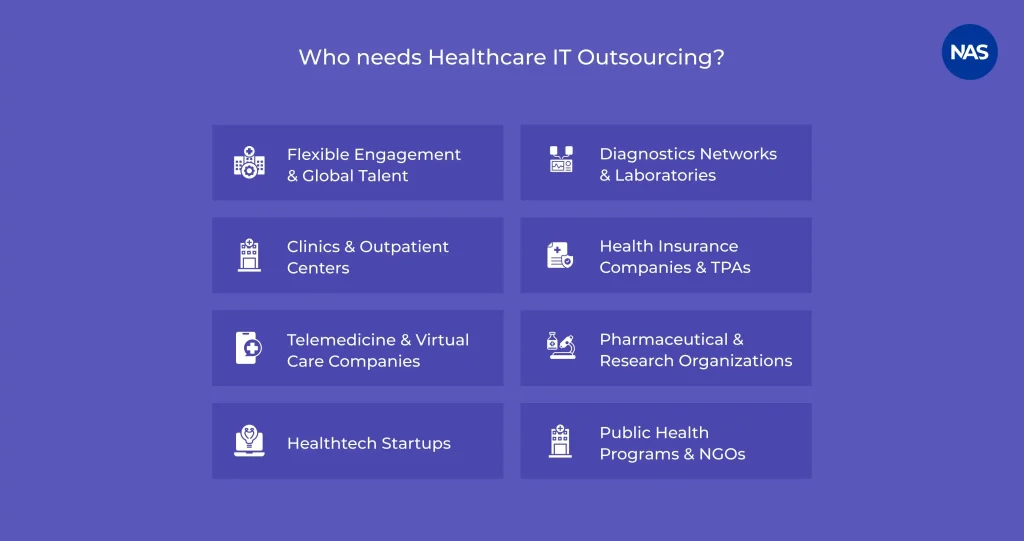
Who Needs Healthcare IT Outsourcing?
Before considering outsourcing, it is important to understand whether it is for you or not. In this section, we have tried to extrapolate on institutions that can enjoy the privilege of outsourcing healthcare IT, along with several use cases.
We have also tried to explain how any company with similar capabilities as us, i.e., ‘NewAgeSysIT’, can help tackle the challenge. So, let’s begin!
1. Hospitals & Health Systems
Use cases:
- EHR modernization
- Clinical workflow automation
- Patient engagement apps
- Interoperability upgrades
- AI-driven diagnostics
- Revenue cycle management systems.
How Outsourcing Helps? – Healthcare software development services like ours have deep expertise in EHR/EMR systems, HL7/FHIR standards, and HIPAA compliance (as said earlier). Capable teams can help modernize hospital IT infrastructure, integrate disparate systems, and build secure and scalable digital platforms that directly impact clinical efficiency.
2. Clinics & Outpatient Centers
Use cases
- Appointment scheduling systems
- Teleconsultation modules
- Billing automation
- Electronic prescriptions
- Custom patient portals.
How Outsourcing Helps? – A Healthcare IT outsourcing company like us can deliver lightweight, custom healthcare applications that not only streamline your operations but also don’t disrupt care. This results in reduced manual work and improved patient experience.
3. Telemedicine & Virtual Care Companies
Use cases:
- Telehealth platforms
- Video consultation systems
- Digital triage tools
- Remote monitoring dashboards
- Multi-specialty virtual clinic apps
How Outsourcing Helps? – Any company, including us, with strong telemedicine software development capabilities, can build scalable platforms. Platforms that offer secure video calls, EMR access, e-prescriptions, and analytics, while delivering compliant yet high-performing virtual care solutions.
4. Healthtech Startups
Use cases:
- MVP development
- AI-driven health apps
- Digital therapeutics
- Wearable integration
- Chronic care management platforms
- Wellness apps
How Outsourcing Helps? – Startups require rapid prototyping, agile development, and access to a custom healthcare software development company with full-stack healthcare product teams. These teams, if provided, can launch fast, validate ideas, and even scale with lower upfront cost.
5. Diagnostics Networks & Laboratories
Use cases:
- Lab Information Systems (LIS)
- Sample tracking apps
- Home test booking systems
- Radiology imaging software
- Device integration.
How Outsourcing Helps? – NewAgeSysIT teams have the talent to automate diagnostic platforms by providing end-to-end workflow management, seamless integration with hospital EHRs, and even secure handling of PHI and lab data.
6. Health Insurance Companies & TPAs (Third Party Administrators)
Use cases:
- Claims processing automation
- Fraud detection software
- Member portals
- Provider network management systems
- AI-based underwriting tools
How Outsourcing Helps? – By combining our healthcare domain knowledge with advanced analytics and secure APIs, we can deliver systems that not only deliver enhanced transparency but also reduce processing time and minimize any operational overhead.
7. Pharmaceutical & Research Organizations
Use cases:
- Clinical trial management systems
- Drug discovery platforms
- R&D data analytics
- Medical device software
- Compliance dashboards.
How Outsourcing Helps? – Our expertise in regulated software development, cloud architecture, and AI/ML helps us deliver creative solutions that support your research workflows while maintaining data integrity and delivering improved collaboration amongst teams.
8. Public Health Programs & NGOs
Use cases:
- Population health dashboards
- Vaccination tracking systems
- Mobile health apps
- Disease surveillance platforms
How Outsourcing Helps? – Any company like us would be able to build scalable and secure platforms. These platforms will be able to handle large data volumes, multi-region access, and compliance with national/international health data standards.
What Can You Outsource? – Issues IT Outsourcing in Healthcare Directly Solves!
Healthcare organizations are privy to similar digital challenges that most industries struggle with, which are:
- Rising costs
- Shortage of dependable IT talent
- Long development cycles
- Interoperability issues
- Compliance risks (most important)
Outsourcing healthcare software development takes off this worry and puts it on the shoulders of an experienced team that specializes in all of the above.
So, besides the obvious challenges above, below we have mentioned other key areas where outsourcing can directly solve these persistent real-world challenges:
| Also Read: Healthcare business ideas for startups for your next venture! |
1. Custom Healthcare Software Development
Though most healthcare organizations may seem to work similarly, their challenges and requirements can be unique. Why? Well, the application requirements are built around specific clinical, operational, and engagement needs. So, finding something off-the-shelf is not always the solution.
Common Challenges:
- Most internal IT teams lack the capacity to build a completely new patient or provider app.
- The cycles between clinical and technical workflows are longer due to consistent switching.
- Ensuring compliance with HIPAA, HL7/FHIR, and interoperability requirements is difficult on a development level.
What Can Be Outsourced?
A dedicated healthcare software development company like NewAgeSysIT will take end-to-end ownership of your product. This includes designing, developing, and securing custom solutions for patient apps, provider dashboards, and admin systems which are compliant and delivered under a pre-established timeline.
2. Telemedicine & Virtual Care Software
Building a stable virtual care ecosystem that evolves can be challenging. Imagine, even adding a simple video call feature requires secure communication layers, integration of clinical workflows, and seamless EHR connectivity.
Common Challenges:
- Building a secure and low-latency video module can be complex
- Integrating your telehealth services with EHRs requires deep domain knowledge
- Scaling platforms for higher patient load also requires expertise
What Can Be Outsourced?
Specialized custom healthcare software development services can deliver a great telemedicine software development experience, secure video modules, scheduling systems, triage tools integration, EMR access, and e-prescription workflows. And, all this is built quickly and correctly without putting any pressure on the internal teams.
3. EHR/EMR Development & Integration
Reliance on EHR systems for healthcare providers is a reality. However, the architectures and interoperability involved are often outdated, making care delivery and data exchange slow.
Common Challenges:
- Legacy EHR systems limit interoperability
- In-house teams struggle with HL7, FHIR, and custom workflows
- The risk of data inconsistency is higher during migration
What Can Be Outsourced?:
Healthcare software development outsourcing gives access to engineers who are skilled in EHR/EMR systems, regulatory standards, and API integrations. This enables a much more smoother data exchange, reduction in documentation errors, and helps you streamline clinical workflows.
4. Remote Patient Monitoring (RPM) Solutions
The requirements for chronic care, home-based care, and post-discharge monitoring are on the rise because of changing lifestyles. To effectively tackle this, healthcare providers require a secure and scalable system that manages patients in real-time across multiple devices. And, this can be easily achieved through outsourcing remote patient monitoring software development.
Common Challenges:
- Utilization of multiple wearable devices/IoT that use different operating systems
- Building a secure real-time dashboard that collects all this data and making sense of it can be tricky.
- Ensuring regulatory compliance for all the transmitted patient data is another hurdle to cross.
What Can Be Outsourced?:
Many IT outsourcing for healthcare software development services offer dedicated RPM (remote patient monitoring) teams. Teams that can manage device integrations, create compliant cloud data, design alert systems, and dashboards to monitor patients at scale.
5. AI-Driven Healthcare Applications
AI today is transforming diagnosis, automation, and decision support for healthcare providers. But, building a system that isn’t medically accurate can be catastrophic. So, one requires specialized engineering, clinical validation, and rigorous compliance (models require anonymous patient data).
Common Challenges:
- The expertise of internal teams in AI/ML engineering is often limited
- It is difficult to validate medical algorithms
- Ensuring that the AI model is fair, is not biased, and is clinically accurate is a job for experts.
What Can Be Outsourced?:
AI-focused healthcare teams bring up their experience in predictive analytics, imaging automation, NLP assistants, and risk scoring. Also, they know how to develop it within regulatory boundaries and how to validate it for real clinical environments.
6. Healthcare Cloud, DevOps & Infrastructure
Cloud environments and automated DevOps are an essential component of any software or application today. They ensure that your service remains 24*7 operational, performs well, and delivers continuously.
Common Challenges:
- On-premise legacy systems slow down operations
- Most healthcare providers lack an internal team that understands automated DevOps
- Frequent downtime or slow deployment cycles are a pressing issue
What Can Be Outsourced?:
Outsourced cloud & DevOps specialists can modernize infrastructure, automate CI/CD workflows, improve security, optimize costs, and provide 24/7 monitoring and maintenance.
7. Legacy Modernization
Many healthcare institutions still make use of outdated systems. This not only increases security risks but hinders interoperability and limits scalability.
Common Challenges:
- Older hospital systems often increase security risks
- Legacy systems are incompatible with new digital tools
- Upgrades are costly and resource-heavy internally
What Can Be Outsourced?:
External teams use proven modernization frameworks. This helps refactor, rebuild, or migrate legacy systems to modern, interoperable, and FHIR-ready platforms, without any disruption of ongoing operations.
| Also Read: Here’s a complete software development guide to understand the process and common pitfalls around development! |
Benefits of Healthcare IT Outsourcing
Beyond cost reduction and compliance, healthcare IT outsourcing provides several strategic advantages that help organizations modernize faster and operate more efficiently.
We’ve talked about benefits indirectly in the previous sections. However, there is more to the story.
1. Faster Innovation Adoption
Most outsourcing teams today are already privy to working with new-generation technologies like AI, IoT, FHIR, cloud-native systems, and modern UX patterns. Also, just like us, most companies deliver healthcare mobile app development services for better accessibility. This allows them to innovate faster by adopting these technologies without putting their healthcare organization through a long internal learning curve.
2. Shorter Development Cycles
Outsourcing offers dedicated engineering teams, QAs, DevOps, and compliance specialists, which makes your projects move much more smoothly from concept to deployment.
3. Reduced Operational Load on Staff
Healthcare IT outsourcing teams also provide prolonged support. So, clinicians and admin teams don’t really need to handle technical issues or system maintenance. And this allows you to completely focus on patient care and daily operations.
4. Strong Delivery Framework & Predictable Progress
Healthcare software development services deliver structured project governance, sprint-based execution, clear SLAs, and healthcare-specific workflows. This not only minimizes your risk but also ensures timely delivery of the project.
5. On-Demand Access to Cross-Functional Expertise
Organizations have instant access to experienced professionals. These professionals are well-versed with tasks like EHR integration, cloud architecture, UI/UX, AI/ML, and API engineering. However, if you hire these individuals individually, it would incur a recurring monthly cost, and it is often much higher for experienced professionals.
6. Elastic Scaling for Any Project
In healthcare software development outsourcing, you get teams that can scale up or down during a new initiative, keeping the budgets flexible for tasks like RPM rollouts, AI integrations, telemedicine modules, etc.
7. Lower Long-Term Tech Debt
Outsourcing healthcare software development teams follow modern architectural standards. For example, microservices, modular code, automated testing, CI/CD, etc., which reduce future work and system fragility.
8. Better Documentation & Knowledge Transfer
Proper documentation and knowledge transfer are crucial as they enable you to handle any issue that occurs in the future. A good custom healthcare software development company delivers comprehensive documentation, architecture diagrams, and DevOps playbooks that ensure this handover is smooth and prevents knowledge loss within the organization.
9. Improved System Interoperability
Outsourcing helps you unify fragmented systems like EHRs, LIS, telehealth, billing, etc., for better data exchange and improved clinical decision making.
10. Accelerated Digital Transformation
With external expertise managing all your development, modernization, integration, and infrastructure, you can easily advance towards a much more connected and digital-first environment.
How can Any Outsourcing Healthcare Software Development Company Ensure Quality, Compliance, and Security?
Healthcare data is sensitive; therefore, the compliance standards demanded can’t be compromised. A reliable outsourcing healthcare IT partner adheres to a strict engineering and compliance framework, making sure every solution is safe, scalable, and aligned as per regulatory requirements.
In this section, we will be exploring how a healthcare software development outsourcing agency does that. But before that, let’s have a look at all the important compliances that require adherence.
List of Regulatory Requirements in Outsourcing Healthcare IT – Depending on Region and Category:
| Category | Compliance Standard | Region | What does it require? |
|---|---|---|---|
| Patient Data Privacy & Security | HIPAA (Health Insurance Portability and Accountability Act) | United States | Protection of patient health information (PHI) using strict privacy, security, and breach notification rules. |
| HITECH Act | United States | To strengthen HIPAA enforcement and secure adoption of electronic health records. | |
| GDPR (General Data Protection Regulation) | Europe (Applies globally when handling EU resident data) | Requires strong consent, data protection, and privacy practices for personal health data. | |
| NIST Cybersecurity Framework | United States (Global best practice) | Provides guidelines to identify, protect, detect, and respond to lurking cyber risks. | |
| SOC 2 (Service Organization Controls 2) | Global | Ensures that service providers maintain secure systems for data confidentiality, privacy, and availability. | |
| ISO 27001 | Global | Demands a robust information security management system with continuous risk control. | |
| PCI-DSS (Payment Card Industry Data Security Standard) | Global | Sets security requirements for handling patient payment card information. | |
| Interoperability & Data Exchange | HL7 (Health Level Seven) | Global | Defines rules and formats for structuring and exchanging clinical data across healthcare systems. |
| FHIR (Fast Healthcare Interoperability Resources) | Global | Modern HL7 standard using APIs for fast and secure healthcare data exchange. | |
| ONC Health IT Certification | United States | Demands EHR systems meet federal standards for interoperability, security, and functionality. | |
| Medical Devices & Clinical Systems | ISO 13485 | Global | Defines quality management requirements for medical device software and hardware. |
| FDA 21 CFR Part 11 | United States | Sets rules for electronic records and signatures in clinical and medical software systems. |
Now, here are the strategies taken by any custom healthcare software development company to ensure compliance.
1. Secure, Cloud-Native Architecture
The solutions designed by healthcare IT outsourcing companies usually utilize encrypted cloud environments, zero-trust principles, and hardened infrastructure. The aim is simple: to protect PHI (Protected Health Information) at each layer.
2. Industry-Standard Compliance Practices (SOC2, ISO Frameworks)
The engineering process followed is through industry-compliant practices like SOC2, ISO-based quality management, and continuous monitoring. This makes the solution dependable and audit-ready.
3. Encrypted Data Flows & End-to-End Protection
All data, be it at rest, in transit, or during API exchange, is protected using strong encryption, secure communication protocols, and controlled access pathways.
4. Regular HIPAA Audits & Continuous Compliance Checks
Healthcare IT outsourcing companies conduct internal audits, documentation reviews, and risk assessments periodically. This enables them to perform HIPAA-compliant software development.
5. Strict Role-Based Access & Governance
Outsourcing healthcare software development companies know the importance of role-based access, especially for PHIs, clinical, and operational data. So, they make use of techniques like least-privileged access, multi-factor authentication, and detailed activity logs to prevent any unauthorized access.
6. Verified PHI Handling Protocols
One of the most strategic advantages of outsourcing healthcare IT is that you get a team that follows standardized processes for handling PHI. Here the sensitive information collected, processed, transferred, stored, or disposed of is all at minimum risk of exposure throughout the entire development lifecycle.
7. End-to-End Quality Assurance & Testing
Another method that companies involved in IT outsourcing in healthcare utilize to ensure compliance is that they conduct automated and manual testing. This includes a plethora of testings like functional testing, load testing, interoperability testing, etc., to make sure every release is robust, stable, and ready for real clinical environments.
Different Engagement Options in Healthcare Software Development Outsourcing
One of the basic advantages of hiring a healthcare software development company is access to different engagement models. If you don’t know, basically, an engagement model lets you decide the kind of support you can get from a healthcare IT outsourcing company.
Below are some of the most commonly offered engagement models:
1. Dedicated Developers
Here you can request a dedicated team for your project. This is ideal when you are looking at long-term support and specialized talent that works with your internal team. Some ideal situations are ongoing product development, maintenance, or compliance-heavy work.
2. Full-Cycle Project Outsourcing
This is best if you are looking for an end-to-end solution, from discovery to deployment, with minimal internal overhead.
3. IT Staff Augmentation
It is perfect for teams that have strong in-house leadership but lack specific skills. For example, FHIR, HL7, cybersecurity, UI/UX, etc. This lets you scale quickly without any full hiring cycles.
4. Hybrid Onshore–Offshore Model
It is ideal for organizations that need a balance of cost efficiency and close collaboration. Here, onshore leads ensure alignment while the offshore team delivers high-volume development at a much lower cost.
How to Mitigate Risks in Healthcare IT Outsourcing?
Whether you choose us or any other company, what’s important is that you learn to mitigate the risks involved. Why is it important? Well, let’s say you chose NewAgeSysIT as your partner; in essence, it means that we are the tools that turn your vision into reality. However, you are still the captain who governs the direction.
So, you need to follow certain practices and demand the same from your outsourcing partners:
- Clear Communication
Communication is key. So, it becomes important to make sure that it is structured through relevant channels, regular check-ins are conducted, and the progress made should be transparent between the two parties. This would, in the future, prevent any misunderstandings or misaligned expectations amongst stakeholders.
- SLA-Driven Delivery
Make sure the SLA or service-level agreements cover all the important aspects for both parties (outsourcing team and client). This includes predictable timelines, measurable outcomes, and accountability throughout the development lifecycle.
- Code Reviews & Quality Gates
It is important that routine peer reviews and automated testing are conducted and use of CI/CD pipelines are taken into effect. This would help maintain code quality, reduce defects, and improve long-term maintainability of the software.
- Compliance-First Development
All the features that are built and integrated into the system should be aligned as per regulations like HIPAA, HITECH, GDPR, and other local data laws to minimize legal and audit risks.
- Data Security Protocols
Make sure your healthcare IT outsourcing partners follow all the essential data security protocols. For example, encryption, secure cloud configurations, identity management, and PHI access controls to safeguard any sensitive data from breach.
- Transparent Pricing
Get a clear cost structure and the estimates upfront. This avoids unnecessary budget burnout or overruns and improves your financial predictability.
How Much Does Outsourcing Healthcare Software Development Cost?
The price of developing your project will always be a dynamic number till the final invoice is released. However, it is possible to give you a ballpark estimate.
So, through the tables, we have provided you with the prices of developing software of varied complexities (U.S. prices), a typical cost breakdown, and the outsourcing prices in different countries.
Cost by Complexity:
Complexity | Typical U.S./Onshore Cost ($100–$220/hr) | Timeline | What’s Included |
|---|---|---|---|
| Basic MVP | $80k–$200k | 8–12 weeks | Core features, simple backend, basic UI, prototype-level build |
| Mid-sized Platform | $200k–$500k | 3–6 months | Telemedicine modules, scheduling, payments, dashboards, EHR-lite integration |
| Enterprise / Compliance-Heavy System | $600k–$1.5M+ | 6–18+ months | Multi-module systems, advanced security, deep HL7/FHIR interoperability, AI/RPM features, large-scale cloud infrastructure |
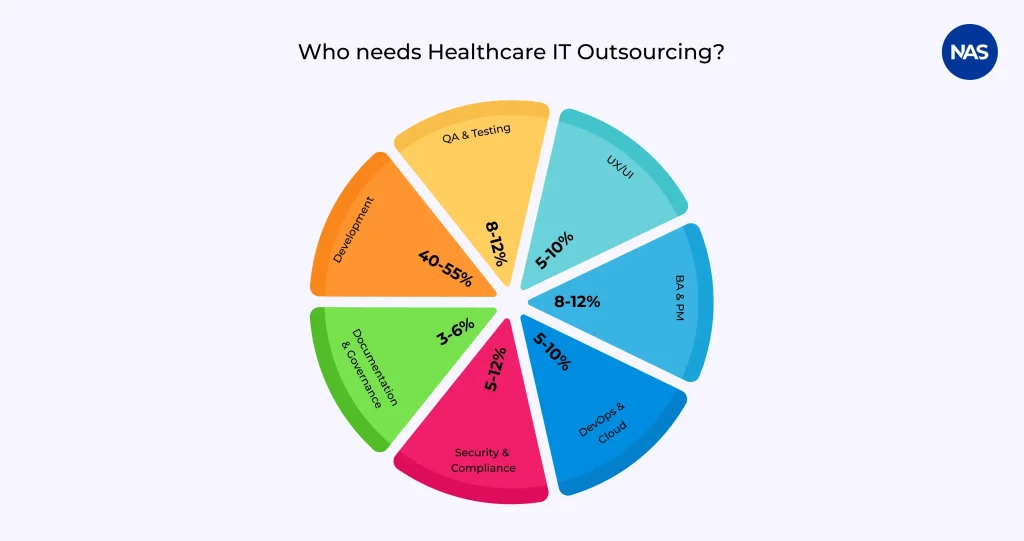
Cost Breakdown Based on Development Stages (Typical %):
| Component | % of Budget |
|---|---|
| Development | 40–55% |
| QA & Testing | 8–12% |
| UX/UI | 5–10% |
| BA & PM | 8–12% |
| DevOps & Cloud | 5–10% |
| Security & Compliance | 5–12% |
| Documentation & Governance | 3–6% |
Regional Rate:

| Region | Hourly Rate |
|---|---|
| India / South Asia | $20–$50 |
| Eastern Europe | $35–$85 |
| Latin America | $35–$80 |
| North America | $100–$220 |
NewAgeSysIT Prices:
Our typical prices for delivering app development services lie between $25-$49 per hour. We are based in the U.S. However, since we have multiple offshore development centers, this allows us to keep our costs to a minimum.
| Complexity | Typical Outsourced Cost (at $25–$49/hr) | Timeline | What’s Included |
|---|---|---|---|
| Basic MVP | $20k–$70k | 8–12 weeks | Core features, simple backend, basic UI, prototype-level build |
| Mid-sized Platform | $50k–$150k | 3–6 months | Telemedicine modules, scheduling, payments, dashboards, EHR-lite integration |
| Enterprise / Compliance-Heavy System | $100k–$330k+ | 6–18+ months | Multi-module systems, deep integrations, advanced security, HL7/FHIR interoperability, AI/RPM options |
Why Choose NewAgeSysIT as Your Healthcare IT Partner?
This is the space where we defend ourselves by telling you what our capabilities are and what we offer if you choose us as your healthcare software development outsourcing partner.
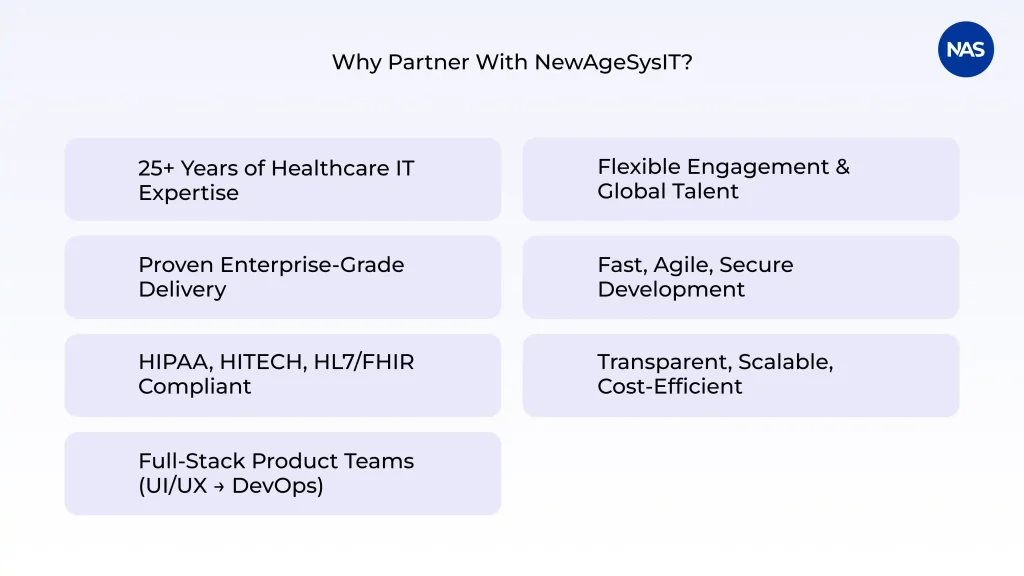
- Decades of Experience: NewAgeSysIT has been standing tall and delivering software development services to the U.S. and other countries with global healthcare standards for more than 25+ years. Our work experience brings the desired maturity and insights that no newer vendor can match.
- Enterprise-grade Track Record: We have worked with large-scale and compliance-heavy clients. And, even in such odds, we have delivered robust and scalable solutions.
- Healthcare-first Compliance and Standards Expertise: The need to be compliant is empirical, and we understand it. We have talent that is skilled in HIPAA, HITECH, HL7/FHIR, and other healthcare regulations. Ensuring protection of sensitive patient data is our number one priority, our solutions are interoperable and audit-ready.
- Full-stack Capabilities: With us, you get access to services like UI/UX, backend development, DevOps, QA, etc.,within a team.
- Flexible Engagement Models: Based on your requirements, you can choose dedicated developers, a full lifecycle team, staff augmentation, or hybrid onshore-offshore collaboration.
- Rapid Development without Compromises: Our Agile Workflows, continuous integration, automated testing, and modern engineering practices ensure faster time-to-market while making no compromises with compliance and reliability of the solution.
- Complete Transparency and Control: We ensure transparency in project governance, document deliverables, and try to provide full control and avoid any vendor lock-in.
- Access to Global Resource Cost-Efficiently: We are a U.S.-based company. However, we have offshore development centers too, which help us offer our clients global talent while keeping the cost competitive.
NewAgeSysIT Healthcare IT Outsourcing Case Studies
Now, to showcase our capability as a credible healthcare software development outsourcing agency, we have mentioned a few of our case studies.
1. Opus Health & Wellness — HIPAA-Compliant E-Commerce MVP

Problem: The client had the requirement of a CBD eCommerce platform that is compliant and can go live quickly without risking any regulatory violations.
What We Delivered:
- A clean, scalable MVP with all the essential modules, including catalog, checkout, clinician portal, and education hub
- HIPAA-aligned secure transactions
- Full subscription model, rep locator, and physician onboarding integrated into the system
Business Value for Stakeholders:
- Accelerated Go-to-Market: Launched a compliant MVP far faster than any internal team could
- Immediate Revenue Activation: Online sales started from Day 1 with subscription support
- Reduced legal & operational risk: Compliance baked into product architecture
- Scalability: Architecture prepared for product expansion into new countries & regions
2. Auntie App — Childcare Marketplace for Parents & Babysitters

Problem: The founder wanted a trusted childcare marketplace MVP. A solution that focused on safety, background checks, and delivered verified caregivers with non-negotiable policies.
What We Delivered:
- Two-sided marketplace for connecting parents & vetted babysitters
- Advanced search filters, background checks, secure chat, booking, payments, and session tracking for the solution
- Subscriptions for recurring revenue
Business Value for Stakeholders:
- Rapid user acquisition: Helped the platform reach 1,200+ active users post-launch
- Trust-first architecture: Background checks + verified profiles that built credibility from day one
- Revenue-ready MVP: Subscription engine that added stable recurring income
- Future-proof product: Architecture-ready platform for scaling across cities
3. CashDocs — Unified Doctor–Patient Engagement Platform
Problem: The client asked for a single app that simplified all their discovery, telemedicine, appointments, and medical records tasks. All this without overwhelming users or violating HIPAA terms.
What We Delivered:
- Patient app + doctor portal
- Search, booking, telemedicine, EMR access, and secure messaging capabilities
- Appointment & practice management
- Full HIPAA-compliant workflows
Business Value for Stakeholders:
- Reduced Workload: Reduction of 30% in administrative workload for the clinics
- Better Engagement: Higher patient engagement through the integration of built-in messaging & telemedicine
- Higher Retention: Stronger retention because of integrated EMR & medication tracking
- Compliant Solution: Compliance-first from the MVP stage avoided expensive rewrites later

Concluding Words
It’s not like there aren’t healthcare providers who have developed their solution in-house. However, just like most companies have to go beyond off-the-shelf solutions that plenty of others are using, there are times when you require the expertise of healthcare software development services.
The majority of these outsourcing companies have worked on multiple projects before they approach yours. So, for you, it may be the road not taken, but for them, it’s mostly taken again with a few unique adjustments.
So we hope that with this article, you may have been able to understand the importance of healthcare IT outsourcing. And, may have understood all the benefits of finding a partner. So, if by any means, you feel we are credible enough to shoulder your work, do connect with us. Let’s hope to meet on the other side.
FAQs
Q.1 Is there a strategic advantage to outsourcing healthcare IT?
Not one, there are many strategic advantages you enjoy if you outsource healthcare software development:
- Access to advanced healthcare technologies faster
- Specialized expertise which is often not available in-house
- It reduces the operational and development costs of building a solution
- The solutions developed are scalable and flexible
- HIPAA-compliant software development
- Accelerated digital transformation and time-to-market
Q.2 Is outsourcing healthcare software development a smart move?
If you don’t have an internal development team or you lack access to specialized talent, then yes, it is a smart move. Also, IT outsourcing for healthcare software development is cheaper and commitment-free (if you thought about hiring dedicated in-house developers).
Q.3 How do you choose a HIPAA-compliant healthcare software development partner?
For first-timers, finding a company capable of delivering HIPAA-compliant software development can be tricky, so follow these steps:
- Look into the company’s prior HIPAA experience and confirm if they can handle projects that involve PHIs and other regulatory requirements.
- Ask them about their security practices. Make sure they utilize techniques like encryption, access controls, audit logs, and a secure development process.
- Check them for different certifications like HITRUST, ISO 27001, SOC 2, and partner-level HIPAA training.
- Evaluate the company’s technical skills. And, review their past work with EHR workflows, telemedicine modules, and FHIR or HL7 standards.
- Make sure they follow proper documentation standards. Common documents include BAAs, compliance reports, and risk assessments.
- Check if their understanding of healthcare workflows and interoperability isn’t subpar.
- See if the solutions developed by them can scale and support long-term growth, upgrades, and maintenance needs of your project.
- Read client testimonials left by previous clients.
Q.4 What are the risks of outsourcing healthcare IT and how to mitigate them?
We will answer the question in two parts, i.e., Risks and Mitigations. Let’s begin:
Risks:
- Data security vulnerabilities and HIPAA compliance issues
- Loss of control over the development and processes
- Miscommunication is mostly due to time zones or cultural gaps
- Inconsistent product quality
- Vendor lock-in and long-term dependency
- Hidden costs and budget overruns
How to Mitigate:
- Choose a vendor with proven HIPAA compliance and security certifications
- Set clear SLAs, KPIs, and communication guidelines, before project starts
- Start with a pilot project to validate quality and capability
- Use open standards (FHIR/HL7) and insist on full documentation for the project
- Keep pricing transparent and milestone-based payments
Q.5 How does outsourcing healthcare software development improve time-to-market?
A healthcare software development company immediately delivers you access to skilled healthcare tech experts, ready-made components, and mature development processes.
Additionally, they build, test, and deploy faster because they understand important factors like compliance, interoperability, and healthcare workflows.
Q.6 What are the steps to choosing a healthcare software development partner?
To choose a credible custom healthcare software development company, you can take the help of the following steps:
- Define your project requirements, with its scope, features, compliance requirements, and timeline.
- Check the expertise in the company in the healthcare domain for service development capabilities for EHR/EMR, telemedicine, AI, or digital health apps.
- Verify compliance knowledge for both global (HIPAA, HITECH, GDPR, HL7/FHIR standards)and relevant local regulations.
- Evaluate technical capabilities based on tech stack, cloud, DevOps, and security practices.
- Review their past projects and references.
- Assess the company for communication and collaboration by checking the process, time zones, and reporting standards
- Consider engagement models
- Validate the cost and transparency offered to ensure pricing clarity, SLAs, and milestones. e-based deliverables
Q.7 What is the need to follow regulatory requirements in outsourcing healthcare IT?
Here are several reasons why IT outsourcing for the healthcare software domain mandatorily follows regulatory requirements:
- To protect sensitive patients. ent data
- It is a legal requirement
- It puts the reputation at risk, with both patients and stakeholders
- Supports interoperability for seamless data exchange
- Makes the solution audit-ready
- Facilitates a scalable solution for compliant systems
Q.8 How does healthcare digital transformation through IT outsourcing work beyond basic modernization?
Beyond basic modernization, here is how healthcare digital transformation works:
- It aids in adoption of value-based care models as opposed to volume of services
- It enhances patient engagement by developing mobile apps, portals, and telehealth platforms
- It integrates AI and analytics with features like predictive diagnostics, risk scoring, and operational insights
- Leverages IoMT and connected devices for remote monitoring, wearables, and smart medical devices
- Automates workflows for clinical, administrative, and revenue cycle processes
- Ensure interoperability for smooth data exchange across EHRs, labs, and telemedicine systems
Q.9 Why is outsourcing telemedicine software development beneficial for regulatory compliance?
Outsourcing telemedicine software development to a specialized partner, in several ways:
- They stay updated on regulations, both global and regional
- They know the importance of implementing secure communication protocols
- Capability to handle PHI protocols
- Unhinged EHR/EMR integration compliance
- Reduction in legal and operational risks
Q.10 How can outsourcing EHR/EMR software development help improve clinical workflows?
Outsourcing EHR/EMR development improves clinical workflows by following these means:
- Faster documentation with automation and smart templates
- Better decision-making through integrated clinical insights
- Smoother workflows via custom workflow engines
- Strong interoperability with labs, pharmacies, and other systems
- More user-friendly interfaces for clinicians
- Continuous improvements for support and updates
Q.11 What makes outsourcing AI-driven healthcare software solutions more cost-efficient?
Here are several reasons why that is the case:
- No heavy hiring, training, or cost to hire specialists in-house
- Lower infrastructure costs, as custom healthcare software development already offers ML pipelines, GPUs, and data engineering tools
- Faster development cycles for pre-trained models and reusable AI components
- Reduced project risk because of proven workflows and compliance standards





