
Welcome to Blogs
Discover actionable insights, in-depth research, and expert perspectives, all in one place.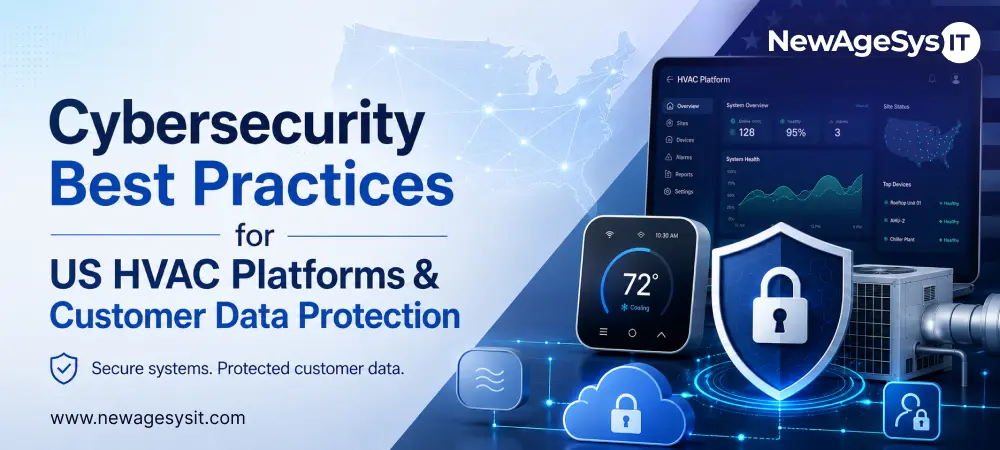
HVAC 6 min read
Cybersecurity Best Practices for US HVAC Platforms And Customer Data Protection

| This article is part of our series on HVAC software compliance, security, and regulatory strategy for US markets |
US HVAC platform cybersecurity carries a risk most software categories never face: physical safety. HVAC platforms often store customer home addresses alongside access codes, gate codes, alarm information, and other security details. A breach of this data is not just a privacy incident. It can create direct physical security risks for customers. That consequence makes HVAC cybersecurity distinct from most other software categories.
This elevated risk shapes how teams approach HVAC mobile and web app development from the first design decision. Customer access credentials should be treated as highly sensitive throughout the platform, which is why custom HVAC software and CRM development have to embed protection at the architecture level.
EPA compliance records create a second area of concern because unauthorized exposure or alteration could facilitate misrepresentation during regulatory responses. State breach notification laws apply broadly. Incidents involving home access data may warrant faster notification than the standard 30 to 90 day timelines, given the potential impact on customer safety.
Customer Home Data Protection Architecture
Role-based separation is the starting point. Office staff handling billing and scheduling do not need home access codes at all. Keeping that data out of their view limits how far a single compromised account can reach.
Encryption Standards
Apply AES-256 at rest to customer identity, home addresses, access codes, security system information, and payment tokenization records. Use TLS 1.3 as the minimum for all API communications. Home access data needs one layer more: field-level encryption. Access codes and security notes are encrypted at the database field level, so reading them requires explicit, authorized decryption.
Time-scoped Access to Home Data
Technicians should see access codes only for their assigned jobs on the day of service. Historical jobs and the full customer database stay out of reach. Access is automatically revoked upon job completion, so home security data is closed within the service window. On Android development and iOS development for field apps, this scoping belongs in the app’s data layer itself.
EPA Record Tamper Protection
Store completed refrigerant records in an append-only architecture. Nothing can be altered after submission. Log every read and write to EPA records, including the user identity and timestamp. These records are regulatory documentation, and the audit trail proves their integrity.
EPA refrigerant records, CCPA-relevant customer data, and state licensing checks often depend on the same platform controls. The broader compliance framework is covered in EPA Section 608, CCPA & State Licensing Compliance in US HVAC Software
Digital Work Authorization Security and Storage
A secure ESIGN/UETA work authorization record captures more than a signature. The audit trail should include identity confirmation, a device fingerprint, a timestamp, and the exact approved document version. These elements must be stored immutably so the record accurately reflects what the customer agreed to at the time of signing.
Append-only storage is what makes the authorization defensible. Once a customer signs, the record cannot be modified. That tamper-evident evidence can support payment collection when disputes arise.
Document version management is equally important. When estimated terms change, the platform should preserve prior versions so historical approvals remain linked to the terms that were actually in effect at signing.
Retrieval speed matters as much as storage. Authorization records should be accessible within seconds during dispute resolution. Commercial customer purchase-order documentation should be stored under the same security and retrieval standards as digital signatures. That keeps the authorization record consistent and defensible across all customer workflows. In mobile app development for field teams, the signing flow should write directly to that secure store.
In iOS development, the same secure signing flow should preserve audit trails, document versions, and identity confirmation from the field app itself.
Authentication and Session Security
Multi-factor authentication (MFA) should be mandatory for any account with access to customer home addresses, access codes, or other security information. A single compromised credential can create physical safety risks for customers. That risk makes MFA a foundational security control for HVAC platforms.
Mobile field tools require additional protection. Biometric authentication, including iOS Face ID and Android biometric authentication, helps secure work order sign-offs and provides device-level confirmation of user identity. This additional verification can strengthen the defensibility of digital completion records.
Management accounts with broad database visibility should use time-scoped session expiry to reduce exposure from unattended or compromised sessions. Lost or stolen devices also require a rapid response capability. That includes remote wipe for technician devices holding customer home access data.
IoT integrations should follow the same security standards. Smart thermostat API connections should use token-based authentication with defined rotation schedules. That keeps credentials secure throughout the integration’s lifecycle. On custom software development, these controls belong in the platform’s core auth layer rather than bolted on per feature.
These controls should be treated as build requirements, not late-stage add-ons. Their budget impact is covered in Cost of Compliance & Security Integration in US HVAC Software Projects.
Incident Response for HVAC Data Breaches
Physical safety changes how HVAC organizations should respond to data breaches. A breach involving customer access codes, alarm information, or other home security data carries extra weight. It may require direct customer notification faster than standard state timelines. This physical safety dimension is what distinguishes HVAC incident response from many other software categories.
Not every incident carries the same level of urgency. A home access data breach, a payment data compromise, an EPA record integrity incident, and a customer database exposure each present distinct risks. Each may require its own notification and remediation actions. Incident response plans should map escalation and notification procedures to each scenario.
Multi-state HVAC businesses face additional complexity. Most states require breach notification within 30 to 90 days, and the timelines vary by jurisdiction. Response plans should track state-specific requirements and escalation paths.
Testing is equally important. Annual penetration testing should include home access data exfiltration scenarios, a physical-safety-focused assessment that many general security testing programs overlook
OSHA Safety Documentation in HVAC Software
OSHA compliance adds a documentation layer that HVAC software should support directly. Platforms should maintain per-technician safety training records covering confined space entry, electrical safety under NFPA 70E, refrigerant handling, fall protection, and ladder safety. Tracking these records at the individual technician level helps support training and compliance management.
Certification management should also include OSHA 10 and OSHA 30 credentials for each technician. Digital incident reporting enables field teams to capture safety events electronically, eliminating paper-based reporting workflows.
Safety Data Sheets (SDS) complete the safety documentation framework. Technicians should be able to access SDS information for refrigerants and chemicals through the platform, including at the job site when needed. On mobile app development for field teams, that access should work offline, since job sites are not always connected.
OSHA requirements affecting HVAC operations include electrical safety, refrigerant handling, confined spaces, and fall protection. Organizations should consult qualified OSHA counsel for specific compliance requirements.
Final Thoughts
HVAC platforms gain on multiple fronts when the core controls are built in. Time-scoped home access data security, EPA record tamper protection, biometric field authentication, and physical-safety-aware incident response protect customers, compliance standing, and business continuity at once. These controls help reduce cybersecurity risk while supporting operational resilience and regulatory readiness.
If your organization is building or securing a US HVAC platform, embed the core controls from the engineering foundation. That means field-level encryption for home access data, append-only storage for EPA records, and time-scoped access. Together, they protect the physical safety of your customers and the regulatory standing of your platform.
See how these requirements fit into broader HVAC platform initiatives at NewAgeSysIT. Learn more about digital transformation solutions from one of the leading AI software companies in the United States.
Core Development
Keep exploring the custom services.

AI Software Development
Custom AI Software Development
Build intelligent, production-ready software from machine-learning models to AI-driven automation designed around your business goals.
Learn more
Mobile App Development
Custom Mobile Application Development
Native and cross-platform mobile apps that are fast, secure, and built to scale across iOS and Android.
Learn more
Web App Development
Custom Web Application Development
Scalable, secure web applications, from customer portals to complex dashboards, tailored to how your business actually works.
Learn more



