Welcome to Blogs
Discover actionable insights, in-depth research, and expert perspectives, all in one place.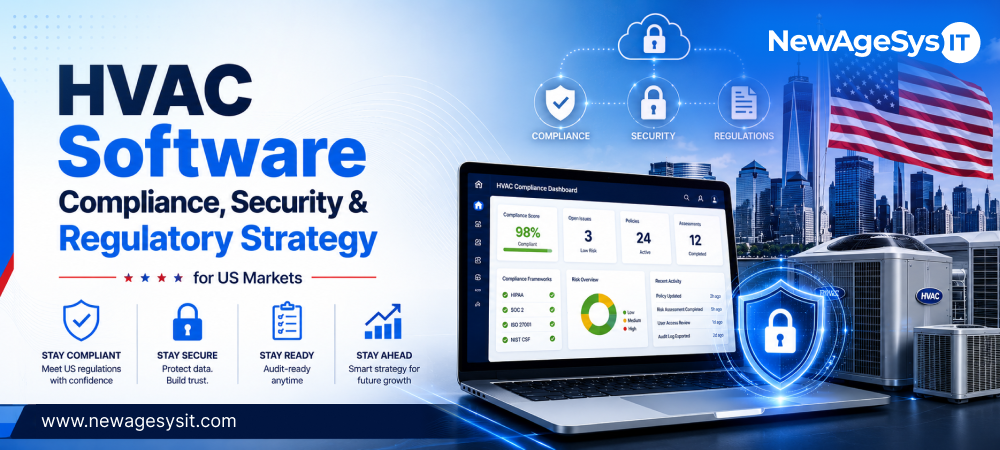
HVAC 10 min read
HVAC software compliance, security, and regulatory strategy for US markets

Introduction: Why US HVAC software compliance is more complex than most founders expect
Most HVACTech founders budget for the features customers will see and treat regulation as a thin layer to add later. HVAC software compliance in the USA does not work that way. The obligations reach across federal environmental law, federal energy standards, a federally enforced accuracy program, state contractor licensing, state privacy law, and workplace safety documentation. Each one carries its own enforcement mechanism and shapes how the software stores, validates, and retains data.
The stack includes EPA Section 608 refrigerant records, state contractor licensing, DOE minimum efficiency standards, ENERGY STAR program accuracy, CCPA consumer data rights, OSHA safety documentation, and enforceable digital work authorization. No single regulator owns the whole picture, which is part of why the gap is so easy to miss.
The consequences of getting this wrong are operational, not theoretical. Inadequate refrigerant records expose a business to EPA civil penalties. A lapsed technician license can trigger state action. A checkbox approval can leave a work order unenforceable the moment a customer disputes the bill. Teams that plan HVAC mobile and web app development services and custom HVAC software and CRM development services around these obligations from day one avoid the most expensive corrections.
The US HVAC software compliance stack
US HVAC web application development software is subject to a broader set of regulators than most software categories. Mapping the full stack early tells the engineering team what the data model has to support before a line of code is written. The point is not to treat every framework identically. It is to know which one touches which field, and which one carries the heaviest penalty for getting it wrong.
- EPA Section 608 (Clean Air Act): Businesses handling regulated refrigerants must keep per-job records of purchases, quantities charged and recovered, equipment serviced, and the technician’s EPA 608 certification type. Gaps carry EPA civil penalties.
- DOE minimum efficiency standards: DOE sets minimum SEER2 and HSPF2 requirements, effective January 2023. Minimums differ across the North, South, and Southwest, so quoting software has to apply the correct minimum for each installation location.
- ENERGY STAR program accuracy: The program is voluntary, but the FTC enforces accuracy. Software promoting ENERGY STAR equipment has to verify current certification against the EPA ENERGY STAR product database. Misrepresentation creates FTC exposure.
- State contractor licensing: Most states license HVAC contractors and technicians, so software managing credentials has to track license status and renewal dates.
- CCPA: For California customers, contact details, service history, home addresses, and payment data are all considered personal information.
- ESIGN and UETA: Digital work authorizations have to meet these standards to be enforceable. A checkbox alone does not qualify.
- OSHA: Technicians working with electrical systems, refrigerants, and confined spaces need documented safety training records.
Qualified environmental, licensing, and privacy counsel should confirm the specifics for your business.
EPA Section 608: The most critical HVAC-specific compliance obligation
EPA Section 608 is the defining federal compliance framework for HVAC businesses. The Clean Air Act governs refrigerant handling, technician certification, and record-keeping.
Businesses that use regulated refrigerants must maintain detailed per-job records. These cover refrigerant purchases, quantities charged and recovered, equipment serviced, and the technician’s EPA 608 certification type. These records must generally be retained for at least three years and remain readily accessible for inspection.
Refrigerant type precision is a major software requirement. The industry is moving away from R-22, which is phased out, and R-410A, which is being phased down. The replacements are lower-global-warming-potential alternatives such as R-32, R-454B, and R-466A. To track them accurately, HVAC platforms need a current, validated list of refrigerants. Free-text refrigerant entry can create inconsistent records that become difficult to verify during an EPA review.
Technician certification tracking is equally important. Type I covers small appliances, and Type II covers high-pressure systems. Type III covers low-pressure systems, and Universal certification covers all equipment categories. Software should validate that a technician’s certification is appropriate for the refrigerant being handled before a job is logged.
Failure to maintain required refrigerant records can expose HVAC businesses to EPA enforcement actions and significant civil penalties. As a result, HVAC software platforms form part of the compliance infrastructure. Custom android app development, offline synchronization, data integrity, and audit-ready exports become architectural requirements rather than optional features.
EPA Section 608, CCPA, and state licensing have deeper engineering requirements. The full details appear in EPA Section 608, CCPA & State Licensing Compliance in US HVAC Software.
Digital work authorization: the most universally applicable HVAC software obligation
Customer authorization before work begins is one of the most universally required operational and legal controls in the HVAC industry. When estimate approvals and post-service work order sign-offs are collected through mobile applications, they should comply with ESIGN and UETA requirements to support the creation of enforceable digital records.
A compliant digital authorization captures four core elements: clear intent to approve, identity confirmation, a timestamp, and the specific document version approved. A checkbox alone does not satisfy this standard.
Pre-service estimate approval documents that the customer reviewed and accepted the scope of work and pricing before service begins. This approval record helps protect HVAC businesses when customers later dispute charges or question the agreed scope.
Post-service custom ios app development work order sign-off provides customer confirmation that the work was completed as described. Stored immutably, this record serves as the closing authorization and supports payment collection.
Commercial HVAC customers introduce an additional requirement. Many operate through purchase-order workflows, so HVAC software must accommodate PO-based authorization alongside standard digital approvals and sign-offs.
The cybersecurity requirements for storing and protecting work authorization records are covered in Cybersecurity Best Practices for US HVAC Platforms & Customer Data Protection.
Cybersecurity: the operational foundation of US HVAC software compliance
HVAC platforms hold a combination of data that few other systems carry at once: customer home addresses with access codes and security system details, payment data, service history, and EPA compliance records. That mix turns a breach into a physical safety problem, not just a financial one.
This is the distinguishing risk. If customer access codes leak from an HVAC platform, the exposure is physical security for real homes. Most software categories never face that consequence, and it should drive the security design.
Time-scoped access is the core control. A technician should see access codes only for the jobs assigned that day, never historical jobs or the full customer database. Role-based separation reinforces this: office staff handling billing and scheduling do not need home access codes at all, so the design should keep that data entirely out of their view. EPA refrigerant records require tamper-evident storage because they are regulatory documentation rather than ordinary operational data, which means an audit log that records every read and write with user identity and timestamp. State breach notification laws generally require notice within 30 to 90 days, and a home access data breach may warrant faster notice, given the safety stakes.
ENERGY STAR and DOE regulations for HVAC tech platforms
DOE efficiency standards reshaped HVAC quoting in January 2023. That month, SEER2 and HSPF2 replaced SEER and HSPF under updated testing procedures. Because SEER2 values are not directly comparable to prior SEER ratings, HVAC software must use current efficiency data. Regional minimums also vary across the North, South, and Southwest, making location-aware filtering a core requirement for quoting.
The practical risk is significant. Equipment that satisfies DOE minimum standards in the North may not be compliant for installation in the South or Southwest. Recommending an ineligible unit can create customer liability, so quoting and recommendation tools must apply regional compliance logic.
ENERGY STAR certification accuracy creates a separate compliance requirement. HVAC software promoting ENERGY STAR-certified equipment should verify current certification against the EPA ENERGY STAR product database rather than relying solely on manufacturer claims. Misrepresentation can trigger FTC enforcement concerns. The same principle applies to IRA incentives and utility rebate programs, where eligibility requirements change frequently, and inaccurate information can mislead customers.
The full framework for ENERGY STAR and DOE regulations affecting HVAC tech platforms is covered in ENERGY STAR & DOE Regulations for HVAC Tech Platforms in the United States.
DOE SEER2/HSPF2 standards took effect in January 2023, and ENERGY STAR certifications can change. Verify current requirements and consult qualified regulatory counsel when making compliance decisions.
The real cost of US HVAC software compliance
Compliance is the budget line that founders underestimate most. Built into the architecture from the start, it adds roughly 15 to 25 percent to development cost. Retrofitted after launch, it adds 50 to 100 percent. The difference is not a rounding error. It is the gap between a planned line item and a mid-development funding crisis.
As planning ranges rather than quotes, the major pieces look like this. An EPA Section 608 compliance module runs about $10,000 to $25,000, the most HVAC-specific cost with no equivalent elsewhere. ESIGN and UETA work authorization runs about $5,000 to $15,000. Home access data security, covering field-level encryption and time-scoped access, runs about $6,000 to $18,000. CCPA consumer rights, including data export, a deletion pipeline with an EPA retention hold, and consent management, run about $8,000 to $22,000. DOE regional efficiency filtering in quoting runs about $8,000 to $20,000.
Set against these numbers, the cost of EPA non-compliance is the figure that matters most. Civil penalty exposure dwarfs any compliance investment. A detailed breakdown appears in the cost of compliance and security integration in US HVAC software projects.
Building a compliance-first US HVAC software architecture
Compliance-first architecture is not the expensive option. Addressing regulatory requirements at the design stage always costs less than retrofitting them after deployment. For the platform layer, teams can start with custom software development services.
EPA Section 608 compliance infrastructure
Use a validated refrigerant type dropdown rather than free text, log pounds charged and recovered per job, and match the technician’s EPA 608 certification type to the refrigerant. Add offline sync with data integrity and reporting that exports in EPA inspection format. Certification management should track type per technician, validate at dispatch, and alert before renewal so refrigerant work never lands with an uncertified technician.
ESIGN and UETA work authorization architecture
Capture identity confirmation, timestamp, and document version on pre-service estimate approval, stored as an immutable, retrievable record. Hold post-service sign-offs in append-only storage so nothing can be altered after signing. That tamper-evident record is what holds up in a payment dispute.
Customer home data security
Apply field-level encryption to access codes, alarm details, and security notes. Grant time-scoped access so technicians see home data only for the assigned job on the day of service, and revoke access automatically when the job closes. The default for sensitive home data should be no access, with exposure granted only for the window the job requires.
CCPA consumer data rights
Build data export within the 45-day window, a deletion pipeline that respects the EPA three-year refrigerant retention hold, and opt-out management for California customers. The retention hold is the subtle part: a deletion request has to clear personal data while leaving federally mandated refrigerant records intact.
DOE regional efficiency compliance
Filter the equipment catalog by the SEER2 minimum for the installation region, and refresh the ENERGY STAR certification status from the EPA product database on a set schedule. Keep SEER2 ratings visually distinct from legacy SEER inventory so quotes never compare the two as if they were equivalent.
Teams scoping this work can start from custom software development services for the platform layer or custom mobile app development services for the field tools.
Common US HVAC software compliance failures
The same failures show up again and again, and each one is preventable at the design stage.
- Free-text refrigerant fields: technicians type names inconsistently, such as R410A, R-410A, or R 410A, so records cannot compile into EPA-compliant logs and fail inspection.
- EPA logging left out entirely: a work order platform built without refrigerant tracking, with the gap discovered at inspection.
- ESIGN-noncompliant authorization: a checkbox approval with no identity confirmation, unenforceable in a payment dispute.
- Home access data in standard storage: access codes and alarm details are stored without field-level encryption or time-scoped access controls, exposing physical security in the event of a breach.
- DOE regional efficiency ignored in quoting: replacement quotes are generated without location-aware SEER2 filtering, which can recommend non-compliant equipment for the installation region.
These failures usually begin before development starts. A regulatory and technology review can identify missing EPA logging, weak authorization records, home access data exposure, and DOE filtering gaps before they become expensive rebuilds. Pre-build consulting context is covered separately in Why US HVACTech Startups Need a Regulatory & Technology Consultant Before Building.
Final Thoughts
US HVAC software earns the trust of enterprise operators when it is built right. That means EPA refrigerant logging, ESIGN-compliant work authorization, time-scoped home access data security, and DOE regional efficiency compliance. Together, these make a platform defensible under regulatory scrutiny.
If your organization is building US HVAC software, the most effective approach is to align these requirements from the design stage. EPA Section 608 architecture, ESIGN work authorization, home access data security, and DOE regional efficiency all belong in the plan early. Doing so significantly reduces regulatory risk and protects the business’s operational standing.
Learn more about how these requirements fit into broader HVAC software development initiatives from one of the leading AI software companies in the United States.
Core Development
Keep exploring the custom services.

AI Software Development
Custom AI Software Development
Build intelligent, production-ready software from machine-learning models to AI-driven automation designed around your business goals.
Learn more
Mobile App Development
Custom Mobile Application Development
Native and cross-platform mobile apps that are fast, secure, and built to scale across iOS and Android.
Learn more
Web App Development
Custom Web Application Development
Scalable, secure web applications, from customer portals to complex dashboards, tailored to how your business actually works.
Learn more