
Welcome to Blogs
Discover actionable insights, in-depth research, and expert perspectives, all in one place.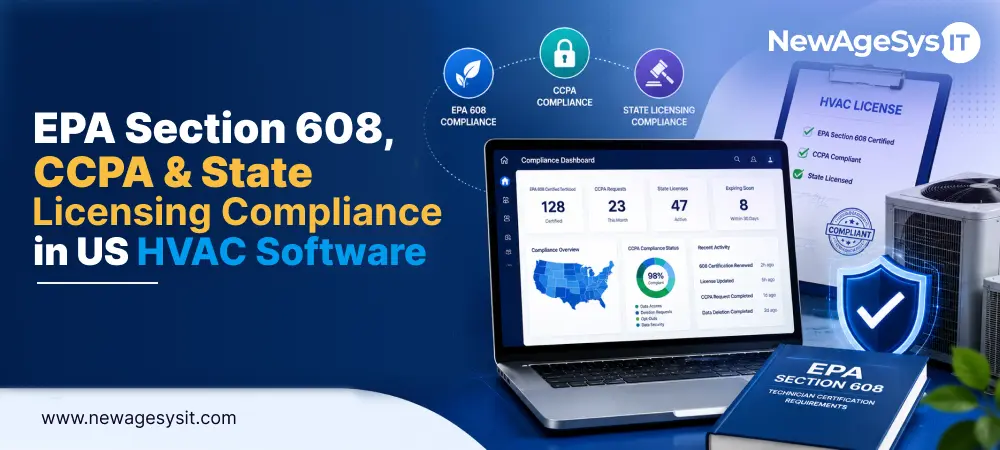
HVAC 7 min read
EPA Section 608, CCPA And State Licensing Compliance in US HVAC Software

| This article is part of our series on HVAC software compliance, security, and regulatory strategy for US markets |
EPA CCPA HVAC software compliance USA requirements are shaped by three major frameworks: EPA Section 608, the California Consumer Privacy Act (CCPA), and state contractor licensing regulations. Each influences how HVAC software stores data, validates technician credentials, manages refrigerant records, and protects customer information. Missing any of these requirements can create significant operational, legal, and compliance exposure.
EPA Section 608 is the most HVAC-specific of the three obligations. It establishes federal refrigerant record-keeping requirements for businesses handling regulated refrigerants. Teams planning HVAC mobile and web app development services and custom HVAC software and CRM development services should account for these requirements during architecture and data model design.
The CCPA applies to platforms serving California customers that meet applicable thresholds. Customer contact information, service history, and home access data may all qualify as personal information. State contractor licensing is often overlooked, yet software managing technician credentials should track state-issued HVAC licenses alongside EPA 608 certifications.
This article provides strategic and technical guidance, not legal advice. Consult qualified environmental, licensing, and privacy counsel for specific compliance determinations.
EPA Section 608 compliance engineering requirements
EPA Section 608 sets clear engineering expectations for HVAC software. The Clean Air Act requires refrigerant records to be retained for at least three years. Software must support that retention and make records easy to retrieve during an audit.
Refrigerant type validation
Use a validated dropdown rather than free-text entry. The list should cover R-22, R-410A, R-32, R-454B, R-466A, R-407C, and other current refrigerants. Enforcing valid selection prevents inconsistent records. As the low-GWP transition continues, the list needs regular updates to reflect ongoing phasedowns.
Per-job refrigerant records
Each job record should capture the refrigerant type, pounds charged, pounds recovered, recovery cylinder, equipment type and location, service date, and technician certification type. Technicians often work in basements and attics with no signal. Offline capture with reliable sync prevents the partial or lost records that create compliance gaps.
Technician certification management
Track the EPA 608 certification type for each technician: Type I, Type II, Type III, or Universal. Dispatch validation should match the certification type to the refrigerant being handled. Add expiry alerts at 60 and 30 days before renewal.
Inventory and compliance reporting
Track refrigerant cylinder purchases and reconcile them against usage and recovery totals. Generate compliance reports automatically in EPA inspection format. This is where web application development services and custom software development services can build the audit-ready exports inspectors expect.
EPA Section 608 compliance engineering requirements
EPA Section 608 sets clear engineering expectations for HVAC software. The Clean Air Act requires refrigerant records to be retained for at least three years. Software must support that retention and make records easy to retrieve during an audit.
Refrigerant type validation
Use a validated dropdown rather than free-text entry. The list should cover R-22, R-410A, R-32, R-454B, R-466A, R-407C, and other current refrigerants. Enforcing valid selection prevents inconsistent records. As the low-GWP transition continues, the list needs regular updates to reflect ongoing phasedowns.
Per-job refrigerant records
Each job record should capture the refrigerant type, pounds charged, pounds recovered, recovery cylinder, equipment type and location, service date, and technician certification type. Technicians often work in basements and attics with no signal. Offline capture with reliable sync prevents the partial or lost records that create compliance gaps.
Technician certification management
Track the EPA 608 certification type for each technician: Type I, Type II, Type III, or Universal. Dispatch validation should match the certification type to the refrigerant being handled. Add expiry alerts at 60 and 30 days before renewal.
Inventory and compliance reporting
Track refrigerant cylinder purchases and reconcile them against usage and recovery totals. Generate compliance reports automatically in EPA inspection format. This is where custom software development services can build the audit-ready exports inspectors expect.
State HVAC contractor licensing compliance
State licensing makes HVAC compliance complex, especially for businesses operating across multiple states. Most states require HVAC contractors and technicians to hold state-issued licenses, but requirements, license categories, and renewal periods vary significantly.
License tracking is a core software requirement. Contractor licenses apply to business entities, technician licenses apply to individuals, and specialty licenses may cover refrigeration, boiler, or other regulated work. Each category carries different state-specific obligations.
Dispatch validation is the control that prevents licensing violations. Assigning a technician whose license has expired or is not valid in a particular state can create compliance exposure. Dispatch systems should verify the active license status before assigning a job. In mobile app development for field teams, this check belongs in the assignment flow itself.
Multi-state HVAC operations face additional complexity because each state maintains its own licensing categories and continuing education requirements. To support compliance, software should track per-state licensing status for every technician. The same profile should hold state licenses and EPA 608 certifications together in one place. For native field tools, Android development can surface license status directly at dispatch.
State HVAC licensing requirements vary significantly by state. Organizations should consult qualified licensing counsel for state-specific compliance requirements.
CCPA and state data privacy for HVAC platforms
The CCPA applies to HVAC platforms serving California customers that meet the applicable revenue or data volume thresholds. When applicable, customer contact information, service history, home addresses, and payment data are treated as personal information. The platform must manage these categories accordingly.
Home access data requires additional protection. Customer access codes, gate codes, alarm information, and other security details stored in HVAC software carry physical safety implications beyond standard privacy concerns. Appropriate safeguards and clear CCPA disclosures are essential. On iOS development for field apps, which includes encrypting home access data at the device level.
The CCPA grants consumers several key rights. These include access to their data through export, deletion of personal information, and the right to opt out of data sales. Deletion requests can create a compliance challenge because EPA Section 608 requires refrigerant records to be retained for at least three years.
Data breach notification is particularly important for home access data. Because these records may affect customer physical security, organizations should treat related breaches with heightened urgency and strong security controls.
Customer data risks, breach controls, and protection measures are discussed in Cybersecurity Best Practices for US HVAC Platforms & Customer Data Protection.
ESIGN/UETA compliance for HVAC work authorization
Pre-service estimate approval is enforceable only when it satisfies ESIGN and UETA requirements. A valid digital approval must capture four elements: the customer’s intent to approve, identity confirmation, a timestamp, and the specific estimated version being approved. A checkbox alone does not meet this standard.
Post-service work order sign-off completes the authorization process by confirming that the work was performed as described. Stored in an append-only, immutable record, this confirmation helps protect payment collection when customer disputes arise.
Commercial HVAC customers often require additional documentation workflows. Many operate through purchase orders, so software should support PO-based authorization alongside standard digital approvals and work order sign-offs.
Document version management matters too. When estimated terms change, the platform should preserve every prior version. Each historical approval remains linked to the document in effect at the time of signing. Authorization records must also be retrievable within seconds, ensuring rapid access during payment disputes and customer inquiries. On custom software development, retrieval should be engineered for sub-second access from the start.
Common EPA and Compliance Failures in US HVAC Software
The same compliance failures recur in HVAC software projects, and each is preventable during the design stage.
Free-text refrigerant fields: Technicians enter refrigerant names inconsistently, such as R410A, R-410A, or R 410A. As a result, records cannot compile into EPA-compliant logs.
EPA logging omitted entirely: A platform is built without refrigerant tracking, and the gap is discovered during an EPA inspection when remediation is far more costly.
CCPA non-compliance for national apps: Platforms serving California customers fail to implement consumer data rights workflows or provide required disclosures for home access data.
Home access data without field-level encryption: Customer access codes are stored in standard database fields, creating physical security exposure if a breach occurs.
ESIGN-noncompliant approvals: A checkbox approval without identity confirmation creates an authorization record that may be unenforceable in a payment dispute.
Addressing these issues during architecture and development costs significantly less than correcting them after an inspection, audit, or security incident.
Budget planning, compliance scope, and security integration costs are covered in Cost of Compliance & Security Integration in US HVAC Software Projects.
Final Thoughts
US HVAC software is better positioned for enterprise due diligence when the core controls are built in. That means validated EPA refrigerant logging, state license tracking, CCPA consumer rights management, and ESIGN-compliant work authorization. Together, they help a platform withstand regulatory inspection. These requirements influence platform architecture, credential management, customer data handling, and field operations from the outset.
If your team is building US HVAC software, design these controls into the architecture before development begins. That covers EPA Section 608 refrigerant logging, state license expiry management, CCPA consumer rights, and ESIGN-compliant work authorization. It is the most cost-effective compliance strategy available. Learn more about digital transformation solutions from one of the leading AI software companies in the United States.
Core Development
Keep exploring the custom services.

AI Software Development
Custom AI Software Development
Build intelligent, production-ready software from machine-learning models to AI-driven automation designed around your business goals.
Learn more
Mobile App Development
Custom Mobile Application Development
Native and cross-platform mobile apps that are fast, secure, and built to scale across iOS and Android.
Learn more
Web App Development
Custom Web Application Development
Scalable, secure web applications, from customer portals to complex dashboards, tailored to how your business actually works.
Learn more



