TL;DR Cross-platform development lets you build apps for iOS and Android from a shared codebase, reducing time-to-market and costs but delivering a near-native user experience. The cross-platform app development market is expected to reach $546.7 billion by 2033, driven by multi-platform support, cost efficiency, and faster launches. Modern frameworks like React Native, Flutter, .NET MAUI, Ionic, Cordova, Xamarin, NativeScript, Kotlin Multiplatform, Electron, Node.js, Sencha Touch, and Corona SDK enable shared business logic with customizable, platform-specific UI. Key benefits of cross-platform app development include reusable code, faster development, lower costs, broad audience reach, and native-like look and feel. Best practices focus on sharing business logic while customizing the UI per platform, using platform-specific code when necessary, conducting real-device testing, optimizing performance, and aligning the framework choice with your team’s skills and long-term maintenance needs. The future of cross-platform development is shaped by AI-powered code generation, low-code/no-code tools, tighter native-like performance, deeper integration with AR/VR, ML, IoT, and stronger security and compliance, making it a strategic choice for startups and enterprises alike. |
Smartphones have been an inevitable part of communication and entertainment. Developers are building more applications to serve a wide range of purposes, from AI, AR, and VR to weather. To ensure the best user experience, developers develop mobile apps with the smartphone’s OS in mind, whether iOS or Android. Whether you are targeting iOS or Android, adopting the right development approach can significantly improve the final solution you bring to market.
Choosing between native and cross-platform app development is one of the critical decisions you need to make for your mobile app development project. However, it’s worth noting that cross-platform mobile development is highly valued for its multi-platform support, quick time-to-market, and cost efficiency, as reflected in the projected CAGR of about 16.7% for the period 2025-2032. When you choose a cross-platform development framework over native, then this is a core decision with enormous implications for the application design, the technologies used to build the app, and, eventually, the users who can access it.
Now, think this: Is your existing tech stack missing the mark? Is your team stuck dealing with the drawbacks of the mobile application development frameworks or languages you work with? Whether your existing workflow involves native or cross-platform development, or even if you’re considering a cross-platform app development approach for your upcoming project, you need to dive deep into the concept and benefits of the process.
In this blog, we will discuss in detail the top cross-platform app development frameworks available in the market. We will also discuss the benefits of cross-platform app development and the steps you should take to ensure app development is reliable, safe, and convenient.
What Is Cross-Platform Mobile Development?
It is the approach of developing mobile apps that can run on multiple operating systems from a shared codebase. Unlike writing individual apps in Swift for iOS and Kotlin for Android, developers write code once and deploy it across both platforms. This method has been massively adopted across the modern era, with companies such as Microsoft, Facebook, Shopify, Walmart, Discord, and Airbnb using cross-platform app development frameworks for their mobile applications.
Cross-Platform App Development Frameworks: Key Statistics to Know
- Cross-platform framework development is projected to jump from $50 bn in 2025 at a 20% CAGR through 2033.
- According to recent studies, more than 40% of developers now prefer cross-platform app development frameworks due to their increased cost-effectiveness and efficiency.
- By 2033, the cross-platform app development market is expected to hit $546.7 billion.
Cross-platform tools can save over 30% of app development time compared to native app development, which is advantageous for rapid launches, startups, and MVPs that aim for early market traction.

Comparison: Native Vs. Cross-Platform Apps
With native and cross-platform development strategies, each has its own advantages and limitations based on your project goals. The native apps adhere to platform-specific guidelines and can completely leverage device-level features. This offers high-end performance and an unparalleled user experience. But native applications are confined to the platform they’re built for—this means you need to develop separate apps for Android and iOS to reach a large audience, which can add to time and costs.
Native and cross-platform development are two distinct approaches to creating mobile applications. Native apps deliver high performance and ensure seamless platform integration, whereas cross-platform app development frameworks offer the fastest development cycles and an extensive reach through shared codebases. Choosing between native Vs. Cross-platform development relies on budget, speed, scalability, and platform-specific requirements.
| Aspect | Native Development | Cross-Platform Development |
|---|---|---|
| Codebase | Separate code for iOS & Android | Single shared codebase for both platforms |
| Performance | Best-in-class, fully optimized | Near-native performance with modern frameworks |
| UI/UX Consistency | Perfect platform-specific UI | Consistent UI across platforms; can act like native |
| Development Speed | Slower (two apps, two teams) | Faster (shared logic, fewer resources) |
| Cost | Higher due to dual development | Lower due to the centralized development approach |
| Platform Access (APIs/Hardware) | Full access to all native APIs | Most APIs are available; some demand native modules |
| Maintenance & Updates | Double the process | One update gets deployed across both OS |
| Application | High-performance apps, heavy graphics, device-intensive apps | Startups, MVPs, business apps, faster go-to-market |
Pros and Cons of Cross-Platform Mobile App Development
Cross-platform development for Android and iOS has reached new heights due to emerging technologies. It is becoming increasingly attractive and dynamic for developers, mainly due to the surge in near-native mobile app development frameworks. Here are the pros and cons of cross-platform mobile development.

Benefits:
- Building individual native apps for every platform is costly, whereas a cross-platform app uses a single shareable code, helping you stay within your budget.
- Costs are minimized as only a team of programmers is needed for app development and app maintenance. Only basic knowledge of the standard languages is required; the development tools will handle the remaining work.
- Cross-platform applications have a native feel and appearance, which is ideal for user experience.
- Hybrid development is an approach for companies that wish to build simple apps, attract users across different mobile devices, and launch their products to market faster and at a reduced cost.
Challenges:
- The complex code of near-native and hybrid solutions blends native and non-native elements, potentially affecting overall performance.
- Cross-platform apps can’t support every feature and native-only functions of mobile devices, such as animation and 3D, resulting in limited functionality.
- While Google and Apple incorporate new features into iOS and Android, native solutions can easily adopt them. However, hybrid apps would need to wait until those updates are adjusted to the preferred cross-platform framework, which causes a delay.
However, with the right approach and best practices, you can ensure that your cross-platform development is apt and aligns with your requirements.
Top Frameworks for Cross-Platform Mobile App Development
Here are the five best cross-platform app development frameworks crucial for cross-platform mobile app development:
1. React Native
As an open-source, free framework, React Native enables developers to build iOS and Android apps with React and JavaScript. Developed by Facebook, it has become one of the best cross-platform mobile app development frameworks. It lets developers use their existing JavaScript and React knowledge to build their applications. Hence, web developers can easily leverage React Native development to build mobile apps without gaining new programming expertise.
Besides, React Native also offers hot reloading, which lets engineers make code changes and see instant results, speeding up development and making it more efficient. It also supports a wide range of plugins and third-party libraries, making it easy to integrate new features and functionality into a mobile app.
2. Flutter
A free and open-source UI toolkit, Flutter builds natively compiled apps for web, mobile, and desktop platforms with a unified codebase. Developed by Google, it gained popularity among developers for its performance, speed, and usability.
In addition to ensuring cross-platform mobile app development, this cross-platform app development framework also enables the creation of desktop and web applications. It is a versatile tool for cross-platform development. But Flutter’s Dart language can pose particular challenges for framework adoption, as no engineers have used it before. Like React Native, Flutter also supports hot reload, allowing developers to modify code and see results immediately.
Also, Flutter’s widget-based architecture helps developers build custom UI components that can be reused across the application, enhancing mobile app development speed and productivity.
3. .NET MAUI
.NET Multi-platform App UI (MAUI) is a free, open-source platform for building cross-platform mobile apps that evolved from the Xamarin framework. This is a well-known Microsoft cross-platform mobile app framework that uses C# and the .NET Framework, available under the MIT license and part of Visual Studio.
Here are the components that fall under the development toolset of .NET MAUI:
- MAUI project templates
- XAML to define layouts and the user interface
- Styles and theming for UI/UX customization
- Device APIs to access features such as sensors, the camera, and geolocation.
- Hot Reload feature.
It also delivers a component-based architecture that lets developers scale development speed and code maintainability. Also, it supports various app architectures, such as Model-View-ViewModel (MVVM), Model-View-Presenter (MVP), and Model-View-Controller
4. Cordova
Backed by Adobe, PhoneGap falls as a distribution of the Cordova framework. This mobile app framework is widely regarded as a well-known tool for hybrid solutions, mainly because Cordova applications can be written in JavaScript, CSS, and HTML5.
This hybrid mobile app development framework also provides native containers and plugins for every mobile platform and lets C++ developers add features that access device functionality. After these are created, the Cordova application runs in a WebView within a native container on the preferred platform.
5. Ionic
Being a well-known UI SDK, Ionic is one of the best hybrid app mobile development frameworks. It has the highly sought-after properties of ease of maintenance, open-source, scalability, and readability. The framework also offers a library of CSS, HTML, and JS components that enable the development of highly interactive, visually appealing applications.
Ionic offers a versatile set of tools and features, including unique support for material design, native-style mobile UI elements, and layouts. It also offers customers consistent updates and resources from the development community. Ionic-based hybrid apps have reliable features and custom tools that improve user-friendliness. But all of these depend on wrappers like Cordova to run on a device.
6. Node.js
This is a highly reliable framework for cross-platform app development. Since it is a JavaScript runtime framework built on the Chrome V8 JavaScript engine, it supports server-side and scalable networking app development in an open-source environment.
Node.js cross-platform applications are highly responsive and largely efficient. The framework can handle multiple concurrent connections. It also has a rich library of JavaScript modules, enabling simplified development of web applications.
7. Xamarin
The Xamarin cross-platform app framework is significantly different from the other cross-platform app development frameworks we have discussed in the sections above. This streamlined framework caters to app development for iOS, Android, and Windows, using .NET and C#, rather than HTML and JS libraries. It lets developers use 90% of the code to build an app for three different platforms.
Xamarin offers applications with features similar to those of a native app, using its most powerful APIs, making it difficult to distinguish it from React Native. Let’s look at the features of Xamarin and explain why it remains one of the best choices for cross-platform development.
8. NativeScript
NativeScript is a JavaScript-based, free cross-platform framework. For developers seeking WORA (Write Once, Run Anywhere) functionality, NativeScript is an ideal choice. The framework also provides all native APIs, enabling developers to reuse existing plugins directly from NPM (Node Package Manager) in their projects.
With NativeScript, developers only need to define it once and let NativeScript adapt to run anywhere. It offers developers an end-to-end web resource, along with plugins for all types of solutions. This eliminates the need for third-party solutions.
9. Sencha Touch
It focuses on web-based cross-platform app development and is typically used to create stunning applications that leverage hardware acceleration techniques. With the framework, developers can create well-tested, securely integrated libraries and UI components.
It is popular for providing built-in native-like themes for major platforms such as iOS, Android, Windows, BlackBerry, etc. It has an effective backend data package that works with data sources. It includes customizable and built-in UI widgets.
10. Kotlin Multiplatform
Developed by JetBrains, this framework extends the Kotlin language, enabling developers to write shared code that works across both iOS and Android. As part of Kotlin since 2017, Kotlin Multiplatform has become popular because it provides a genuine shared codebase experience while ensuring platform-specific implementations.
Kotlin Multiplatform helps developers share the business logic layer across platforms, thereby minimizing duplication and ensuring consistency. Though the business logic can be shared, Kotlin Multiplatform ensures the use of native UI components, keeping the app’s appearance consistent with the platform.
11. Electron
The framework helps web developers create cross-platform desktop apps using web technologies such as CSS, HTML, and JavaScript. Technologies such as Visual Studio and Slack demonstrate that they can be used to develop full-fledged desktop applications with a centralized codebase.
It avails web technologies and native desktop APIs. It is compatible with Linux, macOS, and Windows, and the architecture supports adding Node.js modules to augment complex functionalities.
12. Corona SDK
Corona SDK lets programmers build 2D applications for all core platforms, such as Windows and Kindle. It provides 10x faster game and mobile app development capability. Because the backend framework depends on Lua (a multi-paradigm programming language), it produces impressive results.
The language revolves highly around the key elements of development, such as portability, speed, scalability, usability, and extensibility. Being a free-of-cost framework that works across Windows and macOS, it also supports real-time testing.

Modern Approach: AI-Driven Cross-Platform App Development
The recent evolution in cross-platform app development is AI-powered platforms that leverage cross-platform code from natural language descriptions. This process infuses the advantages of cross-platform development with the pace of no-code tools. Many AI-powered cross-platform apps also rely on Golang-based microservices for performance-intensive tasks and real-time data processing, as Golang development services enable the compilation of fast, lightweight binaries across platforms.
Benefits of AI-Powered Cross-Platform Development:
- Develop cross-platform apps for iOS and Android using a single description
- Develops production-ready React Native code
- Automatically applied platform-centric optimizations
- Access to complete source code for customization
- Deploy to App Store & Play Store with a single click
When to Choose Cross-Platform Development?
Cross-platform solutions for mobile app development can help you save time and effort while developing applications for iOS and Android. It can be challenging to integrate new tools and technologies into an organization. However, with the help of a leading cross-platform app development company, you can make it easier. Choose cross-platform development when:
- You wish to launch on Android and iOS.
- The development budget or timeline is less.
- Your team has web development expertise, particularly in JavaScript.
- The application doesn’t need heavy platform-centric features.
- You need to maintain a single codebase.
- Time-to-market is crucial.
Debugging Common Myths About Cross-Platform App Development
Multiplatform development evolves continuously. A few cross-platform app development frameworks, such as Kotlin Multiplatform, offer the benefits of both native and cross-platform apps and eliminate the limitations that are commonly associated with such approaches. Let’s unveil the popular myths about cross-platform application development:
1. Cross-platform apps offer poorer performance compared to native apps.
Multiplatform applications have long been prone to poor performance. But the quality and performance of your product highly depend on the tools you use for app development. The modern cross-platform app development frameworks offer all the tools essential to build applications with a native-like user experience. By leveraging various compiler backends, Kotlin Multiplatform is compiled to platform-specific formats—native binaries (iOS) and JVM bytecode (Android). As a consequence, the shared code has the same performance as what you get while writing them natively.
2. Cross-platform app development frameworks are not secure.
This is a common myth that native applications are more secure and reliable than cross-platform apps. However, the latest cross-platform development tools enable developers to build secure apps with reliable data protection. Mobile engineers need to adopt additional measures to ensure their applications are safe.
3. Cross-platform apps don’t have access to every native function of mobile devices.
No cross-platform framework gives you full access to the device’s features when building applications. Also, a few modern multiplatform development technologies can let you overcome this concern. For instance, Kotlin Multi platform provides easy access to the iOS and Android SDKs. It offers a mechanism that combines expected and real decelerations to ensure you have full access to device features.
4. Managing cross-platform projects is generally difficult.
Cross-platform solutions can help you manage resources effectively. It lets your development teams learn how to write and reuse shared code. iOS and Android developers can achieve high transparency and efficiency by collaborating and sharing knowledge.
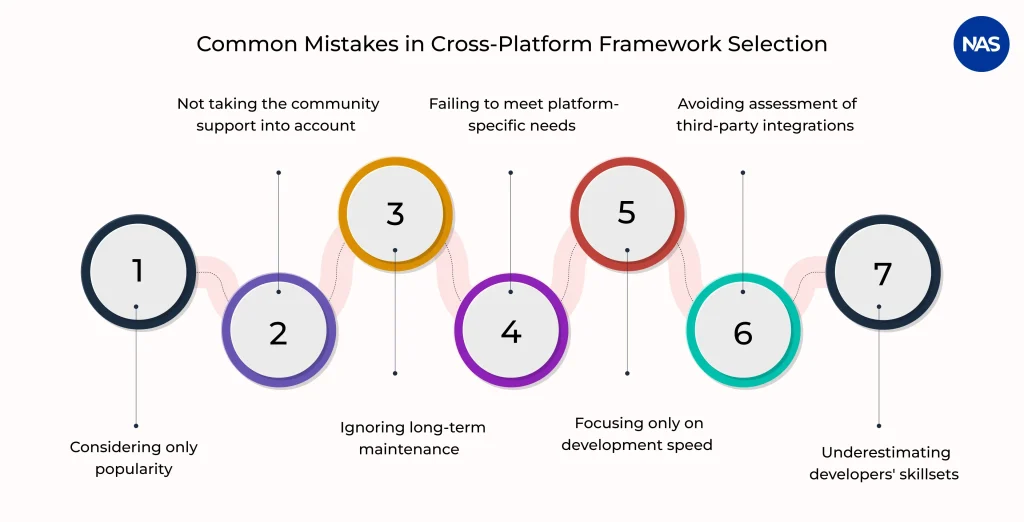
#1: Don’t Choose Only Based on Popularity
Relying only on popularity can be counterproductive. While one framework may be prominent, it may not align with your project goals, performance requirements, or supported platforms. Rather than focusing solely on the hype, you should understand which tools are ideally suited to your project needs.
| 💡Tip: Choose the tools that ideally fit your project requirements, performance needs, and supported platforms. |
#2: Don’t Avoid Community Support or Documentation
Frameworks with limited tutorials, insufficient documentation, or declining community support can affect development and make troubleshooting difficult. The right choice for a cross-platform app development framework is one with an active community and comprehensive guidance that helps you quickly address issues and access the proper practices.
| 💡Tip: Consider community support and documentation to address your development concerns and adopt the best practices. |
#3: Don’t Ignore Long-Term Maintenance
Some frameworks might be effective initially; however, they don’t keep up with the OS changes, new devices, or security issues. The lack of emphasis on maintainability adds to the cost and technical complexity. This is because a framework with desired longevity and regular updates will be chosen to ensure sustainable cross-platform app development.
| 💡Tip: Focus on maintainability, regular updates, and OS changes to make it sustainable. |
#4: Don’t Fail to Cater to Platform-Specific Requirements
iOS and Android aren’t considered equally for all mobile development frameworks. App quality can be affected by failing to focus on platform-centric UI and UX considerations. When evaluating cross-platform mobile app development frameworks, it is essential to assess their flexibility to ensure an app appears and works as expected on every platform.
| 💡Tip: Make sure the app is flexible and works as desired on each and every platform with platform-centric UI and UX considerations. |
#5 Don’t Focus Only on Development Speed
The need to build quickly is essential, but focusing on short-term speed at the expense of performance and maintainability can lead to technical debt. Architectural design needs to strike a balance between development efficiency and long-term reliability, while minimizing problematic refactoring and ensuring future scalability.
| 💡Tip: Strike a balance between development efficiency and long-term reliability rather than focusing only on development speed. |
#6 Don’t Avoid Assessing Third-Party Integrations
The number of applications that rely on plugins or other libraries is huge. The framework that has limited third-party adherents can hinder functionality and demand numerous workarounds. Maintaining compatibility with essential integrations is a significant factor in the development process.
| 💡Tip: Make sure you concentrate on essential integrations to make the development process great with high functionality. |
#7: Don’t Underestimate the Developers’ Skill sets
Deploying a system that is not within your team’s control could increase development time and reduce productivity. Learn the expertise and training needs of developers, and long-term capabilities, before choosing a cross-platform framework. The appropriate framework should be aligned with the team’s competencies to ensure scalability and performance.
| 💡Tip: Understand the training requirements of the developers and select tools that match your team’s strengths. |

Cross-Platform Development Best Practices
- Share business logic and customize UI
Share business logic, API calls, and data management across platforms. You can reuse it across Android and iOS. Customize UI components as needed to align with every platform’s design principles.
- Leverage Platform-Specific Code When Required
Keep pace with the framework. When you require platform-centric functionality, use platform-specific code. With .ios.js and .android.js file extensions, React Native can make this effortless.
- Implement Real Device Testing
Simulators are helpful, but they don’t completely replace real-device testing. Performance, device-specific features, and gestures can act differently on actual hardware.
- Optimize for Performance
Utilize performance profiling tools, execute lazy loading, and optimize images; moreover, prevent undesired re-renders. Flutter and React Native offer stunning performance profiling tools.
- Stick to Platform-Specific Design
Users expect applications to feel native to their platform. Use various navigation patterns, UI conventions for iOS & Android, and typography.
Cross-Platform Development Future Trends
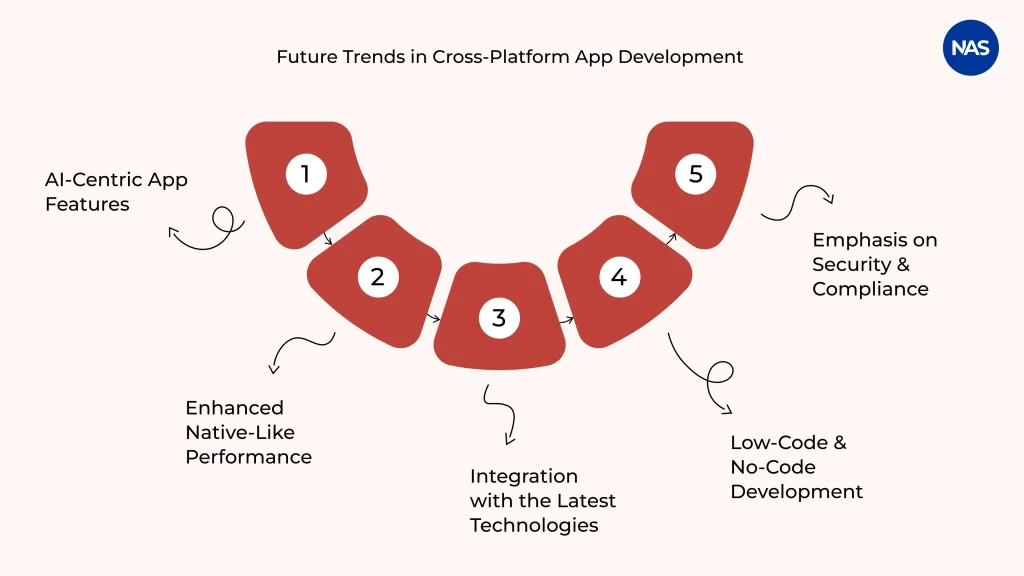
1. AI-Centric App Features
AI is enhancing the app’s capabilities with features for on-device processing, predictive analytics, and self-centric user experience. Apps will be intelligent and learn about their users based on their behaviour, anticipating their requirements. These could be particularly helpful when considering industries like logistics to optimize operations in real time.
2. Enhanced Native-Like Performance
Cross-platform systems like React Native and Flutter close the performance gaps to native apps. With a high-performance system, GPU-scaled rendering, systematic memory management, and native integration between modules, these offer a responsive and effortless user experience.
3. Integration with the Latest Technologies
Augmented Reality (AR), Blockchain, Machine Learning, and IoT (Internet of Things) are becoming more involved in cross-platform app development. This offers ease of communication through interactive experiences, smart devices, and enhanced data protection, simplifying operations and increasing transparency.
4. Low-Code & No-Code Development
Low-code/no-code platforms are the latest methods for app development, enabling business leaders to prototype quickly, reduce costs, and help non-coders create applications. This tendency allows for momentum, innovation, and speed to market, particularly for SMEs and startups.
5. Emphasis on Security & Compliance
With the growing importance of data security, cross-platform app development frameworks are integrating end-to-end encryption, GDPR compliance, and biometric authentication. These solutions keep user data secure and maintain high standards, which are crucial in an industry that handles sensitive data.
Final Thoughts
Presently, many companies create mobile versions of their business websites to gain an edge in the market. Cross-platform development is the most viable solution for businesses, as it enables them to create trustworthy applications that are compatible with every customer device.
Nevertheless, partnering with a credible cross-platform mobile development services provider offering consulting, migration, support, and maintenance services is crucial.
With NewAgeSysIT, you have that promise: the promise to provide clients with cross-platform mobile app development services, ensuring you always get the product that works best for your customers. To gain more information about how we can help you with cross-platform development, reach out to our experts.
FAQ
1. What are the advantages of native development over cross-platform development?
Native development provides higher performance, device-level optimization, and comprehensive access to platform-centric capabilities, which are essential for enterprise-grade applications. It also guarantees effortless UI/UX and lasting maintainability, making native development better when speed and security are the key metrics.
2. What are the steps to create a cross-platform mobile application?
Cross-platform app development usually requires requirement analysis, UI/UX planning, selecting appropriate cross-platform app development frameworks, shared code development, API integration, and multi-device testing. A unified codebase scales delivery while making the platform consistent. This lets leaders minimize costs and shorten time-to-market while maintaining high quality.
3. What are the main performance and design challenges in cross-platform development?
Cross-platform development can face challenges such as limited access to the latest native features and minor performance trade-offs compared to fully native applications. Design consistency needs careful consideration to prevent losing the native look and feel. By carefully selecting mature cross-platform app development frameworks, you can reduce most of these risks.
4. Which programming language or framework is best for cross-platform apps?
Frameworks like Flutter and React Native lead the industry due to strong community support and rapid UI rendering capabilities. The best choice depends on your internal expertise, product roadmap, and integration requirements. Many enterprises look for scalability and ecosystem maturity when choosing cross-platform app development frameworks.
5. What is the cost difference between native and cross-platform app development?
Cross-platform solutions generally cost 30–40% less because they rely on cross-platform app development services that build a single codebase for iOS and Android. Native development requires two separate teams, increasing both development and maintenance costs. Businesses seeking faster delivery and lower investment often prefer cross-platform development.
6. What are the most popular cross-platform frameworks available today?
Flutter, React Native, and Xamarin remain the top choices due to robust toolkits and enterprise adoption. These frameworks accelerate development, focusing on functionality and scalability. Additionally, they give the flexibility businesses need for future product expansion.
7. What is the difference between a hybrid app and a cross-platform app?
Hybrid apps run in a web view, which limits performance, whereas cross-platform apps compile closer to native code, resulting in better responsiveness. Cross-platform apps provide a more polished user experience and stronger feature compatibility. Many enterprises choose this option when partnering with a cross-platform mobile application development company to scale efficiently.