
Welcome to Blogs
Discover actionable insights, in-depth research, and expert perspectives, all in one place.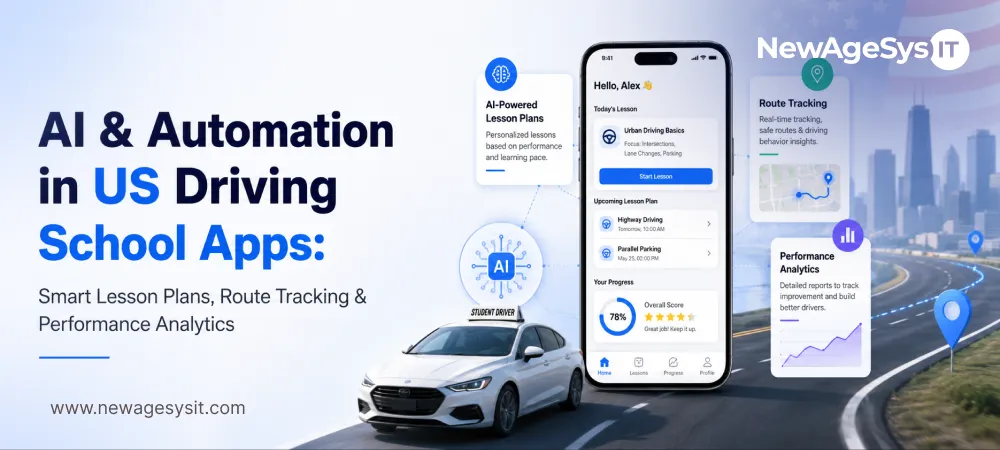
Driving School Software 6 min read
AI & Automation in US Driving School Apps: Smart Lesson Plans, Route Tracking & Performance Analytics

| This article is part of our series on CDL Driving School Mobile Apps in the USA: Building Smarter Driver Training Experiences in 2026 |
AI in driver training makes more sense when you look at what fleets already do.
Telematics-based coaching tools such as DriveCam and Lytx use driver behavior data to improve commercial driving performance. An AI driving school app in the USA applies that same idea earlier, while the student is still learning.
For driving schools, this moves AI from a future idea into a competitive planning question. If another school uses adaptive lesson plans, route optimization, and performance analytics, the gap becomes operational. They can improve readiness tracking and instructor utilization.
The data already exists inside most schools. BTW logs, route history, skill assessments, instructor notes, practice scores, and booking behavior all show how a student is progressing.
The ROI is not limited to better instruction. Schedule gap filling, predictive road-test readiness, automated progress alerts, and route planning can also reduce manual follow-up.
That is why AI should be scoped with the training workflow, not added as a loose feature later. In driving school mobile and web app development services, the data model matters as much as the interface. For CDL programs, custom CDL software and CRM development services should account for ELDT records, route evidence, and compliance workflows.
AI-Adaptive Lesson Planning
AI-adaptive lesson planning should answer one field-level question: what should this student practice next? The app should not push the same curriculum sequence to every learner. It should read recent skill assessment scores and identify what the next session should prioritize.
- Lesson focus from skill gaps: The instructor app, built through custom mobile app development, reviews the student’s latest competency scores before suggesting the session focus. If mirror use, lane positioning, speed management, or gap selection is weak, the next lesson should reflect that pattern.
- Pre-session instructor brief: Before the lesson, the instructor sees a short summary inside the app. It should show the student’s skill profile, suggested focus areas, and repeated error patterns from previous sessions.
- CDL-specific adaptive learning: For CDL students, AI should connect theory performance with BTW training. Weak Air Brakes or Combination Vehicles scores can trigger targeted review before related range or on-road work.
- Reusable lesson plan library: The app can include plans for first highway drives, night driving, and parallel parking. Backing practice and pre-trip inspection review can also be included.
- Instructional progression guardrails: AI recommendations should follow established driving instruction progressions. The app should not suggest complex driving tasks before foundational skills are assessed as competent.
AI can only recommend useful lessons when the core student workflows are already structured. Booking, progress tracking, and communication are covered in Must-Have Features in Modern US Driving School Mobile Apps.
GPS Route Tracking and Analysis
GPS route tracking across iOS app development and Android app development should give instructors more than a line on a map. The real value is route exposure.
A student may complete the required BTW hours without sufficient exposure to highway, traffic, parking, or intersections. Route history helps instructors see those gaps before road-test readiness is assumed.
During each session, the app can capture the GPS track and attach it to the BTW record. That gives the school a visual history of where the student trained and what road conditions they experienced.
Route analysis can then support better planning. A beginner may need low-traffic streets and simple turns. A more advanced student may need highway merging, denser intersections, parallel parking routes, or unfamiliar road environments.
For CDL programs, route records also support on-road training documentation. GPS history can help link logged driving hours to the actual route taken during training.
Speed data should be handled carefully. The goal is not to turn the app into a surveillance tool. It should help instructors identify moments where speed control needs review and use that context during debriefs.
Performance Analytics and Road Test Readiness Prediction
Custom software development enables deeper performance analytics that should help your school see whether a student is improving or just completing hours.
A student can finish the BTW requirement and still repeat the same mistakes across sessions. Lane positioning, mirror use, braking, parking, and intersection judgment may still be inconsistent.
Analytics can show whether skill scores are trending upward, staying flat, or changing only by instructor.
- Multi-session skill trend analysis: The app should track competency scores across lessons. This helps distinguish real progress from one good or bad session.
- Error pattern identification: The system can identify repeated mistakes across skill assessments. Lane positioning, mirror use, gap selection, braking, parking, and intersection technique may need targeted review.
- Road test readiness prediction: A readiness score can combine BTW hours, skill trends, test performance, and recurring error patterns. It should support instructor judgment, not replace it.
- School-level analytics: Operators can review pass rates by instructor, training package, location, or month via a web app development platform. This helps identify what lesson patterns correlate with stronger outcomes.
- Predictive maintenance overlay: Vehicle mileage trends and BTW session volume can help forecast maintenance windows. That connects fleet planning with training capacity.
Automated Student Journey Management
Automation should help students keep moving through the training journey without constant staff follow-up.
Many driving schools lose momentum after enrollment. A student signs up, delays the first session, stops booking, or forgets the next requirement. The app should detect those gaps early.
- Enrollment-to-first-session automation: The app can send enrollment confirmation, intake forms, first-session booking prompts, and parent notifications for minor students.
- Inactive student detection: If a student misses the school’s booking interval, the system can trigger re-engagement.
- Road test eligibility notification: Students can receive an alert when BTW hours, knowledge test status, and instructor recommendation align.
- Post-road test follow-up: Passing students can receive congratulations and referral prompts. Students who fail can receive remediation scheduling and next-step guidance.
- Annual refresher reminders: Schools offering refresher lessons can send renewal or safe-driving reminders to past students.
Data Privacy and Safety in Driving School AI
AI features should not change the rules around student data. They should respect them more carefully.
Route tracking, skill assessments, lesson notes, and progress records can all contain sensitive information. For minor students, that data may also require parent access controls and consent workflows.
- GPS data privacy: Route tracking creates sensitive location data. For California students, the California Consumer Privacy Act (CCPA) and California Privacy Rights Act (CPRA) may apply. The app should define what is collected, how long it stays, and who can access it.
- Minor student data in AI: AI systems handling teen-driver records should follow the broader student record rules. Where applicable, the Family Educational Rights and Privacy Act (FERPA) requires careful access controls. Parent visibility and consent workflows should be planned before AI features are added.
- AI lesson plan limitations: AI-generated lesson suggestions should guide instructors, not control the lesson. The instructor should keep the final judgment over training decisions.
- Federal Motor Carrier Safety Administration data integrity: For CDL programs, AI should never alter source compliance records. Analytics can interpret Entry-Level Driver Training (ELDT) data, route evidence, and performance patterns. The source compliance record should remain unchanged.
Final Thoughts
AI works best in a driving school app when it builds on reliable training data.
BTW logs, skill assessments, route history, and practice test results create the foundation. Once that data is structured, AI can support adaptive lesson planning, route analysis, road-test readiness, and student journey automation.
For driving schools and CDL programs, the goal is not to automate instructor judgment. It is to give instructors a better context and give operators clearer visibility into training outcomes.
If your school is planning AI features, start with the basics. Clean data, GPS route history, privacy controls, and instructor review workflows should come before advanced automation.
Working with an experienced driving school technology partner helps align AI features with training accuracy, student privacy, and operational value. Learn more about digital transformation solutions from a leading AI software companyin the United States.
Core Development
Keep exploring the custom services.

AI Software Development
Custom AI Software Development
Build intelligent, production-ready software from machine-learning models to AI-driven automation designed around your business goals.
Learn more
Mobile App Development
Custom Mobile Application Development
Native and cross-platform mobile apps that are fast, secure, and built to scale across iOS and Android.
Learn more
Web App Development
Custom Web Application Development
Scalable, secure web applications, from customer portals to complex dashboards, tailored to how your business actually works.
Learn more



