Guaranteed Expert Consultation Within 1 Hour. Click Here!
Guaranteed Expert Consultation Within 1 Hour. Click Here!

Guaranteed Expert Consultation Within 1 Hour. Click Here!
Guaranteed Expert Consultation Within 1 Hour. Click Here!
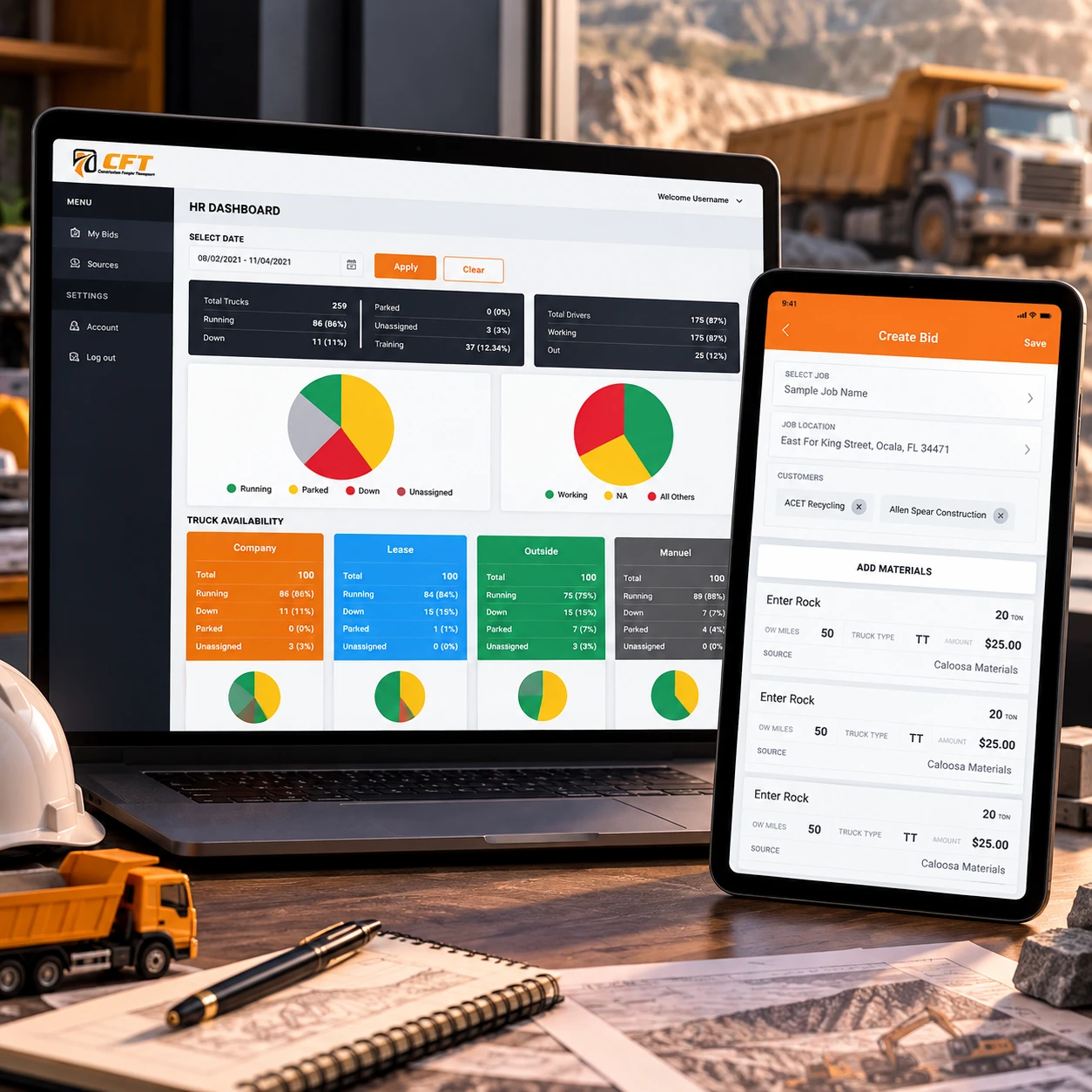
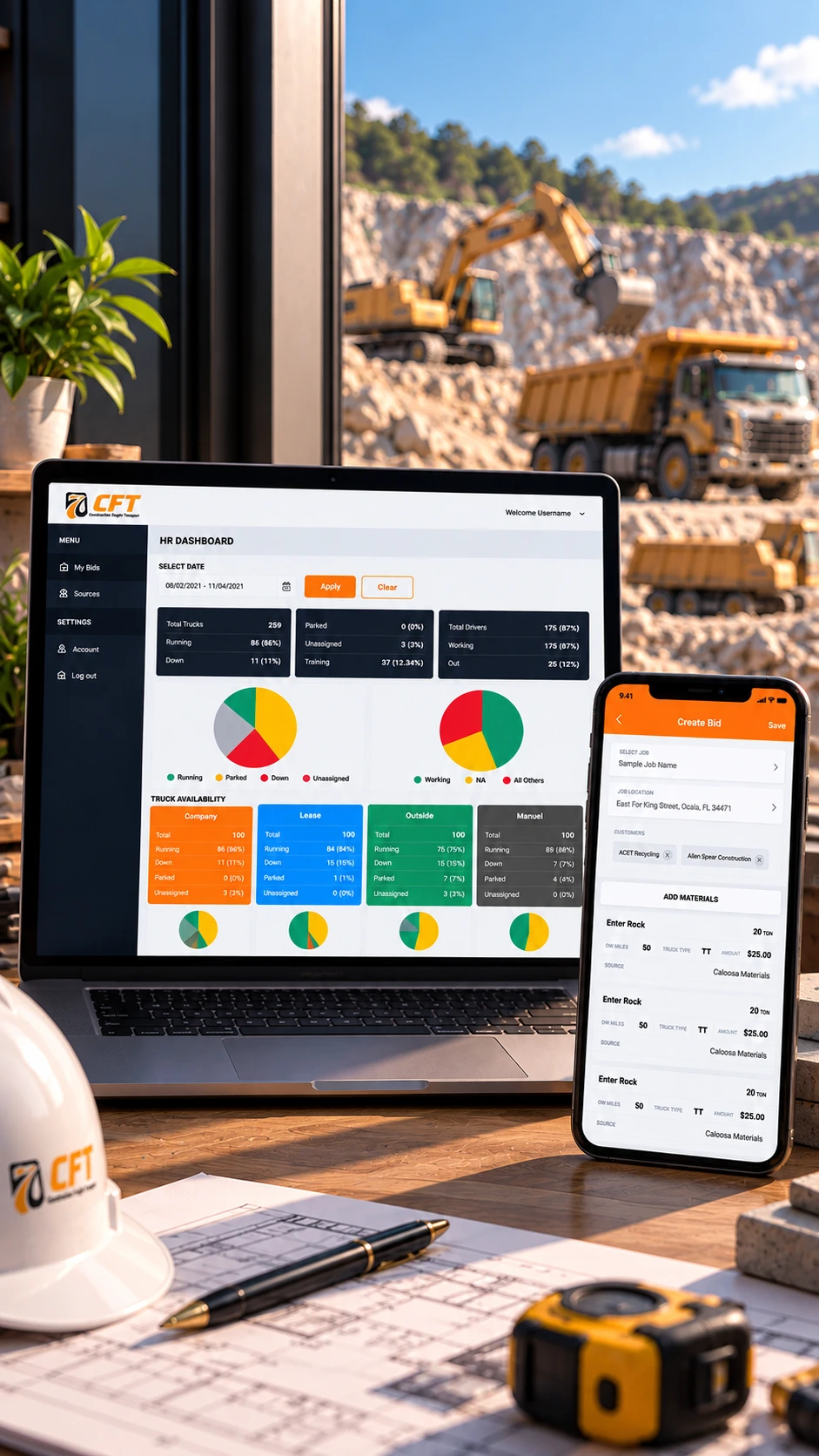
Central Florida Transport was running quoting, bidding, order management and reporting out of Google Sheets, with sales tracking scattered across individuals and no mobile access for reps in the field. NewAgeSysIT replaced that with a custom ERP covering sales, fuel, dispatch, HR and a reporting layer that draws from all four, paired with a native iOS application built specifically for what a sales rep needs in front of a customer. The company now saves 30-40% of the time previously lost to manual process, with full visibility across every job in progress.
Process Tracking
100% coverage
Time Saved
Across operational processes
30-40%
Time saved across operational processes
20-30%
Reduction in internal effort and investment
100%
Process tracking coverage
Reports that previously took assembling from several disconnected places became available in real time.
Central Florida Transport is a transportation and logistics company operating across Central Florida, managing work for both haulers and direct clients. Before this build, the business ran on Google Sheets and manual processes covering quoting, bidding, order management and reporting.
That is worth stating plainly rather than softening. A working transport business running core operations out of spreadsheets is not an embarrassing detail, it is an extremely common one, and naming it is what makes a reader in the same position trust the rest of the page.
The engagement was full-cycle: requirements gathering and prototyping through development, deployment and user training. CFT engaged NewAgeSysIT for custom software development rather than an off-the-shelf ERP, on the basis that a transport business with its own way of quoting, dispatching and tracking fuel would end up working around a generic product rather than with it.
CFT's operations had outgrown the tools holding them together. Quoting, bidding, order management and reporting all ran through Google Sheets, which meant every figure depended on someone entering it correctly and every report depended on someone assembling it from several places first. Sales tracking lived across individual people rather than in a system. Communication between teams broke down regularly because there was no shared view of what was happening. And the field sales team, the people actually in front of customers, had no mobile access to any of it, so anything they needed had to come via a phone call to the office. Moving a functioning business off spreadsheets and onto a system it can actually run on is what digital transformation looks like in practice: not a strategy document, but four departments that stop re-keying the same figures into different files.
Sales, fuel, dispatch and HR each had their own workflows and their own idea of what a record looked like, and building a single ERP that served all four without any of them feeling like an afterthought meant settling the data model before anything else was designed. The requirements phase was deliberately heavier than it would be on a simpler build: separate working sessions with each team, their processes mapped individually, and only then a structure that could hold all of them. Getting that wrong would have produced four systems sharing a login screen.
The temptation with a companion mobile app is to mirror the desktop system. That produces something a sales rep cannot use quickly while standing in a customer's yard. The app was scoped instead around what a rep actually does in the field, which is log a customer interaction, submit an order, check a job status, pull up a bid or a quote, and everything that belongs at a desk stayed in the ERP. Deciding what to leave out was the harder half of that decision and the reason the app gets used.
Prototyping before production code turned out to be the decision that protected the timeline. Putting wireframes in front of CFT's team surfaced a number of mismatches between what the development team had assumed was needed and what people actually wanted to do day to day. Resolving those at the wireframe stage cost days. Resolving them mid-build would have cost weeks and produced a system that people worked around rather than with. On an internal-tools project, adoption is the entire measure of success, and adoption is decided by whether the software matches the job.

When four departments each have their own definition of a record, the data model has to be settled before any interface is designed. CFT's requirements phase was deliberately heavier than a simpler build would need, which is what stopped the ERP becoming four systems sharing a login.
A companion mobile app should not mirror the desktop system. Scoping CFT's iOS app to what a rep does standing in front of a customer, which is orders, job status, bids and quotes, and leaving desk work in the ERP, is the reason the app gets used rather than bypassed.
On internal tools, adoption is the only measure of success, and adoption is decided by whether the software matches the job people actually do. Putting wireframes in front of CFT's teams before production code surfaced assumption mismatches that would have cost weeks to fix mid-build.
Fuel is one of the largest controllable costs in a transport business and it is routinely the least visible, because the data sits in paper records and spreadsheets nobody trusts. Bringing consumption, vendors and purchases into the same system as everything else turns a cost into something manageable.
The time saving from an ERP usually comes from the reporting layer rather than the modules. Reports that previously required assembling data from several places became available in real time, which is what changed the speed and confidence of management decisions.
If your operations have outgrown the spreadsheets holding them together, NewAgeSysIT has replaced that setup with a custom ERP and a field application built around how the business actually works.

Get expert guidance before you invest in AI software development. Work directly with Giovanni and Bibin to validate your technology direction, align AI with business goals, and make confident decisions that reduce risk and accelerate outcomes.
Request a Strategic Consultation
The sales module carries the full commercial workflow, covering bids, quotes, job sheets, customer records and orders, with a live pipeline view that gives sales managers visibility across the whole team rather than a monthly assembled summary. Quotes generate from within the system and connect directly to the bidding module, which tracks open bids and submissions and pushes automated notifications ahead of bid deadlines. Customer management holds haulers and direct clients in one database with performance tracking, service detail and contact history, plus location mapping so the team can see geographically where accounts sit and where active jobs are being worked.
Fuel management was a substantial addition for a fleet operation and one of the clearest wins in the build. The module tracks consumption across vehicles, monitors levels, manages vendor relationships, logs purchases, and generates reporting that shows management where fuel spend is actually going and where usage can be tightened. Before it existed, that data sat in a mix of paper records and spreadsheets that nobody fully trusted, which meant fuel, one of the largest controllable costs in a transport business, was effectively unmanaged.
Dispatch and job tracking is where transportation and logistics software earns its place. The module gives the team real-time visibility into job progress and customer locations, handles incoming orders, schedules dispatches and assigns drivers, with live delivery tracking and status updates through to completion. For a transport company this is not a reporting convenience, it is day-to-day operational infrastructure, and it is the difference between knowing where a job stands and phoning someone to find out.
The HR module consolidated employee data that had been spread across separate records into one place: attendance, leave, payroll, benefits and onboarding. It is the least glamorous module in the build and one of the most useful, because it removes an entire category of administrative work that grows directly with headcount.
Above the four operational modules sits a reporting layer that draws from all of them into a single dashboard, with detailed analytics across deliveries, orders and staff performance and customisable reports for business insight and compliance. This is where the time saving actually comes from. Reports that previously required assembling information from several disconnected places became available in real time, which changed both the speed and the confidence of decisions at management level. Turning four separate operational records into one queryable picture is data science and analytics work as much as it is application development.
Field sales mobile app development produced a native iOS application built around the rep rather than around the ERP. Reps pull up job sheet listings with bill status and job detail, add and manage customers with location mapping, create and submit orders on the spot, handle bids, and view and download quotes as PDFs. Dispatch and tracking carry over from the ERP so a rep can check job progress and customer locations without calling the office. The same headline metrics from the ERP dashboard, covering bids submitted, quotes created, job statuses and success rates, surface in the app, so a rep always knows where they stand without going back to a desk.
The ERP and web layer were built with Angular over an Express.js and Node.js backend, with MongoDB holding flexible operational records and MySQL the structured transactional and financial data, behind a Redis cache. The field application was built through native iOS app development in Swift and Cocoa Touch, for the responsiveness a sales team using it every day in the field expects. The platform runs on AWS infrastructure: EC2 on Ubuntu behind an Application Load Balancer and Nginx, with PM2 process management, CloudWatch monitoring and AWS Backup Manager.
Take the free assessment right here and get an instant 100-point validation score plus a stage-by-stage diagnostic of exactly what to strengthen first.

CFT replaced theirs with a custom ERP across sales, fuel, dispatch and HR plus a native field app, and got back 30-40% of the time the old process was consuming.
Operational Process Time
30-40% saved
Internal Effort and Investment
20-30% lower
| Layer | Technology |
|---|---|
| ERP Frontend | Angular, HTML5, CSS3, JavaScript |
| Backend | Express.js, Node.js |
| Mobile Application | Swift, Cocoa Touch, native iOS |
| Databases | MongoDB (operational records), MySQL (transactional and financial data) |
| Cache | Redis |
| Load Balancer | AWS Application Load Balancer |
| Web Server | Nginx |
| Process Manager | PM2 |
| Monitoring | AWS CloudWatch |
| Backup | AWS Backup Manager |
| Hosting | AWS EC2, Ubuntu Linux |
The infrastructure layer matters more on an ERP than on a consumer product, because the business cannot operate for a day without it.

Discover your project budget with our interactive AI-powered app cost calculator.
| Phase | Key Output |
|---|---|
| Discovery & Requirement Analysis | Separate working sessions with sales, fuel, dispatch and HR, each department's processes documented individually |
| Workflow Mapping & Planning | Cross-department data model settled before any design work, module boundaries defined |
| Design & Prototyping | Wireframes reviewed with CFT's team, assumption mismatches surfaced and resolved pre-build |
| Development & Integration | Five ERP modules, reporting layer, native iOS app, API integration between ERP and app |
| Deployment & Optimization | Production deployment on AWS, user training, post-launch optimisation |
Each department was interviewed and mapped separately, because each had its own definition of what a record was, and the cross-department data model was settled before design began rather than during the build. UI/UX design then ran as wireframes validated with the people who would use the system daily, which is the step that caught the assumption mismatches early. On an internal-tools project that sequence is not process hygiene, it is the difference between a system people use and a system people work around.
| Role | Responsibilities |
|---|---|
| N × Business Analyst / Project Lead | Department workflow mapping, requirements documentation, client sessions, training delivery |
| N × Angular Engineer | ERP web interface across five modules and the reporting dashboard |
| N × Backend Engineer (Express.js) | API layer, cross-module data model, reporting aggregation |
| N × iOS Engineer (Swift) | Native field sales application |
| N × UI/UX Designer | Wireframes, prototype, ERP and mobile interface design |
| N × DevOps Engineer | AWS infrastructure, load balancing, monitoring and backup |
| N × QA Engineer | Cross-module testing, ERP-to-app data integrity, UAT |
Replacing the systems a business already runs on needs people who will sit with each department and map what they actually do before writing anything, because on internal tools the requirements work is where the project is won or lost. Teams can be extended with that profile through our IT staff augmentation services, which place vetted engineers into an existing product team under the client's own sprint direction.
CFT saves 30-40% of the time previously consumed by manual process, and 20-30% of the internal effort and investment that went with it. Faster bidding and quoting also changed the commercial position: the company can respond to opportunities earlier, which the client credits with winning additional business.
| Metric | Before | After | Change |
|---|---|---|---|
| Time spent on operational process | Manual entry and assembly across Google Sheets | 30-40% time saving | Process time returned to the business |
| Internal effort and investment | Duplicated work across disconnected spreadsheets | 20-30% reduction | Effort no longer spent maintaining the records themselves |
| Process tracking coverage | Partial and inconsistent | 100% of processes tracked | Every job visible through to completion |
| Reporting | Assembled manually from several sources | Real-time from a single dashboard | Decisions made on current data rather than last week's |
| Metric | Before | After | Change |
|---|---|---|---|
| Bid and quote turnaround | Manual, slow | Automated and integrated | Earlier responses on open bids, credited with winning more business |
| Field sales access | Phone calls back to the office | Job detail, customers, orders and tracking on a native iOS app | The gap between what happened in the field and what the business knew closed |
| Data consistency | Manual entry across disconnected systems | Centralised across sales, fuel, dispatch and HR | Inconsistencies from re-keying eliminated |
| Fuel cost visibility | Paper records and untrusted spreadsheets | Consumption, vendor and purchase tracking with reporting | A major controllable cost became manageable |
Bespoke ERP, CRM and internal systems built around how a business actually operates.
Dispatch, tracking and operations platforms for transport and logistics businesses.
Related case study, shipping marketplace with fleet dispatch and live tracking.
We grow strong with a 100% in-house team, 30+ years of industry expertise, and proven results. From concept to launch, we deliver innovation with precision and reliability.
Your idea is 100% protected by our non-disclosure agreement
Guaranteed expert consultation within 1 hour
Call directly: 1-609-919-9816
Get a free project estimate in under 60 minutes.
