Guaranteed Expert Consultation Within 1 Hour. Click Here!
Guaranteed Expert Consultation Within 1 Hour. Click Here!

Guaranteed Expert Consultation Within 1 Hour. Click Here!
Guaranteed Expert Consultation Within 1 Hour. Click Here!
A smart childcare app to make caregiving easier and more convenient.
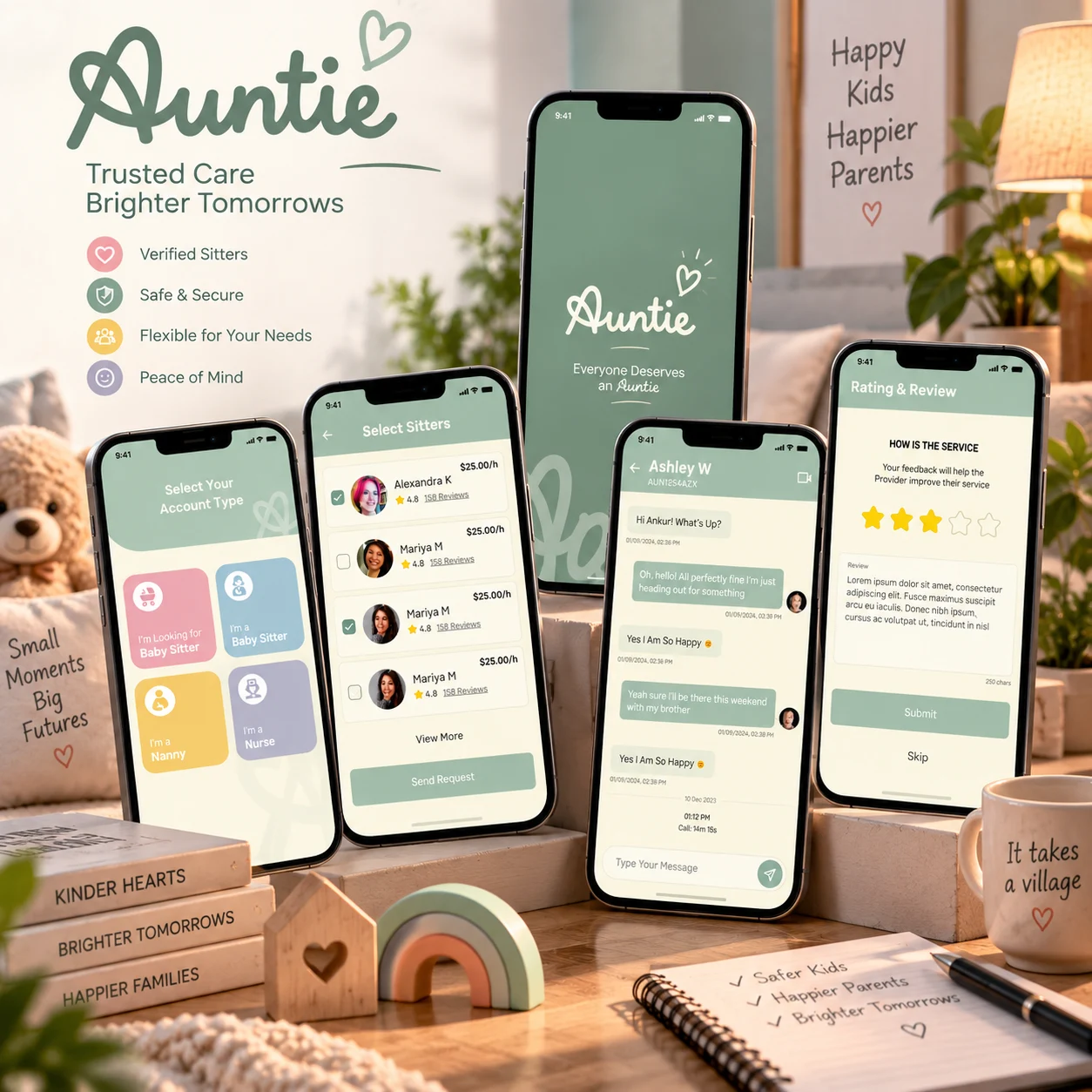
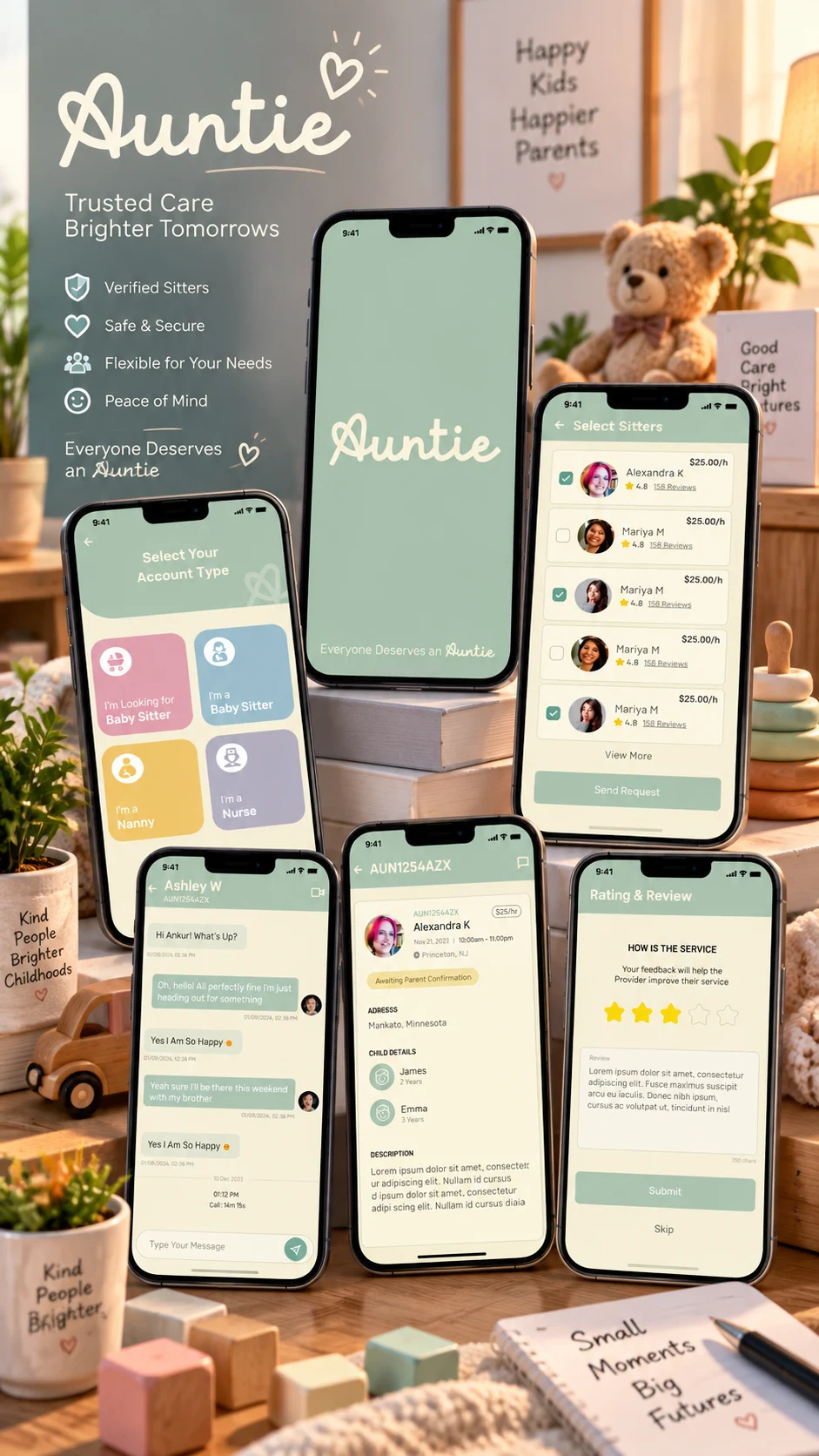
NewAgeSysIT built Auntie, a two-sided childcare marketplace where parents find, book, message, track and pay care providers inside one platform rather than across referrals, social groups and separate booking and payment tools. Providers get their own business side: availability management, booking acceptance, job status updates, ratings and a route to new clients. Provider onboarding runs a structured flow that includes identity verification and an integrated background-check service before a provider can take work. Auntie now has more than 1,200 active users.
Live Status
Confirmed to completed
Provider Types
Babysitters, nannies, nurses
1,200+
Active users on the platform
5
Live booking states pushed to parents, from confirmed through to completed
3
Provider categories: babysitters, nannies, nurses
Session start and end are recorded in the app, so hours are tracked and the fee calculates automatically from the agreed rate.
Auntie is a childcare marketplace founded by Mike Martini, a US entrepreneur who looked at how families actually search for care and concluded a marketplace could do it better. Before the platform, parents worked through personal referrals, local social media groups and a patchwork of separate providers, with no consistent way to compare one caregiver against another.
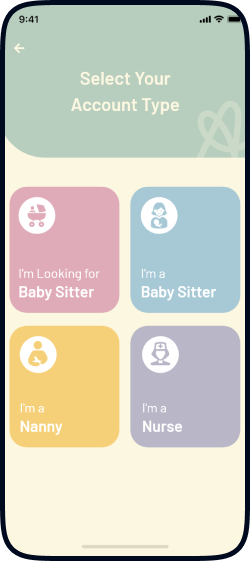
The product carries parents on one side and care providers on the other, with dedicated journeys for each and an admin dashboard behind both. It runs on a monthly subscription that unlocks the full feature set, across React Native applications on iOS and Android plus a web portal.
NewAgeSysIT delivered babysitter booking app development across all three surfaces. The client has since published positive reviews on both Google and Clutch, which is a third-party signal a reader can go and check rather than an unattributed satisfaction claim.
Childcare is one of the most fragmented service markets there is. Parents rely on personal referrals, local social media groups and a patchwork of separate providers, which means discovery is slow, availability is unknowable until someone replies, and there is no consistent basis for comparing one caregiver with another. On the other side, providers struggle to reach new clients and manage their own schedules. Both halves of the market were under-served by the same absence: no shared place where supply, availability and reputation were visible at once.
A parent choosing a caregiver is making a decision with very little information and very high stakes, and no amount of interface polish substitutes for a reason to trust the person on the other end. The platform's answer was to give a parent more to go on than a profile photo: a structured onboarding flow for providers that includes identity verification and an integrated background-check service, visible experience and specialisation, ratings and reviews accumulated across completed bookings, in-app messaging and video before a booking is confirmed, and payments handled through the platform rather than in cash. None of that removes the judgement a parent has to make. It gives them more to make it with.
Parents want to search, filter, compare and book quickly. Providers want to manage availability, accept or decline work, update job status and build a reputation over time. The two groups act on the same booking record and need almost nothing in common from the interface around it. Building both into one platform without either feeling like an afterthought meant designing the two journeys separately over a shared data model, with dedicated interfaces for each role rather than one screen with permissions applied.
The point of maximum anxiety is not before a booking, it is during one. The platform pushes live status through the whole service lifecycle, from booking confirmed to provider on the way, provider arrived, service started and service completed, so a parent is never in the position of wondering whether someone turned up. Session start and end are recorded in the app by the provider, which drives accurate hour tracking and automatic fee calculation from the agreed rate, removing the end-of-session cash negotiation entirely.

A directory ends at a phone number. A marketplace carries the whole relationship. Auntie holds discovery, booking, messaging, live status, payment and review on one record, which is what makes reputation accumulate instead of resetting with every job.
In a trust-driven category, the platform's job is to give the user more to decide with: structured provider onboarding, identity verification, an integrated background-check service, accumulated ratings, and messaging and video before a booking is confirmed. The decision still belongs to the parent. The platform makes it a better-informed one.
The anxious moment in an on-demand service is during delivery, not before it. Pushing five live states from booking confirmed through to service completed turns the least visible part of the experience into the most visible.
Recording session start and end in the app removes the end-of-job money conversation. Hours are tracked automatically and the fee calculates from the agreed rate, which protects both sides from a dispute neither wants to have.
Two-sided platforms need two designs, not one with permissions. Parents optimise for search and comparison, providers for schedule control and reputation. The same booking record, two entirely different products around it.
If you are building a marketplace where trust decides whether a transaction happens at all, NewAgeSysIT has delivered this at production scale across mobile and web.

Get expert guidance before you invest in AI software development. Work directly with Giovanni and Bibin to validate your technology direction, align AI with business goals, and make confident decisions that reduce risk and accelerate outcomes.
Request a Strategic Consultation
Auntie was built as one of the two-sided marketplace platforms we specialise in, supply and demand each with their own journey, matched on location and availability, transacting and rating inside the product. Parents and providers get separate journeys over one connected booking record, with dedicated interfaces for parents, providers and administrators. Unlike a directory, where discovery ends with a phone number, every stage sits inside the platform: search, profile, booking, messaging, payment, review. The record a parent creates when they search is the same record that carries the payment and the rating afterwards.
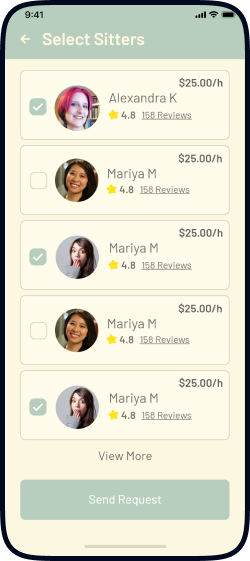
Parents filter providers by location and service radius, availability, specialisation, experience level, and ratings and reviews, with Google Places and geocoding handling location resolution. The matching narrows a wide local supply to the handful of providers who are actually plausible for a given booking, which is the difference between a directory listing everyone and a marketplace surfacing the right few.
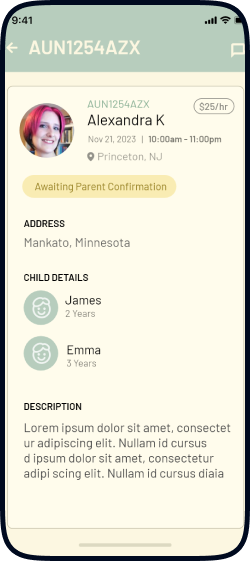
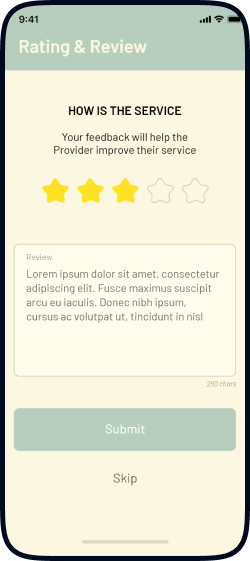
Providers complete a structured onboarding flow before they can take bookings: profile creation covering background, experience, hourly rate and availability, identity verification, and an integrated background-check service through National Crime Search. On top of that sit the signals that accumulate over time, including ratings and written reviews after every completed session, in-platform messaging that keeps early contact on the record, and verified payment methods on both sides. The purpose of the layer is to give a parent a documented basis for a decision rather than a blank profile.
On-demand service booking platform development put the whole service lifecycle in front of the parent as it happens: booking confirmed, provider on the way, provider arrived, service started, service completed. Providers start and end the session in the app, which records actual hours worked and calculates the fee automatically against the agreed rate. Push notifications and email carry each state change, so neither side has to ask the other what is happening.
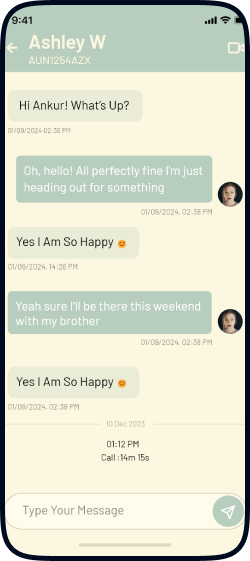
Integrated messaging lets parents and providers agree details before a booking, stay in contact during it, and follow up afterwards, with the conversation held inside the platform rather than moving to personal phone numbers. Video calling extends the same channel. Used before a booking it lets a parent meet a provider properly rather than judging from a profile, which is the point in the process where a conversation changes a decision.
Payment runs through Stripe against hours recorded in the app, and the platform operates on a monthly subscription that unlocks the full feature set. Providers get a business side rather than just a listing: availability management, booking acceptance and decline, job status updates, direct communication with families, an accumulating rating, and a route to clients they would not otherwise reach, with the scheduling and payment administration that normally eats into a self-employed caregiver's week handled by the platform.
React Native mobile app development delivered the parent and provider applications on iOS and Android alongside a web portal and admin dashboard, with a Node.js backend behind Nginx, JWT-based authentication, and data across PostgreSQL, MySQL and MongoDB. The platform runs on AWS cloud infrastructure with CI/CD through GitHub Actions and Jenkins, built to extend into adjacent care categories without re-engineering the foundation. Messaging and notifications run through Twilio, payments through Stripe, background checks through National Crime Search, and location services across the Google Maps API family including Places, Geocoding and Routes.

Take the free assessment right here and get an instant 100-point validation score plus a stage-by-stage diagnostic of exactly what to strengthen first.

Auntie carries structured provider onboarding, live booking status, in-platform messaging and payment on a single record, across iOS, Android and web.
Active Users
1,200+
Live Booking States
5

Discover your project budget with our interactive AI-powered app cost calculator.
| Layer | Technology |
|---|---|
| Mobile Applications | React Native, iOS and Android |
| Web Portal & Admin Dashboard | React.js |
| Backend | Node.js |
| Web Server | Nginx |
| Databases | PostgreSQL, MySQL, MongoDB |
| Authentication | JWT, Google Sign-In, Apple Sign-In, Facebook authentication |
| Messaging & Notifications | Twilio, push notifications, email services |
| Video Calling | Integrated video calling service |
| Payments | Stripe |
| Background Verification | National Crime Search (NCS) |
| Location Services | Google Places API, Geocoding API, Maps Static API, Navigation SDK, Maps, Roads API, Route Optimization API |
| Analytics | Google Analytics |
| CI/CD | GitHub Actions, Jenkins |
| Cloud | AWS, scalable storage and APIs |
Location services are the deepest layer in this stack, which is what a marketplace needs when matching depends on who is genuinely close enough to take a booking.
| Phase | Key Output |
|---|---|
| Discovery & Planning | Two-sided marketplace scope, provider role structure, trust and verification requirements defined |
| UI/UX Design | Separate parent and provider journeys designed over a shared booking model |
| Development | React Native apps, web portal and admin, matching and filtering, NCS verification integration, lifecycle state engine, messaging and video, Stripe and subscription billing |
| Deployment | App store release, provider onboarding, AWS infrastructure |
The structural decision was to design the two sides of the marketplace as separate journeys over one shared booking model rather than as one interface with permissions applied. Parents optimise for search and comparison, providers for schedule control and reputation, and the two sets of screens have almost nothing in common. Project managers, designers and developers worked together through delivery, with the trust and verification requirements scoped during discovery rather than added once the booking flow already existed, because what a provider has to complete before taking work shapes the account model everything else reads from.
| Role | Responsibilities |
|---|---|
| N × Project Manager | Client collaboration, scope, milestone tracking |
| N × React Native Engineer | Parent and provider mobile applications, lifecycle states, messaging and video |
| N × Frontend Engineer | Web portal and admin dashboard |
| N × Backend Engineer | Matching and filtering, booking lifecycle engine, hour tracking and fee calculation, NCS and Stripe integrations |
| N × UI/UX Designer | Parent and provider journeys, trust surfaces and profile design |
| N × QA Engineer | Cross-role testing, verification flow, payment and subscription validation |
A marketplace whose booking record has to carry verification state, live lifecycle status, tracked hours and a payment needs engineers who will treat that record as the product rather than as a database table. Teams can be extended with that profile through our IT staff augmentation services, which place vetted engineers into an existing product team under the client's own sprint direction.
Auntie has grown to more than 1,200 active users, with parents and providers transacting end to end inside the platform. The client has published positive reviews on both Google and Clutch, which a reader can go and check.
| Segment | Before | After | What Changed |
|---|---|---|---|
| Parents | Referrals, social groups and separate providers | Filtered search across location, availability, specialisation, experience and ratings | Discovery time reduced, comparison possible for the first time |
| Parents, during a booking | No visibility once a session started | Five live status states through to completion | The most anxious part of the process became the most visible |
| Providers | Dependent on word of mouth, scheduling and invoicing by hand | Availability management, booking control, automatic hour tracking and fee calculation | Administrative overhead absorbed by the platform |
| Both sides | Cash arrangements, no record | In-platform payment, messaging and reviews on one record | A documented history replaces an informal arrangement |
| Metric | Before | After | Change |
|---|---|---|---|
| Active users | 0, pre-launch | 1,200+ | Two-sided liquidity reached on both parent and provider sides |
| Provider onboarding | N/A | Structured flow with identity verification and an integrated background-check service | A documented basis for a parent's decision |
| Third-party validation | N/A | Published client reviews on Google and Clutch | Verifiable, unlike an unattributed testimonial |
| Category headroom | Childcare only | Cloud-native architecture built to extend to adjacent care categories | Foundation reusable without re-engineering |
Booking, dispatch and live status for services delivered to the customer's door.
Two-sided marketplaces with location matching, in-app payment and two-way ratings.
Related case study, booking, dispatch and service lifecycle tracking.
We grow strong with a 100% in-house team, 30+ years of industry expertise, and proven results. From concept to launch, we deliver innovation with precision and reliability.
Your idea is 100% protected by our non-disclosure agreement
Guaranteed expert consultation within 1 hour
Call directly: 1-609-919-9816
Get a free project estimate in under 60 minutes.
