
Welcome to Blogs
Discover actionable insights, in-depth research, and expert perspectives, all in one place.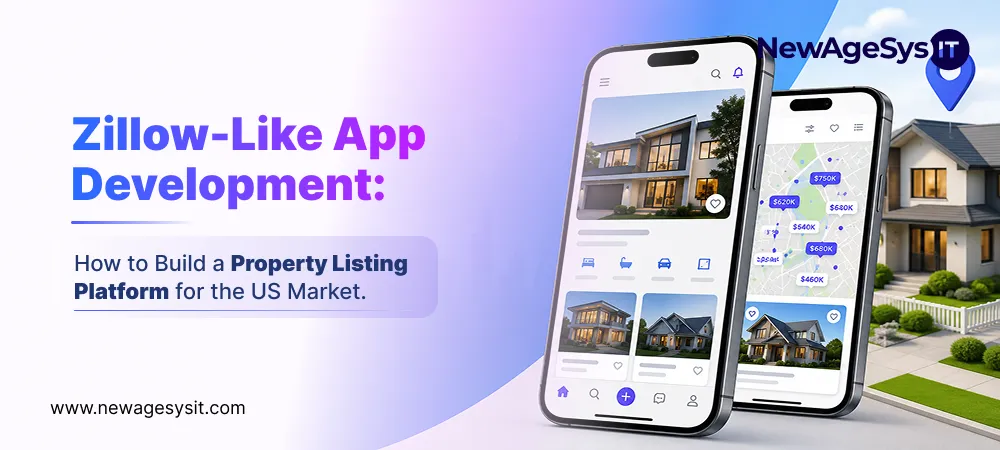
App Development 9 min read
Zillow-Like App Development: How to Build a Property Listing Platform for the US Market

| This article is part of our series on Real Estate Mobile Application in the USA: Building Smarter Property Experiences |
One of the most technically complex and compliance-intensive real estate technology projects is building a Zillow-like property listing platform for the US market. It requires MLS data infrastructure, consumer mobile UX, IDX compliance, and a sustainable lead monetization model.
This is why many proptech founders require real estate mobile and web app development services. They also need real estate CRM development to carry out the operations.
Despite Zillow’s dominance in the market, there is an opportunity for local proptech platforms. Much of Zillow’s strength comes from brand recognition and data breadth, rather than deep, local market expertise. The local proptech platforms can compete by providing better data quality, local expertise, and agent relationships.
Zillow-like app development in the USA requires solving three problems simultaneously: MLS data access and compliance, consumer mobile experience, and a sustainable business model. Though there is a lot of technical investment, the market opportunity for well-executed local real estate platforms is significant.
The Core Architecture of a US Property Listing Platform
A modern US property listing platform is built on a comprehensive architecture that balances data complexity with stability and performance.
- MLS data pipeline: Integration with RESO Web API for each covered MLS market, data normalization layer, IDX compliance rule enforcement, field mapping, and scheduled synchronization. This makes it the most complex and costly architectural component.
- Listing database and search index: Platforms save property details with relational databases like PostgreSQL. Tools like Elasticsearch or Solr are used as the search layer to search and filter properties for a large number of listings.
- Lead management backend: Leads are captured and routed to agents or brokerages, and connected to a CRM. This helps turn user activity into revenue.
- Consumer app layer: It includes frameworks like React Native or Flutter for cross-platform mobile delivery and Next.js for web. Everything is connected through a common GraphQL or REST API.
- Media CDN: Property photos and virtual tours are delivered via a CDN to ensure 20–40 high-resolution images load quickly.
- Notification infrastructure: Firebase for cross-platform push notifications, delivering price change notifications, new listing alerts, and open house reminders.
MLS Data Integration for a Listing Platform
MLS data integration is the backbone of Zillow-like app development in the USA. It focuses on data strategy decisions that determine the platform’s geographic scope and data quality.
- MLS access strategy: Direct RESO Web API integration with each local MLS vs using a data aggregator (Bridge Interactive, Trestle) that provides multi-MLS data through a single connection.
- Direct MLS integration: Better data quality, direct compliance relationship with the MLS, but requires individual data use agreements and ongoing per-MLS maintenance.
- Data aggregator (Bridge Interactive, Trestle): They provide a faster multi-MLS access through a single API. However, the field coverage may be less complete and data freshness slightly lower than direct integration.
- Data use agreement strategy: Each MLS requires a signed data use agreement before data access. This agreement defines what features can be built, how data can be displayed, and what monetization models are permitted.
- Data freshness architecture: Platforms that update listings within 15 minutes of MLS changes, using RESO API change detection endpoints. They provide a far superior user experience than daily batch sync.
- Multi-MLS field normalization: Different MLS systems use a variety of names and values (e.g., property type labels differ by MLS). Normalization converts this information to a standardized schema to maintain consistency.
Teams often use custom software development to handle these complexities at scale
Consumer UX Design for a US Property Listing Platform
User experience is the key to building a competitive US real estate app.
- Performance-first design: Fast-loading maps and search filter response time are the most impactful UX factors. Users abandon real estate apps that feel slow during property search.
- Photo-first listing experience: The listing detail page must give priority to visual content before text details because high-quality property images increase engagement.
- Progressive disclosure: Show the most important listing information (price, beds/baths, location) first and reveal other details (HOA, property history, tax data) when users are engaged.
- One-tap agent contact: Reduce friction between property discovery and agent engagement to increase conversion rate.
- Saved search notification design: The notification copy for listing alerts must include property photo, price, and key specs in the notification content to drive return visits.
- Onboarding and registration friction management: There must be a balance between capturing user information for lead generation and reducing registration friction that leads to drop-off.
To ensure performance and usability, teams often rely on mobile app development or custom Android app development for native performance requirements.
Revenue Models for US Property Listing Platforms
Zillow-like platforms can convert traffic into revenue through monetization.
- Agent advertising model (Zillow Premier Agent equivalent): Agents pay for premium placement and lead delivery in specific zip codes, creating predictable recurring revenue but may impact user experience.
- Lead referral fee model: Platform captures and refers buyer and seller leads to agents in exchange for a referral fee (25–35% of the agent commission) at closing.
- Transaction coordination fee: This model charges a fee per transaction facilitated through the platform, often used in iBuyer and platform brokerage models.
- Mortgage lead generation: It connects pre-qualified buyers to mortgage lenders in exchange for lead fees.
- Subscription for agents and brokerages: It includes monthly subscription for listing syndication, lead notification, and agent profile features.
COMPLIANCE / ACCURACY NOTE
Lead referral fee models and mortgage lead generation involve regulatory considerations under RESPA. Agent advertising models must comply with IDX display rules. Consult qualified real estate legal counsel before finalizing the revenue model.
What Differentiates a Successful Listing Platform from Zillow
A clear differentiation strategy allows local and niche listing platforms to compete against Zillow and Realtor.com.
- Superior local data quality: Platforms that maintain local MLS relationships and invest in data freshness can outperform national aggregators in terms of providing more accurate listing data.
- Niche property specialization: Platforms can deliver an excellent user experience by focusing on luxury real estate, commercial property, land, multifamily investment properties, or new construction. Zillow lacks expertise in these areas.
- Hyper-local content: Neighborhood guides, local market reports, school information, and community data curated by local market experts adds depth that national platforms struggle to replicate.
- Agent experience integration: Platforms that build deeper agent workflow integration (showing coordination, transaction tracking, and client communication) create stickiness that goes beyond simple listing browsing.
- Investor-focused features: Cap rate calculators, rental yield analysis, cash flow projections, and 1031 exchange tools are valued by investment buyers.
Investor-focused features and premium UX delivered natively benefit from custom iOS app development for the iOS-dominant affluent buyer demographic.
Development Timeline and Team Structure
A competitive US property listing platform requires realistic expectations around development timeline and team structure.
- MVP listing platform includes single MLS, web + cross-platform mobile, core search, and basic lead capture. It takes 4–6 months to develop with a team of 4–6 engineers.
- Multi-MLS expansion (adding 3–5 MLS markets) takes 2–3 months per MLS addition depending on data use agreement complexity and field mapping differences.
- A full competitive platform (multi-MLS, AI recommendations, agent CRM integration, comprehensive analytics) takes a 12–18 months development program. It typically requires a team of 8–15 engineers.
- The most common timeline underestimation is MLS data use agreement negotiation and data normalization. Each MLS integration takes 4–12 weeks of back-and-forth before data access is live.
Final Thoughts
Zillow-like app development in the USA requires solving three challenges. These include MLS data infrastructure, high-performance consumer UX, and a compliant, scalable revenue model.
Successful US proptech founders define a clear MLS data strategy, Fair Housing-compliant feature design, and a differentiated market position. They build stronger foundations and produce more competitive and more compliant products. NewAgeSysIT works with US proptech founders to build MLS-integrated, IDX-compliant property listing platforms from single-market MVPs to multi-MLS consumer apps competing with national aggregators.
FAQ
What is MLS data integration, and why is it the hardest part of building a platform like this?
MLS data integration means connecting to each local Multiple Listing Service through its RESO Web API, then normalizing that data, enforcing IDX compliance rules, and keeping it synchronized on a schedule. It’s called out as the most complex and costly piece of the architecture because it isn’t just a technical connection, it also determines the platform’s geographic coverage and directly shapes how good the listing data actually is.
Should I integrate directly with each MLS or use a data aggregator like Bridge Interactive or Trestle?
It’s a tradeoff, not a clear winner either way. Direct integration with each MLS gives better data quality and a direct compliance relationship, but it means signing and maintaining individual data use agreements with every market you cover. A data aggregator gets you multi-MLS access faster through a single connection, but field coverage tends to be less complete and the data isn’t quite as fresh as a direct feed.
What is a “data use agreement,” and why does it matter before I can even access MLS data?
It’s a signed agreement required by each individual MLS before you’re allowed to access their data at all, and it isn’t just a formality. It specifically defines what features you’re allowed to build with that data, how it can be displayed on your platform, and which monetization models are permitted, which means your product roadmap is partly shaped by these agreements before a single line of code gets written.
How long does it actually take to build a platform like this?
An MVP covering a single MLS, with web and cross-platform mobile, core search, and basic lead capture, takes 4 to 6 months with a team of 4 to 6 engineers. Expanding to additional MLS markets after that adds 2 to 3 months per market, and a full competitive platform with multi-MLS coverage, AI recommendations, agent CRM integration, and analytics runs 12 to 18 months with 8 to 15 engineers. The most commonly underestimated part is MLS data use agreement negotiation, which typically takes 4 to 12 weeks of back and forth per MLS before you actually get data access.
How can a local platform realistically compete with Zillow?
Zillow’s advantage is mostly brand recognition and data breadth, not deep local expertise, which leaves real openings. Local platforms tend to win through superior local data quality, specializing in a niche Zillow doesn’t serve well (luxury, commercial, land, multifamily, new construction), hyper-local content like neighborhood guides and school data, deeper agent workflow integration, and investor-focused tools like cap rate calculators and 1031 exchange features.
What revenue models are available, and what compliance rules apply to them?
The main options are agent advertising for premium placement in specific zip codes, a lead referral fee of roughly 25 to 35 percent of the agent’s commission at closing, a transaction coordination fee common in iBuyer models, mortgage lead generation, and subscriptions for agents and brokerages. Lead referral fees and mortgage lead generation both involve RESPA considerations, and agent advertising has to follow IDX display rules, so real estate legal counsel should review the revenue model before it’s finalized, not after.
Why does data freshness matter so much, and what counts as “fresh enough”?
Because a listing platform is only as trustworthy as its most recent data, and buyers notice immediately when a “new” listing has already sold. Platforms that update within 15 minutes of an MLS change, using RESO API change detection endpoints, deliver a meaningfully better experience than platforms running on a daily batch sync, where listings can sit stale for up to a full day.
Core Development
Keep exploring the custom services.

AI Software Development
Custom AI Software Development
Build intelligent, production-ready software from machine-learning models to AI-driven automation designed around your business goals.
Learn more
Mobile App Development
Custom Mobile Application Development
Native and cross-platform mobile apps that are fast, secure, and built to scale across iOS and Android.
Learn more
Web App Development
Custom Web Application Development
Scalable, secure web applications, from customer portals to complex dashboards, tailored to how your business actually works.
Learn more



