
Welcome to Blogs
Discover actionable insights, in-depth research, and expert perspectives, all in one place.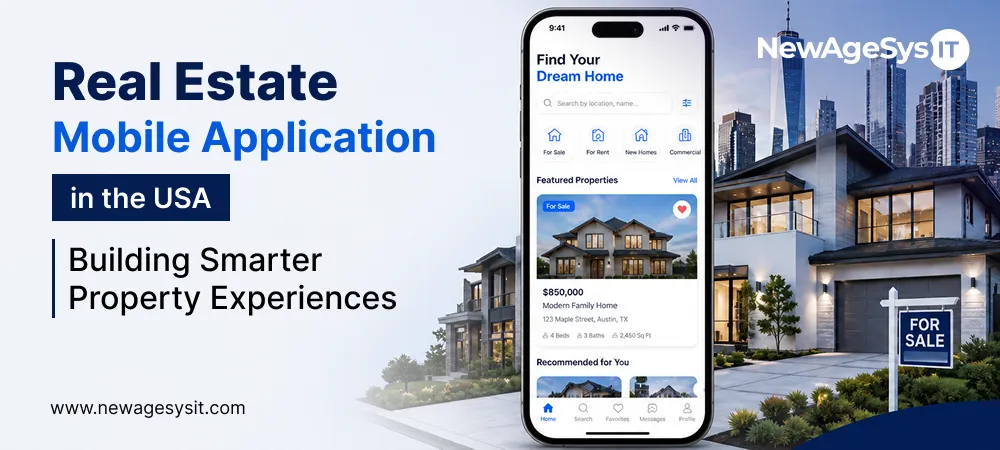
Real Estate 10 min read
Real Estate Mobile Application in the USA: Building Smarter Property Experiences

Why Mobile is Now the Primary Real Estate Interface in the USA
Real estate mobile app development in the USA has undergone a significant transformation, making mobile the primary channel for property search, client communication, and transaction management.
More than 60% of property searches in the USA begin with mobile, which makes it very important to have a seamless mobile experience.
This is why brokerages, proptech founders, and technology teams are now exploring real estate mobile and web app development services to deliver map-based property search, instant listing notifications, virtual tour access, and agent contact from a single mobile interface. Platforms like Zillow, Realtor.com, and Redfin are dominating the consumer property search market with a superior mobile experience, which is giving tough competition to brokerages and proptech startups. However, building a competitive US real estate mobile app requires MLS/IDX integration, fair housing-compliant features, and real estate workflow design. At the same time, mobile apps rely on backend systems such as real estate software and CRM development services to manage workflows, transactions, and a lot more.
This article maps the complete landscape of US real estate mobile app development, which includes consumer property search apps, agent productivity tools, and AI-powered recommendation engines.
The US Real Estate Mobile App Market: Consumer vs Professional Apps
The US proptech mobile ecosystem is divided into two categories: consumer real estate apps and professional real estate apps.
The main focus of consumer apps is property search app development. These apps prioritize search quality, mortgage tools, listing exploration, and seamless agent connection. The complete experience of speed, data freshness, and intuitive UX measures the success of these apps.
Professional apps are built for agents and brokers. These apps compete on workflow efficiency, lead management, listing management, mobile data access, and integration depth because an agent measures success in terms of productivity, which means closing more transactions with less administrative time.
Many US brokerages require both apps: a consumer app to capture buyer and seller leads and a professional app to manage these leads.
However, building these apps requires real estate-specific domain knowledge beyond general mobile development. The technical requirements for both apps are significantly different. Consumer apps rely on MLS/IDX integrations to list data, whereas professional apps require a CRM backend, transaction management, and document handling.
Consumer apps need a dual-launch strategy. These apps must launch on both iOS and Android to reach the addressable audience. Therefore, cross-platform development becomes a standard requirement in US proptech mobile development.
Must-Have Features in US Real Estate Mobile Apps
The feature gap between a competitive US real estate mobile app and a generic property search tool lies in MLS integration depth, notification architecture, and the accuracy of tools like mortgage calculators and polygon-based map search and not visual design.
Core features include the following:
- Map-based property search with polygon drawing is now the standard consumer expectation for mobile property discovery.
- Real-time MLS data synchronization to ensure listing updates are reflected within hours of MLS status changes, which maintains user trust.
- Push notification architecture to provide listing alerts, price drops, and agent messages, which is critical for real-time engagement.
- Saved search and property favorites to convert one-time visitors into returning users with registered accounts. This forms the foundation for lead capture and user retention.
- Mortgage calculator integration to help buyers calculate payments within the app, leading to more engagement.
- Agent and broker profiles to help users discover, review, and connect with the agents directly within the app.
These features transform a basic property app into a complete property experience platform.
The complete feature framework for modern US real estate mobile apps is covered in Must-Have Features in Modern US Real Estate Mobile Apps (Search, Listings, Mortgage Calculators).
Property Listing Platform Development: The Zillow Model
Building a competitive property listing platform in the US requires more than developing a mobile app — it requires an MLS data ingestion pipeline, a search and indexing infrastructure, a compliance layer for IDX display rules, and a consumer experience strong enough to compete with platforms like Zillow.
The following factors should be considered while developing a competitive property listing platform in the US:
MLS data integration: Platforms must implement MLS data integration through the RESO Web API. It has now become the modern standard for MLS data access. IDX compliance controls also need to be considered. Platforms must be designed to adapt to different listing attributes, data freshness standards, and display rules.
Consumer Experience: Platforms like Zillow and Redfin have set a benchmark of a superior UX experience. For an enriching experience, the apps must be fast, intuitive, and deliver a visually rich interface.
Lead Monetization: The architecture of US property listing platforms must support the chosen revenue model to monetize through agent advertising, lead referral fees, mortgage lead generation, and transaction coordination.
For a detailed breakdown, see Zillow-Like App Development: How to Build a Property Listing Platform for the US Market.
Real Estate Agent and Broker Mobile Apps
The agent and broker mobile app category is an important aspect of US real estate mobile app development. While consumer apps are designed for property discovery, agent and broker apps help agents in lead management, client communication, and transaction management.
Mobile CRM is essential for US agents because they are field-based professionals. Their primary requirement is mobile access to leads, listings, client communication, and transaction status. A modern agent and broker mobile app must support lead management, client communication, task management, and pipeline tracking with a seamless mobile interface for on-the-go usage.
Instant lead notifications allow the agents to respond to leads within minutes, increasing conversion rates. Showing coordination on mobile is equally important. Requesting appointments, receiving confirmations, capturing feedback, and updating clients from a single interface is what agents need.
Agents operating in areas with poor connectivity need offline capability in these apps. The apps must provide access to data when offline.
Modern apps should also support document capture and digital signatures, allowing agents to collect e-signatures and photograph inspection items in the field.
The full feature and architecture framework for real estate agent and broker mobile apps is covered in Real Estate Agent & Broker App Development: CRM & Lead Management on Mobile.
AI and Automation in US Real Estate Mobile Apps
AI and automation are the primary competitive differentiators in the US real estate mobile apps — platforms that recommend the right properties to the buyers before they search, and identify the most convertible leads, consistently outperform those that depend only on manual search and follow-ups.
A competitive app must offer AI-driven features to provide better user experience.
Smart property recommendations use ML models to analyze buyer preferences from search queries, property views, and saved listings to surface properties that match buyers’ interests before they search for them.
Predictive pricing, powered by Automated Valuation Models, provides real-time property value to buyers, sellers, and agents, helping them take the next step in the deal.
Conversational property search is a natural language search that translates ‘I want a 3-bedroom with a yard near good schools under $600k’ into MLS search parameters, making the search more meaningful.
AI-powered Market trend alerts notify users about inventory changes, price trends, and days-on-market shifts, keeping them engaged.
Lead scoring in agent apps uses ML models to predict which prospects are most likely to convert, enabling agents to focus on high-conversion opportunities.
COMPLIANCE FLAG
AI recommendation algorithms used in US real estate apps carry Fair Housing enforcement risk. Models must be tested for disparate impact across protected class demographics before deployment. This is an emerging proptech compliance area, not a theoretical concern.
The complete AI and automation framework is covered in:
AI & Automation in US Real Estate Apps: Smart Recommendations & Predictive Pricing
Real Estate Mobile App Security and Fair Housing Compliance
Compliance in US real estate mobile apps is an architecture requirement. Fair Housing, IDX, RESPA, and data privacy obligations must be designed into the platform from day one. Treating compliance as a post-launch legal review leads to operational and legal risk that is significantly more expensive to remediate than building correctly from the start.
Key compliance areas are:
- Fair Housing Act compliance is important in mobile search. Search filters that allow excluding neighborhoods by characteristics correlating with protected class demographics require legal review.
- AI recommendation engines must be tested for disparate impact across protected class demographics to ensure there is no bias in property visibility across different user groups.
- IDX compliance is a critical factor. The real estate mobile apps must follow MLS data use agreements. Correct implementation of listing attribution, data freshness, and display restrictions is a must in the mobile interface.
- User data privacy is regulated. Real estate apps collect location data, search history, and behavioral analytics of the users, which are subject to CCPA/CPRA for California users and growing state privacy law requirements.
- App Store real estate category policies have specific requirements for apps that display listings or facilitate financial interactions between users and agents.
COMPLIANCE FLAG
AI recommendation algorithms used in US real estate apps carry Fair Housing enforcement risk. Models must be tested for disparate impact across protected class demographics before deployment. This is an emerging proptech compliance area, not a theoretical concern.
COMPLIANCE / ACCURACY NOTE
Fair Housing Act compliance for algorithmic features and IDX compliance requirements are legal obligations. Consult qualified real estate legal counsel before designing AI recommendations, geographic filtering, and algorithmic marketing features.
Mortgage calculator integrations that connect to lender rate feeds and lead referral fee structures between platforms and agents or lenders may implicate RESPA (Real Estate Settlement Procedures Act). Consult qualified legal counsel before implementing mortgage lender integrations, co-marketing arrangements, or lead referral fee features.
Technology Stack for US Real Estate Mobile Apps
Choosing the right technology stack plays a crucial role while creating a real estate mobile app. A modern app must have an MLS data backend, search infrastructure, mapping systems, and media delivery.
A major decision needs to be made on native vs cross-platform. Most US real estate consumer apps use React Native or Flutter for cross-platform delivery. But native development is perfect for high-performance map rendering or camera integration for property photography. For this, platform capabilities like iOS development and Android development are required.
MLS data backend with RESO Web API integration requires a data ingestion pipeline, field normalization layer, and search index powered by Elasticsearch. It is an investment in backend engineering.
Push notification infrastructure (Firebase Cloud Messaging for Android and APNs for iOS) provides alerts for user engagement.
Google Maps API is a primary choice of US real estate apps for mapping and geolocation. A seamless map performance means higher user engagement.
Real estate listings include 20-30 high-resolution photos and video tours, which require CDN-backed image delivery with progressive loading. This makes media delivery a crucial factor.
Real Estate Mobile App Development Cost and Partner Selection
It is critical to understand the cost and select the right development partner in real estate mobile app development. Though the features, scope, and market coverage can impact the budget, it is important to set the right expectations in terms of cost.
For a consumer property search app that has cross-platform, single MLS, and core features, the initial development cost may range between $80,000 and $200,000. This excludes MLS data fees and ongoing maintenance.
For a full Zillow-competitor platform that has multi-MLS, AI features, agent platform, and both native apps, the range starts from $400,000 and goes up to $1.2M+. It is usually a multi-phase development program.
An agent productivity app with mobile CRM, lead management, document capture, and offline capability can cost $100,000–$280,000.
MLS integration has one of the most underestimated costs. Each MLS market adds $20,000–$60,000 in development cost, which makes multi-market expansion more expensive.
While selecting a development partner, factors like MLS integration experience, IDX compliance knowledge, and a deep understanding of real estate workflows must be considered.
To know about detailed cost ranges for US real estate mobile app development, see How Much Does It Cost to Develop a Real Estate Mobile App in the USA.
To avoid costly mistakes by aligning tech strategy, compliance, and scalability early, see Why US Real Estate Companies Should Consult a Technology Advisor Before Building an App.
Final Thoughts
US real estate mobile app development requires specialization that general mobile development agencies lack. It requires MLS integration expertise, Fair Housing-compliant feature design, real estate workflow knowledge, and a superior consumer UX for which standards are set by Zillow and Redfin.
US real estate businesses that choose to go for modern mobile apps build competitive advantages over generic platforms, as these apps are compliant with IDX and Fair Housing requirements, designed around real buyer and agent workflows, and optimized for the US property search experience.
If your organization is planning US real estate mobile app development, aligning feature scope, MLS integration strategy, and compliance requirements with your business model before development begins significantly improves both cost predictability and product outcomes.
Core Development
Keep exploring the custom services.

AI Software Development
Custom AI Software Development
Build intelligent, production-ready software from machine-learning models to AI-driven automation designed around your business goals.
Learn more
Mobile App Development
Custom Mobile Application Development
Native and cross-platform mobile apps that are fast, secure, and built to scale across iOS and Android.
Learn more
Web App Development
Custom Web Application Development
Scalable, secure web applications, from customer portals to complex dashboards, tailored to how your business actually works.
Learn more



