
Welcome to Blogs
Discover actionable insights, in-depth research, and expert perspectives, all in one place.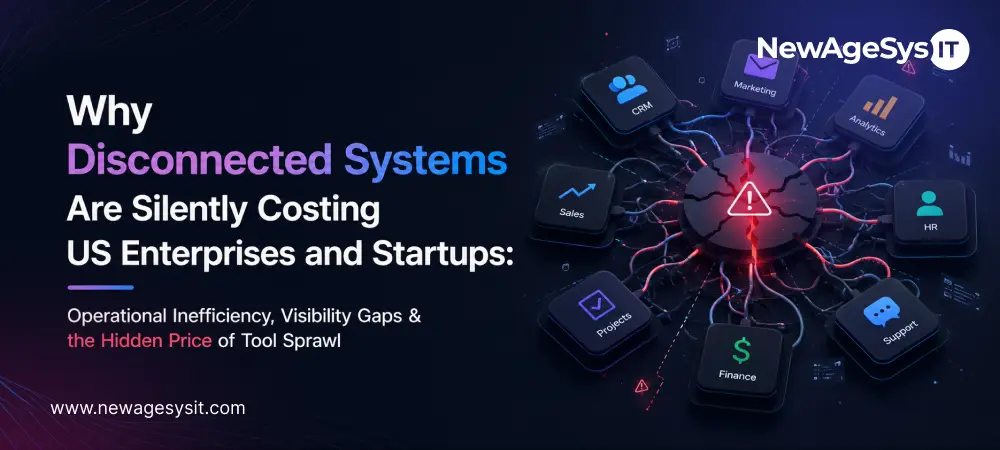
Platform Modernization 6 min read
Why Disconnected Systems Are Silently Costing US Enterprises and Startups: Operational Inefficiency, Visibility Gaps & the Hidden Price of Tool Sprawl

| This article is part of our series on Continuous Platform Modernization for US Enterprises And Startups: Replacing Fragmented Systems with a Unified, Secure, Cloud-First Architecture |
Introduction: A Problem That Doesn’t Have a Name Until It Does
The cost of disconnected systems rarely announces itself to enterprise leaders as a technology problem. It shows up as a leadership problem. You ask a simple operational question, and someone has to make three phone calls to answer it. A report arrives twelve hours late because two systems disagree on the numbers. A new employee spends three weeks gaining access to the six tools needed to do the job.
That experience has a name: fragmentation. Most organizations have lived with it for so long that they mistake it for the ordinary cost of doing business. It is not. It is a quantifiable operational tax that quietly grows within the organization until it becomes the ceiling on what the business can do next.
This article identifies the symptoms, traces how costs accumulate, and provides leaders with a framework for deciding what to do about them. Addressing fragmentation is exactly what custom software development and web application development are designed to support.
The Five Operational Symptoms
Fragmentation is often easier to recognize through its symptoms than through its technical causes. Most growing organizations are living with at least three of the five warning signs below. Individually, they may seem like minor inefficiencies. Together, they create a measurable operational tax that slows decisions, increases costs, and limits growth.
Data Entered Manually in Multiple Systems
The same customer, shipment, or case is logged in three places by three different people because the systems do not communicate with each other. Every duplicate entry creates another opportunity for errors and another reconciliation task waiting to be scheduled.
No Single Source of Truth for Operational Status
When two systems disagree on the status of an order, case, employee record, or customer account, someone has to call someone else to determine which version is correct. That call is never in the budget, yet it happens repeatedly throughout the week.
Reports Built by Exporting and Combining Spreadsheets
A report takes half a day to assemble and is already outdated by the time it is presented. The data was accurate when it was exported, but business activity continued while the spreadsheet was being built.
Employees Switching Between Four to Eight Tools for One Workflow
The context-switching tax accumulates quickly. Time, attention, and error risk increase every time an employee leaves one system to check another. Multiply that by every person who performs the workflow each day.
Leadership Cannot Answer Basic Operational Questions in Real Time
This is the ceiling moment. When the CEO or COO cannot get a real-time answer without making phone calls, the organization is operating without clear visibility, and strategic decisions are being made using information that was accurate yesterday.
How Tool Sprawl Accumulates (the Acquisition Pattern)
Tool sprawl is not a management failure. It is the predictable outcome of organizational growth. Most organizations begin with a small set of systems and add new tools as needs emerge. A better CRM is adopted to support sales. A specialized project management tool solves a departmental challenge. A team purchases software independently because it addresses an immediate need. An acquisition introduces an entirely separate technology stack. Meanwhile, a legacy system modernization candidate that still mostly works remains in place because replacing it feels expensive and risky. Each decision makes sense when it is made.
Site Security followed this same pattern. As a physical security services company, its growth eventually outpaced the disconnected tools it started with. The challenge was not poor decision-making. Growth created new operational requirements faster than existing systems could absorb. Over time, fragmentation shifted from a manageable inconvenience to an operational ceiling, making the case for modernization increasingly clear.
That moment arrives for many organizations between 50 and 500 employees. This is why fragmentation is not primarily a large-enterprise problem. It is a growth problem, and growing organizations will accumulate the same layers unless they actively manage against it.
Visibility Gaps as a Risk Multiplier
Visibility gaps are not just an efficiency problem. They are a risk multiplier. For a physical security company, a customer whose status is unclear in the operational system can become a liability exposure. For a financial services firm, a compliance record that exists only in a disconnected system is a gap that an examiner will eventually uncover. For any organization, a decision made using yesterday’s export may have been different if current information had been available.
There is another risk worth naming: false confidence. Organizations that build visibility dashboards on top of fragmented data do not gain real-time operational awareness. Instead, they get a synchronized view of multiple systems that may not agree with one another. The dashboard shows what each system reported. It does not necessarily show what is true.
Real visibility is an architectural outcome, not a reporting layer added at the end of a project. It emerges when data flows between systems without manual intervention, and operational status can be trusted across the organization. That is exactly what a unified platform is designed to produce. Until that foundation exists, every dashboard is only as reliable as the disconnected systems feeding it.
The Build-vs-Integrate-vs-Replace Decision Matrix
There are three ways to respond to fragmentation, and the right approach is determined on a system-by-system basis rather than through a single organization-wide decision.
Integrate the systems that work well independently but do not communicate effectively. Connect them through APIs and an event-driven architecture. In these cases, the fragmentation exists in the gaps between systems, while the systems themselves still provide value.
Replace the systems that have become operational ceilings. These platforms cannot scale, cannot be integrated cost-effectively, or actively block the way the organization needs to operate. Replace them incrementally through phased migrations that avoid business disruption.
Build a unified platform layer over systems that are too embedded to replace but too fragmented to tolerate. This orchestration layer decouples the user experience from the back-end systems, allowing employees to work through a single interface while legacy platforms continue operating and are migrated behind the scenes.
Most real-world modernization efforts use all three approaches. The decision for each system ultimately depends on operational impact and replacement cost.
| Response | Trigger Condition | Cost Implication | Timeline | Risk Profile |
| Integrate | The system works well, but does not share data | Lowest upfront cost; ongoing integration and maintenance | Shortest | Low; systems remain in place |
| Replace | The system is a ceiling and cannot scale or integrate effectively | Highest cost: new build or licensing plus migration | Longest | Highest; mitigated through phased delivery |
| Unified Platform Layer | The system is too embedded to replace but too fragmented to keep unchanged | Moderate cost; orchestration layer development | Medium | Moderate; legacy systems remain operational during transition |
Final Thoughts
Organizations that identify the fragmentation problem and quantify it in terms of labor hours, error rates, and delayed decisions are the ones that can objectively evaluate platform modernization investments. Fragmentation accumulates through normal growth, while visibility gaps turn operational inefficiencies into business and compliance risks.
Recognizing the symptoms is the starting point. The decision framework provides leaders with the vocabulary to move from “this is frustrating” to “this is costing us a specific amount each month, and here is what we are going to do about it.” The response is not a default action. It is a deliberate decision based on operational impact, risk, and cost. Once fragmentation is quantified, the path forward is covered in From Fragmented Tools to a Unified Platform, and because fragmentation returns when modernization is treated as a one-time effort, Continuous Modernization explains why the practice must be ongoing.
If your organization is experiencing any of these five symptoms, and most growing organizations experience at least three, the first step is putting a number on the cost of each one before evaluating any technology response. Learn more about digital transformation solutions from one of the leading AI software companies in the United States.
Core Development
Keep exploring the custom services.

AI Software Development
Custom AI Software Development
Build intelligent, production-ready software from machine-learning models to AI-driven automation designed around your business goals.
Learn more
Mobile App Development
Custom Mobile Application Development
Native and cross-platform mobile apps that are fast, secure, and built to scale across iOS and Android.
Learn more
Web App Development
Custom Web Application Development
Scalable, secure web applications, from customer portals to complex dashboards, tailored to how your business actually works.
Learn more



