Welcome to Blogs
Discover actionable insights, in-depth research, and expert perspectives, all in one place.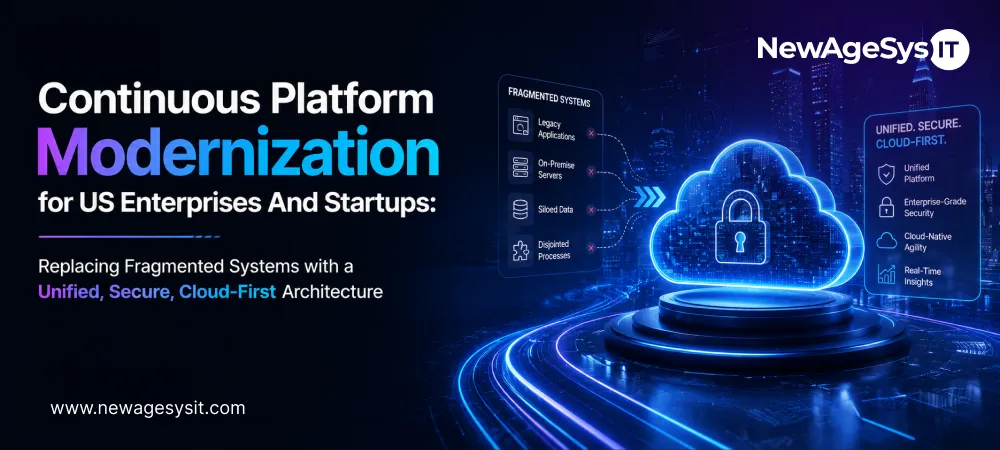
Platform Modernization 14 min read
Continuous Platform Modernization for US Enterprises And Startups: Replacing Fragmented Systems with a Unified, Secure, Cloud-First Architecture

Introduction: Platform Modernization for Enterprises and the Fragmentation Ceiling Most Organizations Hit Between 50 and 500 Employees
Most growing organizations eventually reach a point where leadership can no longer answer a basic operational question without calling someone, exporting a spreadsheet, or toggling between multiple systems. Where is everything right now? What is the current status? What happened last week? This is the moment when platform modernization for enterprises becomes a leadership priority rather than a technology initiative.
Organizations often reach a fragmentation ceiling. It is rarely caused by a single failing system. Instead, it is the accumulated weight of best-of-breed point solutions, department-specific purchases, acquired-company software, and legacy platforms that mostly work, each adding another layer of manual handoffs and invisible operational cost.
Through custom software development and web application development, organizations can replace, orchestrate, or unify disconnected systems into a coherent operational layer. Data flows without manual intervention, status becomes visible without switching tools, and decisions are made using current information rather than yesterday’s export.
This guide explores the fragmentation problem, the modernization journey, cloud-first architecture, the operating practices that sustain long-term success, and the leadership framework behind the investment decision. Using the Site Security transformation as a reference, it also shows how a unified platform creates the foundation for future Private AI adoption and enterprise-scale automation.
What Fragmentation Actually Costs (Five Operational Symptoms)
Fragmentation does not show up as a line item. It shows up as five operational symptoms that most leaders recognize immediately once named.
First, the same data gets entered manually in multiple systems. One shipment, customer, or case logged in three places by three people, because the systems do not share what they know. Every duplicate entry is an error waiting to happen and a reconciliation task waiting to be scheduled.
Second, there is no single source of truth for operational status. Two systems disagree, and someone has to call to find out which one is right. That call is never in anyone’s budget.
Third, reports get built by exporting and combining spreadsheets. A half-day task that is already slightly outdated by the time it reaches the room. The data was accurate at the moment of export and moved on while the spreadsheet was being formatted.
Fourth, employees switch between four to eight tools to complete one workflow. This is the context-switching tax, paid by every person in the organization, every day.
Fifth, leadership cannot answer basic operational questions in real time without making a call. This is the ceiling that turns a technology issue into a leadership one.
Individually, these look like inefficiencies to manage. Together, they are compounding costs. Labor hours, error rates, delayed decisions, and customer-experience failures accumulate invisibly until the total surfaces as a crisis. The full cost of tool sprawl, quantified by symptom and paired with a build-versus-integrate-versus-replace decision matrix, is covered in “Why Disconnected Systems Are Silently Costing US Enterprises and Startups.”
The Build-vs-Integrate-vs-Replace Decision
One of the most important decisions in platform modernization is determining what to integrate, what to replace, and what to unify under a single layer. Not every fragmented system should be replaced, and treating modernization as a complete rebuild is often what turns a focused initiative into an expensive, multi-year project.
Integrate systems that function well independently but do not communicate effectively. Expose them through secure APIs, connect them through an event-driven architecture, and keep them in place. In these cases, the fragmentation exists in the gaps between systems rather than in the systems themselves.
Replace systems that have become operational ceilings. These platforms cannot scale, cannot be integrated cost-effectively, or actively prevent the organization from operating the way it needs to. Replace them incrementally through phased migrations rather than all at once, allowing the business to continue operating throughout the transition.
Build a unified platform layer over systems that are too embedded to replace but too fragmented to tolerate. This orchestration layer decouples the user experience from back-end complexity, allowing employees to work through a single interface while underlying systems are upgraded or migrated behind the scenes.
The Site Security engagement combined all three approaches, which is the reality for most successful modernization initiatives.
The Site Security Story: From Operational Ceiling to Unified Platform
Site Security is a physical security services company whose growth eventually outpaced the disconnected tools it started with. Each system solved a specific problem when it was adopted, but none shared information effectively with the others. Over time, fragmentation stopped being a manageable inconvenience and became an operational ceiling.
The previous state was familiar to many growing organizations: disconnected operational systems, manual handoffs between departments, no unified view of operations, and a leadership team that relied on phone calls, spreadsheets, and exported reports to answer basic questions about the business.
The transformation followed a measured modernization strategy. A unified platform orchestrated existing systems via APIs, while still delivering value and replacing systems that could not be integrated effectively. Those capabilities were wrapped within a consistent operational layer, creating a single environment for managing work across the organization. As a result, capabilities that were previously difficult or impossible became achievable. (Specific operational outcomes and before-and-after metrics should be verified with the client before publication.)
What makes Site Security valuable as a reference is that it is a complete modernization story rather than a hypothetical architecture. The decisions made during the engagement, what to integrate, what to replace, how to phase the transition, and how to manage stakeholder adoption, form a repeatable framework that other organizations can apply.
For a deeper look at phased sequencing, orchestration versus replacement, and change management as architecture, see “From Fragmented Tools to a Unified Platform.
The Modernization Journey: Phased, Not Big-Bang
The most common platform modernization failure is not technology. It is sequencing. Organizations that attempt to replace everything at once, migrate before validating against real operational data, or build a future-state platform while the current environment is still running the business often create the disruption they were trying to eliminate. A big-bang cutover can break the business while it’s being fixed.
The alternative is a phased modernization approach. Start by mapping the current state: every system, every data flow, and every integration point. Identify the highest-friction junctions where manual handoffs occur between systems, and prioritize improvements based on operational impact, specifically where fragmentation is creating the greatest cost, delay, or risk each week. From there, build the unified platform incrementally, allowing modernization to progress without disrupting day-to-day operations.
The discipline that makes this possible is decoupling the user experience from the back-end logic. Systems can be migrated, replaced, or upgraded behind the scenes while employees continue working in the same interface they already know. Done well, modernization is something the organization barely notices until the benefits begin to accumulate, not a crisis that tests everyone’s patience, productivity, and trust.
Continuous Modernization: The Practice That Keeps It Working
Organizations that complete a modernization project and declare it finished often find themselves back at the fragmentation ceiling within three to five years. New tools are introduced, new team members bring new requirements, and the next layer of technical debt begins accumulating almost immediately. The platform was treated as a destination when it is actually an ongoing practice.
Continuous modernization is that practice. It includes regular architecture review cadences, deprecation policies for tools that no longer support the unified platform, integration health monitoring, and a backlog of technical improvement work maintained alongside feature development. Together, these disciplines prevent fragmentation from quietly returning over time.
At Site Security, platform modernization operates as an ongoing capability rather than a completed event. New operational requirements are evaluated for platform fit, and the architecture absorbs change without turning every new need into a disruptive project. That is the goal: a platform that evolves with the business instead of being overtaken by it.
For the full continuous-modernization operating model, including metrics, lifecycle management, and the technology-partner relationship, see “Continuous Modernization: Why Platform Modernization Is Not a One-Time Project.”
Cloud-First & Event-Driven: the Architecture That Connects It
Once the journey is sequenced, the question becomes what holds the unified platform together. The answer is an event bus, a messaging layer such as AWS EventBridge, Azure Service Bus, or Apache Kafka, through which every system publishes what it knows and every downstream system subscribes to what it needs. A status change in one place propagates automatically to all places that depend on it. No polling, no manual sync, no overnight reconciliation job.
Cloud-first in 2026 means cloud-native services: managed databases, serverless compute, and cloud messaging, rather than on-premise architecture lifted onto a virtual machine and rebranded as modern. For US enterprises in regulated sectors, it also means the compliance and security architecture is built in from day one rather than retrofitted later. Role-based access, encryption in transit and at rest, audit logging, and a SOC 2 attestation posture are designed alongside the platform, not bolted on after.
The business payoff is the part leadership cares about most. Real-time operational visibility stops being a separate dashboard project and becomes a natural consequence of the architecture. When data flows as events through a shared layer, the current state of operations is always knowable, without anyone assembling it by hand.
For the full cloud-first, event-driven, security, and scaling architecture, including SOC 2 design and the connection to Private AI adoption, see “Cloud-First & Event-Driven Architecture for US Enterprise Platform Modernization.”
Leadership Priorities: Five Questions Before Authorizing the Project
Before approving a platform modernization initiative, technology leaders should be able to answer five questions. These are not checklist items. They are the inputs that shape architecture, scope, and investment decisions.
- First, what is fragmentation currently costing the organization in labor, errors, and delayed decisions each month? Without a number, modernization remains a technology project. With one, it becomes an ROI decision.
- Second, which systems are ceilings and which are foundations? Not every fragmented system needs to be replaced, and understanding the difference determines where to invest.
- Third, what is the organization’s compliance posture across the unified platform? The answer depends on the industry and may involve SOC 2 attestation, HIPAA, GLBA, or other requirements. Compliance must be considered from the beginning, not added later.
- Fourth, who owns the architecture after delivery? A platform without clear ownership gradually drifts back toward fragmentation.
- Fifth, what does success look like at 12 months, 24 months, and 5 years? Modernization without outcome metrics is never fully measured or proven.
For the full decision framework, including build-vs-buy-vs-integrate, partner selection, and startup-vs-enterprise timelines, see “Platform Modernization Priorities for Technology Leaders.”
Unified Platform as the Foundation for AI Adoption
The connection worth stating plainly is this: fragmented systems prevent AI adoption, and unified platforms enable it. A Retrieval-Augmented Generation system that cannot find a consistent source of truth, because the knowledge is scattered across five disconnected tools, simply does not work. The unified platform is the prerequisite, not an optional enhancement.
This is why organizations that complete the modernization journey often find themselves ready for the next one. With operational data made coherent by a unified platform, deploying AI on their own knowledge becomes realistic rather than aspirational. That is a separate effort, covered through AI integration and adoption services, but it begins here. The platform you build to solve fragmentation turns out to be the same foundation the next wave of technology depends on.
Final Thoughts
The fragmentation ceiling is real, measurable, and increasingly common as organizations grow. Enterprises and startups that treat platform modernization as an ongoing practice rather than a one-time project tend to achieve better long-term outcomes. They quantify the cost of fragmentation, sequence modernization without disrupting the running business, build cloud-first and event-driven platforms with compliance readiness from day one, and maintain architectural ownership through an ongoing partner relationship.
The result is a unified operational platform that compounds in value over time. Every new system connects more easily, every new team member gains visibility faster, and organizational data becomes an asset rather than a liability.
If your organization is hitting the fragmentation ceiling, unable to answer basic operational questions in real time without calling someone, mapping the current-state cost, modernization sequence, and target architecture before development begins is what turns a technology project into an operational transformation.
Learn more about digital transformation solutions from one of the leading AI software companies in the United States.
FAQ
What is the “fragmentation ceiling,” and when do organizations typically hit it?
It’s the point where leadership can no longer answer a basic operational question, like where something currently stands, without calling someone, exporting a spreadsheet, or toggling between systems. Most organizations hit it somewhere between 50 and 500 employees, and it’s rarely caused by one failing system, it’s the accumulated weight of point solutions, department-specific purchases, acquired-company software, and legacy platforms that each mostly work on their own.
What are the five operational symptoms of fragmentation?
The same data gets entered manually into multiple systems that don’t share what they know, there’s no single source of truth so two systems can disagree and someone has to call to find out which one is right, reports get built by exporting and combining spreadsheets that are already slightly outdated by the time they’re presented, employees switch between four to eight tools to complete a single workflow, and leadership can’t answer basic operational questions in real time without making a call. Individually these look like inefficiencies. Together, they’re compounding costs that stay invisible until they surface as a crisis.
How do you decide whether to integrate, replace, or build a unified layer over an existing system?
Integrate systems that function well on their own but don’t communicate effectively, exposing them through secure APIs or event-driven architecture while leaving them in place, since the fragmentation there lives in the gaps between systems, not in the systems themselves. Replace systems that have become genuine operational ceilings, ones that can’t scale or can’t be integrated cost-effectively, doing it incrementally through phased migrations rather than all at once. And build a unified platform layer over systems that are too embedded to replace but too fragmented to tolerate as-is, which lets employees work through one interface while what’s underneath gets upgraded behind the scenes.
Why did the Site Security modernization use all three approaches (integrate, replace, build) instead of just one?
Because that combination is described as the reality for most successful modernization initiatives, not a special case. Not every fragmented system in an organization has the same problem: some function fine and just need to be connected, some are true ceilings that need replacing, and some are too embedded to rip out but too fragmented to leave alone, so a single strategy applied across the board would have left real problems unaddressed.
Why do modernization projects that try to replace everything at once usually fail?
Because the most common failure in platform modernization isn’t the technology, it’s the sequencing, and a big-bang cutover can end up breaking the business while it’s supposedly being fixed. The alternative is a phased approach: map the current state, every system, data flow, and integration point, identify the highest-friction junctions first, and build the unified platform incrementally so modernization progresses without disrupting the operations that are still running the business.
What does “decoupling the user experience from the back-end logic” actually mean in practice?
It means systems can be migrated, replaced, or upgraded behind the scenes while employees keep working in the same interface they already know, instead of every backend change forcing everyone to learn a new tool. Done well, this is what makes modernization something the organization barely notices happening until the benefits start showing up, rather than a disruptive event that tests everyone’s patience and trust.
Why does completing a modernization project not mean the work is actually done?
Because organizations that declare a modernization project finished often find themselves back at the fragmentation ceiling within three to five years, as new tools get introduced and new team members bring new requirements that start accumulating technical debt almost immediately. The underlying issue is treating the platform as a destination you arrive at, when it’s actually meant to be an ongoing practice.
What does “continuous modernization” actually involve day to day?
Regular architecture review cadences, deprecation policies for tools that no longer support the unified platform, integration health monitoring, and a backlog of technical improvement work that gets maintained alongside feature development rather than being pushed aside by it. Together these are what prevent fragmentation from quietly building back up over time.
What is an “event bus,” and why does it replace manual syncing between systems?
It’s a messaging layer, examples given are AWS EventBridge, Azure Service Bus, or Apache Kafka, through which every system publishes what it knows and every downstream system that needs that information subscribes to it. A status change in one place then propagates automatically to everywhere that depends on it, which eliminates the need for polling, manual syncing, or overnight reconciliation jobs entirely.
What does “cloud-first” actually mean in 2026, as opposed to just using cloud servers?
It specifically means cloud-native services, managed databases, serverless compute, and cloud messaging, not an on-premise architecture that’s simply been lifted onto a virtual machine and rebranded as modern. For organizations in regulated sectors, it also means compliance and security, role-based access, encryption in transit and at rest, audit logging, and a SOC 2 attestation posture, get designed alongside the platform from day one instead of getting bolted on afterward.
What five questions should leadership be able to answer before authorizing a modernization project?
What fragmentation is currently costing the organization each month in labor, errors, and delayed decisions. Which systems are genuine ceilings versus which are foundations worth keeping. What the organization’s compliance posture needs to be, which might involve SOC 2, HIPAA, GLBA, or other requirements depending on the industry. Who owns the architecture after delivery, since a platform without clear ownership tends to drift back toward fragmentation. And what success actually looks like at 12 months, 24 months, and 5 years out.
Why can’t an organization just deploy AI on top of its existing fragmented systems?
Because a Retrieval-Augmented Generation system depends on finding a consistent source of truth, and that simply doesn’t work if the underlying knowledge is scattered across five disconnected tools that don’t agree with each other. Fragmented systems actively prevent AI adoption, while unified platforms enable it, which is why a unified platform is treated as a prerequisite for meaningful AI deployment rather than a nice-to-have that can be added alongside it.
Core Development
Keep exploring the custom services.

AI Software Development
Custom AI Software Development
Build intelligent, production-ready software from machine-learning models to AI-driven automation designed around your business goals.
Learn more
Mobile App Development
Custom Mobile Application Development
Native and cross-platform mobile apps that are fast, secure, and built to scale across iOS and Android.
Learn more
Web App Development
Custom Web Application Development
Scalable, secure web applications, from customer portals to complex dashboards, tailored to how your business actually works.
Learn more