
Welcome to Blogs
Discover actionable insights, in-depth research, and expert perspectives, all in one place.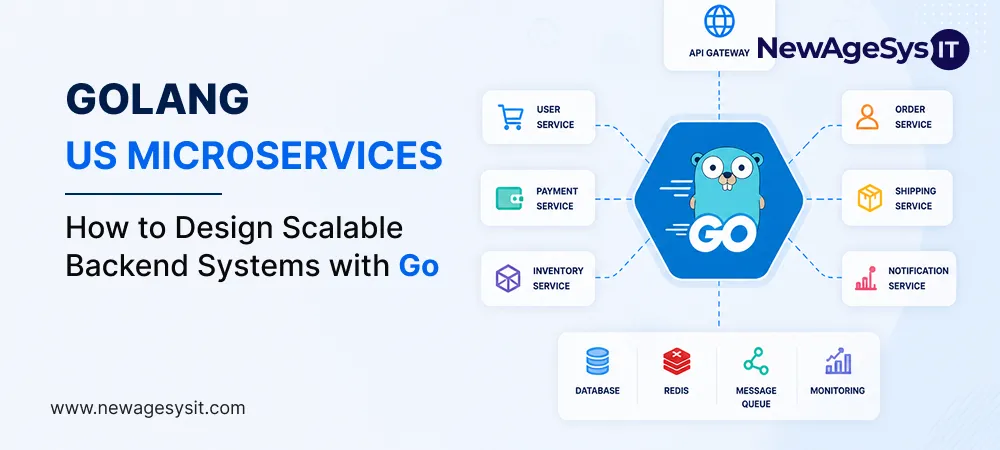
Golang 7 min read
Golang US Microservices Architecture: How to Design Scalable Backend Systems with Go

| This article is part of our series on Custom US Golang Software: Building High-Performance Backend Systems & Cloud-Native Applications |
Golang microservices architecture that USA engineering teams build on has become the default for distributed backend systems. Container efficiency, startup speed, and concurrency determine operational cost. The infrastructure US companies deploy microservices on is itself built in Go: Kubernetes, Docker, Prometheus, containerd, and etcd. This is not coincidental. It is the tooling depth that no other language ecosystem matches.
The operational economics make the case clearly. A Go microservice produces a 5–15MB Docker image versus 200–500MB for Java Spring Boot. Startup time averages 100ms versus 5–30 seconds. Memory per instance runs 50MB versus 500MB+. At 50 services across 3 environments, these differences compound into infrastructure savings that justify the architectural investment.
Golang development services designed for microservices leverage this alignment from the first service. For US companies looking to hire a Golang developer with distributed systems experience, microservices architecture is the strongest starting point. Go’s concurrency model and binary deployment deliver the clearest advantage in this context.
This article covers Go microservices design from service decomposition and communication patterns to data consistency, observability, resilience, and testing strategy.
Service Decomposition Principles for Go Systems
Decomposition is where Go microservices design succeeds or creates the distributed monolith anti-pattern. Getting boundaries wrong makes distributed systems worse than the monolith they replaced. Five principles guide correct decomposition:
1. Domain-Driven Design boundaries: Go’s package system aligns naturally with DDD bounded contexts. Each service owns its domain model, data types, and business rules. Cross-service data coupling (Service A importing types from Service B) is the first sign of a distributed monolith forming. Go’s module system makes this coupling visible and preventable.
2. Single responsibility per service: Each Go microservice handles one bounded capability: user authentication, order processing, payment, or notification. The API contract defines the boundary. Everything behind it can change independently.
3. Database per service: Each Go service owns its own data store. PostgreSQL for transactional data, Redis for caching and session management, and MongoDB for document-oriented access patterns. Shared databases between services create deployment coupling that eliminates the primary benefit of microservices.
4. Go module boundaries: go.mod per service enforces dependency isolation. This prevents the version conflicts that plague monorepo microservice architectures in other ecosystems. Each service manages its own dependency tree through custom software development practices that keep services independently deployable.
5. Service sizing: Go backend microservices are operationally cheap to run. The approximately 4KB goroutine stack and single binary deployment mean smaller, more focused services are viable. Per-service overhead is negligible compared to JVM-based alternatives.
Service Communication: REST, gRPC, and Message Queues
Communication patterns define the performance ceiling of a Golang microservices architecture that USA teams maintain in production. Choosing the wrong protocol for the wrong interaction type creates bottlenecks that scale linearly with service count. Three communication models serve different needs:
gRPC for Internal Service Communication
Go’s protoc-gen-go plugin generates both server and client code from .proto definitions. Bidirectional streaming, multiplexed HTTP/2 connections, and binary Protocol Buffer serialization achieve a 3–5x performance advantage over JSON REST for internal calls. Payloads are 30–50% smaller than equivalent JSON.
gRPC-Gateway adds external accessibility. It generates REST/JSON reverse proxies from gRPC service definitions. This exposes internal gRPC services as REST APIs for external consumers without maintaining two API implementations.
REST for External APIs
HTTP/JSON REST remains the right choice for external-facing APIs. Client compatibility and developer tooling familiarity outweigh gRPC’s performance benefit for public endpoints. Go’s net/http or Gin serve REST APIs efficiently. The pattern for most Golang distributed systems US teams deploy: gRPC internally, REST externally.
Asynchronous Messaging
Not every interaction needs a synchronous response. Event-driven communication handles workflows where it does not:
- Apache Kafka (confluent-kafka-go or Sarama) for high-throughput event streaming and event sourcing.
- NATS (nats.go) for lightweight pub/sub and request-reply patterns with lower operational overhead than Kafka.
- RabbitMQ (amqp091-go) for traditional message queue patterns with routing and dead-letter handling.
Go’s channel-based concurrency model aligns naturally with event-driven messaging. Consumer groups and concurrent message processing are idiomatic in Go. No external thread pool management required.
Data Consistency Patterns in Go Microservices
Distributed data consistency is the hardest problem in microservices architecture. Go does not solve it automatically. But its concurrency primitives and context propagation make the standard patterns cleaner to implement. Four patterns handle different consistency requirements:
| Pattern | How Go implements it | When to use |
| Saga | Go’s context package propagates cancellation across service boundaries, enabling compensating transaction patterns for eventual consistency without two-phase commit. | Multi-service workflows where all-or-nothing atomicity is required across service boundaries. |
| Outbox | Write events to a local database outbox table within the same transaction as domain state changes. Ensures at least one delivery to message brokers without dual-write risk. | Any service that must reliably publish events after state changes. |
| Event sourcing | Append-only event logs using EventStoreDB or custom PostgreSQL implementations. Go’s efficient binary serialization (encoding/gob or Protocol Buffers) keeps event storage compact. | Systems where audit trail, temporal queries, or replay capability are requirements. |
| CQRS | Separate read models (optimized for query patterns) from write models (optimized for command consistency). Go’s interface system makes projection handlers clean and testable. | Services where read and write scaling requirements differ significantly. |
Microservices with Go USA teams build that implement these patterns correctly achieve eventual consistency without distributed transaction nightmares.
Observability and Resilience Patterns
A Golang microservices architecture USA operators run in production is only as reliable as its observability and resilience layer. Without both, failures cascade silently until they become outages. Five capabilities form the production safety net:
1. Distributed tracing: OpenTelemetry Go SDK (go.opentelemetry.io/otel) provides vendor-neutral tracing. It exports to Jaeger, Zipkin, AWS X-Ray, or Datadog. A single request traversing five services must produce a connected trace showing latency per service. Without this, debugging distributed failures is guesswork.
2. Circuit breaker: sony/gobreaker or failsafe-go prevents cascade failures when a downstream service degrades. When the payment service responds slowly, the circuit breaker trips. It returns fast failures to the order service instead of consuming goroutines waiting on timeouts.
3. Rate limiting: golang.org/x/time/rate token bucket limiter protects services from traffic spikes without external infrastructure. Applied at the Golang service mesh ingress or per-service middleware, depending on where traffic control is needed.
Production health and debugging round out the resilience layer:
- Health checks: /healthz and /readyz endpoints following Kubernetes probe conventions. Liveness confirms the process is running. Readiness confirms it can serve traffic. Separate probes prevent Kubernetes from routing requests to initializing pods.
- Structured logging with correlation IDs: Propagating trace and request IDs through Go context links log entries across service boundaries. zap or zerolog for high-performance structured JSON output feeding directly into centralized logging platforms.
Go Microservices Testing Strategy
Testing distributed systems requires strategies beyond unit tests. Go’s toolchain and ecosystem support every layer of the web application and microservices testing pyramid. Four testing layers ensure production reliability.
- Unit testing service logic: Go’s testing package with table-driven tests and interface mocking (gomock or testify/mock). Domain logic tested without external dependencies. go test -race detects race conditions in concurrent code before they reach production.
- Contract testing: Pact Go for consumer-driven contract tests. When Service A depends on Service B’s API, the contract test verifies that changes do not break expectations. No full integration environment required.
- Integration testing: testcontainers-go spins up real PostgreSQL, Kafka, and Redis instances in Docker. Reproducible environments in CI pipelines. No shared test databases. No state leakage between tests.
- End-to-end testing: Lightweight E2E tests against a local Docker Compose environment representing the full service mesh. These validate cross-service workflows that unit and contract tests cannot cover.
Final Thoughts
Go microservices architectures built with clear domain boundaries, gRPC internal APIs, event-driven async patterns, and OpenTelemetry observability deliver operational efficiency and resilience at scale. The language’s binary size, startup speed, and goroutine concurrency model are not just performance advantages. They are operational economics that compound across every service in the mesh.
If your US backend system is being designed as a microservices architecture, start with Go’s concurrency model, gRPC communication, and Saga-based consistency patterns. Apply them from the design stage, not after deployment. This produces a more efficient and resilient distributed system than migrating these patterns after deployment. NewAgeSysIT architects Go microservices for production-grade distributed systems from the first service.
Core Development
Keep exploring the custom services.

AI Software Development
Custom AI Software Development
Build intelligent, production-ready software from machine-learning models to AI-driven automation designed around your business goals.
Learn more
Mobile App Development
Custom Mobile Application Development
Native and cross-platform mobile apps that are fast, secure, and built to scale across iOS and Android.
Learn more
Web App Development
Custom Web Application Development
Scalable, secure web applications, from customer portals to complex dashboards, tailored to how your business actually works.
Learn more



