
Welcome to Blogs
Discover actionable insights, in-depth research, and expert perspectives, all in one place.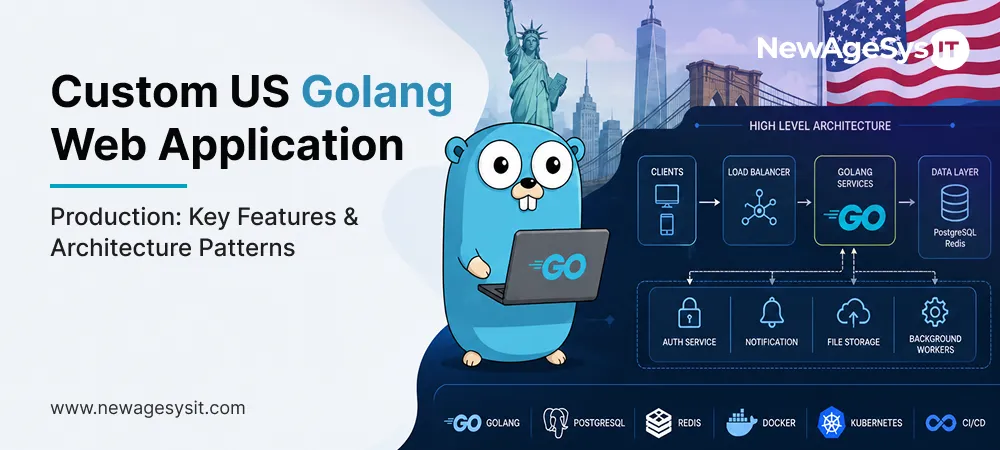
Golang 6 min read
Custom US Golang Web Application Production: Key Features & Architecture Patterns

| This article is part of our series on Custom US Golang Software: Building High-Performance Backend Systems & Cloud-Native Applications |
Golang web application development USA engineering teams invest in a mature, production-proven approach. It handles high concurrent load with predictable performance. This is not a niche technology choice.
Go powers some of the largest web services in the world. Cloudflare’s DNS infrastructure, Twitch’s chat backend, Dropbox’s metadata service, and SoundCloud’s API gateway all run on Go.
Go web applications process HTTP requests with approximately 10–50 microsecond overhead per request. That is significantly less than comparable Java Spring or Node.js Express services. That raw performance difference matters at 10,000+ requests per second. Overhead per request multiplied across millions of daily requests translates directly into infrastructure cost.
Golang development services built for web application production deliver this performance. No operational complexity of JVM tuning or concurrency limitations of single-threaded Node.js. For US companies looking to hire a Golang developer or engage a Go development team, web applications are the most common entry point. The Go ecosystem rewards this starting position with production-ready tooling
This article covers the key features and architecture patterns for building production Go web applications in the US. These include framework selection, database integration, security architecture, deployment, testing, and observability.
Golang Web Framework Selection
Framework selection is a long-term architectural decision. Migrating between Go frameworks is more involved than switching Node.js frameworks due to middleware compatibility differences. Choosing correctly upfront prevents expensive re-architecture.
1. net/http Standard Library
Go’s built-in HTTP server handles production workloads directly. Many large-scale US services use net/http with custom middleware rather than a framework, prioritizing control and zero external dependencies. For Golang web development US teams who want full ownership of their HTTP layer, net/http is the starting point.
2. Gin
The most widely used Golang web framework. Approximately 40x faster than net/http for complex routing patterns, with a battle-tested middleware ecosystem. Best choice for REST API backends and microservices requiring high throughput. The default recommendation for most Go web app USA production projects.
3. Echo
Similar performance profile to Gin with a slightly different API design. Strong middleware ecosystem and built-in data binding. Commonly chosen for enterprise REST APIs where structured request validation is a priority.
4. Fiber
Built on fasthttp rather than net/http, achieving the highest raw throughput in the Go framework ecosystem. Best for extremely latency-sensitive services. Important caveat: Fiber is not net/http compatible, which affects some middleware libraries.
5. Chi
Lightweight, idiomatic, net/http-compatible router. Favored by teams that want routing structure without framework overhead. Strong choice when composability and standard library compatibility are priorities.
The framework decision connects directly to how the web application development project handles middleware, database integration, and deployment architecture. All covered in the sections below.
Database Integration Patterns in Go Web Applications
Database integration is where Golang web application development USA projects succeed or fail at scale. Go’s database ecosystem is mature, but choosing the wrong integration pattern creates performance bottlenecks that are expensive to refactor.
| Integration | Best for | Trade-offs |
|---|---|---|
| database/sql (standard library) | Full SQL control, any SQL database via driver | Manual scanning, verbose query code |
| GORM | Rapid development, auto-migration, association management | N+1 query risk, query performance overhead |
| sqlx | Named parameters, struct scanning, query-level control | No auto-migration, still requires SQL knowledge |
| pgx | High-performance PostgreSQL, COPY protocol, PostgreSQL-specific types | PostgreSQL only, not portable to other databases |
For custom Go web app projects requiring NoSQL, the ecosystem is equally mature. MongoDB (official Go driver), Redis (go-redis for caching and session management), and Elasticsearch (olivere/elastic or official client) are all production-grade options. Each serves as a reliable foundation for custom software development.
Authentication, Middleware, and Security Architecture
Security architecture in Go web applications benefits from Go’s strong standard library cryptographic primitives. The language provides the building blocks. The application architect assembles them.
The authentication layer starts with JWT. golang-jwt/jwt handles stateless token-based authentication. Go’s standard crypto/tls and crypto/hmac packages provide the underlying security primitives without external dependencies. For enterprise applications requiring SSO, OAuth2 integration through golang.org/x/oauth2 supports Google, GitHub, Microsoft, and generic OAuth2 providers. This covers the social and enterprise authentication flows US clients need.
Request processing runs through middleware chains that compose authentication, rate limiting (golang.org/x/time/rate), CORS, request logging, and panic recovery. Middleware order matters: rate limiting before authentication prevents unauthenticated request floods from consuming authentication service resources.
Once requests pass through middleware, three security layers protect the application:
- Input validation. go-playground/validator for struct-level validation with field tags, catching malformed input before it reaches business logic.
- SQL injection prevention. Parameterized queries via database/SQL prepared statements. Go’s database patterns naturally prevent injection when used correctly. The risk surfaces when developers bypass prepared statements.
- TLS configuration. Go’s crypto/tls provides excellent defaults, including HSTS, certificate rotation, and mutual TLS (mTLS) for service-to-service communication. Golang web application development USA teams building internal service networks use mTLS to ensure only authorized services communicate.
Go Web Application Deployment Architecture
Go’s deployment characteristics are where the language’s design decisions pay operational dividends. Every deployment advantage traces back to the single static binary.
Multi-stage Docker builds compile the application in a Go builder image. Then copy only the static binary into a minimal distroless or Alpine base. Production images of 5-15MB versus 200MB+ for equivalent Java or Python services. Smaller images mean faster pulls during scaling events, lower registry storage costs, and reduced attack surface from eliminated OS packages.
Kubernetes deployment aligns naturally with Go’s runtime characteristics:
- Fast startup (typically under 500ms) means new pods pass health checks quickly during rolling deployments.
- Graceful shutdown via context cancellation propagated through the call stack ensures in-flight requests complete before pod termination.
- Horizontal scaling with high pod density. Go’s low per-request memory footprint and efficient goroutine scheduling run more replicas per node than equivalent JVM services.
Config management follows 12-factor app patterns: environment variables via os. Getenv for simple configuration. The viper library handles structured configuration from files, environment variables, and remote config stores. Twelve-factor compliance is idiomatic in Go, not an afterthought.
Testing and Observability in Go Web Applications
Go’s testing and observability tools are built into the standard toolchain, not bolted on through third-party frameworks.
- Built-in testing. Go’s testing package provides unit tests, benchmarks, and fuzz testing with no external test runner. Go test runs all tests. Go test -bench runs benchmarks. Go test -race detects race conditions. No configuration files, no framework dependencies.
- HTTP handler testing. net/http/httptest provides a test server and response recorder for testing HTTP handlers without network overhead. Handlers are tested as functions, not through HTTP calls, making tests fast and deterministic.
- Integration testing. testcontainers-go spins up real PostgreSQL, Redis, or Kafka instances in Docker for integration tests. Reproducible database state for every test run. No shared test databases, no state leakage between tests.
- Structured logging. zap (Uber) or zerolog for high-performance structured JSON logging. 10–100x faster than fmt.Println logging with zero-allocation hot paths. Structured logs feed directly into ELK, Datadog, or Splunk without parsing.
- Metrics and tracing. Prometheus client_golang for metrics exposition and OpenTelemetry Go SDK for distributed tracing. The standard US production observability stack.
Final Thoughts
Go web applications built with the right framework, database integration, security architecture, and deployment patterns perform well under load. They deliver high concurrency and low infrastructure cost. The framework ecosystem is mature. The database integrations are production-tested. The deployment model produces containers small enough that scaling events are measured in seconds, not minutes.
If your US web application project demands high-concurrency performance or containerized deployment efficiency, Go is worth evaluating. Comparing its ecosystem against your specific traffic patterns and team capabilities gives the clearest picture for making a technology decision. NewAgeSysIT builds Go web applications engineered for production scale from day one.
Core Development
Keep exploring the custom services.

AI Software Development
Custom AI Software Development
Build intelligent, production-ready software from machine-learning models to AI-driven automation designed around your business goals.
Learn more
Mobile App Development
Custom Mobile Application Development
Native and cross-platform mobile apps that are fast, secure, and built to scale across iOS and Android.
Learn more
Web App Development
Custom Web Application Development
Scalable, secure web applications, from customer portals to complex dashboards, tailored to how your business actually works.
Learn more



