
Welcome to Blogs
Discover actionable insights, in-depth research, and expert perspectives, all in one place.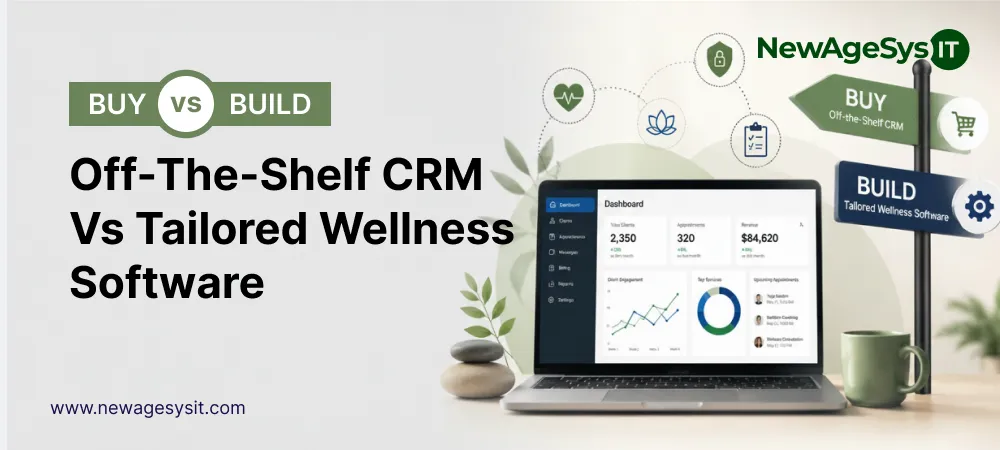
Wellness 5 min read
Buy vs Build in US Wellness Tech: Off-the-Shelf CRM vs Tailored Wellness Software

| This article is part of our series on Digital Transformation in US Wellness: AI, Automation & Scalable WellTech Innovation. |
The buy vs build wellness software USA decision is the most consequential technology choice a wellness business makes. And it is not made once. It is made separately for every capability: CRM, booking system, client app, wellness content, AI coaching, and wearable integration.
What makes this decision uniquely complex for wellness businesses is compliance. HIPAA applicability is fact-specific. Informed consent architecture must meet ESIGN/UETA standards. Health data governance obligations affect what a platform can safely store and how. The wrong SaaS choice can create compliance exposure that is expensive to unwind.
This article provides a practical decision framework for US wellness technology teams evaluating custom wellness app development and wellness CRM development against off-the-shelf alternatives.
The Off-the-Shelf Wellness Software Landscape
The off-the-shelf wellness software market is mature and well-segmented. The first step in any buy vs. build analysis is to figure out what each category does well and where it stops.
Spa and wellness CRM platforms like Vagaro, Mindbody, and Boulevard handle standard booking, billing, and client management effectively. Vagaro at $90 per month looks compelling against an $80,000 custom CRM. That comparison shifts significantly when three-year cost compounding and customization limits are modeled properly.
Clinical wellness platforms like Jane App and Healthie provide HIPAA-compliant foundations for applicable practices. For acupuncture clinics, integrative health centers, and medical spas, this reduces one significant compliance burden.
General wellness app builders serve simple content and booking needs. They rarely support proprietary AI coaching, multi-modality scheduling, or custom wearable integrations.
The shared limitation across all categories is workflow standardization. Off-the-shelf platforms are built for average wellness businesses. Custom multi-modality scheduling, proprietary informed consent architecture, and unique client journey design consistently exceed what SaaS supports without workarounds.
Data ownership is another consideration. Client health intake data and treatment history held in third-party SaaS creates export complexity and long-term vendor lock-in. A custom software development approach keeps that data fully within your control, no vendor export complexity, no long-term lock-in on client health intake data and treatment history.
What Custom Wellness Software Development Offers
Custom wellness software is built around how your business actually operates. Not around the average wellness workflow, a SaaS vendor designed for the broadest possible market.
- Custom wellness CRM supports real client lifecycle management. Treatment preference tracking, multi-provider scheduling, and practitioner commission structures are built to match your specific operations. No workarounds required.
- Proprietary AI wellness coaching goes further than generic models. ML systems trained on your specific client population deliver more accurate wellness recommendations and more reliable retention predictions.
- Informed consent architecture can be built precisely to match your service menu. ESIGN/UETA compliant consent forms with service-specific contraindication disclosures and treatment-specific consent versions are standard in custom builds. They are rarely available in SaaS platforms.
- Branded client apps built through custom mobile app development create a premium experience that white-label alternatives cannot match. Clients engage with your brand directly, not a generic platform skin.
- Break-even economics are real for multi-location operations. Custom development frequently reaches cost parity with SaaS licensing within three to five years. After that point, every year is pure differentiation advantage.
The Wellness Buy vs Build Decision Framework
The most defensible wellness technology architecture follows one principle. Buy commodity infrastructure. Build competitive differentiation. Here is how to apply that across four decision dimensions.
Client Experience Differentiation
Does this capability create a competitive advantage? Custom AI wellness coaching, proprietary loyalty mechanics, and unique informed consent experiences differentiate your brand. Billing, basic booking, and standard payment processing do not. Those are commodities. Buy them.
Compliance Architecture Requirements
Does your wellness business have HIPAA obligations? This is a fact-specific legal determination. Not every SaaS platform meets the technical safeguard requirements that HIPAA-applicable businesses need. Medical spa, IV therapy, and clinical wellness services often have consent requirements that generic SaaS waiver tools cannot accommodate correctly.
Scale Economics
Model three-year total cost honestly. Per-location SaaS pricing compounds significantly as a wellness chain grows. Custom development frequently reaches break-even within three to four years. Include SaaS vendor exit costs too. Migrating client health data and treatment history from an embedded platform grows more expensive every year you wait.
Wearable Integration Requirements
Most wellness SaaS platforms offer limited wearable integration depth. Deep Apple HealthKit integration, Oura Ring API access, and Whoop connectivity require full control over integration scope and data governance. For iOS-first wellness platforms building on HealthKit, custom iOS app development with explicit consent architecture built into the data pipeline is the only path that satisfies both Apple’s developer policies and CCPA sensitive personal information obligations. Full control over integration scope and data governance requires custom development.
Common Buy vs Build Mistakes in US Wellness Technology
Four mistakes appear repeatedly in US wellness technology decisions.
- Choosing a non-HIPAA-compliant platform for a HIPAA-applicable business: Medical spas and clinical wellness centers have selected SaaS CRMs without Business Associate Agreement capability. The compliance gap only becomes visible after deployment.
- Building commodity infrastructure: Custom development resources spent on standard billing or basic booking deliver no competitive advantage. Mature SaaS handles these capabilities at market-standard quality for a fraction of the cost.
- Ignoring wearable integration limits: Purchasing a wellness platform without evaluating its wearable integration depth is a common oversight. Many platforms don’t support Oura Ring or Apple Watch connectivity to the depth that premium wellness clients expect.
- Ignoring total SaaS cost at scale: Mindbody at $500 per month across a growing multi-location wellness chain compounds significantly. Three-year cost modeling across projected locations changes the economics entirely.
Final Thoughts
The buy vs build decision in US wellness technology is not a one-time choice. It is a recurring strategic discipline applied to every capability your business invests in.
The principle is consistent. Buy commodity infrastructure. Build competitive differentiation. Verify compliance architecture before committing to either path.
Wellness businesses that approach these challenges with documented decision criteria build more defensible technology portfolios. Three-year cost models and honest compliance assessment matter. Reactive vendor decisions rarely produce either.
Wellness businesses that work through compliance requirements, model three-year costs, and map their differentiation needs before choosing a path tend to make better long-term decisions, and working with a US wellness app development company that understands both paths reduces both the planning risk and the execution cost
Core Development
Keep exploring the custom services.

AI Software Development
Custom AI Software Development
Build intelligent, production-ready software from machine-learning models to AI-driven automation designed around your business goals.
Learn more
Mobile App Development
Custom Mobile Application Development
Native and cross-platform mobile apps that are fast, secure, and built to scale across iOS and Android.
Learn more
Web App Development
Custom Web Application Development
Scalable, secure web applications, from customer portals to complex dashboards, tailored to how your business actually works.
Learn more



