
Welcome to Blogs
Discover actionable insights, in-depth research, and expert perspectives, all in one place.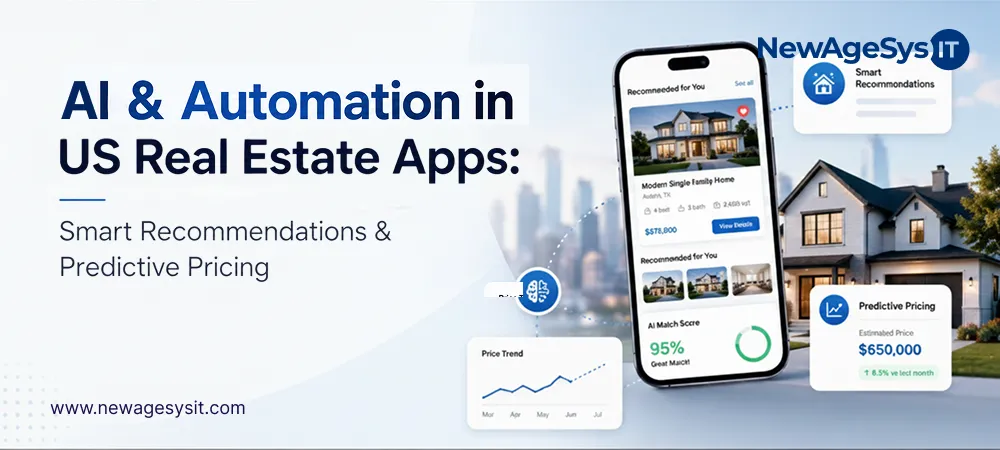
Real Estate 6 min read
AI & Automation in US Real Estate Apps: Smart Recommendations & Predictive Pricing

| This article is part of our series on Real Estate Mobile Application in the USA: Building Smarter Property Experiences |
AI and automation are no longer optional differentiators in US real estate apps. They are now becoming standard tools for property recommendations, pricing insights, predictive insights, and lead management.
Zillow, Redfin, and Opendoor have invested hundreds of millions in AI. AI and automation have become baseline requirements for competitive proptech products.
AI real estate apps in the USA must operate within Fair Housing compliance constraints while working with incomplete and inconsistent MLS data. Recommendation algorithms and lead routing systems must be designed carefully to preserve user trust.
Most US brokerage apps and local property platforms do not have an AI layer. Platforms investing in automation through custom real estate app development solutions stay competitive in the market. Modern CRM platforms and real estate software solutions also help in enhancing the functionality of platforms.
AI-Powered Property Recommendations
AI-powered property recommendation engines have become instrumental in modern US real estate apps.
- Collaborative filtering: Multiple users view, save, and contact agents for similar homes. In this case, the system provides recommendations of related listings to users by identifying behavior similarities. For example, ‘users like you also viewed and saved these properties’.
- Content-based filtering: The system matches listing attributes (property type, price range, features, neighborhood characteristics) to the user’s expressed and inferred preferences.
- Behavioral signal inputs: Recommendation engines are refined using search queries, property views, time spent on listing detail pages, photo scroll behavior, and save actions.
- Hybrid recommendation: It involves combining collaborative and content-based approaches with explicit search criteria.
- Fair Housing compliance in recommendations: Recommendation algorithms must be tested for disparate impact across protected class demographics. Algorithms that systematically show different listing sets to users based on inferred demographic characteristics create Fair Housing exposure.
COMPLIANCE / ACCURACY NOTE
AI recommendation systems in real estate apps must follow Fair Housing laws. An algorithm may create legal risks if it shows different property listings to users based on factors linked to protected groups. Consult qualified real estate legal counsel before launching these features.
Automated Valuation Models (AVMs) for Real Estate Apps
Automated Valuation Models (AVMs) are considered to be valuable AI applications in real estate technology.
- AVM approaches: Most real estate apps combine multiple approaches. These include repeat-sales models (Case-Shiller methodology), hedonic regression models (property feature-based valuation), and ML-based hybrid models.
- Training data requirements: AVMs require historical transaction data (MLS sold records), current listing data, and property characteristics data (assessor records). They also use property photo and floor plan data for feature-based models.
- Zestimate-level accuracy benchmarks: Zillow’s Zestimate median error rates fall within 2–3% in markets with dense transaction history. Proptech platforms should benchmark AVM accuracy against similar market conditions.
- AVM confidence indicators: Many platforms display a confidence range (estimated value: $580,000–$620,000) alongside the point estimate. These indicators improve user trust and a potential legal risk management practice.
- Data freshness dependency: AVM accuracy depends on data freshness and transaction history. In fast-changing markets, the model must be retrained or calibrated frequently when market conditions shift.
- AVM as seller lead magnet: The highest-converting seller lead capture mechanism is ‘What is my home worth?’. It drives immediate engagement and leads registration.
Predictive Analytics for Market Trends and Investment Signals
Predictive analytics help buyers, sellers, and investors make better real estate decisions.
- Price trend prediction: ML models predict neighborhood price appreciation over 6–12 month horizons. This data helps buyers to know whether a market is trending up, stable, or softening.
- Days on market prediction: It predicts how quickly a property will sell based on historical market conditions and property characteristics. This helps sellers set expectations while helping buyers evaluate urgency.
- Market heat index: It provides real-time indicators of buyer competition in specific zip codes or neighborhoods. This data is powered by offer count data, days on market trends, and list-to-sale price ratios.
- Investment property analysis: Cap rate calculation, rental yield estimation, cash flow projection, and neighborhood rental demand indicators. These tools are not provided by mainstream consumer apps.
- Best time to buy/sell alerts: ML models identify market timing signals for specific neighborhoods.
Platforms investing in predictive analytics also rely on custom software development services to support growing model complexity.
AI recommendations and predictive pricing for listing platforms are discussed in ‘How to
Build a Property Listing Platform for the US Market.’
AI in Real Estate Lead Management and Agent Tools
AI is reshaping agent and brokerage operations on the operational side.
- AI lead scoring: ML models analyze search frequency, property saves, and price range adjustment on custom mobile real estate platforms. Based on this user behavior, they predict which leads are most likely to transact within 90 days.
- Next-best-action recommendations: AI suggests the right follow-up step for each lead. The system may recommend calling now, sending listing alerts, and sharing market reports based on user activity patterns.
- Automated follow-up sequences: AI drip campaigns, especially in Android real estate apps, send recommendations when users resume property search activity. It helps in improving user engagement.
- AI-generated market reports: The system automatically generates neighborhood market summaries for improving agent-client communication. These summaries include average price, days on market, inventory level, and recent sales.
- Conversational AI for lead qualification: Chatbots qualify leads by collecting buyer’s activity details before routing to an agent. This information includes buyers’ timeline, pre-approval status, and property preferences.
Conversational Search and Natural Language Processing
Natural Language Processing (NLP) is making property search more conversational and intuitive.
- Natural language property search: AI systems translate conversational search into structured MLS query parameters using NLP. For example: ‘Find me a 3-bedroom house near downtown with a yard under $500k.’
- Voice search integration: A practical productivity feature for agents that can be used while driving between showings. It is especially useful in mobile real estate apps built through iOS development.
- Chatbot-based property inquiry: Chatbots can answer listing questions, schedule showings, and collect buyer preferences. They handle these inquiries 24/7 without agent intervention.
- AI property description generation: AI systems automatically generate compelling listing descriptions from property data fields. It helps in saving listing agents significant time on each new listing.
- Search refinement suggestions: AI-powered suggestions help buyers narrow searches when results are too broad. For example: ‘Based on your saves, you might prefer 2-car garage properties. Should I add that filter?’
Fair Housing Compliance for AI Features
Fair Housing compliance makes real estate AI systems operate under legal frameworks that prohibit discriminatory outcomes.
- Disparate impact testing: AI recommendation systems must avoid producing different outcomes for protected demographic groups.
- Prohibited data inputs: ML models must not use neighborhood racial composition, school district demographic data, or other proxies for protected class membership as training features.
- Audit trail for algorithmic decisions: Real estate AI systems must maintain records to explain how recommendations were generated.
- Regular bias auditing: Periodic independent review of AI model outputs for disparate impact identifies and reduces systematic bias. It is becoming a best practice in the US real estate AI space.
Conclusion
AI and automation are redefining competitive differentiation in US real estate apps. Users expect modern property platforms to offer smarter property recommendations, accurate pricing intelligence, and agent productivity tools.
Competitive US real estate platforms implement AI with rigorous Fair Housing compliance testing, transparent confidence indicators, and audit-ready algorithmic records.
Organizations adding AI features to US real estate apps should validate Fair Housing compliance during early development stages. This reduces legal risks and prevents growing enforcement issues associated with proptech AI deployments.
Core Development
Keep exploring the custom services.

AI Software Development
Custom AI Software Development
Build intelligent, production-ready software from machine-learning models to AI-driven automation designed around your business goals.
Learn more
Mobile App Development
Custom Mobile Application Development
Native and cross-platform mobile apps that are fast, secure, and built to scale across iOS and Android.
Learn more
Web App Development
Custom Web Application Development
Scalable, secure web applications, from customer portals to complex dashboards, tailored to how your business actually works.
Learn more



