
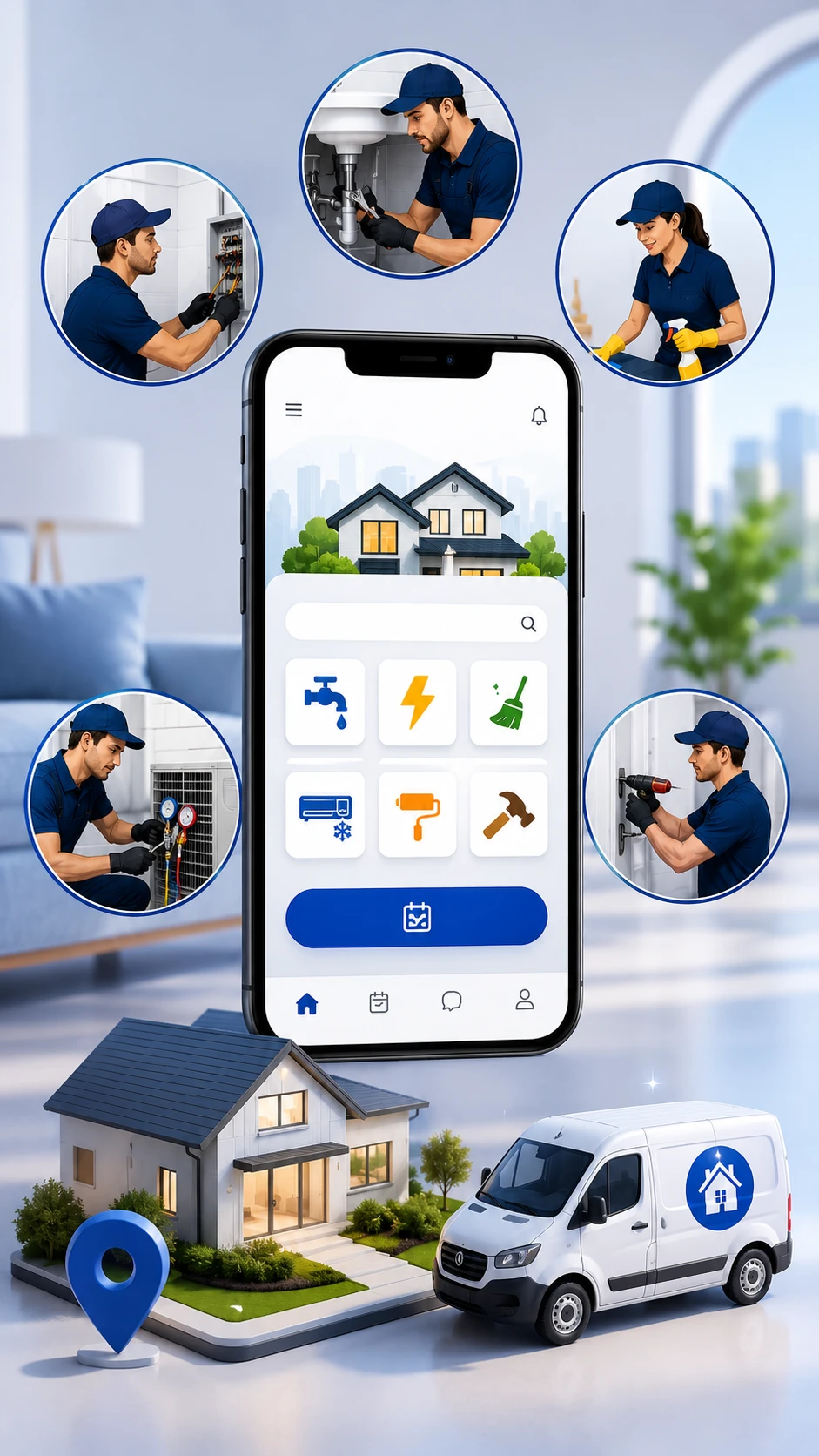
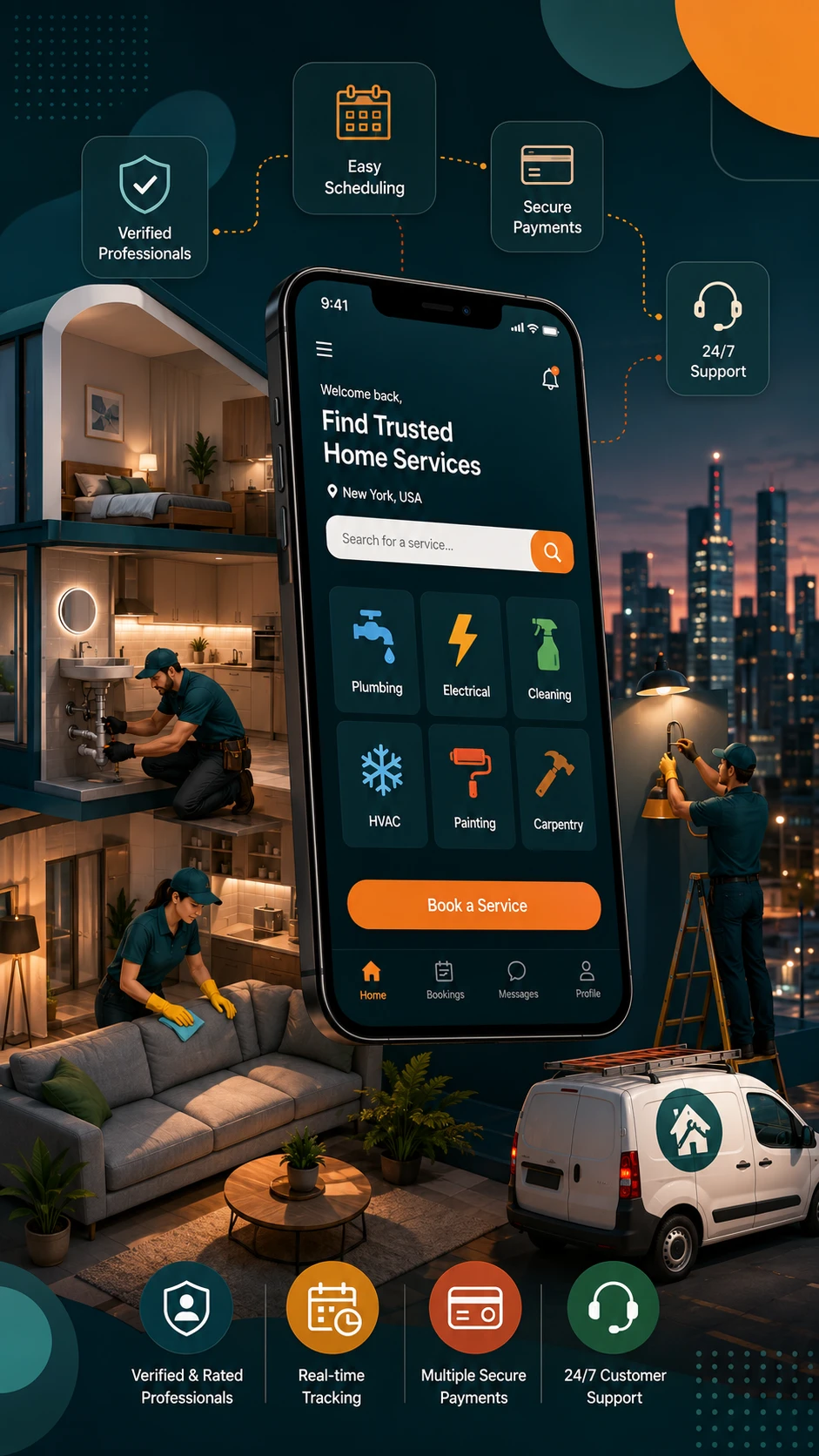


You build an on-demand home-services app by choosing a model first. That means picking between a marketplace, like TaskRabbit, or managed, like Urban Company. You also choose a focused niche and a single city to start. From there, you build three connected products around that model. A customer app handles booking, a provider app handles job management, and an admin panel oversees both. These products share service listings, geolocation, scheduling, secure payments, and ratings. Throughout, you solve the chicken-and-egg problem by seeding vetted providers first. In the United States in 2026, a single-category MVP starts around $25,000, with cost scaling by tier from there. Full pricing detail follows in the cost section ahead.
This guide covers the complete path from idea to a launched US home-services app. That includes the marketplace model, the three products, provider trust, features, tech stack, cost, timeline, and compliance.
Timing matters here. The US handyman-app segment was valued near $1.5 billion in 2024. It is projected to reach roughly $5.2 billion by 2033. The global on-demand home-services market is forecast to cross $1.5 trillion by 2030. Over 46 percent of Americans reportedly want to book home services online. Hundreds of local niches remain underserved against the giants. This guide is written for marketplace founders and local service businesses. It is also written for franchises, product managers, and CTOs planning a build. By the end, you will be able to scope, budget, and brief a real project.
Two truths that matter most
Two truths matter more than anything else here. First, this is three products in one platform, not one simple app. Second, supply has to come before demand, or the marketplace fails. Successful on-demand app development depends on getting that sequence right from day one.
What Is An On-Demand Home Services App?
An on-demand home-services app connects homeowners with vetted service professionals. That includes cleaners, plumbers, electricians, handymen, and movers. It works through three products sharing one backend. A customer app handles browsing and booking. A provider app handles job management for the professional. An admin panel handles oversight, vetting, and dispute resolution. Geolocation, scheduling, secure payments, and ratings tie the whole system together. TaskRabbit, Thumbtack, Angi, and Urban Company all represent this category well.
Underneath that definition sits a real operational choice. A marketplace model lets providers self-serve and set their own terms. TaskRabbit and Thumbtack's bid-based leads represent this approach directly. A managed model works differently, with the platform vetting, training, and controlling quality. Urban Company is the clearest example of this stricter approach. There is also a scope choice worth understanding early. An aggregator like TaskRabbit covers many service categories at once. A niche or single-service app like Handy goes deeper into one category instead. HomeAdvisor sits closer to the lead-generation side of this same spectrum.
Provider trust and the booking experience define this category more than anything else. The provider app is also more complex than most founders expect. Custom mobile app development must support job acceptance, scheduling, and real earnings tracking.

Estimate Your App Development
Cost in Seconds
Discover your project budget with our interactive AI-powered app cost calculator.
Why Build An On-Demand Home Services App in 2026?
You build a home-services app in 2026 because demand is large and recurring. The US handyman-app segment is projected to grow substantially by 2033. Estimates place it moving from roughly $1.5 billion in 2024. It could reach close to $5.2 billion within that window. The global on-demand home-services market is forecast to cross $1.5 trillion by 2030. Over 46 percent of Americans reportedly want to book home services online. AI-assisted development now lets focused teams launch a niche MVP fast, often in weeks rather than quarters.
$1.5B
US handyman-app segment in 2024
$5.2B
Projected US segment by 2033
$1.5T
Global on-demand market by 2030
46%+
Americans who want to book online
These figures point to a market that is both large and underserved. Market size alone only tells part of the story here. The broader US home-services market itself runs into the hundreds of billions. Demand for online booking specifically is the more telling signal. Over 46 percent of Americans reportedly want this option available to them, according to Allied Market Research. That figure suggests real behavioral change, not just casual interest.
The collapsing barrier to entry matters just as much as demand. AI-assisted development can now ship a working MVP in six to ten weeks. That timeline was unrealistic for most small teams only a few years ago. Founders once needed large engineering budgets just to reach a testable product. That barrier has fallen considerably, opening the field to smaller, focused teams.
TaskRabbit pioneered this model, but it does not own the space. Hundreds of local markets and specific niches remain genuinely underserved. Local competitors consistently win on trust and speed over national giants. Homeowners often prefer a provider who understands their specific neighborhood or building type.
The opportunity is in focus, not scale
The real strategy is picking one category, one city, and one model. Niches like eco-friendly service, senior-friendly care, 24/7 emergency work, or trades-specific focus all work well. Serving one of these niches better beats trying to out-scale TaskRabbit or Angi directly. A smaller, sharper offering often earns trust faster than a broad, generic one.
What Types Of On-Demand Home Services Apps Can You Build?
The main types are multi-service aggregators, like TaskRabbit, Thumbtack, and Angi. Single-service or niche apps, like Handy's cleaning focus, form a second type. Managed-quality platforms, like Urban Company, make up a third category. Lead-generation marketplaces, like HomeAdvisor and Thumbtack's bid model, are a fourth type. Subscription or recurring-service apps round out the list. Each type carries a different model, a different operational burden, and a different cost profile.
Model choice should match your operational capacity, not just competitor formats. Aggregators win on variety and cross-category engagement but are harder to bootstrap. Single-service apps win higher conversion within a focused audience and launch more easily. Managed platforms deliver higher trust and repeat rate but carry heavier operations. Lead-generation platforms monetize simply but carry real lead-quality risk. Choosing the wrong type for your team's capacity tends to show up quickly in retention.
Multi-Service Aggregators
Many service categories sit under one roof with this model. Cross-selling between categories drives real retention over time. TaskRabbit and Thumbtack represent this aggregator model well, though bootstrapping remains genuinely hard. Building enough supply across several categories at once takes real time and capital.
Single-Service / Niche Apps
One category gets the full focus with this model, instead of many at once. Handy's cleaning-only focus is a clear example of this approach. Niche focus tends to produce easier launches and stronger early conversion.
Managed-Quality Platforms
Vetting, training, and direct quality control define this model. Urban Company represents this managed approach at real scale. The tradeoff is heavier operations in exchange for higher customer trust.
Lead-Generation Marketplaces
Providers pay per lead or bid for jobs under this model. HomeAdvisor and Thumbtack's bid model both represent this pay-per-lead approach. Monetization is simple here, though lead quality can vary.
Subscription / Recurring-Service Apps
Recurring cleaning or maintenance plans get sold directly under this model. Predictable revenue and stronger retention are the main advantages. Some players, including Handy, have layered subscription plans onto their core service.
Got Problems? Let Us Help You With the Right Solution


How Do You Solve The Chicken-and-Egg (Cold-Start) Problem and Choose Marketplace vs Managed?
You solve the chicken-and-egg problem by solving supply first. That means onboarding 20 to 30 vetted providers in a single city. Do this before running a single customer ad. Customers will not come without available providers on the platform. Providers will not stay active without real jobs coming through. You then choose between two operating models for the long term. A marketplace model lets providers self-serve, which scales faster with less trust control. TaskRabbit represents this approach clearly. A managed model means you vet, train, and control quality directly. That is harder operationally, but it builds stronger trust and repeat rates. Urban Company represents this stricter, often more valuable long-term model.
The cold-start problem is genuinely the hardest part of this business. A two-sided marketplace carries no value at all when empty. Balancing supply and demand together is difficult under normal conditions. The fix is concentrating both sides in one small market first. A single city or even a single neighborhood works well here. Reaching real liquidity fast matters more than reaching scale early. Validating offline first is worth doing before writing any code. Calling 20 potential customers directly can confirm real demand exists. This kind of manual validation costs almost nothing compared to building the wrong product.
Seeding supply first is the concrete next step after validation. Recruit and vet a core group of providers early on. Guarantee them some early demand before turning on customer acquisition. Only then should broader customer-facing marketing efforts begin in earnest. Rushing customer acquisition before supply is ready tends to waste marketing spend entirely.
The marketplace-versus-managed choice shapes every stage of development that follows. Marketplace models scale faster since providers largely self-serve their own terms. That speed comes at the cost of ceding real quality control. Managed models are operationally heavier, requiring active vetting and training. That heavier lift tends to produce stronger trust and better repeat behavior. Urban Company's results suggest management can outperform the marketplace on long-term value. Niche focus paired with a single-city launch lowers the liquidity threshold further. It also meaningfully reduces early customer acquisition cost.
What Features Does an On-Demand Home Services App Need? (Must Have and Advanced)
A home-services app needs three separate feature sets. The customer app needs service browsing and provider search with geolocation. It needs booking and scheduling, secure payment, and real-time tracking. Ratings, reviews, and in-app chat round out the customer side. The provider app needs a profile, job requests, and job management tools. It needs scheduling, earnings tracking, and navigation support. The admin panel needs provider vetting, dispute resolution, and commission management. It also needs analytics across the whole platform. Advanced builds add AI matching, dynamic or surge pricing, subscriptions, and smart-home or insurance integrations.
Three imperatives matter more than the rest of the feature list combined. Trust features come first, since vetting, verified reviews, and secure escrow payment drive bookings. Homeowners are inviting strangers into their homes, so trust signals carry real weight. The provider app is harder than it looks, so budget real time for it. Job lifecycle management, earnings tracking, and navigation all take genuine engineering effort. Geolocation, scheduling, and secure payment form the technical core of the entire platform.
Customer App Features
Service category browsing and geolocation-based provider search anchor this side, often through Google Maps API. Booking, scheduling, and secure payment via Stripe follow from there. Real-time tracking, ratings, reviews, and in-app chat through Twilio round this out. Support access within the app helps resolve issues before they escalate into disputes.
Provider App Features
Profile creation with identity verification leads this side, alongside job requests and acceptance. Job management, scheduling, and a calendar view follow from there. Earnings and payouts typically run through Stripe Connect. Navigation support, often via Google Maps, and availability management complete this side. Providers rely on this app daily, so usability here directly affects retention.
Admin Panel and Advanced Features
Provider vetting and background checks anchor this layer, typically through Checkr. Dispute resolution and commission or payout management follow, run from an admin dashboard. Analytics close out the core admin layer. Advanced additions include AI matching, dynamic pricing, subscriptions, and smart-home or insurance integrations.
How Do You Build an On-Demand Home Services App? Step-By-Step
You build a home-services app in seven stages. First, validate the niche and choose the model, category, and city. Second, plan the supply-first cold-start strategy before anything else. Third, design the customer, provider, and admin UX together. Fourth, choose a tech stack with geolocation, scheduling, and payments. Fifth, develop all three products on a shared backend. Sixth, test booking, payments, tracking, and both-sided flows thoroughly. Seventh, launch in one market, then expand by category and city.
-
1
Validate Niche and Choose Model, Category, City
Decide between marketplace and managed models before anything else. Validate demand offline by calling 20 potential customers directly first.
-
2
Plan Supply-First Cold-Start
Recruit and vet 20 to 30 providers before running customer ads. Guarantee early demand to that core group first.
-
3
Design Customer, Provider and Admin UX
Wireframe all three products together in Figma before development starts. Scoping them together avoids costly architecture mistakes later.
-
4
Choose Tech Stack
Prioritize geolocation through Google Maps API, scheduling, and payments through Stripe. Background checks through Checkr and a stack built on React Native, Flutter, Node.js, and PostgreSQL round out this decision.
-
5
Develop Three Products on a Shared Backend
Build the customer, provider, and admin products against one shared backend. This backend powers matching, tracking, and payments across all three.
-
6
Test Booking, Payments, Tracking and Both-Sided Flows
Validate reliability across booking, payment, and real-time tracking flows. Test edge cases on both the customer and provider side carefully.
-
7
Launch in One Market and Expand
Launch through App Store Connect and Google Play Console in a single city. Expand category by category and city by city after that.
Validate offline first, since calling 20 customers beats guessing at demand. Scope all three products correctly from the very start. Treating this as one simple app leads to wrong architecture choices. That mistake often forces expensive mid-build changes later on. Do not underinvest in the backend, since it powers matching, tracking, and payments throughout custom software development. This is a common and genuinely costly mistake teams make. Launch in one city and one category before expanding further. Expanding too early, before the first market reaches real liquidity, often backfires.
What Tech Stack is Used to Build an On Demand Home Services App?
The dominant 2026 stack centers on React Native or Flutter for mobile, Node.js or Python for the backend, and PostgreSQL with Redis for data. React Native or Flutter typically power both the customer and provider apps, making mobile app development faster and easier to maintain across two separate products. React or Next.js typically power the admin panel and the web-based booking experience. Node.js or Python runs the shared backend. PostgreSQL with Redis handles data and real-time state. Most teams host on AWS, Google Cloud, or Azure. Google Maps API powers geolocation and tracking. Stripe with Stripe Connect handles payments and provider payouts. Twilio covers SMS and chat, and Checkr handles background checks.
| Layer | Recommended Tools | Why It Matters |
|---|---|---|
| Customer and provider mobile apps | React Native, Flutter | Cross-platform code reduces cost across two separate apps |
| Admin panel and web booking | React, Next.js | Powers oversight tools and the web booking experience |
| Backend | Node.js, Python | Shared across all three products, handles dispatch logic |
| Matching engine | Python services, PostgreSQL | Ranks providers by location, rating, and availability for each job |
| Database and cache | PostgreSQL, Redis | Manages core data and real-time state together |
| Cloud hosting | AWS, Google Cloud, Azure | Scales with booking volume and real-time load |
| Geolocation and maps | Google Maps API | Central to search, tracking, and navigation, a real recurring cost |
| Real-time tracking | Google Maps API, WebSockets | Powers live provider location updates during active jobs |
| Payments and payouts | Stripe, Stripe Connect | Splits and pays providers, supports escrow-style holding |
| SMS and notifications | Twilio | Powers booking alerts and in-app chat |
| Background checks | Checkr | Supports lawful, compliant provider vetting |
| Auth | Firebase | Handles secure account access across all three products |
The backend is genuinely the heart of this entire platform. It handles matching, tracking, and payments across three separate products at once. Teams that skip this step often pay for it later in a costly rebuild. All three apps share this one backend, so scope them together from day one. A backend built for only one product tends to require costly rework later. Cross-platform frameworks give real cost advantages without a major performance tradeoff.

Speak With Our Consultant
Partners
Get expert guidance before you invest in AI software development. Work directly with Giovanni and Bibin to validate your technology direction, align AI with business goals, and make confident decisions that reduce risk and accelerate outcomes.
Request a Strategic Consultation
What AI and Automation Features Belong in a 2026 Home Services App?
AI provider-customer matching ranks the best professional by skill, location, rating, and availability. Dynamic or surge pricing adjusts rates during high demand periods. AI chatbots support 24/7 booking and customer support. Smart scheduling optimization improves how jobs get assigned across providers. Fraud and quality detection protect trust across the platform. Demand forecasting rounds out the list, built on LLM APIs and ML models.
Each capability draws on different data and solves a different problem. AI matching consumes location, ratings, and availability data to rank providers. Smart scheduling works alongside it, optimizing job assignments across a provider's calendar. Together, these two act as efficiency levers, since better matches raise satisfaction and retention. A well-matched job also tends to generate stronger reviews on both sides.
Dynamic pricing works differently, functioning as a direct revenue lever instead. It follows an Uber-style model, raising rates during peak or festive periods. AI chatbots, often powered by the OpenAI API, handle round-the-clock booking and support questions. This reduces pressure on human support staff during off-hours. Fraud and quality detection act as a trust safeguard across the platform. This capability flags suspicious activity or declining service quality automatically. Catching these issues early protects the platform's reputation over time. Demand forecasting closes out the list, using historical booking data and LLM or ML models to predict busy periods by category and city. This lets platforms pre-position provider capacity and time promotions before demand spikes rather than reacting after the fact.
AI-powered platforms are beginning to outperform legacy apps in several areas, particularly matching accuracy, pricing intelligence, and fraud detection. Matching accuracy, pricing intelligence, and fraud detection are the areas most cited. LLM and AI usage should be treated as a real, ongoing operating cost. It is not a one-time build expense, and it scales with usage volume. Teams that plan for this cost early tend to avoid budget surprises later.
How Much Does It Cost To Build an On-Demand Home Services App In the US? (2026)
In the United States in 2026, a single-category home-services MVP costs $25,000 to $60,000. A mid-tier app with GPS tracking, AI matching, in-app chat, and dynamic pricing runs $60,000 to $120,000. A full multi-service, multi-city marketplace reaches $120,000 to $300,000 or more. The biggest cost drivers are the three separate products, covering customer, provider, and admin. Real-time geolocation adds further cost, as do payments and payouts. Ongoing costs for maps, payment fees, SMS, and cloud are often overlooked entirely.
Building three products multiplies scope more than most founders expect. The provider app specifically tends to be underestimated during initial planning. Real-time tracking and dispatch logic both add meaningful engineering cost. US-based teams typically run higher than offshore equivalents on this kind of build. Development in India can run 60 to 70 percent cheaper by comparison. Cross-platform development with React Native can cut mobile build cost by 30 to 40 percent. AI-assisted development can meaningfully compress MVP timelines too. Founders who plan for all three products from the start avoid the worst cost surprises.
Cost by Build Tier (Single-Category MVP / Mid-tier / Multi-Service Marketplace)
| Tier | Scope | Typical US Range | Timeline |
|---|---|---|---|
| Single-category MVP | One service category, one city, basic booking | $25,000 to $60,000 | 2.5 to 4 months |
| Mid-tier | GPS tracking, AI matching, in-app chat, dynamic pricing | $60,000 to $120,000 | 4 to 6 months |
| Multi-service marketplace | Multiple categories, multiple cities, full feature set | $120,000 to $300,000+ | 6 to 10+ months |
What Drives Home Services App Cost the Most?
The three separate products, customer, provider, and admin, drive cost more than any single feature. Real-time geolocation and dispatch logic add meaningful engineering weight too. Payments and payouts, especially through Stripe Connect, require careful implementation. Provider vetting adds operational and technical cost together. QA across two very different user experiences extends both time and budget. Each of these factors compounds when multiple service categories launch at once.
Ongoing Costs: Maps, Payments, SMS and Cloud (the per-use lines)
Google Maps API charges per use, scaling directly with search and tracking volume. Stripe fees typically run around 2.9 percent plus 30 cents per transaction, plus payout fees. SMS and notifications through Twilio charge per message sent. Cloud costs scale with overall usage and user growth. Background checks through Checkr charge per provider screened. General maintenance typically runs 15 to 25 percent of build cost annually. Provider and customer acquisition adds further ongoing cost on top of all of this. These per-use costs are easy to underestimate before real usage data exists.
A simple estimator combines model choice, all three products, and real-time or map cost. Add payment infrastructure, AI features, and 15 to 25 percent for maintenance. Add ongoing per-use API costs on top of that full picture.
How Long Does It Take To Build an On-Demand Home Services App?
An on-demand home-services app takes about 2.5 to 4 months for a single-category MVP. A mid-tier app with GPS tracking, AI matching, and chat takes 4 to 6 months. A full multi-service, multi-city marketplace takes 6 to 10 months or more. The three separate products extend timelines more than most other factors. Real-time geolocation through Google Maps API and payment or payout integration through Stripe also add real time. AI-assisted development can compress the MVP timeline meaningfully.
A realistic phase breakdown looks roughly like this. Validation and design typically take 3 to 5 weeks at the start. Core development across all three products makes up the bulk of the timeline. Geolocation, payments, and real-time features often run in parallel with that work. QA across both the customer and provider experience follows next. Launch in a single city, through App Store Connect and Google Play Console, comes last.
The provider app and admin panel both add real time beyond the customer app alone. Scoping all three products together on one backend is more efficient than building them separately. Teams that treat the provider app as an afterthought tend to see timelines slip the most.
What Are The Biggest Challenges and Mistakes When Building a Home Services App?
The biggest mistakes start with ignoring the chicken-and-egg problem entirely. Launching without seeded supply is a common and costly early failure. Scoping three products as one simple app is another frequent mistake. Underinvesting in the backend causes real problems later in the build. Weak provider vetting destroys trust quickly once customers notice it. Launching broad instead of focusing on one niche or city spreads resources too thin. Overlooking ongoing per-use costs and gig-worker compliance creates problems after launch.
The cold-start trap deserves the most attention on this list. Seeding supply first and going niche or single-city both help avoid it. Mis-scoping three products as one is a close second mistake. That error leads to wrong architecture choices and expensive mid-build changes. Backend underinvestment is a related, equally damaging mistake. The backend powers matching, tracking, and payments across the whole platform.
Weak vetting is a trust problem more than a technical one. Trust is genuinely the product in this category, so background checks matter. Verified reviews reinforce that trust once providers pass initial screening. A single bad experience can undo months of trust-building work quickly. Launching broad instead of concentrated spreads resources too thin early on. Concentrating in one niche and city helps reach real liquidity faster.
Operating-cost and compliance blind spots round out the common mistakes here. Maps, Stripe, and SMS per-use costs add up faster than founders expect. Gig-worker classification and background-check law both carry real legal weight. Every one of these mistakes is solvable with supply-first launch and correct product scoping. Strong vetting and an experienced build partner help close the remaining gaps.
What Compliance and Safety Rules Apply to US Home Services Apps?
US home-services apps must navigate gig-worker classification carefully. Independent contractor versus employee status is a real, state-varying legal question. California's ABC test is one prominent example of this variation. Apps must also conduct lawful background checks under the Fair Credit Reporting Act. This typically runs through Checkr or HireRight, with proper disclosure and consent. Apps should carry or require liability insurance for in-home work. Payments must meet PCI-DSS standards, usually offloaded through Stripe. CCPA, CPRA, and other state privacy laws apply broadly too. Marketplace trust and safety obligations around vetting and disputes round this out.
Worker classification is a genuine, state-varying legal and financial question. Whether providers count as contractors or employees carries real tax implications. California's ABC test is one of the stricter state tests in effect. Other states apply different tests, so this varies by location. Getting this wrong can carry real financial and legal consequences for a platform. Background checks bring their own compliance layer under federal law. The FCRA governs provider screening directly, requiring disclosure and consent. Checkr and HireRight are the tools most commonly used for this screening.
Insurance and liability matter more in this category than in most software builds. Platform liability for in-home work is a real, ongoing concern. Requiring or offering provider insurance helps manage that exposure directly. On payments, PCI-DSS compliance typically runs through tokenized gateways like Stripe. Marketplace payout rules, often through Stripe Connect, add a further compliance layer.
Data privacy requirements extend through CCPA, CPRA, and other state laws. Trust and safety obligations round out the compliance picture here. Vetting, identity verification, and ratings integrity all fall under this umbrella. Dispute resolution processes matter too, since disputes are inevitable at scale. A clear, documented process for handling disputes protects both providers and customers. Worker classification and provider vetting remain the category's sharpest legal pressure points. Verifying current law with counsel is strongly recommended before launch.
This section is not legal advice. Verify all current worker-classification, background-check, and privacy obligations with qualified legal counsel before launch.
How Do On-Demand Home Services Apps Make Money?
Home-services apps primarily make money through commission or processing fees. This typically means a percentage of each booking, in the TaskRabbit style. Lead-generation fees are a second model, where providers pay per lead. HomeAdvisor reportedly charges $5 to $20 per lead under this model. Subscriptions are a third path, covering premium customer plans or provider visibility. These typically run $10 to $30 per month. Featured or sponsored listings add further revenue in competitive cities. Dynamic or surge pricing, typically processed through Stripe, rounds out the list. Commission and lead-generation remain the dominant levers across the category.
Commission per booking is the core marketplace model most platforms rely on. The platform takes a cut of each completed transaction directly. This model aligns platform revenue directly with real completed work. Lead-generation works differently, charging providers per inquiry instead of per booking. HomeAdvisor represents this model clearly, though lead quality can vary. Providers sometimes pay for leads that never convert into paid work.
Subscriptions add recurring revenue on both sides of the marketplace. Customers might pay for unlimited booking access, while providers pay for priority placement. Lower commission tiers sometimes come bundled with provider subscription plans too. This recurring structure tends to build stronger loyalty than one-off transactions alone.
Featured listings let providers pay directly for better visibility. This works especially well in competitive, high-density cities. Surge or dynamic pricing follows an Uber-style model during peak demand periods. Successful platforms often combine several of these models for stability. Relying on a single revenue stream tends to leave a platform more exposed. Managed platforms in particular can often charge more for guaranteed quality.