
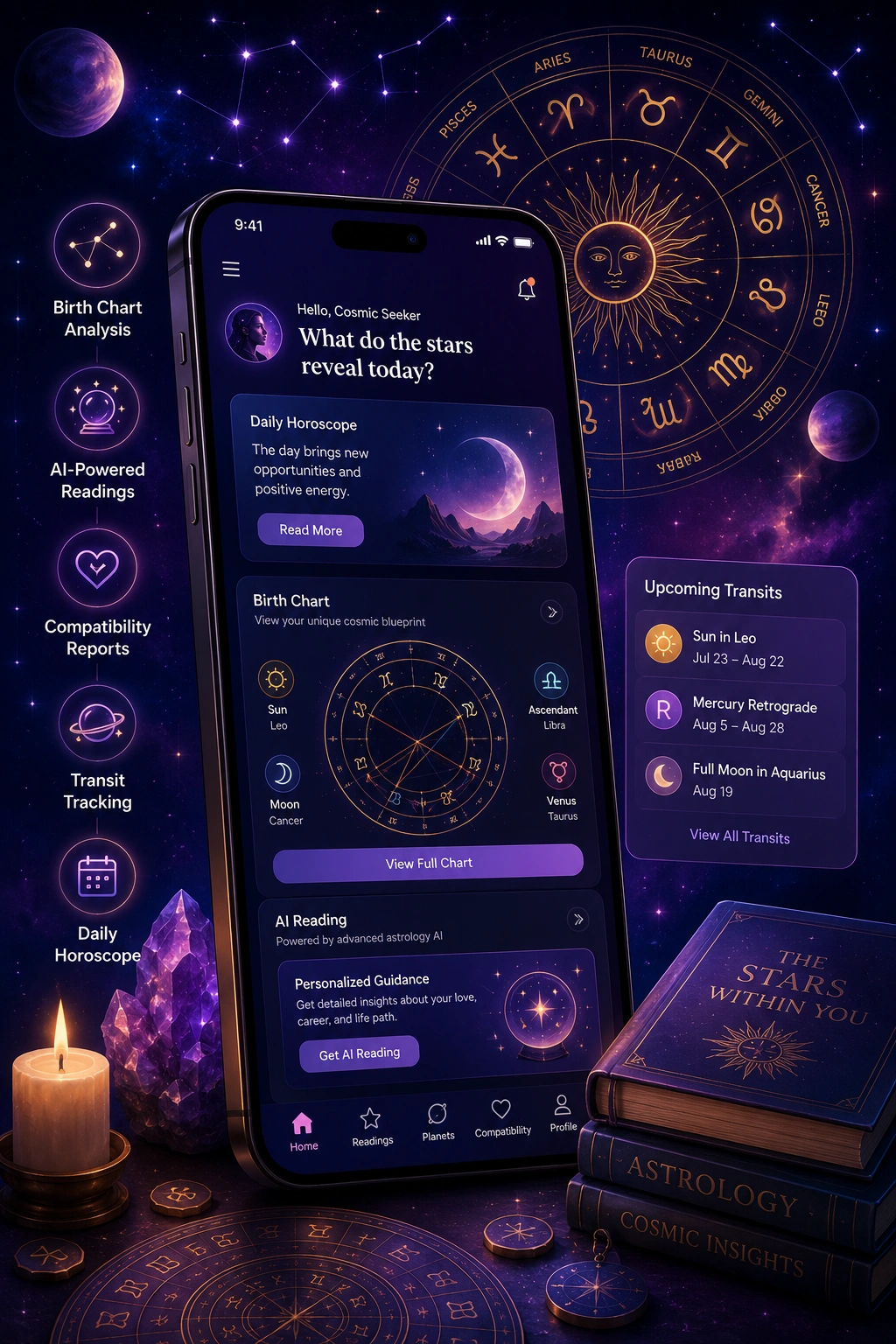
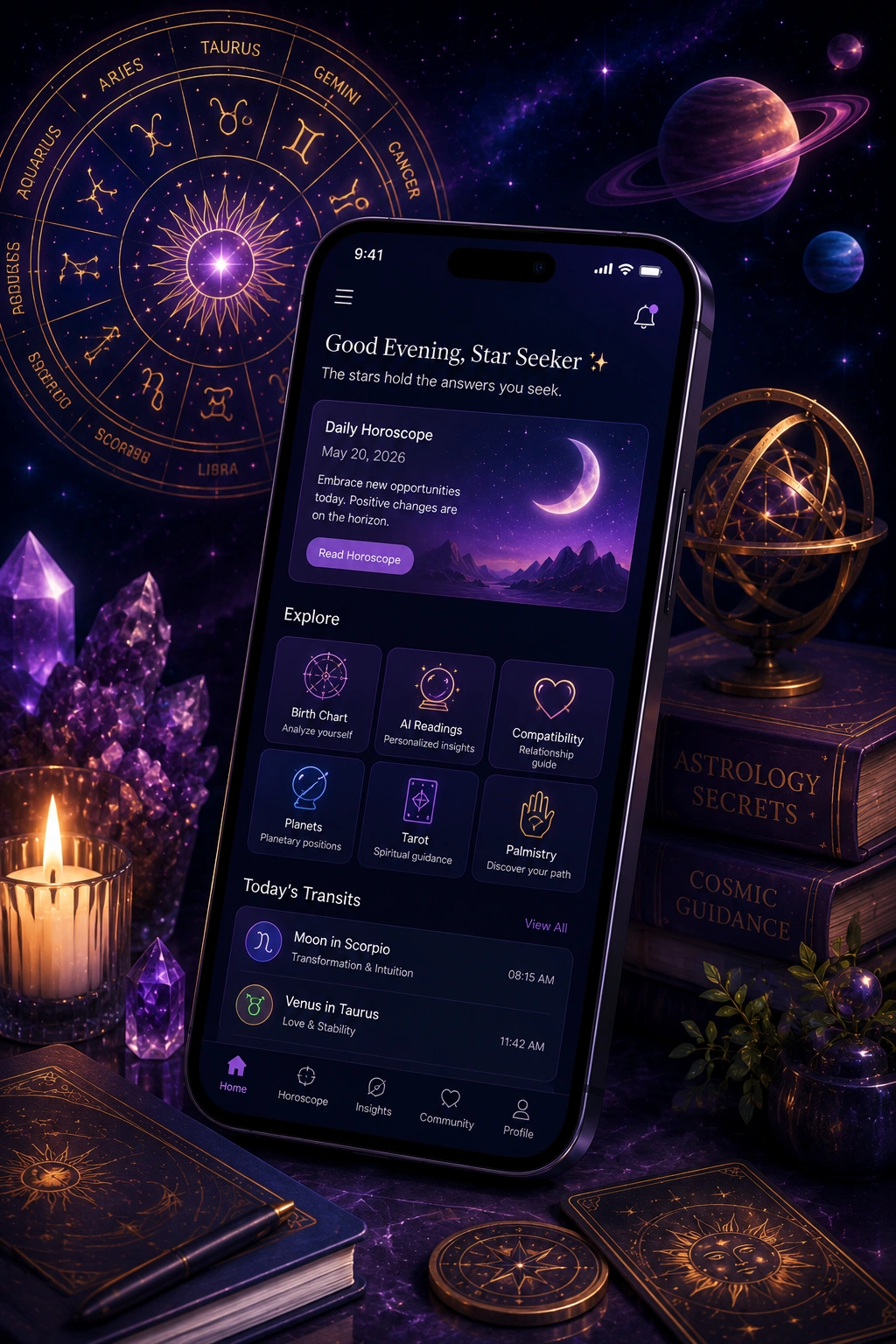


You build an astrology app by choosing a model first. That means picking between an automated content app, like Co-Star or The Pattern, or a live-consultation marketplace, like AstroTalk. You then integrate an accurate birth-chart engine. Swiss Ephemeris or an astrology API works here, never something built from scratch. You ship an MVP around birth-data onboarding, a daily horoscope feed, birth charts, and compatibility. Push notifications round out that core experience. You then differentiate with an AI interpretation layer. That layer generates personalized, human-like readings from real chart data. In the United States in 2026, a content-app MVP starts around $15,000, with cost scaling by tier from there. Full pricing detail follows in the cost section ahead.
This guide covers the complete path from idea to a launched US astrology app. That includes the model choice, the birth-chart engine, AI readings, features, tech stack, cost, timeline, and compliance.
Timing matters here. The horoscope and astrology app market was valued near $153 million in 2025. It is growing at an estimated 11.3 percent annual rate. Roughly 60 percent of US users are women aged 18 to 34. Gen Z and Millennials are driving most of that growth. Co-Star reportedly earns close to $5 million a year from around 30 million users. That figure alone proves automated content apps can scale.
Two decisions matter more than anything else here. Choosing the right product model and integrating a reliable birth-chart engine are the two decisions that matter most in custom astrology app development. A single timezone error in that engine destroys user trust instantly.
Who this guide is for
This guide is written for consumer-app founders and wellness brands. It is also written for content creators, product managers, and CTOs planning a build. By the end, you will be able to scope, budget, and brief a real project.
What Is An Astrology App?
An astrology app delivers personalized astrological insights to its users. That includes birth charts, daily horoscopes, transit forecasts, and compatibility readings. These insights come from a user's date, time, and place of birth. An astronomical calculation engine, like Swiss Ephemeris or NASA JPL data, generates them. The category spans automated content apps like Co-Star and The Pattern. It also includes live-consultation marketplaces like AstroTalk.
Underneath that definition sits real technical and business complexity. Birth-data onboarding collects a user's date, time, and location carefully. The birth-chart engine calculates planetary positions, houses, and aspects from that data. A daily horoscope feed keeps users engaged after onboarding ends. Transit forecasts track how current planetary movement affects a user's chart. Compatibility, also called synastry, compares two people's charts directly. Some apps add live astrologer consultations on top of all this.
One distinction matters more than any other here. An automated content app generates everything through code or AI, with no live practitioners. Co-Star and The Pattern both work this way, typically through subscription or freemium pricing. A live-consultation marketplace works completely differently. It connects users with real astrologers through per-minute billing and digital wallets. AstroTalk represents this model, structurally closer to Upwork than to a content app.
Birth-chart engine accuracy is non-negotiable in either model. A wrong calculation destroys credibility almost immediately. This category sits at the intersection of wellness, AI, and personalized media, so custom mobile app development matters just as much as the underlying astrology engine itself.

Estimate Your App Development
Cost in Seconds
Discover your project budget with our interactive AI-powered app cost calculator.
Why Build An Astrology App in 2026? (US Market and Opportunity)
You build an astrology app in 2026 because the category is growing and sticky. The horoscope and astrology app market was valued near $153 million in 2025. It is growing at roughly 11.3 percent annually. About 60 percent of US users are women aged 18 to 34. Its scale, tens of millions of users on a largely free model, shows the category can monetize even without heavy paywalls. AI personalization is reshaping the category too. Co-Star reportedly integrated GPT-style protocols into its reading experience. Nebula reportedly grew 250 percent on the strength of similar personalization. Static horoscopes are becoming daily, conversational experiences as a result.
$153M
Horoscope & astrology app market, 2025
11.3%
Estimated annual growth rate
~60%
US users are women aged 18 to 34
250%
Nebula's reported growth on personalization
These figures point to a category with real staying power. Market size alone understates the opportunity here. Broader AI-astrology projections, according to Data Insights Market, run considerably higher than the base figure. The demographic concentration is just as telling as the growth rate. Nearly 60 percent of users skew Gen Z and Millennial women specifically. Social trends on platforms like TikTok continue driving much of that demand.
Monetization proof already exists across the category's biggest names, and Co-Star's revenue is the clearest data point for it. Nebula's reported growth tracks closely with its personalization improvements too. Both examples suggest personalization drives revenue more than raw feature count.
The addressable market here is larger than it first appears. It extends well beyond people who strictly believe in astrology. Anyone curious about personality psychology or relationship compatibility tends to try one of these apps. The bar to entry, in terms of user willingness, is genuinely low.
White space exists in a few specific areas
AI-personalized voice and tone is one clear opportunity. Niche communities, including Vedic astrology, tarot-blended content, and queer-focused spaces, are another. Astrology-dating and social or compatibility virality round out the remaining opportunity. The category's real 2026 shift is moving from generic sun-sign content toward AI-driven personalization.
What Types Of Astrology Apps Can You Build?
The main types are content and horoscope apps, like Co-Star and The Pattern. Birth-chart and natal-analysis apps form a deeper, chart-focused second type. Live-consultation marketplaces, like AstroTalk, make up a third category. Astrology-based dating and compatibility apps are a fourth type. Niche-tradition apps, including Vedic or Kundli tools like AstroSage, or tarot-blended apps, round out the list. Each type carries a different engine depth, content strategy, and cost profile.
Model choice determines architecture and cost more than any single feature does. A content or horoscope app combines editorial content, an engine, and push notifications. That combination is far lighter than a live-consultation marketplace. A marketplace needs three distinct user types, meaning users, practitioners, and admin. It also needs per-minute billing and a full wallet system. Astrology-dating apps add real matching logic on top of standard chart features. The content-app path reaches the market fastest but caps revenue lower. The marketplace path takes longer to build but carries higher revenue potential.
Content / Horoscope Apps
Sun-sign and personalized horoscopes combine into a daily feed with this model. Push notifications drive daily return visits consistently. Co-Star and The Pattern both represent this editorial-plus-engine model well, typically running $15,000–$40,000 for a solid build.
Birth-Chart / Natal-Analysis Apps
Natal charts, transits, and planetary aspects get deeper treatment with this model. Swiss Ephemeris typically powers the underlying calculations here. TimePassages represents this detail-oriented, engine-heavy approach directly, usually running $25,000–$55,000 given the calculation depth involved.
Live-Consultation Marketplaces
Real astrologers connect with users through per-minute billing on this model. Three distinct user types, plus a digital wallet, define this model's complexity. AstroTalk represents this marketplace approach, complete with its own practitioner app, typically running $70,000–$150,000+ given the billing infrastructure required.
Astrology Dating & Compatibility Apps
Synastry-based matching connects potential partners under this model. Zodiac compatibility scoring drives much of the matching logic here. High shareability makes this type especially prone to organic virality, with builds typically running $30,000–$65,000.
Niche-Tradition Apps (Vedic / Tarot)
Focused communities around specific traditions get served directly with this model. AstroSage represents the Vedic or Kundli-focused approach well. Tarot-blended apps combine card-based readings with standard astrological content, with a typical build running $20,000–$45,000.
Got Problems? Let Us Help You With the Right Solution


How Do You Build The Birth-Chart Engine And AI Interpretation Layer?
You build the birth-chart engine by integrating an existing astronomical library or API. Swiss Ephemeris is the industry standard, validated directly against NASA JPL data. Astro-Seek and Astro.com's API offer similar integration paths. Writing your own engine is not the right approach here. Planetary-position, house, and aspect calculations are a genuine specialist problem. A single timezone error in this layer destroys user credibility fast.
You then build the AI interpretation layer through a hybrid approach. Deterministic astrology facts come first, generated by the engine itself. An LLM, whether OpenAI, Anthropic, or an open-source model, interprets those facts next. A structured facts object or RAG setup constrains that interpretation. Guardrails ensure readings stay personalized and human-like, never fabricated.
The Ephemeris Layer
The ephemeris layer deserves careful attention before any other engineering work begins. Integrate Swiss Ephemeris and validate its output against NASA JPL data directly. Accurate geocoding matters just as much as the calculation engine itself. GeoNames combined with the Google Time Zone API handles this reliably. Historical time offsets are the number one correctness trap in this category. A birth recorded before a regional timezone change can throw off an entire chart. Once calculations run correctly, normalize the output into planets, signs, houses, and aspects. Budget roughly $5,000 to $10,000 for this single component of the build.
The AI Interpretation Layer
The AI interpretation layer follows a proven, repeatable pattern. Compute the astrology facts deterministically through the validated engine first. Pass those facts as a structured object, or through RAG context, to the LLM. The model then generates a conversational, personalized reading from that structured input. Guardrails, toxicity filters, and human-in-the-loop review matter for sensitive topics specifically. Logging the prompt, the facts object, the model version, and the output hash supports long-term reliability.
Two correctness imperatives run through this entire pillar
First, there is zero tolerance for timezone errors or mislabeled planetary aspects. Second, the engine depends on the AI interpreting facts rather than inventing them.
What Features Does An Astrology App Need? (Must-Have And Advanced)
At minimum, an astrology app needs birth-data onboarding, including a "time unknown" option. It needs an accurate birth-chart engine and a daily horoscope feed. Push notifications, a compatibility or synastry tool, and user profiles round out the core. Subscriptions complete the must-have list. Advanced builds add AI-personalized readings and transit forecasts. They also add a journal, tarot content, and social or community features. Marketplace apps add live astrologer chat and per-minute billing on top of all this.
Three imperatives matter more than the rest of the feature list combined. The daily horoscope feed, paired with push notifications, is the number one retention mechanic. Over-notifying users, though, quickly causes real churn. Getting notification timing right requires ongoing analytics and experimentation. The compatibility tool functions as this category's virality engine. High shareability here consistently drives organic user acquisition. Onboarding UX also sets the tone for the entire app experience. Collect only what is truly needed, meaning birth date, time, and place. Explain clearly why an exact birth time actually matters to chart accuracy. Always offer a "time unknown" option for users who lack that detail.
Compatibility features roughly double the computational load compared to a single chart. Live consultation, where offered, adds an entire marketplace layer on top of the core app.
Core / MVP Features
Birth-data onboarding with a "time unknown" option anchors this layer.
The birth-chart engine and a daily horoscope feed follow from there.
Push notifications typically run through Firebase Cloud Messaging.
Compatibility tools, user profiles, and subscriptions through Stripe round out this core layer.
Firebase Auth commonly handles secure account access here.
Engagement and Retention Features
Personalized daily and weekly readings tailored to each user lead this tier.
Transit and moon-phase alerts keep the experience feeling current.
A journal for personal reflections adds a habit-forming layer.
Streaks, social sharing, and friend compatibility round out this engagement tier.
Advanced / Differentiating Features
AI conversational readings, often powered by the OpenAI API, lead the advanced set.
Tarot content and astrology-dating or matching features extend from there.
Multi-language support broadens the addressable audience considerably.
Marketplace builds add live astrologer chat with per-minute billing and a digital wallet.
How Do You Build An Astrology App? Step-By-Step
You build an astrology app in seven stages. First, choose the model and define a focused MVP, limited to Tier 1 features. Second, integrate the birth-chart engine and validate its accuracy. Third, design birth-data onboarding alongside a cosmic, calming UX. Fourth, build the daily content and AI interpretation layer with guardrails in place. Fifth, add push notifications, compatibility, and subscriptions. Sixth, test calculation accuracy, timezones, and content quality thoroughly. Seventh, launch on the App Store and Google Play, then iterate with retention analytics.
-
1
Choose Model and Define Focused MVP
Decide between a content app and a consultation marketplace early. Limit initial scope strictly to Tier 1 features only.
-
2
Integrate Birth-Chart Engine and Validate Accuracy
Integrate Swiss Ephemeris rather than building a calculation engine from scratch. Validate every output directly against NASA JPL data.
-
3
Design Onboarding and Cosmic UX
Wireframe the birth-data flow in Figma, including a "time unknown" option. Keep the visual tone calming and genuinely cosmic throughout.
-
4
Build Daily Content and AI Interpretation Layer
Combine deterministic chart facts with a constrained LLM for each reading. Guardrails must sit around every generated piece of content.
-
5
Add Push, Compatibility and Subscriptions
Push notifications drive daily retention, while compatibility drives viral sharing. Subscriptions typically layer on top of both of these mechanics.
-
6
Test Accuracy, Timezones and Content Quality
Validate zero timezone errors across a wide range of test cases. Run AI-generated content through quality and tone review carefully.
-
7
Launch and Iterate with Retention Analytics
Launch through App Store Connect and Google Play Console together. Tune notification timing and content based on real retention data afterward.
The field's biggest mistake is launching with every feature at once. Ship Tier 1 first, meaning birth chart, daily readings, compatibility, and push. Validate retention on that focused set before adding anything else. Tier 2 and Tier 3 features can follow once retention data supports them.
Accuracy validation matters throughout this entire process. Test consistently against NASA JPL data and aim for zero timezone errors. AI content QA deserves the same rigor throughout custom software development, covering guardrails, tone, and human review.
What Tech Stack Is Used To Build An Astrology App?
The dominant 2026 stack pairs React Native or Flutter for cross-platform mobile development. Native SwiftUI or Kotlin remains optional for teams wanting a fully native feel. Node.js, Python, or Go typically power the backend. Swiss Ephemeris, validated against NASA JPL data, handles chart calculations. GeoNames combined with the Google Time Zone API handles geocoding and time accuracy. PostgreSQL with Redis caching manages core data and performance. AWS or Google Cloud, often through Cloud Run or ECS, handles hosting. OpenAI or Anthropic LLMs, paired with RAG, power AI readings. Firebase Cloud Messaging handles push, and Stripe with RevenueCat handles subscriptions.
| Layer | Recommended Tools | Why It Matters |
|---|---|---|
| Mobile frontend | React Native, Flutter | Cross-platform code reduces build cost significantly |
| Backend | Node.js, Python, Go | Handles chart logic, AI orchestration, and API calls |
| Ephemeris engine | Swiss Ephemeris, NASA JPL validation | Never build this yourself, integrate and validate instead |
| Geocoding and time | GeoNames, Google Time Zone API | Solves the historical timezone accuracy trap directly |
| Database and cache | PostgreSQL, Redis | Stores chart data with fast retrieval for daily feeds |
| Cloud hosting | AWS, Google Cloud | Cloud Run or ECS scales with daily generation load |
| AI layer | OpenAI, Anthropic, RAG | Powers personalized readings constrained by real chart facts |
| Push notifications | Firebase Cloud Messaging | Drives the daily retention loop central to this category |
| Subscriptions | Stripe, RevenueCat | Handles billing across web and mobile app stores |
Two stack imperatives matter more than any specific tool choice here. Never build your own ephemeris, since integrating and validating an existing one is far safer. Timezone and geocoding accuracy form the correctness backbone of the entire app.
A single codebase across platforms cuts real development costs. Reports suggest reasonable latency targets, like a p95 under 300ms, keep key endpoints feeling responsive. The same stack supports web application development for admin tools and content management alongside the mobile app.
Speak With Our Consultant
Partners
Get expert guidance before you invest in AI software development. Work directly with Giovanni and Bibin to validate your technology direction, align AI with business goals, and make confident decisions that reduce risk and accelerate outcomes.
Request a Strategic Consultation
What AI And Automation Features Belong In A 2026 Astrology App?
AI-personalized horoscope and chart readings define a competitive 2026 astrology app. These readings are conversational and human-like, generated from deterministic chart facts. AI compatibility analysis adds a second layer of personalization on top. AI chat companions handle open-ended astrology Q&A directly with users. Mood- and behavior-aware personalization tailors content further over time. Automated daily-content generation rounds out the list, built with LLMs like OpenAI or Anthropic. A structured facts object and RAG, paired with safety guardrails, constrain all of it.
Each capability consumes different data and serves a distinct purpose here.
Personalized reading
Personalized reading draws on chart facts generated by the engine itself.
Compatibility analysis
Compatibility analysis draws on two separate charts compared against one another.
Chat companions
Chat companions draw on ongoing user interaction alongside static chart facts.
Mood-aware personalization
Mood-aware personalization, where collected with proper consent, adds behavioural and lifestyle signals into the mix.
AI is the clearest 2026 differentiator in this entire category. It turned static sun-sign content into something personalized and conversational. Co-Star's reported GPT integration is one clear example of this shift. Nebula's growth reportedly reflects a similar personalization-driven pattern.
The safety pattern here matters as much as the personalization itself
The LLM must interpret deterministic facts rather than invent new astrology outright. Guardrails against medical, financial, or deterministic claims are non-negotiable. Toxicity filters and human-in-the-loop review protect sensitive content specifically. LLM API usage should be treated as a real, ongoing operating cost. Daily content generation at real scale adds up meaningfully over time.
How Much Does It Cost To Build An Astrology App In The US? (2026)
In the United States in 2026, a content-app astrology MVP costs $15,000 to $35,000. A mid-tier app with AI personalization, compatibility, and subscriptions runs $35,000 to $70,000. A live-consultation marketplace or advanced AI platform reaches $70,000 to $150,000 or more. The biggest cost drivers are the model choice, content or marketplace. The birth-chart engine, typically $5,000 to $10,000, adds a distinct cost layer. AI interpretation and, for consultation apps, live-billing infrastructure round out the drivers.
The birth-chart engine is a discrete, well-bounded component of any build. Integrating it, rather than building it, keeps this cost contained. Compatibility features roughly double the computational requirements of a single-chart app. A live-consultation marketplace is a fundamentally bigger build than a content app. It needs three user types, per-minute billing, and a digital wallet system. The real-time billing engine is genuinely the hardest part of that build. US-based teams typically run higher than offshore equivalents on comparable work. Cross-platform development can cut mobile build cost by 30 to 40 percent.
Cost by Model and Tier (Content MVP / Mid-tier AI / Consultation Marketplace)
| Tier | Scope | Typical US Range | Timeline |
|---|---|---|---|
| Content-app MVP | Birth chart, daily feed, compatibility, push | $15,000 to $35,000 | 2 to 3 months |
| Mid-tier AI | AI personalization, compatibility, subscriptions | $35,000 to $70,000 | 3 to 5 months |
| Consultation marketplace | Live astrologers, per-minute billing, advanced AI | $70,000 to $150,000+ | 4 to 7+ months |
What Drives Astrology App Cost the Most?
Ongoing and AI / Operating Costs
- • LLM API usage for daily AI readings scales directly with active users.
- • Push notification infrastructure adds a smaller but real recurring cost.
- • Content production, especially for editorial-style horoscope writing, adds ongoing expense too.
- • Cloud hosting costs scale with daily generation volume and overall user growth.
- • General maintenance typically runs 15 to 25 percent of build cost annually.
The field's caution here is clear: AI personalization costs are commonly under-budgeted. A simple estimator combines model choice, engine cost, and the AI layer. Add marketplace billing cost where relevant, plus 15 to 25 percent for maintenance. Add ongoing AI run cost on top of that full picture.
How Long Does It Take To Build An Astrology App?
An astrology app takes about 2 to 3 months for a content-app MVP. That MVP covers birth charts, daily feed, compatibility, and push notifications. A mid-tier app with AI personalization and subscriptions takes 3 to 5 months. A live-consultation marketplace or advanced AI platform takes 4 to 7 months or more. The AI interpretation layer and content QA extend timelines the most. For marketplaces, the real-time billing engine adds further time on top.
A realistic phase breakdown looks roughly like this. Discovery and design typically take 2 to 3 weeks at the start. Ephemeris integration and validation follow, given how critical accuracy is here. Onboarding design and the daily feed build happen next. The AI layer and its content QA process run alongside that work. Push notifications, compatibility, and subscriptions layer in after that. Store submission through App Store Connect and Google Play Console comes last.
The content-app path is genuinely the fastest build in this entire guide's tier
Low structural complexity keeps that timeline short and predictable. A consultation marketplace adds a full practitioner app and per-minute billing on top. Both of those additions extend the timeline considerably. AI prompt tuning and content QA also add real time before launch.
What Are The Biggest Challenges And Mistakes When Building An Astrology App?
The biggest mistakes start with building your own ephemeris instead of integrating one. Timezone and birth-time errors are a close second, destroying credibility fast. Launching with every feature at once, instead of a focused Tier 1 MVP, is another common failure. Over-notifying users turns the retention engine into a churn engine. Letting AI fabricate astrology, instead of interpreting real facts, damages trust quickly. Making medical, financial, or deterministic claims erodes that trust further still.
Building a custom ephemeris
Building a custom ephemeris deserves the most attention on this list. Integrating Swiss Ephemeris and validating against NASA JPL data is the safer path.
Timezone and birth-time errors
Timezone and birth-time accuracy is the category's number one correctness trap. A single error here can destroy user credibility almost instantly.
Feature overload at launch
Feature overload at launch is a closely related mistake worth avoiding. Ship Tier 1 first, validate retention, then expand toward Tier 2 and beyond.
Notification overuse
Notification overuse is a subtler but equally damaging mistake. The exact mechanic that drives retention becomes a churn engine when mistimed. Tuning notification frequency with real analytics helps avoid this trap.
Unconstrained AI
Unconstrained AI is a related and serious risk in this category. The AI must interpret deterministic facts rather than invent new astrology. Guardrails and human review protect against this failure mode directly.
Claims and wellbeing
Claims and wellbeing round out the most serious mistakes here. Avoid medical, financial, or fatalistic predictions across all generated content. Keep the overall tone supportive rather than deterministic or alarming. This is a genuine trust and ethics requirement in this category.
Every one of these mistakes is solvable with a validated engine and constrained AI. Focused scope and an experienced build partner help close the remaining gaps.
What Compliance, Privacy And Wellbeing Rules Apply To US Astrology Apps?
US astrology apps may face real data-privacy obligations depending on their users and where they operate. CCPA and CPRA apply directly to apps serving California residents, and other states carry comparable laws worth checking against your specific user base. Data export and deletion capabilities are typically required under these laws. Apps must comply with COPPA if minors may realistically use the platform. App Store and Google Play content and subscription rules apply broadly too. Payments must meet PCI-DSS standards, usually offloaded through Stripe. As a genuine wellbeing and trust duty, apps must avoid medical, financial, or deterministic claims. AI-generated content must stay safe and supportive throughout. Apps should be transparent so that readings serve entertainment and self-reflection purposes.
Data privacy
Data privacy sits at the center of this compliance picture. Birth date, time, location, and behavioral data all count as personal information. CCPA, CPRA, and relevant state laws apply, alongside GDPR for any EU users. Explicit consent, along with data export and deletion options, is expected here. Age-gating matters too, since COPPA applies if under-13 users are realistically possible.
Platform rules & payments
Platform rules add another layer worth planning for early. Apple and Google both maintain content and subscription guidelines for this category. Some platforms apply specific rules to spiritual or astrology-labeled apps. Payments bring their own requirement, meeting PCI-DSS through tokenized gateways like Stripe.
Claims & wellbeing
Claims and wellbeing form the category's genuine trust requirement. Avoid medical, financial, legal, or deterministic and fatalistic predictions entirely. Include clear "for entertainment" or "for self-reflection" framing throughout the app. Keep tone wellness-positive rather than alarming or absolute. AI guardrails and human review matter most for sensitive topics specifically. This wellbeing and claims duty reduces both regulatory and reputational risk considerably.
None of this constitutes legal advice, and verifying current law with counsel is recommended.
How Do Astrology Apps Make Money? (Monetization Models)
Astrology apps primarily make money through subscriptions and freemium models. Free daily horoscopes typically fund paid deep-dives, compatibility, and premium reports. Pricing commonly runs $4.99 to $19.99 per month. In-app purchases are a second model, covering one-time birth-chart or tarot reports. Live-consultation revenue is a third path, through per-minute astrologer chats in marketplace apps. Secondary streams, like merchandise and affiliate sales, add further revenue. Subscriptions remain the dominant, highest-retention lever across the category.
Freemium and subscription
Freemium and subscription is the proven core model in this space. Free daily content funnels users toward paid deep-dives over time. Co-Star and most content apps follow this exact pattern. Pricing typically lands between $4.99 and $19.99 per month.
In-app purchases
In-app purchases work as an à la carte alternative or addition. Birth charts, compatibility reports, and tarot readings all fit this model well. This approach boosts average revenue per user without requiring a subscription commitment.
Live consultation
Live consultation represents the highest-ARPU path in this entire category. Per-minute astrologer billing, as seen in AstroTalk's marketplace model, drives that higher revenue.
Secondary revenue streams
Secondary revenue streams add smaller but meaningful additional income. Merchandise, like crystals or journals, and affiliate marketplace partnerships both fit here.
The field's recommended pattern layers several of these models together. Freemium and subscription form the base, with à la carte reports layered on top. Optional live readings can sit above that for users wanting deeper engagement. Protecting user trust matters throughout this monetization strategy. Avoid over-paywalling the daily habit that keeps users returning in the first place.
Key Takeaways
1 Integrating a validated ephemeris matters more than almost any other early decision.
2 Constraining the AI to interpret facts, rather than invent them, protects long-term trust.
3 Making push-driven daily content the retention engine keeps users coming back.
4 Shipping a focused Tier 1 MVP first avoids the category's most common early mistake.
5 Keeping claims and tone responsible protects both users and the platform's reputation.
6 A content-app MVP can launch in 2 to 3 months and cost roughly $15,000 to $35,000.