

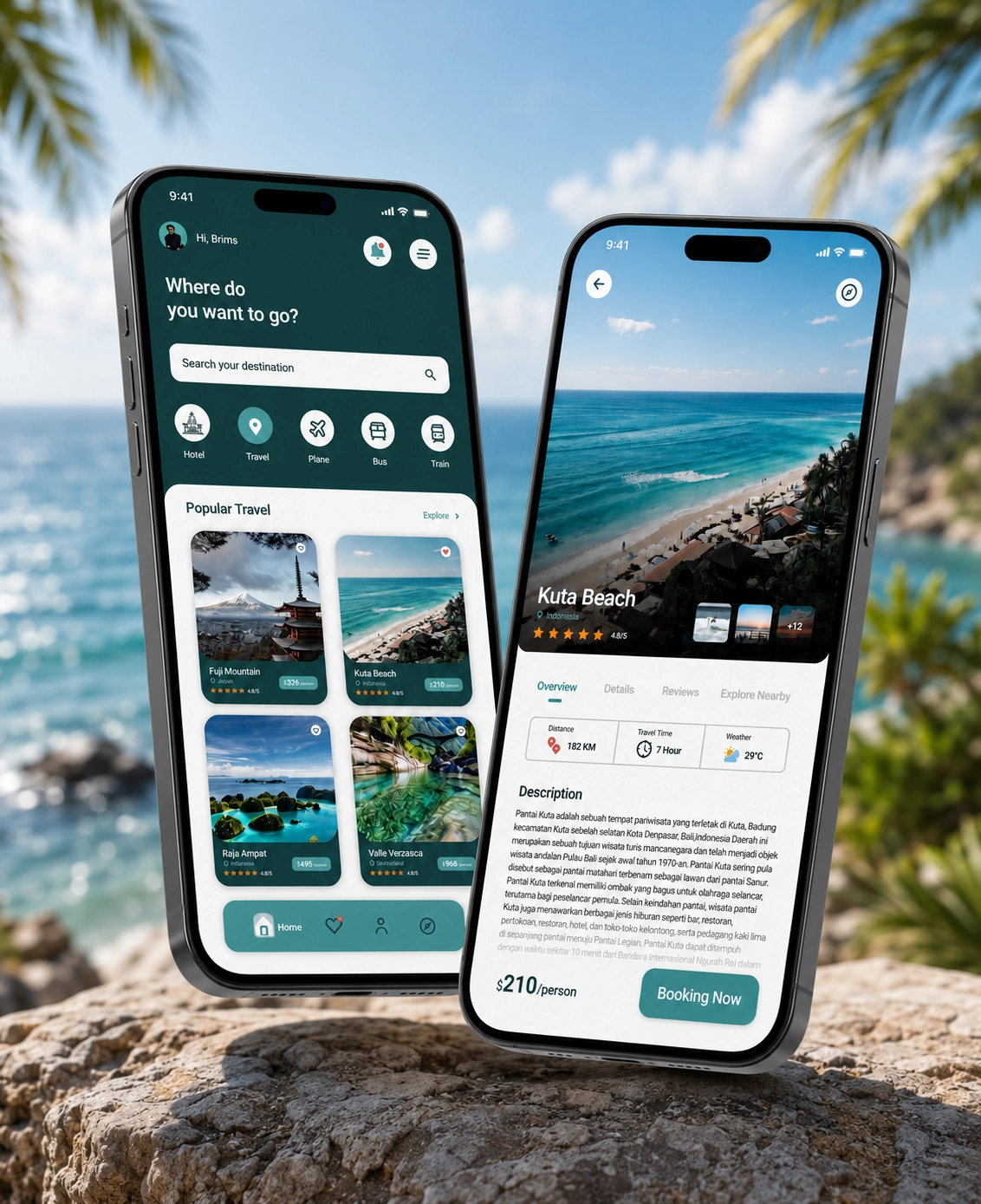


You build a travel planning app by choosing a focus among itinerary building, all-in-one trip organizer, or booking-enabled planner. From there, you ship an MVP around an itinerary builder, destination discovery, interactive maps (Google Maps or Mapbox), and saved trips. In 2026, that means adding AI itinerary generation and booking integrations through APIs like Amadeus, Sabre, or affiliate links.
In the United States in 2026, a lean MVP costs $25,000–$65,000. A mid-tier app with AI itineraries and booking APIs runs $65,000–$160,000.
An advanced multi-platform AI travel planner reaches $160,000–$400,000 or more.
This guide covers the full path from idea to a launched US travel planning app. It includes core features, AI itinerary architecture, maps and booking integration, tech stack, cost breakdown, and compliance requirements. The timing matters. Over 65% of travelers prefer a booking app over a website, according to industry research.
The online travel booking market is on track toward $1.2 trillion in 2026. AI personalization is reshaping how trips are planned. That shift opens real space for focused products.
Who this guide is for
This guide is written for travel-tech founders, product managers, agencies, and CTOs. By the end, you will be able to scope, budget, and brief a travel app build. Google distributes travel AI across Search, Maps, and Gemini and has no standalone product in its pipeline. The winning move is vertical specialization and superior UX in a niche.
Founders without in-house engineers often partner with a specialist for custom travel app development to move faster. This avoids costly architectural missteps from the outset.
What is a Travel Planning App?
A travel planning app is a mobile or web application that helps users discover destinations, build itineraries, and manage trips. It combines destination search, an itinerary builder, interactive maps, saved trips, and real-time travel data. In 2026, leading apps also integrate AI-generated plans and booking APIs like Amadeus and Sabre. TripIt, Wanderlog, and Hopper each represent a different point on that spectrum.
At its core — a travel planning app handles destination discovery, day-by-day itinerary creation, and route planning. It also covers trip collaboration, real-time alerts, and post-booking management. The category breaks into four distinct types.
Pure itinerary planner
A pure itinerary planner like TripIt or Wanderlog focuses on organizing and sharing trip plans.
All-in-one trip organizer
An all-in-one trip organizer layers maps, booking storage, and documents on top of planning.
Booking-enabled planner
A booking-enabled planner adds live inventory and transactions.
AI trip planner
An AI trip planner uses an LLM to generate preference-aware, day-by-day plans.
The planning-first versus booking-first distinction matters for scoping. Booking adds significant API, payment, and compliance scope. Travel agencies and operators often pair the consumer app with travel and trip-planning software and CRM system development services. That combination connects the consumer experience to agency-side customer and booking management.

Estimate Your App Development
Cost in Seconds
Discover your project budget with our interactive AI-powered app cost calculator.
Why Build a Travel Planning App in 2026? (US Market & Opportunity)
Phase 01 · Mobile-first and AI-native
Travel is mobile-first and AI-native in 2026. Research consistently shows that more than 65% of travelers choose a mobile app over a website when booking trips. The online travel booking market is approaching a $1.2 trillion valuation in 2026. Mobile travel booking is projected to exceed $526 billion by 2032, according to industry projections.
McKinsey research links AI-driven personalization to roughly a 20% lift in customer satisfaction. Travel Weekly confirms that AI-assisted planning is now a baseline traveler expectation. Amadeus research points to the same shift across hotel and flight booking behavior.
Phase 02 · Win a niche, not breadth
The structural opportunity is precise. Google has built travel AI into Search AI Overviews, Maps, and Gemini, with no standalone product on the roadmap. Startups cannot out-data Google. They can win a niche. Adventure travel, family trips, accessible travel, business travel, and specific regions are all viable targets. Superior UX in a focused vertical beats breadth every time.
Phase 03 · The winning architecture
The winning 2026 architecture chains three layers together. AI personalization drives the planning experience. Frictionless booking converts intent into revenue. Embedded fintech multiplies margins.
Hopper demonstrated this model by anchoring revenue in embedded fintech products. Those products have grown into a dominant share of its overall earnings. A product with one clean revenue stream at MVP and an expansion-ready backend is what scales.
What Types of Travel Planning Apps Can You Build?
The main types are itinerary builders, all-in-one trip organizers, AI trip planners, booking-enabled apps, and niche experience apps. Each carries a different integration depth and cost profile.
A pure itinerary planner is far lighter to build than a booking-enabled OTA-adjacent app. That model needs GDS or booking APIs, payments, and inventory handling from Kayak-style aggregators or direct GDS connections. The strongest 2026 opportunity sits at the intersection of niche focus and AI personalization.
Itinerary Builder Apps
Itinerary builders handle day-by-day planning, saved places, and trip timelines. They require the lightest integration in the category. Google Maps API and Mapbox power the location layer. TripIt and Wanderlog are the benchmark products in this space.
All-in-One Trip Organizers
These apps combine an itinerary builder with maps, booking storage, and travel document management. They also include real-time alerts via flight-status APIs and calendar sync. TripIt Pro represents the fuller version of this model.
AI Trip Planner Apps
AI trip planners generate preference-aware, constraint-aware itineraries using a large language model. The key is combining an LLM via the OpenAI API or Gemini with a constraint-solving optimizer. Without that optimizer, plans are plausible but not feasible.
Booking-Enabled and OTA-Adjacent Apps
These apps let users search and book flights, hotels, and experiences directly. They carry the heaviest integration and compliance scope in the category. Amadeus, Sabre, and NDC are the booking-layer standards. Stripe handles payments.
Niche and Experience Apps
Niche apps target adventure travel, family trips, accessible travel, or local experiences. The total addressable market is smaller, but engagement is high and competition is thinner. GetYourGuide and Roadtrippers are the reference points here.
How Does AI Itinerary Generation Work?
AI itinerary generation combines a large language model with a constraint-solving optimizer. The LLM running via the OpenAI API or Gemini handles natural-language understanding and generates candidate plans.
The optimizer enforces real-world rules including distances, opening hours, budgets, travel time, and user preferences. Without the optimizer, the output is plausible text, not a feasible day-by-day plan. Pure LLM wrappers without constraint solving produce a high rate of invalid itineraries.
LLM intent layer
The architecture has three layers. The LLM parses intent such as "a quiet beach in Spain with good coffee" and generates candidate itineraries.
Constraint & optimization layer
The constraint and optimization layer then validates every plan against real data. It checks geolocation distances, opening hours, transit time, and budget. Leading players use this hybrid LLM-plus-optimizer approach to reach reliable accuracy.
Data grounding layer
The data grounding layer then pulls real places, ratings, and availability from Google Places API. It also pulls from maps and booking APIs so recommendations are real and bookable, not just plausible.
The common failure mode
The common failure mode is skipping the constraint layer entirely. A pure LLM wrapper frequently produces itineraries with closed venues, impossible transit times, or non-existent hotels. RAG (retrieval-augmented generation) is the standard technique for grounding the LLM in current, real-world data. AI itinerary quality is both a primary differentiator and a meaningful cost lever in 2026.
What Features Does a Travel Planning App Need? (Core + Advanced)
A travel planning app needs destination search and discovery at minimum. It also needs an itinerary builder with day-by-day organization. Interactive maps powered by Google Maps or Mapbox are essential. Saved and offline trips, user accounts, and trip collaboration round out the MVP feature set. Advanced builds add AI itinerary generation, booking integration via Amadeus or Sabre, real-time flight and weather alerts, expense tracking, and AR navigation.
Maps and places integration and offline access quietly drive the most cost and long-term retention. Travelers are often offline or roaming. Booking integration is the single biggest scope multiplier in any travel app build.
Core and MVP Features
Must-haveDestination search and discovery is powered by Google Places API with filtered browsing by category, rating, and region.
The itinerary builder and day planner offers drag-and-drop day organization with time blocks and place cards.
Interactive maps and POIs use Google Maps API or Mapbox. They display custom markers, route lines, and points of interest.
Saved and offline trips store full itinerary data locally for roaming scenarios. This is critical for international travelers.
Accounts and social login use Firebase Auth to handle email, Google, and Apple sign-in with minimal backend overhead.
Trip collaboration provides shared trip access with role permissions for travel companions, covering both view and edit access.
Push and flight alerts run through Firebase Cloud Messaging and Apple Push Notification service. Weather data comes from OpenWeather API.
Advanced and Differentiating Features
AdvancedAI itinerary generation uses an LLM-plus-optimizer pipeline via the OpenAI API or Gemini. It is grounded in Google Places API data and live booking availability.
Booking integration connects flights and hotels via Amadeus or Sabre for direct booking. Affiliate links via Skyscanner offer a lighter MVP path.
Real-time alerts and disruption handling deliver live flight status with push notifications and rebooking options when disruptions occur.
Expense and budget tracking supports per-person and group expense splitting with multi-currency handling via Stripe.
AR navigation overlays walking directions on a live camera feed. ARKit powers this on iOS and ARCore handles it on Android.
Reviews and UGC let users submit photos, ratings, and tips attached to saved places.
How Do You Build a Travel Planning App? Step-by-Step
Seven stages, in order
Building a travel planning app follows seven stages. Pick a niche and define the MVP. Plan maps and booking integrations early. Design the itinerary and discovery UX. Choose the tech stack and platform strategy. Develop the app and all integrations. Test across devices and data scenarios. Then deploy to the App Store and Google Play.
Stage 1: Pick a niche and define the MVP.
Identify the traveler segment and their core job-to-be-done. Set a feature cut-line. Write a PRD that names the niche, the core flow, and what is out of scope for launch.
Stage 2: Plan map, places, and booking integrations early.
Google Maps API and Google Places API belong in the architecture plan before development begins. Add weather feeds via OpenWeather API at this stage. Decide early whether booking uses full GDS integration or an affiliate model. Per-request and per-booking fees affect unit economics from day one.
Stage 3: Design the itinerary and discovery UX.
Wireframe the day planner, map experience, and offline state in Figma. Test the itinerary builder flow with real users before development starts. Offline UX requires explicit design decisions around cached data and sync.
Stage 4: Choose the tech stack and platform strategy.
React Native and Flutter both support iOS and Android from a single codebase. They cut mobile cost meaningfully against separate native builds. If deep device integration is needed, native Swift or Kotlin may be warranted. Choose the backend framework (Node.js or Python) and cloud provider (AWS, Google Cloud, or Azure) at this stage. PostgreSQL and Redis handle data storage and caching.
Stage 5: Develop the app, backend, maps, AI, and integrations.
Booking API integration, LLM orchestration, and real-time data handling each add weeks of work. Teams engaged in custom software development for travel apps most commonly underestimate these three areas. Build the itinerary core first, then layer maps, then AI, then booking.
Stage 6: Test across devices, offline scenarios, and real-time data.
The device matrix must cover iOS and Android across screen sizes. Test the offline state explicitly. Full trips must be usable without connectivity. Load-test real-time data feeds under concurrent user scenarios.
Stage 7: Deploy and iterate.
Submit to App Store Connect and Google Play Console. The review process typically takes one to two weeks for initial submissions. Set up event-level analytics from day one. Track itinerary completion and booking conversion as the primary retention signals.
How Do You Integrate Maps, Places & Booking (Amadeus, Sabre) APIs?
Integrating travel data means connecting three layers. The first is mapping and placing APIs for discovery and routing. The second is booking APIs for inventory and reservations. The third is supporting data feeds for weather and flight status. The mapping layer uses Google Maps or Mapbox. Discovery runs on Google Places API.
Full GDS booking connects through Amadeus or Sabre. Affiliate-based models use Skyscanner or Travelpayouts instead. Every travel API layer carries per-request or per-booking fees. These are ongoing operating costs, not one-time integration expenses.
Maps and places
Google Maps API delivers strong coverage, developer tooling, and reliable routing data. Mapbox offers more styling flexibility, offline map tiles, and a competitive cost structure at scale. Both support custom markers and route display. The choice affects both cost and user experience.
Booking and inventory
Full GDS integration via Amadeus or Sabre gives direct access to live flight and hotel inventory. It also carries significant domain complexity, NDC and IATA compliance requirements, and a longer integration timeline. The affiliate model using Skyscanner or Travelpayouts is commission-based and lighter to implement. It is the standard MVP path for most first-time builders. Booking integration is also the single biggest compliance multiplier. It adds PCI-DSS and payment-handling scope to any build.
Supporting feeds
OpenWeather API provides forecast and weather-alert data. Flight-status feeds deliver real-time departure and delay information. Currency exchange APIs round out the data layer for multi-destination trips.
The operating-cost reality is often underestimated. Monthly data costs for 10,000 active users can reach hundreds to thousands of dollars. Build this into unit economics before selecting an API tier or provider.
What Tech Stack Is Used to Build a Travel Planning App?
The dominant 2026 stack centers on React Native or Flutter for cross-platform mobile. The backend runs on Node.js or Python. PostgreSQL and Redis handle data storage and caching.
Hosting sits on AWS, Google Cloud, or Microsoft Azure with Cloudflare as CDN. Mapping uses Google Maps or Mapbox. Booking connects through Amadeus or Sabre. Payments run through Stripe. AI itinerary generation uses the OpenAI API or Gemini.
Tech Stack by Layer
| Layer | Recommended Tools | Why |
|---|---|---|
| Frontend (Mobile) | React Native, Flutter | Cross-platform reduces cost. Covers iOS and Android from one codebase. Native mobile app development in Swift or Kotlin is warranted for deep device features like AR. |
| Frontend (Web and Admin) | React, Next.js | Standard for web application development in this stack. Enables server-side rendering for SEO and powers the admin dashboard. |
| Backend | Node.js, Python (FastAPI) | Node.js handles high concurrency for real-time data well. Python is preferred for AI and ML orchestration. |
| Database | PostgreSQL, Redis | PostgreSQL stores structured itinerary and user data. Redis caches maps, places, and search results to reduce API costs. |
| Cloud and CDN | AWS, Google Cloud, Microsoft Azure, Cloudflare | A CDN is not optional. Cached map tiles and assets reduce latency for roaming travelers. |
| Maps and Geolocation | Google Maps API, Mapbox | Google Maps for breadth and routing accuracy. Mapbox for offline tiles and custom styling. |
| Places and Discovery | Google Places API | Standard for POI search, ratings, photos, and opening hours. |
| Booking and GDS | Amadeus, Sabre, NDC | Full GDS for direct inventory. Affiliate APIs like Skyscanner or Travelpayouts for MVP builds. |
| Payments | Stripe | PCI-DSS scope is reduced via tokenized gateway. Handles multi-currency transactions. |
| AI and LLM | OpenAI API, Gemini | Combined with RAG and constraint solving for grounded, feasible itinerary output. |
| Notifications | FCM, APNs | Firebase Cloud Messaging for Android. Apple Push Notification service for iOS. |
| Offline Storage | SQLite, AsyncStorage | Local storage of cached trips and map tiles for roaming scenarios. |
Offline-capable architecture and map data caching are real engineering decisions, not optional extras. AI itinerary features add an LLM-orchestration layer that requires cost management. LLM API calls are billed per token, and high query volumes add up fast.
What AI and Automation Features Belong in a 2026 Travel Planning App?
The AI features that define a competitive 2026 travel planning app start with AI itinerary generation using constraint solving. Conversational trip search, personalized recommendations, dynamic price prediction, AI disruption handling, and AI customer support round out the set. These capabilities are built on the OpenAI API, Gemini, and cloud ML services from AWS.
Conversational trip search
Conversational trip search lets users describe a trip in natural language. A query like "plan a five-day budget trip to Lisbon" returns a structured, actionable itinerary. The LLM handles intent parsing. The constraint-solving optimizer enforces feasibility against real data.
Personalized recommendations
Personalized destination and activity recommendations use preference history, past trips, and behavior signals. Data inputs include user preferences, budget, travel history, and real-time availability from Google Places API.
Dynamic price prediction and alerts
Fintech marginDynamic price prediction and alerts follow the Hopper model. Hopper's AI predicts flight and hotel price movements and advises users when to book. Price-freeze and cancel-for-any-reason products are priced as fintech instruments. This is where embedded fintech margin lives.
AI disruption handling
AI disruption handling detects flight delays or cancellations automatically. It surfaces rebooking options using real-time flight-status feeds combined with booking API access.
AI customer support
AI customer support reduces ticket volume. It handles common travel queries, itinerary questions, and booking modifications through a conversational interface.
Accuracy builds trust
McKinsey research confirms that accurate, actionable AI personalization drives measurable gains in customer satisfaction. That advantage holds only when recommendations are accurate and actionable. AI built on real, bookable data builds trust. AI that produces hallucinated venues or impossible itineraries erodes it faster than any generic product.
How Much Does It Cost to Build a Travel Planning App in the US? (2026)
Building a travel planning app in the United States in 2026 follows a clear cost structure by scope. A lean MVP runs $25,000 to $65,000. A mid-tier app with AI itineraries and booking APIs runs $65,000 to $160,000.
An advanced multi-platform AI travel planner or OTA-adjacent product runs $160,000 to $400,000 or more. The biggest cost drivers are booking and GDS integration, AI itinerary features, real-time data feeds, and annual maintenance at 15 to 25% of build cost plus recurring API fees.
Cost by Build Tier
| Tier | Scope | Typical US Range | Approximate Timeline |
|---|---|---|---|
| Lean MVP | Itinerary builder, maps, saved trips, accounts, and basic discovery. Excludes booking and AI. | $25,000–$65,000 | 3–5 months |
| Mid-Tier | Adds AI itinerary generation, affiliate booking integration, real-time alerts, and expense tracking to the MVP base. | $65,000–$160,000 | 6–9 months |
| Advanced / OTA-Adjacent | Full GDS booking integration via Amadeus or Sabre, embedded fintech, multi-platform delivery across iOS, Android, and web, and advanced AI. | $160,000–$400,000+ | 9–12 months+ |
US-based agencies run higher than offshore partners. A scope that costs $40,000 to $120,000 offshore often reaches $150,000 to $400,000 with a US agency. Cross-platform development via React Native or Flutter cuts mobile cost relative to separate native builds.
What Drives Travel App Cost the Most?
Booking and GDS integration is the single largest cost driver after the core app. Full Amadeus or Sabre integration is domain-specific and compliance-heavy. It adds weeks to any timeline. AI itinerary features via the OpenAI API or Gemini plus a constraint-solving optimizer add $10,000 to $30,000 depending on depth. Real-time data feeds require ongoing API contracts. Google Maps API usage fees scale with query volume. Offline map support adds architectural complexity. Payment handling and PCI compliance add scope.
Ongoing and Hidden Costs
The build cost and the operating cost are different numbers. Travel APIs charge per request or per completed booking. Google Maps API bills per API call. The OpenAI API bills per token. Amadeus and Sabre charge per search and per booking. Monthly API and data costs for 10,000 active users can run hundreds to thousands of dollars. AWS, Google Cloud, or Azure hosting adds a recurring cloud line item. Annual maintenance runs 15 to 25% of the build cost.
Start your estimate at the tier cost. Add the booking approach differential (affiliate is cheaper than full GDS). Add AI feature cost of $10,000 to $30,000. Apply a 10 to 25% buffer for integration and QA overruns. Then model recurring API and ops costs as a separate monthly operating budget.
How Long Does It Take to Build a Travel Planning App?
A lean MVP takes about three to five months. A mid-tier app with AI itineraries and booking integration takes six to nine months. An advanced OTA-adjacent platform takes nine to twelve months or more. Booking and GDS integration and real-time data handling are the components that most extend timelines.
Discovery & design
Discovery and design take three to five weeks. This covers the PRD, wireframes in Figma, and integration planning. Map and place integration via Google Maps API runs in parallel with early development.
Core development
Core development covers the itinerary builder, backend, maps, AI layer, and booking integration. This is the longest phase by a wide margin.
QA
QA covers a device matrix, offline and roaming scenarios, and real-time data reliability.
Submission
App Store Connect and Google Play Console submission typically takes one to two weeks for initial review.
Booking is a separate workstream
Booking and GDS integration is an entirely different workstream from standard app development. Amadeus and Sabre each have their own authentication models, data structures, and error-handling requirements. Teams that plan for this with a dedicated parallel integration track delivered on schedule. Teams that treat it as a standard API integration routinely run weeks over timeline.
What Are the Biggest Challenges and Mistakes When Building a Travel Planning App?
The biggest mistakes fall into six categories. Trying to out-broad Google and Kayak instead of owning a niche. Building a pure LLM wrapper without constraint solving. Underestimating booking and GDS integration complexity. Ignoring offline and real-time data needs. Over-scoping the MVP. Treating travel API fees as a one-time cost rather than an ongoing operating expense.
The breadth trap
The breadth trap is the most common strategic error. Google distributes travel AI across Search, Maps, and Gemini. Kayak aggregates at scale. A new product cannot compete on breadth with either. The winning move is to pick a niche and deliver UX that the incumbents do not prioritize. Adventure travel, accessible travel, family trip planning, and specific regional markets are all viable starting points.
The LLM-wrapper failure mode
The LLM-wrapper failure mode is the most common technical error. An LLM without a constraint-solving optimizer generates itineraries that include closed venues, impossible transit times, and non-existent hotels. Users experience this as a broken product. The fix is a hybrid LLM-plus-optimizer architecture grounded in real Places and availability data.
GDS and booking integration shock
GDS and booking integration shock catches most teams off guard. Full Amadeus or Sabre integration requires understanding NDC and IATA standards, live inventory error-handling, and payment compliance under PCI-DSS. An affiliate model via Skyscanner or Travelpayouts is the right MVP call for most teams. Full GDS belongs in a post-revenue phase.
Offline and real-time data neglect
Offline and real-time data neglect is a UX failure specific to travel. Travelers are often roaming or without connectivity. An app that requires a live connection to display an itinerary fails its core user scenario.
Under-budgeting recurring API costs
Under-budgeting recurring API costs is a unit-economics failure. Teams that build to a fixed development budget without modeling monthly API spend often find the operating cost unsustainable. Model the operating budget before signing any development contract.
What Compliance and Security Rules Apply to US Travel Apps?
US travel planning apps must meet four compliance areas. Payment handling falls under PCI-DSS. Personal and location data falls under CCPA, CPRA, and applicable state privacy laws. Consumer-facing accessibility falls under ADA and WCAG standards.
Air travel booking falls under DOT consumer protection rules, NDC, and IATA requirements. The full compliance stack is backed by encryption, secure authentication, and documented data-handling practices.
Payment handling under PCI-DSS
Payment handling under PCI-DSS is largely scoped down by using a tokenized gateway like Stripe. The app never stores raw card data. Stripe holds PCI certification. The development obligation is to integrate the SDK correctly and avoid logging card fields.
Data privacy under CCPA and CPRA
Data privacy under CCPA and CPRA applies to California residents. Location data and travel history are treated as sensitive under most state privacy frameworks. For apps with international users, GDPR applies to EU travelers. Privacy policy, consent flows, and data-deletion capabilities are required at launch.
Accessibility under ADA and WCAG 2.1 AA
Accessibility under ADA and WCAG 2.1 AA is a real litigation risk for US consumer apps. Text contrast, screen reader support, and tap-target sizing are the most commonly litigated issues. Build accessibility into the design phase, not the QA phase.
Travel-specific compliance under US DOT rules
Travel-specific compliance under US DOT rules applies to apps that facilitate air travel booking. These rules cover price transparency, refund rights, and fare disclosure. Airline NDC and IATA standards govern how flight data is accessed and displayed.
Security baseline requirements
Security baseline requirements apply to all builds. All data in transit requires TLS encryption. Authentication should use a proven provider such as Firebase Auth. Payment fraud protection runs through Stripe's built-in tooling. This is not legal advice. Verify current DOT and state privacy obligations with qualified legal counsel before launch.
How Do Travel Planning Apps Make Money? (Monetization Models)
Travel planning apps make money through five primary models. Booking commissions and affiliate revenue are the most direct path for apps with booking integration. Premium subscriptions unlock advanced features behind a paywall.
Embedded fintech products create high-margin revenue at scale. In-app advertising and sponsored listings monetize audience attention. B2B and SaaS licensing turns the consumer product into an agency tool. Booking commissions and embedded fintech are the highest-margin levers in the category.
Booking commissions and affiliate revenue come from integrating Amadeus, Sabre, or affiliate programs like Travelpayouts. The app earns a commission on every completed flight, hotel, or experience booking. This model fits booking-enabled planners and OTA-adjacent products.
Premium subscriptions follow the TripIt Pro model. A paid tier unlocks real-time alerts, calendar sync, multi-trip management, and priority support. The core planner remains free. This works well for itinerary builder and all-in-one organizer products.
Embedded fintech is the Hopper model. Price-freeze, cancel-for-any-reason, and disruption protection are offered as purchasable add-ons. These products now drive roughly 40% of Hopper's revenue, according to company reporting. This model requires a booking backend and, typically, an insurance or fintech partner.
In-app advertising and sponsored listings place destination boards, hotel cards, and experience tiles as paid placements. This model works only at a meaningful user scale.
B2B and SaaS licensing packages the consumer product for travel agencies and tour operators. It delivers as a white-labeled planning tool or a CRM-connected booking interface.
Start with one clean stream
Launch with one clean revenue stream at MVP. If embedded fintech is part of the long-term plan, architect the booking backend to support it from the start. The fintech products themselves can come in a later phase.
Key Takeaways
1 Own a niche. You cannot out-data Google or out-aggregate Kayak, so win on superior UX in a focused vertical such as adventure, family, accessible, business, or regional travel.
2 Ground AI itineraries in a constraint-solving optimizer plus RAG over real Places and booking data. A pure LLM wrapper produces closed venues and impossible transit times.
3 Start booking with an affiliate model (Skyscanner, Travelpayouts). Reserve full GDS integration via Amadeus or Sabre for a post-revenue phase.
4 Design for offline and real-time data. Travelers are often roaming, so full trips must work without connectivity.
5 A lean MVP launches in 3–5 months from $25,000–$65,000. Model recurring API and ops costs as a separate monthly budget before signing a contract.
6 Build PCI-DSS, CCPA/CPRA, and WCAG compliance into the design phase, and chain AI personalization, frictionless booking, and embedded fintech for margin.