
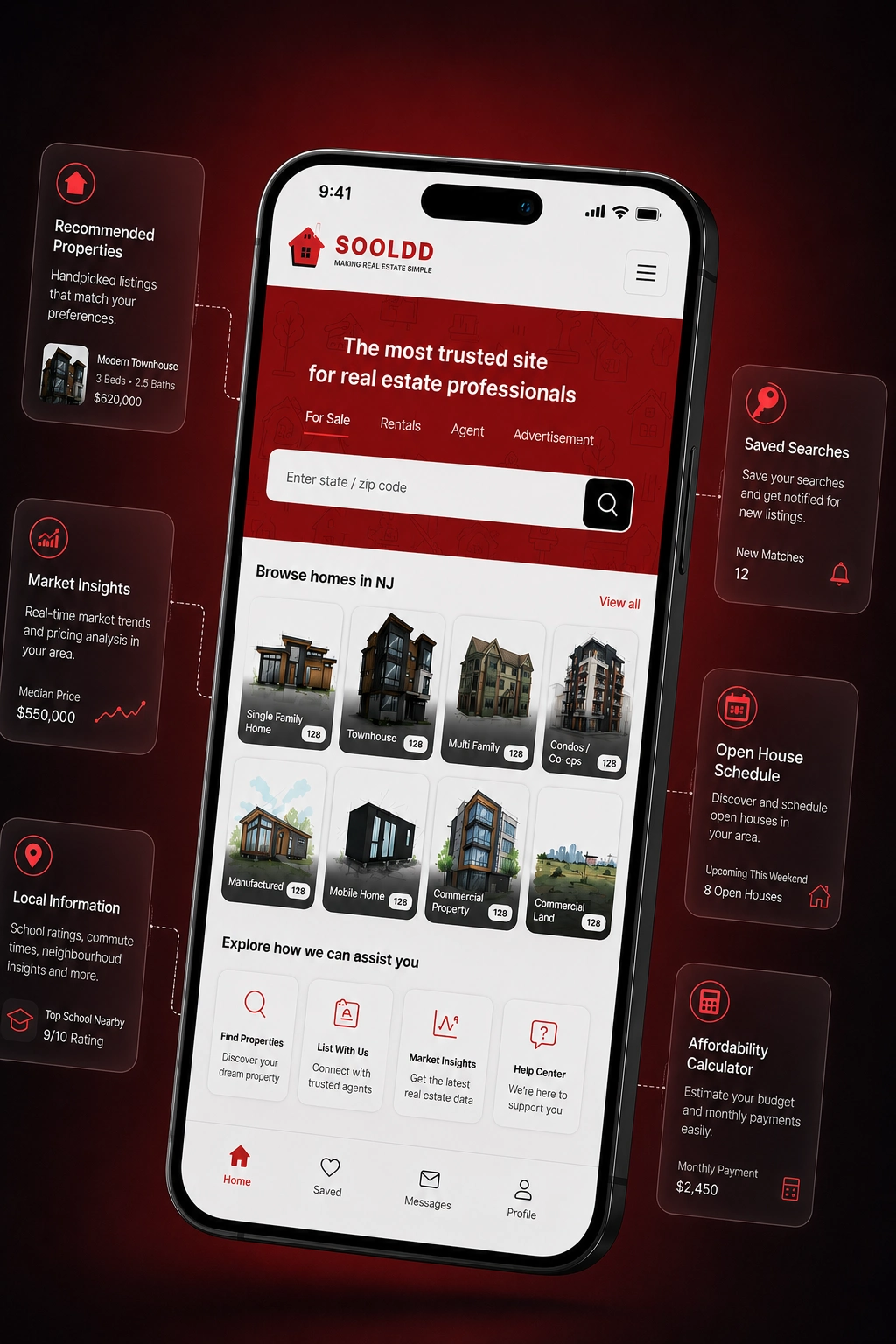


Define your niche before anything else. Buy/sell, rental, property management, and investment each carry a different data model and feature scope. Choose a platform strategy based on your feature requirements.
React Native or Flutter covers cross-platform builds. Native Swift or Kotlin wins for performance-heavy and AR-driven products. Secure live listing data via the RESO Web API under MLS/IDX rules. Ship an MVP with property search, map discovery, saved listings, lead capture, and agent messaging.
In 2026, a lean US real estate app MVP costs $15,000–$60,000. A mid-tier build with AI and third-party integrations runs $60,000–$150,000. An enterprise-grade marketplace starts around $200,000.
This guide covers the full path from idea to a launched US real estate app. It includes features, MLS/IDX data integration, tech stack choices, cost breakdowns, timelines, and compliance. The US PropTech market sits at roughly $24.7 billion in 2026. North America holds the largest global share. Around 97% of US homebuyers use the internet during their property search.
It covers the same ground that separates a Zillow or Redfin-scale product from an early-stage build that stalls at data access. Realtor.com and the National Association of Realtors (NAR) set the regulatory context this guide works within throughout.
Who this guide is for
This resource is built for proptech founders, non-technical entrepreneurs, product managers, and CTOs. By the end, you can scope, budget, and brief a real estate app build confidently. Teams without in-house engineers often partner with a specialist for custom real estate app development. Assembling the expertise from scratch is rarely the faster path.
What Is a Real Estate App?
A real estate app lets users search, list, compare, and transact on properties. It pulls live inventory from Multiple Listing Service (MLS) data via IDX and the RESO Web API. It layers on map-based discovery, saved searches, agent-client messaging, virtual tours, and AI-driven valuations. Zillow, Redfin, and Realtor.com define the consumer baseline.
A real estate app performs several distinct jobs. Property discovery and search. Listing display and lead capture. Agent and broker tools. Transaction support and analytics. The type of app you build determines which job takes priority.
The category you build in shapes every downstream decision. A listing portal or marketplace is a two-sided consumer platform. Zillow, Redfin, Trulia, and Realtor.com define that space. A brokerage or agent app focuses on lead generation and CRM. A property management app handles landlord and tenant operations. An investment or analytics platform delivers deal analysis and yield forecasting.
Most US products ship as cross-platform mobile apps. They are backed by a web admin and an IDX-powered web search interface. The data flow is consistent across all types. MLS is the source of truth. IDX is the display-rights framework. The RESO Web API is the transport layer connecting them.
Brokerage apps pair naturally with real estate software and CRM development services to manage leads and pipelines. Compass and Opendoor show how tightly the consumer layer and back-office tools need to connect. CoStar operates a parallel system for commercial real estate with similar architectural logic.

Estimate Your App Development
Cost in Seconds
Discover your project budget with our interactive AI-powered app cost calculator.
Why Build a Real Estate App in 2026? (US Market & Opportunity)
US property search is overwhelmingly digital and increasingly AI-native. The US PropTech market reached roughly $24.7 billion in 2026. It is growing at approximately 18% CAGR, according to Precedence Research.
$24.7B
US PropTech market, ~18% CAGR
97%
US homebuyers use the internet
130%
More inquiries with virtual tours
~38–55%
North America PropTech investment share
About 97% of US homebuyers use the internet during their search. Around 43% start by browsing properties online before contacting anyone. Listings with virtual tours generate 130% more inquiries than those without.
North America holds the dominant global share of PropTech investment. This ranges from approximately 38% to 55% depending on the source. Zillow's own data shows that 81% of recent renters searched via a mobile website. About 73% used a mobile app. The median US existing-home price is near $398,000, with rising inventory creating more transactional activity.
There is also a structural market shift worth noting. The National Association of Realtors (NAR) settlement took effect on August 17, 2024. It moved buyer-agent compensation offers out of the MLS. Written buyer agreements are now required before a property tour. That change reshuffled agent workflows significantly. It created demand for compliance-aware tooling that incumbents have been slow to address.
Matterport-powered virtual tours signal continued opportunity. Opendoor-style instant offers and CoStar Group's commercial expansion point in the same direction. The product surface area remains wide open.
The opportunity is in specialization, not imitation
The opportunity is not imitation. Zillow, Redfin, and Realtor.com own broad search. The white space is niche verticals. Rentals, commercial, investment analytics, new construction, and FSBO transactions are all underserved by national platforms. Hyper-local market coverage is another gap that incumbents cannot personalize deeply enough to fill.
What Types of Real Estate Apps Can You Build?
Real estate apps fall into five main types. Property marketplaces. Rental platforms. Brokerage and agent tools. Property management apps. Investment or analytics platforms. Each type carries a different data model, user base, and monetization path. The type you choose determines scope, cost, and compliance load directly. A two-sided marketplace is architecturally far heavier than a single-brokerage lead app.
Property Marketplaces & Listing Portals
These are two-sided consumer apps that aggregate buy and sell inventory through MLS/IDX connections. They carry the highest data and scale demands of any real estate product type. Zillow, Redfin, Trulia, and Realtor.com are the defining examples. Building here means solving for data freshness, map performance, and listing volume at the same time.
Rental Marketplaces
Rental platforms connect renters with landlords and property managers. Core features include applications, tenant screening, and rent payments. Plaid handles bank verification. Stripe handles payments. Apartments.com, Zillow Rentals, and Zumper each represent a distinct angle on the renter-landlord matching problem.
Brokerage / Agent Apps (with CRM)
Agent apps focus on lead capture, listing presentation, client messaging, and pipeline management. They pair naturally with a real estate CRM layer. Compass uses a tightly integrated proprietary system. kvCORE, Follow Up Boss, and HubSpot are common third-party CRM options in brokerage builds.
Property Management Apps
These apps serve landlords and property managers with day-to-day operational tools. Leases, maintenance tickets, rent collection, and accounting are the core workflows. Buildium, AppFolio, Yardi, and DoorLoop are the category benchmarks. Workflow depth, not listing data, is the key differentiator here.
Investment & Analytics Platforms
Investment platforms serve buyers analyzing deal economics and portfolio performance. Rental yield forecasts, appreciation potential, and days-on-market trends are core outputs. Roofstock and Mashvisor target individual investors. CoStar serves institutional and commercial users. Automated Valuation Models (AVMs) are a core technical component in this category. Offerpad operates on a transaction model distinct from pure analytics platforms, using instant offers rather than advisory tools.
Got Problems? Let Us Help You With the Right Solution


What Features Does a Real Estate App Need? (Must-Have + Advanced)
A real estate app needs IDX-powered property search with filters at minimum. It needs map-based discovery via Google Maps or Mapbox. It needs detailed listing pages with photos and virtual tours. It needs saved listings, search alerts, lead capture, in-app messaging, mortgage calculators, and secure user accounts.
Advanced builds add AI valuations (AVMs), natural-language search, 3D tours via Matterport, and online tour scheduling.
Map performance and media handling are the two features that drive both cost and retention the most. Getting them wrong kills the product faster than almost anything else.
Core / MVP
Property search with advanced filters. Users need to filter by price, beds, baths, square footage, and property type. Algolia or Elasticsearch powers fast, typo-tolerant search at scale.
Map view with clustering. Google Maps API or Mapbox displays listings geographically. Marker clustering handles dense urban markets without slowing the interface.
Listing detail pages. Each listing shows photos, specs, and price history. MLS data quality directly affects user trust here.
Saved favorites and search alerts. Firebase Auth manages user accounts. Firebase Cloud Messaging (FCM) and Apple Push Notification service (APNs) power saved-search alerts.
Lead capture and agent contact. A clean contact form connecting buyers to agents is the primary monetization trigger.
In-app chat. Twilio powers real-time agent-client messaging. Neither party needs to leave the app to communicate.
Mortgage and affordability calculator. A built-in calculator reduces friction when comparing properties against budget constraints.
Push notifications. New listings, price drops, and inquiry responses require reliable push delivery via FCM and APNs.
Advanced / Differentiating
AI-powered AVM. Automated Valuation Models estimate property values within approximately 5–8% of sale price. They consume historical sales data, listing velocity, and public records. The Zillow Zestimate is the consumer reference point. Building one requires TensorFlow and a high-quality training dataset.
Natural-language and AI search. Users type queries like "3-bed near good schools under $500k" and get relevant results. OpenAI API integration enables this without a custom NLP layer.
3D virtual tours and AR walkthroughs. Matterport and Cupix provide 3D scanning and viewing infrastructure. This feature directly correlates with the 130% inquiry lift cited in market data.
AI recommendation engine. Personalized listings based on browse history and saved searches. A separate ML model and user-behavior event pipeline are required.
E-signature and document handling. DocuSign integration enables offer submissions and lease signings without leaving the app.
In-app tour scheduling. Calendar-based booking eliminates phone-tag between agents and buyers.
Rent and mortgage payments. Stripe handles card payments. Plaid connects bank accounts for ACH transfers in rental products.
Predictive market analytics. Appreciation forecasting, days-on-market trends, and neighborhood price velocity. AWS SageMaker or Google Cloud Vertex AI supports model training and serving at scale.
How Do You Build a Real Estate App? Step-by-Step
Seven stages define the build. Validate the niche and MVP scope. Secure MLS/IDX data access. Design UX and information architecture. Choose the tech stack. Develop the app with all integrations. Test across devices and data edge cases. Then deploy and iterate.
MLS/IDX data access is not a backend task. It is a licensing and credentialing process that runs on the MLS's timeline, not the development team's. Starting it late is the single most common cause of blown launch dates.
-
1
Validate and Scope the MVP
Define the niche, user personas, and the feature cut-line before writing a line of code. A product requirements document (PRD) should answer three questions. Who is the primary user? What is their core job to be done? What is the minimum feature set that makes the app useful on day one? Everything outside that boundary becomes a post-launch roadmap item.
-
2
Secure MLS/IDX Data Access
The integration path you choose determines both your data coverage and your credentialing workload. A direct RESO Web API connection per MLS gives maximum field access but requires separate credentialing for each market. An IDX provider handles display rules and credentialing on your behalf, trading field depth for speed. A third-party aggregator like SimplyRETS normalizes data across multiple MLSs into one consistent API. This is the most practical path for multi-market products. Sign the data-access agreement early regardless of which path you take. Each MLS runs its own approval process on its own clock.
-
3
UX and Information Architecture
Property search apps are discovery tools first. Architecture should prioritize search flow, map UX, and listing detail hierarchy. Wireframe in Figma before moving into visual design. Validate flows with at least five target users before development begins. Poor navigation compounds into low engagement and poor lead conversion.
-
4
Choose Tech Stack and Platform Strategy
Cross-platform development with React Native or Flutter ships both iOS and Android from one codebase. Native Swift or Kotlin wins for AR-heavy builds and deep device integrations. Backend services typically run on Node.js with PostgreSQL as the primary database, hosted on AWS or an equivalent managed cloud. Choose the platform strategy based on feature requirements, not budget alone.
-
5
Develop App, Backend, and Integrations
Development covers property search logic, map and media layers, messaging infrastructure, payment flows, and MLS data ingestion. This is where architectural decisions compound. A poorly structured data model for MLS ingestion creates expensive refactors later. This is also where investing in quality custom software development pays dividends across the full product lifecycle.
-
6
Test Across Devices and Data Edge Cases
Real estate apps have a demanding QA profile. Stale listings, missing media, incomplete address data, and MLS field mapping gaps all destroy user trust. Test across a full device matrix. Load-test the map and search layers specifically. Data edge cases are the more common source of production incidents, not code bugs.
-
7
Deploy and Iterate
App Store Connect and Google Play Console both have review queues. Build that time into the launch plan. First-time submissions sometimes require revisions. Build a lightweight analytics layer before launch. Post-launch iteration driven by real user behavior closes that gap fast.
How Do You Integrate MLS, IDX & RESO Web API Listing Data? (US-Specific)
You integrate listing data by connecting to a Multiple Listing Service through the RESO Web API. This is the 2026 industry standard. It replaced the deprecated RETS protocol, which should not be used in new builds.
The connection runs under IDX display rules. You choose a direct per-MLS connection, an IDX provider, or a third-party aggregator. Aggregators normalize data to the RESO Data Dictionary 2.0 across the 580+ US MLSs.
The distinction between MLS, IDX, and RESO Web API matters and is frequently confused. MLS is the source of truth for listing inventory. IDX is the rights and display framework governing how that data can be shown. The RESO Web API is the transport layer moving data from the MLS to your application.
Direct RESO Web API per MLS
Integration path 1: Direct RESO Web API per MLS. This gives full field access and maximum control. It also requires separate credentialing with each MLS you want to cover. This path suits single-market products or teams with dedicated data engineering capacity.
IDX provider
Integration path 2: IDX provider. Providers like Realtyna handle display rules, data refresh intervals, and MLS credentialing. This is the fastest path to production. Trade-offs include reduced field access and dependency on the provider's update schedule.
Third-party aggregator
Integration path 3: Third-party aggregator. SimplyRETS normalizes listing data across multiple MLSs into a single consistent API. This is the best path for multi-market products. Data is mapped to the RESO Data Dictionary 2.0, which reduces per-MLS normalization work significantly.
Practical constraints to plan for
Practical constraints apply across all three paths. IDX rules govern display attribution and listing refresh intervals. Most MLSs require listing updates at least every 12 hours. Many require shorter windows. The NAR settlement (effective August 17, 2024) removed buyer-agent compensation from MLS data. Any listing display showing compensation fields needs an update. Written buyer agreements are now required before property tours. Verify current display rules with your specific MLS and legal counsel before launch.
What Tech Stack Is Used to Build a Real Estate App?
The 2026 standard tech stack uses React Native or Flutter for cross-platform mobile. Swift and Kotlin handle native builds. Node.js or Python (Django/FastAPI) powers the backend. PostgreSQL handles the database. AWS, Microsoft Azure, or Google Cloud manage hosting. Google Maps or Mapbox handles mapping. Algolia or Elasticsearch handles search. The RESO Web API delivers listing data.
Cross-platform development cuts initial cost and ships both app stores from one codebase. Native development with Swift and Kotlin wins on heavy map experiences, AR walkthroughs, and deep device integrations. The decision should be driven by feature requirements, not budget alone.
| Layer | Recommended Tools | Why |
|---|---|---|
| Mobile (cross-platform) | React Native, Flutter | Single codebase, iOS + Android |
| Mobile (native) | Swift (iOS), Kotlin (Android) | Deep device features, AR, maps |
| Backend | Node.js, Python (Django, FastAPI) | Scalable APIs, async data ingestion |
| Database | PostgreSQL, Firebase, Supabase | Relational integrity, real-time sync |
| Cloud / Infra | AWS, Microsoft Azure, Google Cloud | Scale, CDN, managed services |
| Search | Algolia, Elasticsearch | Fast full-text, geo-filtered search |
| Maps | Google Maps API, Mapbox | Geo discovery, clustering, routing |
| Media / 3D | Matterport, Cupix | Virtual tours, 3D scanning |
| Payments | Stripe, Plaid | In-app payments, bank verification |
| Notifications | FCM, APNs, Twilio | Push, SMS, in-app messaging |
| AI / ML | OpenAI API, TensorFlow, AWS SageMaker | AVM, search, recommendations |
| Listing data | RESO Web API | MLS/IDX integration standard |
Web application development for admin portals and IDX-powered search interfaces typically uses React or Next.js with Node.js backend.
For mobile app development, React Native delivers the widest coverage at the lowest initial investment. Teams needing maximum native performance may prefer dedicated iOS app development or Android app development.

Speak With Our Consultant
Partners
Get expert guidance before you invest in AI software development. Work directly with Giovanni and Bibin to validate your technology direction, align AI with business goals, and make confident decisions that reduce risk and accelerate outcomes.
Request a Strategic Consultation
What AI & Automation Features Belong in a 2026 Real Estate App?
The AI features that separate a competitive 2026 real estate app from a commodity listing tool are well-defined. Automated Valuation Models (AVMs). AI-powered natural-language search. Personalized listing recommendation engines. AI-enhanced 3D tours via Matterport. Predictive market analytics. OpenAI API and TensorFlow are the primary tools powering these capabilities.
Automated Valuation Models (AVMs)
AVMs estimate prices within approximately 5–8% of sale value. They consume historical sales data, listing velocity, public records, school ratings, and local economic indicators. The Zillow Zestimate is the consumer reference point. Building a production-grade AVM requires a large, clean training dataset. Models need continuous retraining as market conditions shift. AWS SageMaker and Google Cloud Vertex AI provide managed infrastructure for training and serving.
Natural-language search
Natural-language search changes how users interact with inventory. A query like "3-bed near good schools under $500k" maps to structured filters via OpenAI API. This reduces friction without requiring users to understand how filters work.
AI recommendation engines
AI recommendation engines personalize listing surfaces based on browser behavior and saved searches. A separate event pipeline captures user behavior. A model updates recommendations in near real time. This is what separates a commodity listing app from a Zillow-class product.
AI-enhanced virtual tours
Cupix and Matterport both support AI-enhanced virtual tour delivery.
Predictive market analytics
Predictive analytics for appreciation and rental yield require clean historical data. Model training pipelines run on TensorFlow or AWS SageMaker.
Data quality directly limits AVM accuracy
Data quality directly limits AVM accuracy. Valuation disclaimers are not optional. Build them into the UX from the start.
How Much Does It Cost to Build a Real Estate App in the US? (2026)
US real estate app budgets in 2026 follow a clear tier structure. A lean MVP sits between $15,000 and $60,000. A mid-tier build with AI and third-party integrations runs $60,000 to $150,000. An enterprise-grade, multi-market marketplace starts at $200,000 or more. The biggest cost drivers are MLS/IDX scope, search and map quality, media capabilities, and back-office tooling. Ongoing maintenance runs 15–35% of build cost annually.
Some production-grade US builds with deep MLS/IDX scope push into the $180,000–$450,000 range. That applies to a first full-feature release spanning multiple markets. These figures reflect design, development, QA, and launch. They exclude ongoing hosting, API fees, and MLS data licensing.
Cost by Build Tier (MVP / Mid-Tier / Enterprise)
| Tier | Scope | Typical US Range | Timeline |
|---|---|---|---|
| MVP | Core search, map, listings, lead capture, basic auth | $15,000–$60,000 | 3–4 months |
| Mid-tier | AI/AVM, virtual tours, payments, CRM integration | $60,000–$150,000 | 5–8 months |
| Enterprise | Multi-market MLS/IDX, marketplace architecture, advanced analytics | $200,000+ | 9–14+ months |
Development rates vary significantly by team location and hiring model. US-based agencies typically bill at $150–$250 per hour. Nearshore and offshore teams run $40–$100 per hour. The gap affects total budget but not timeline or complexity.
The MVP tier assumes a single MLS connection via an IDX provider. Moving to direct RESO Web API integration across multiple markets increases both time and cost significantly.
Feature-level cost estimates give useful reference points. Property search plus MLS/IDX integration runs $8,000–$25,000. Virtual tours add $15,000–$35,000. Security hardening adds $10,000–$20,000. AI and AVM capabilities can add $20,000–$60,000 depending on scope.
What Drives Real Estate App Cost the Most?
Admin and back-office workflows. Agent dashboards, lead routing logic, and reporting tools are frequently underestimated in early scoping.
Ongoing & Hidden Costs
- • Maintenance runs 15–35% of build cost annually.
- • AWS hosting and CDN fees.
- • MLS data licensing fees.
- • Third-party API costs for Google Maps API, Algolia, Twilio, and Stripe.
- • Monitoring, incident response, and security updates.
- • These costs are real and recurring. Omitting them from the initial business model creates budget surprises in the first year.
How Long Does It Take to Build a Real Estate App?
A real estate app takes about 3–4 months for a lean MVP. A mid-tier app with AI and integrations takes 5–8 months. An enterprise marketplace takes 9–14+ months. MLS/IDX credentialing and data mapping frequently add weeks that teams routinely underestimate.
The timeline breaks down by phase as follows. Discovery and design takes 3–5 weeks, covering UX research, Figma wireframes, architecture planning, and the PRD. MLS/IDX access runs in parallel — start the data-access agreement process on day one. The MLS approval timeline is outside the development team's control. A 4–8 week wait is common. Some regional MLSs take longer.
Core development is the bulk of the timeline — backend API, database schema, search layers, listing ingestion, user flows, agent tools, and integrations. QA and testing takes 3–5 weeks: full device matrix, data edge cases, load testing on search and map, and security review. App Store Connect and Google Play Console submission takes 1–2 weeks. Both stores have review queues, and first-time submissions sometimes require revisions.
The real bottleneck is MLS credentialing
The real bottleneck is MLS credentialing and data mapping, not the development team. Build the project plan around that reality from week one.
What Are the Biggest Challenges & Mistakes When Building a Real Estate App?
Companies make several biggest mistakes when building a US real estate app. The most common ones are underestimating MLS/IDX licensing complexity, ignoring IDX display and refresh rules, shipping a slow map or stale listing experience, over-scoping the MVP, skipping Fair Housing and NAR settlement compliance, and treating data quality as secondary.
MLS data fragmentation
Each of the 580+ US MLSs has its own access process, field names, and display rules. Even with RESO Web API standardization, edge cases in field mapping require engineering time. Aggregators like SimplyRETS reduce this burden significantly. The complexity cannot be fully abstracted away. Plan for it.
Stale listings and missing media
A listing showing as active after it is sold destroys user trust instantly. Missing photos make a listing unusable. Both problems stem from poor MLS data refresh discipline. Define and enforce update intervals before launch.
Map and media performance
Users expect Zillow-level map responsiveness. Google Maps API performance degrades quickly under poorly structured geo queries. Optimize clustering and viewport logic early. A slow-loading photo gallery sends users elsewhere just as fast. Test both with realistic data volumes before launch.
Feature creep in the MVP
Eight features done well beats 40 features done poorly, every time. A tight MVP scope is a discipline problem as much as a technical one. Use the PRD to enforce the cut-line.
Fair Housing Act compliance gaps
Targeting logic that restricts listings by demographic proxies violates the Fair Housing Act. This applies to AI recommendation engines as much as manual filters. Legal review of filter and recommendation logic is not optional.
NAR settlement compliance
The August 2024 changes require updated buyer agreement workflows. Buyer-agent compensation fields must be removed from MLS display. Any app launched before that date needs a compliance audit.
Weak lead routing
Slow or inconsistent lead routing wastes the product's primary commercial output. Lead routing logic deserves dedicated QA attention.
What Compliance & Security Rules Apply to US Real Estate Apps?
US real estate apps must comply with the Fair Housing Act. MLS/IDX display rules apply. So does the August 2024 NAR settlement. Data-protection obligations include CCPA/CPRA, GLBA for financial data, and PCI-DSS for payments. The security baseline covers encryption, MFA, and secure cloud architecture.
Industry and regulatory obligations
The Fair Housing Act prohibits features that restrict listings. Protected categories include race, color, religion, national origin, sex, disability, and familial status. This includes search filters, AI recommendations, and marketing targeting. MLS/IDX rules govern display attribution, data refresh rates, and field usage. The NAR settlement requires updated buyer-agreement workflows and removal of compensation fields from listing display.
Data privacy
The California Consumer Privacy Act (CCPA/CPRA) applies to apps serving California residents at scale. It requires data disclosure, deletion rights, and opt-out mechanisms. Additional US state privacy laws are expanding. GDPR requirements apply if the app serves EU users.
Financial and payment compliance
The Gramm-Leach-Bliley Act (GLBA) governs financial information collected during mortgage or pre-qualification flows. PCI-DSS applies to card payment processing. KYC and AML obligations apply where financing or significant transaction flows exist.
Security baseline
Encryption in transit (TLS) and at rest is non-negotiable. MFA and biometric login protect user accounts. Role-based access control limits data exposure across agent, admin, and consumer roles. Secure API design prevents data leakage at the integration layer. Budget $10,000–$20,000 for security hardening in a production build.
Verify all current rules with your specific MLS and qualified legal counsel before launch.
How Do Real Estate Apps Make Money? (Monetization Models)
Real estate apps generate revenue through several paths. Agent subscriptions and lead-generation fees. Featured listing placements. Transaction commissions. Freemium upgrades. In-app advertising. SaaS fees for property management or CRM tooling.
Agent subscriptions & lead-generation fees
This is the dominant model for consumer-facing listing portals. Agents pay for placement, lead routing priority, or zip code exclusivity. Zillow Premier Agent is the category benchmark. The model scales best with high traffic volume.
Premium listing placements
Property managers and developers pay for featured placement above standard search results. This model scales with listing volume and site traffic.
Transaction & referral commissions
Platforms connecting buyers with agents earn a percentage per closed transaction. Opendoor and Offerpad use this model. It requires deeper compliance infrastructure and often a licensed real estate entity in the ownership structure.
Freemium upgrades
Basic search is free. Advanced features like market analytics, unlimited saved searches, and AI-powered recommendations sit behind a paid tier. Investment platforms and data-heavy products use this model effectively.
SaaS subscriptions
Property management and brokerage CRM products typically run on monthly per-seat fees. Buildium and AppFolio both use this model. Stripe handles subscription billing. CoStar uses tiered data subscriptions for commercial users.
In-app advertising
Display advertising from mortgage lenders, movers, and insurance providers supplements other revenue. Sufficient traffic is required to generate meaningful CPM revenue.
Monetization choice shapes architecture. Subscription billing needs Stripe. Lead routing needs CRM integration. Transaction models need compliance infrastructure. Define the model before scoping the build.
Key Takeaways
1 The RESO Web API is the current MLS/IDX standard — RETS is deprecated and should not be used in new builds.
2 MLS/IDX data access is a licensing process on the MLS's clock — start it on day one.
3 The NAR settlement (August 2024) changed buyer-agent workflows and listing display rules.
4 Fair Housing compliance applies to AI recommendation logic, not just manual filters.
5 Data quality and listing freshness are product quality issues, not back-office details.
6 A focused MVP can launch in 3–4 months from roughly $15,000–$60,000.