
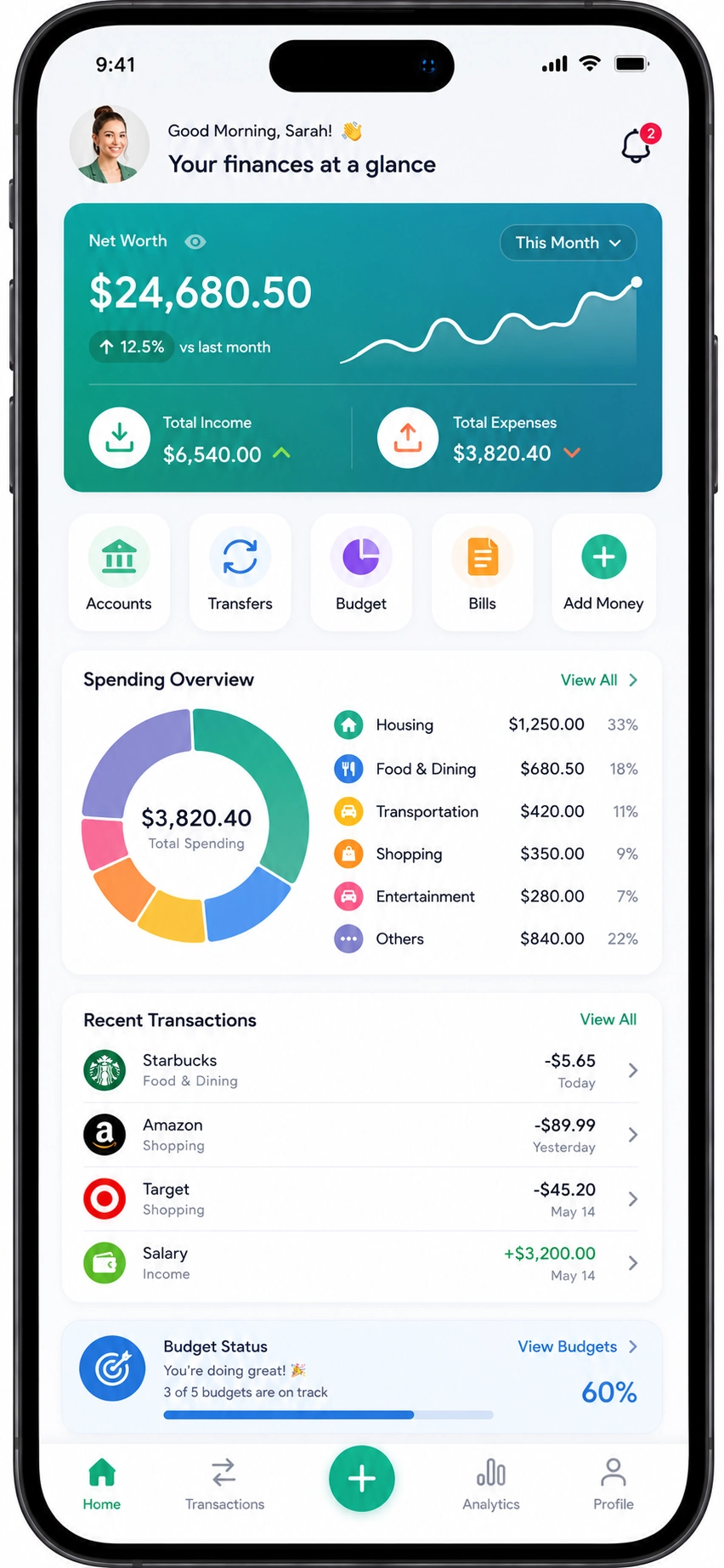
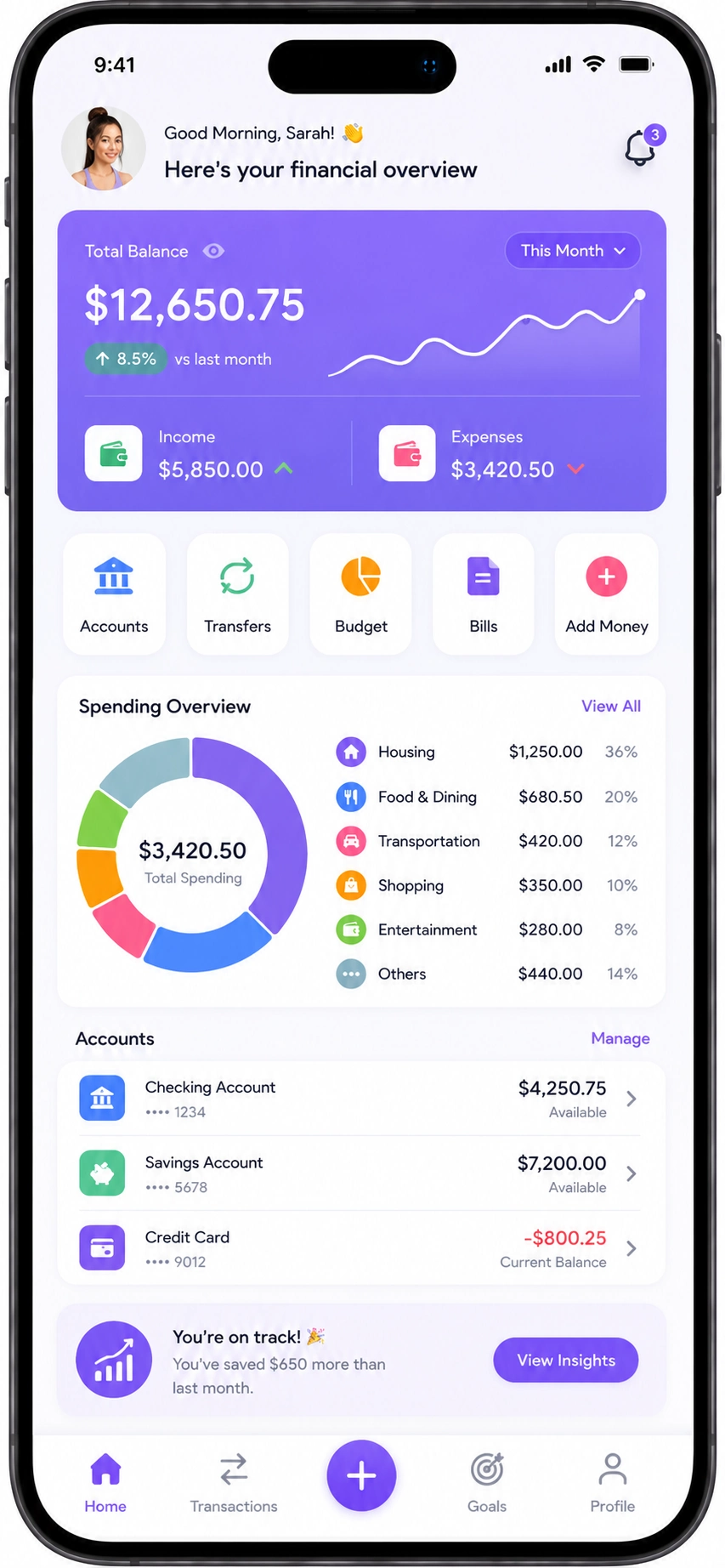


You build a personal budgeting app by integrating read-only bank-data aggregation through Plaid, MX, or Finicity, connecting to over 13,000 US institutions. From there, you build reliable transaction sync and auto-categorization. You ship an MVP built around budgets, a spending and net worth dashboard, and goal tracking. Then you differentiate with a clear methodology, whether behavioral change, automation, or holistic wealth, rather than commodity tracking.
In the United States in 2026, a lean MVP starts around $40,000, with cost scaling from there based on aggregation depth and features. A detailed breakdown of pricing by tier is provided in the cost section.
This guide takes you through the full path from concept to a live budgeting app in the US. That includes bank aggregation, sync reliability, core and advanced features, tech stack choices, and full build-plus-operating cost. It also covers the compliance requirements that apply once you start handling sensitive financial data.
- Intuit shut down Mint in March 2024, displacing more than 25 million users overnight.
- Monarch Money, Rocket Money, YNAB, and Empower absorbed most of that audience, while Cleo’s conversational AI model is reshaping how people expect to interact with their finances.
- This guide is written for fintech founders, personal-finance brands, product managers, and CTOs planning a build. By the end, you will be able to scope, budget, and brief a real project with confidence.
- Two truths matter more than anything else in this category. First, aggregation and sync reliability are the make-or-break engineering problem, and unreliable sync is the exact issue that eroded Mint’s value over time. Second, basic categorization and tracking are now commodity features.
- Successful custom fintech app development starts with a methodology users cannot easily replace.
What Is a Personal Budgeting App?
A personal budgeting app is a mobile or web application that helps users track spending, manage budgets, and understand their finances by connecting to bank and credit accounts through a read-only aggregator such as Plaid, MX, or Finicity. From there, it auto-categorizes transactions and displays budgets, cash flow, net worth, and progress toward goals. The category spans hands-on tools like YNAB, automated trackers like Rocket Money, and holistic dashboards like Monarch Money.
Underneath that simple definition sits a real technical stack. A budgeting app performs read-only account aggregation across banking, credit, and sometimes investment accounts. It syncs transactions and applies auto-categorization, while still allowing manual overrides for edge cases. It builds and tracks budgets by category, in something close to real time. It renders a financial dashboard covering spending, cash flow, and net worth. It tracks goals, monitors bills and subscriptions, and sends alerts when something needs attention.
Two distinctions matter for getting this right. Budgeting is forward-looking, planning to spend $400 on groceries this month. Expense tracking is backward-looking, answering where the money already went. There is also a methodology split worth understanding early. Automation and visibility apps like Monarch and Rocket Money ask for minimal input and lean on smart insights. Hands-on discipline apps like YNAB’s zero-based system, or envelope tools like Goodbudget, assign every dollar a job.
What separates a sticky product from a forgettable dashboard is aggregation reliability paired with a clear methodology. It also helps to remind users constantly that the app is read-only. The same read-only data boundaries and aggregation reliability that define consumer budgeting tools are the foundation of broader fintech software and CRM development for financial services businesses.
Why Build a Personal Budgeting App in 2026? US Market and Opportunity
You build a budgeting app in 2026 because the Mint shutdown in March 2024 displaced 25 million-plus users and reset the market. Monarch Money captured an estimated 10 to 20 percent of them and reached $20 million-plus in ARR. Rocket Money hit 3.4 million-plus users, saving them $245 million-plus. YNAB runs profitably at around $49 million ARR. CFPB open-banking rules under Section 1033, plus AI conversational finance like Cleo’s 74 million conversations, are expanding what these apps can do.
25M+
Intuit’s Mint shutdown in March 2024 displaced 25 million-plus users and reset the market.
$20M+ ARR
Monarch Money captured an estimated 10 to 20 percent of them and reached $20 million-plus in ARR.
$245M+
Rocket Money hit 3.4 million-plus users, saving them $245 million-plus.
74M
AI conversational finance like Cleo’s 74 million conversations is expanding what these apps can do, alongside YNAB’s roughly $49 million ARR.
These signals point to a market in genuine transition, not just steady growth. The Mint shutdown created the single biggest opening this category has seen in years, and Monarch, Rocket Money, YNAB, and Empower were the clear beneficiaries. AI is shifting user expectations too. Cleo’s conversational engagement reportedly grew 2.5 times year over year, showing people want an assistant, not just a spreadsheet with a nicer interface. On the regulatory side, CFPB Section 1033 finalized open banking rules in 2024, making consumer-permissioned data access a formal right rather than a courtesy.
None of this means the door is wide open for another copy of Mint. Basic tracking is commoditized now, so the real white space sits elsewhere. It sits in a differentiated methodology, whether that is behavioral change, autonomous savings, measurable bill savings, or holistic wealth views. It also sits in a generous free tier, since Monarch’s subscription-only model leaves a gap competitors can fill. Couples and family sharing, along with underserved niches like gig-economy earners or younger first-time budgeters, round out the remaining opportunity for a new entrant willing to specialize.
Share your idea, and let’s build the best budgeting app ever!
What Types of Budgeting and Personal Finance Apps Can You Build?
The main types are zero-based budgeting apps like YNAB, and automated expense trackers and savings apps like Rocket Money. There are also holistic financial dashboards like Monarch Money and Empower. Conversational AI finance assistants like Cleo make up another type. Envelope and manual budgeting apps like Goodbudget round out the list. Each type carries a different methodology, a different dependence on aggregation, and a different cost profile.
Methodology and aggregation depth are what actually drive cost here, more than feature count alone. A manual envelope app with no bank linking is far cheaper to build than a holistic dashboard aggregating banking, investments, and liabilities. An AI assistant with conversational analysis sits somewhere in between, depending on how deep the AI layer goes. Since tracking itself is commoditized, methodology remains the clearest way to differentiate a new entrant.
Zero-Based Budgeting Apps
Every dollar gets assigned a job before it’s spent, which drives strong engagement and real behavior change. YNAB and EveryDollar are the category’s clearest examples, both built around zero-based budgeting discipline. A zero-based budgeting app with manual entry typically falls in the $40,000 to $90,000 MVP range.
Automated Expense Trackers & Savings Apps
These apps sync automatically, track subscriptions, and often negotiate bills on the user’s behalf. Rocket Money is the leading example, and Cleo’s Smart Save feature adds autonomous savings on top of automation. An automated tracker with aggregation and bill-negotiation logic typically runs $90,000 to $180,000.
Holistic Financial Dashboards
These combine budgeting, investments, net worth, and goals into a single aggregation-heavy view. Monarch Money, Empower, and Origin represent this category well, with net worth tracking as the anchor feature. A holistic dashboard aggregating banking, investments, and liabilities typically runs $180,000 to $400,000 or more.
Conversational AI Finance Assistants
Built on large language models, these apps offer chat-based spending analysis and proactive nudges. Cleo is the clearest example, using LLM-driven conversation to automate savings decisions. A conversational AI assistant layered on aggregation typically runs $90,000 to $200,000, depending on LLM integration depth.
Envelope & Manual Budgeting Apps
These apps often skip bank linking entirely, appealing to privacy-conscious users who prefer manual entry. Goodbudget represents this envelope-budgeting approach, making it the lightest build in the category. An envelope app with manual entry and no bank linking typically falls in the $25,000 to $50,000 range.
How Do You Integrate Bank Data and Solve the Sync Problem That Killed Mint?
You integrate bank data through a read-only aggregator, either Plaid, MX, or Finicity by Mastercard. Plaid alone connects to over 13,000 US financial institutions. These services use secure tokens instead of storing a user’s actual bank password. To solve the reliability problem that eroded Mint, you need graceful re-authentication flows. You also need strong error handling for quirky bank behavior. Ideally, you go multi-aggregator with fallback coverage too. Broken connections and missing transactions remain the single biggest cause of user churn in this entire category.
Plaid, MX, and Finicity generate secure tokens so credentials never touch your servers directly, which aligns with CFPB Section 1033 open-banking guidance. That said, the sync-reliability problem is the real technical trap teams underestimate.
The exact problem that eroded Mint
Bank connections break often and require re-authentication, some institutions disconnect more frequently than others, and missing or delayed transactions quietly destroy budget accuracy. This is the exact problem that eroded Mint’s value over time: connections breaking silently and transactions disappearing without user notification. Graceful re-auth flows, resilient error handling, and transaction de-duplication logic are not optional extras here.
Teams then face a real choice between single and multi-aggregator setups. A Plaid-primary approach with MX or Finicity as fallback improves institution coverage meaningfully. However, industry estimates suggest multi-aggregator setups add roughly 20 to 30 percent more engineering cost. Budget accordingly if coverage is a priority from day one.
The cost reality behind aggregation is steep and easy to underestimate early on. Plaid alone reportedly runs $180,000 to $360,000 per year at a modest scale. On top of that, teams should budget roughly one full-time engineer per year just for ongoing bank-change maintenance. Reaching true coverage parity with established players typically needs $5 million or more in seed capital, and YNAB itself bootstrapped for two decades to get there. Aggregation is the most make-or-break decision in custom software development for budgeting apps.
What Features Does a Personal Budgeting App Need?
At minimum, a budgeting app needs bank-account aggregation and automatic transaction sync and categorization. It needs manual overrides too, for when categorization gets something wrong. Budget creation and real-time tracking by category are also essential. So is a financial dashboard covering spending, cash flow, and net worth. Goal tracking, bill and subscription alerts, and secure authentication round out the core. Advanced builds add AI insights and forecasting, plus couples or family sharing. They also add investment and net-worth tracking, automated savings, and conversational AI.
Core / MVP Features
Must-haveThis includes bank aggregation via Plaid, automatic transaction sync with ML-based categorization, and manual override options. It covers category-based budgets with real-time tracking, a financial dashboard, goal tracking, alerts, and secure JWT or OAuth authentication. Chart libraries typically power the visual dashboard layer.
Insight & Engagement Features
RetentionThis layer includes spending insights and gentle nudges, subscription tracking, and bill alerts. It adds cash-flow forecasting, small wins or streaks to build habit loops, and Monarch-style couples and family sharing.
Advanced / Differentiating Features
AdvancedThis includes an AI insights layer or conversational assistant, often powered by the OpenAI API or a Cleo-style model. It extends into investment and net-worth tracking similar to Empower, automated savings, debt-payoff planning, bill negotiation, and optional crypto or international account support.
What actually earns daily trust
Two feature areas matter more than the rest combined. The first is auto-categorization accuracy, the daily-trust feature users notice immediately. This typically relies on machine learning trained on merchant data, refined by user corrections over time, with roughly 88 to 92 percent accuracy considered competitive. The second is couples and household sharing, a genuine differentiator in this space.
Monarch’s separate-logins-with-shared-data approach is widely seen as best-in-class, and its absence is a common complaint against competitors. The dashboard combining net worth and spending in one view is ultimately what justifies asking users to pay a subscription. An app that auto-categorizes correctly from day one earns daily trust. An app that miscategorizes regularly trains users to distrust the data and stop opening it.
How Do You Build a Personal Budgeting App? Step by Step
You build a budgeting app in seven stages. First, define the methodology and MVP, cutting to the top five features. Second, integrate the aggregator and design the data model. Third, build transaction sync, categorization, and budgets. Fourth, design a clear financial dashboard UX. Fifth, develop the app, backend, security, and subscriptions. Sixth, test sync reliability, categorization accuracy, and security. Finally, deploy the app to the App Store and Google Play, then continuously improve it with analytics data.
Define Methodology and MVP
Your methodology is your differentiator, so decide it before writing a single feature spec. Cut ruthlessly to the top five features that support it, since feature bloat is what explodes most budgets in this category.
Integrate Aggregator and Design Data Model
Choose between Plaid, MX, and Finicity based on coverage needs and budget. Design your schema around users, accounts, transactions, and budgets from the very start.
Build Sync, Categorization and Budgets
This stage covers re-authentication flows, transaction de-duplication, and ML-based categorization logic. Budget rules and real-time tracking logic get built on top of clean transaction data.
Design the Dashboard UX
Wireframe spending, cash flow, and net worth views in Figma before any development begins. Clarity here matters more than visual flourish, since users check this daily.
Develop App, Backend, Security and Subscriptions
This stage covers encryption, authentication, and billing infrastructure alongside core app development. Security architecture decisions made here are far harder to retrofit later.
Test Sync, Categorization and Security
This stage validates aggregation reliability, categorization accuracy against real transaction data, and full penetration testing. Skipping this stage is the single most common cause of post-launch churn.
Deploy and Iterate
This covers App Store and Google Play Console submission, followed by analytics-driven refinement. Methodology adjustments based on real usage often matter more than new features.
Bank integrations are consistently the messiest part of the build. Budget 12 to 16 weeks, not the 8 weeks teams typically assume. Add another 4 to 6 weeks for security and compliance work in software development, plus a 20 to 30 percent overall buffer. Security should be architected from day one using OAuth 2.0, AES-256 encryption, TLS, and a formal security-consultant review.
What Tech Stack Is Used to Build a Personal Budgeting App?
In 2026, most US budgeting apps use React Native or Flutter for mobile and React or Next.js for the web. Node.js or Python typically power the backend. PostgreSQL handles financial data, with Redis managing caching. Most teams host on AWS, Google Cloud, or Azure. They integrate a bank-data aggregator, either Plaid, MX, or Finicity. Stripe with RevenueCat typically handles subscriptions. OpenAI or Claude usually power AI insights. A security stack built on OAuth 2.0, AES-256 encryption, TLS, and SOC 2-aligned infrastructure rounds out the build.
| Layer | Recommended Tools | Why It Matters |
|---|---|---|
| Mobile frontend | React Native, Flutter | Cross-platform code cuts mobile cost by an estimated 30-40% |
| Web frontend | React, Next.js | Powers a full web dashboard alongside the mobile app |
| Backend | Node.js, Python | Handles business logic, sync jobs, and API orchestration |
| Database | PostgreSQL | Reliable for structured financial data with strong guarantees |
| Caching | Redis | Speeds up dashboard queries, reduces aggregator load |
| Cloud hosting | AWS, Google Cloud, Azure | Supports SOC 2-aligned infrastructure requirements |
| Aggregation | Plaid, MX, Finicity | The most complex and expensive integration in the stack |
| Subscriptions | Stripe, RevenueCat | Handles billing across web and mobile app stores |
| AI and insights | OpenAI, Claude | Powers categorization refinement and conversational features |
| Security | OAuth 2.0, AES-256, audit logging | Bank-grade security is mandatory in this category |
| Notifications | Apple Push Notification service, Firebase Cloud Messaging | Drives bill alerts and spending nudges |
| Analytics | Mixpanel, Amplitude | Guides retention and methodology refinement post-launch |
Bank-grade security is a necessity, not an enhancement. That means AES-256 encryption, multi-factor authentication, OAuth-based access, and full audit logging across the stack. The aggregation layer remains the most complex and expensive piece of this entire build. Cross-platform frameworks give real cost advantages without sacrificing much native performance.
What AI and Automation Features Belong in a 2026 Budgeting App?
The AI features defining a competitive 2026 budgeting app start with AI transaction categorization that learns from corrections. AI spending insights with anomaly and overdraft alerts come next. Conversational finance assistants, built on LLMs like GPT-4o or Claude, in the style of Cleo, are becoming standard. Automated savings that calculate affordable transfers add real value too. Cash-flow forecasting and subscription and bill detection round out the list. Together, these turn a passive dashboard into a proactive money coach.
Each capability consumes different data and serves a different purpose. Categorization models learn from transaction history and user corrections over time. Spending insight engines analyze income and cash-flow patterns to flag anomalies early. Conversational assistants, built on models like GPT-4o or Claude, analyze the same data but respond in natural language. Cleo’s model is the clearest proof this works, reportedly driving 74 million conversations and leaving 85 percent of users feeling better about their finances within a month.
Keep financial AI accurate and compliant
Automated savings features, in the style of Cleo’s Smart Save, calculate what a user can safely transfer without overdrafting. This kind of automation creates measurable value users can point to directly. That said, financial AI carries real responsibility here. It must stay accurate and avoid giving regulated investment advice without proper disclaimers, since it informs decisions rather than acting as a registered investment advisor.
Model LLM API usage as a variable operating cost from the start. It scales with active users and conversation volume, not with build scope. For a mid-tier app with 10,000 monthly active users averaging 20 AI interactions each, LLM API costs at $2.50 per million tokens adds a meaningful monthly line item. Model this before launch.

Estimate Your App Development
Cost in Seconds
Discover your project budget with our interactive AI-powered app cost calculator.
How Much Does It Cost to Build a Personal Budgeting App in the US?
In the United States in 2026, a lean budgeting MVP costs $40,000 to $90,000. A mid-tier app with multi-account aggregation, AI insights, and subscriptions runs $90,000 to $180,000. A full-scale Monarch- or Rocket Money-class platform reaches $180,000 to $400,000 or more. But the defining cost is ongoing aggregation and maintenance. Plaid alone runs roughly $180,000 to $360,000 per year at a modest scale. Multi-aggregator setups add 20 to 30 percent engineering cost. You should also budget roughly 1 FTE per year for bank-change maintenance.
Bank integrations are consistently the costliest and messiest part of the build. Plan for 12 to 16 weeks, not the 8 weeks teams often assume. This accounts for OAuth flows, error states, and re-authentication handling across dozens of bank formats. Security hardening and compliance prep typically add another 4 to 6 weeks. This work happens before a SOC 2 audit is even scheduled. US-based teams run higher than offshore equivalents, primarily due to senior engineering rates for aggregation and security work. Building cross-platform with React Native instead of native iOS and Android can cut mobile build cost by 30 to 40 percent.
On the operating side, Plaid at modest scale typically runs $180,000 to $360,000 per year, with fees scaling by active users and API call volume. Multi-aggregator setups add 20 to 30 percent engineering cost on top of that. Cloud infrastructure through AWS, LLM API costs for AI features, and recurring SOC 2 audits add further expense. General maintenance runs another 15 to 25 percent of build cost per year. Each tier roughly doubles both cost and timeline. Aggregation complexity drives this more than UI work.
A simple estimator pulls all of this together. Take the build cost for your tier. Add aggregation cost, which scales with volume. Add security and compliance cost. Add roughly 1 FTE per year for maintenance. Add your AI run cost on top. That sum gives a realistic yearly figure, not just a build quote.
Build Cost by Tier (MVP / Mid-tier / Full Platform)
| Tier | Scope | Build Range | Timeline |
|---|---|---|---|
| MVP | Manual entry plus single aggregator, basic categorization | $40,000–$90,000 | 3–4 months |
| Mid-tier | Multi-account aggregation, AI insights, subscription tracking, iOS/Android | $90,000–$180,000 | 5–7 months |
| Full Platform | Multi-aggregator, advanced AI, investments, credit monitoring, SOC 2-ready | $180,000–$400,000+ | 8–12 months |
The MVP tier covers manual or single-source aggregation, basic budgeting rules, and simple dashboards. It has no AI and no multi-account sync. Mid-tier adds real multi-account linking across banks and cards. It also adds AI insights such as spending trends and anomaly flags, plus subscription detection. This is where most consumer-facing budgeting apps actually launch. Full Platform adds investment and credit-score tracking, multi-aggregator redundancy, and advanced personalization. Each tier roughly doubles both cost and timeline. Aggregation complexity drives this more than UI work.
Operating Cost: Aggregation, Maintenance & Compliance (the line that dominates TCO)
This is where budgeting apps actually spend money. Plaid at modest scale typically runs $180,000 to $360,000 per year, with fees scaling by active users and API call volume. Coverage from a second aggregator like MX or Finicity comes at the added engineering cost outlined above. Each aggregator has its own data schema, error handling, and edge cases. Bank connections break constantly, since banks change login flows or deprecate endpoints. Plan on roughly 1 FTE per year dedicated to aggregation maintenance alone. Layer on cloud infrastructure through AWS, LLM API costs from OpenAI or similar for AI-driven insights, and recurring SOC 2 audit costs after the first certification. General app maintenance runs another 15 to 25 percent of build cost per year.
Hidden Costs & Capital Requirements
Reaching coverage parity with incumbent apps means reliable connections across small credit unions and regional banks. Matching incumbent-level bank coverage typically requires $5 million or more in seed capital, a figure already noted earlier in this guide. This helps them match established competitors on reliability. Ongoing security review cycles add further cost over time. Elevated customer support load from bank-disconnect and re-authentication issues adds more. Engineering time spent on transaction de-duplication and error-handling logic rarely shows up in initial estimates. It consistently shows up in year-one budgets.
Wish to Calculate How Much Your Budgeting App Will Cost?
We can help you determine the cost of your budgeting application and provide assistance in quickly building your dream solution.
How Long Does It Take To Build a Personal Budgeting App?
A personal budgeting app takes about 3 to 5 months for a lean MVP. A mid-tier app with multi-account aggregation and AI insights takes 5 to 8 months. A full-scale platform takes 8 to 12 months or more. Bank integrations extend timelines the most, so budget 12 to 16 weeks, not 8. Security hardening and compliance validation also extend timelines further. Plan for a 20 to 30 percent buffer on top of all of this.
A realistic phase breakdown looks roughly like this. The initial discovery and design phase generally lasts 3 to 5 weeks. Aggregation integration with Plaid is the long pole in the tent. That stage typically runs 12 to 16 weeks on its own. Categorization and budget logic development follow next. Dashboard design and development run alongside that same stage. Security hardening and compliance work, including steps toward SOC 2, add another 4 to 6 weeks. The final step is submitting the app through App Store Connect and Google Play Console.
Delays cluster consistently around three areas. These are bank integrations, security reviews, and compliance validation. A 20 to 30 percent timeline buffer is a realistic expectation, not pessimism.
What Are the Biggest Challenges and Mistakes When Building a Budgeting App?
The biggest mistakes when building a US budgeting app start with underestimating bank-sync reliability. This is the exact problem that killed Mint. Shipping commodity tracking without a differentiated methodology is another common failure. Ignoring aggregation operating costs, roughly $180,000 to $360,000 per year, is a third mistake. Feature bloat beyond the core five features causes real damage too. Weak security and compliance planning rounds out the bigger risks. Neglecting auto-categorization accuracy and couples or household support also erodes retention.
Sync unreliability
Sync unreliability deserves the most attention of any mistake on this list. Graceful re-authentication, resilient error handling, and multi-aggregator fallback are what prevent Mint’s exact failure mode from repeating.
Commodity tracking
Commodity tracking is a close second mistake, since basic categorization is already solved industry-wide, and differentiation has to come from methodology instead.
Aggregation-cost blindness
Aggregation-cost blindness catches many teams off guard, since total cost of ownership matters far more than initial build cost alone.
Feature bloat
Feature bloat is a subtler trap, and cutting to the top five features early prevents most budget overruns.
Security & compliance shortcuts
Security and compliance shortcuts are never worth the short-term savings, given GLBA, SOC 2, and encryption requirements that apply from day one.
Weak categorization & single-user design
Weak categorization accuracy and single-user-only design remain common complaints against existing competitors. Teams also underestimate how much support load bank disconnects create once the user base grows past a few thousand people.
Every one of these mistakes is solvable with reliable aggregation, a clear methodology, and honest cost modeling.
What Compliance and Security Rules Apply to US Budgeting Apps?
US budgeting apps must comply with the Gramm-Leach-Bliley Act for handling consumer financial information. PCI-DSS applies if the app processes any payments directly. Apps must also comply with CCPA, CPRA, and other applicable state privacy laws. Apps must also align with CFPB Section 1033 open-banking rules for consumer-permissioned data. Market expectations increasingly include SOC 2 certification and bank-grade security. That means AES-256 encryption, MFA, and OAuth as a baseline. Apps also need real transparency about data selling, sharing, and retention.
Financial-data law starts with GLBA, which governs safeguarding consumer financial information across the entire stack. CFPB Section 1033 adds the open-banking dimension, establishing a consumer’s right to permission their own data access. On the payments side, PCI-DSS applies if the app processes payments directly, though Stripe-based subscription billing typically narrows this scope considerably.
Data privacy requirements extend through CCPA, CPRA, other state laws, and GDPR for any EU-based users. Beyond legal minimums, transparency about whether an app sells or shares financial data has become a real competitive trust factor. Users and reviewers scrutinize this closely before choosing a budgeting app to trust with sensitive data.
On security and certification, SOC 2 is increasingly treated as table stakes rather than a differentiator. AES-256 encryption, MFA, OAuth 2.0, read-only aggregation, and full audit logging round out the expected baseline. Notably, HIPAA does not apply here, since that framework governs healthcare data specifically. None of this constitutes legal advice, and consulting financial-services counsel early in the process is strongly recommended.
How Do Personal Budgeting Apps Make Money?
Budgeting apps primarily monetize through subscriptions, the dominant model in this category. YNAB charges around $109 per year, and Monarch charges around $99 per year. That typically lands between $5 and $20 monthly. Freemium models with premium upsells work well too. Rocket Money’s free tier pairs with paid bill negotiation and subscription cancellation. Value-based services, taking a cut of negotiated savings, round out the models. Subscription retention comes down to one defining lever: clear and ongoing ROI.
Subscriptions
Subscription pricing works best when users feel clear, ongoing value every time they open the app. YNAB users reportedly save close to $6,000 in their first year using the platform. Monarch’s roughly $99 annual price point reflects this same value-first subscription logic.
Freemium + Upsell
Freemium plus upsell is Rocket Money’s model, funneling free aggregation and subscription-tracking users into paid bill negotiation. That negotiation service reportedly saved users more than $245 million combined, with average annual savings near $740 per user.
Value-Based Services
Value-based services, taking a percentage of negotiated savings, offer a third path worth considering.
Subscriptions only work long-term when users feel real ROI every time they open the app. A generous free tier also remains a real opportunity, given the gap Monarch’s subscription-only approach leaves open.