
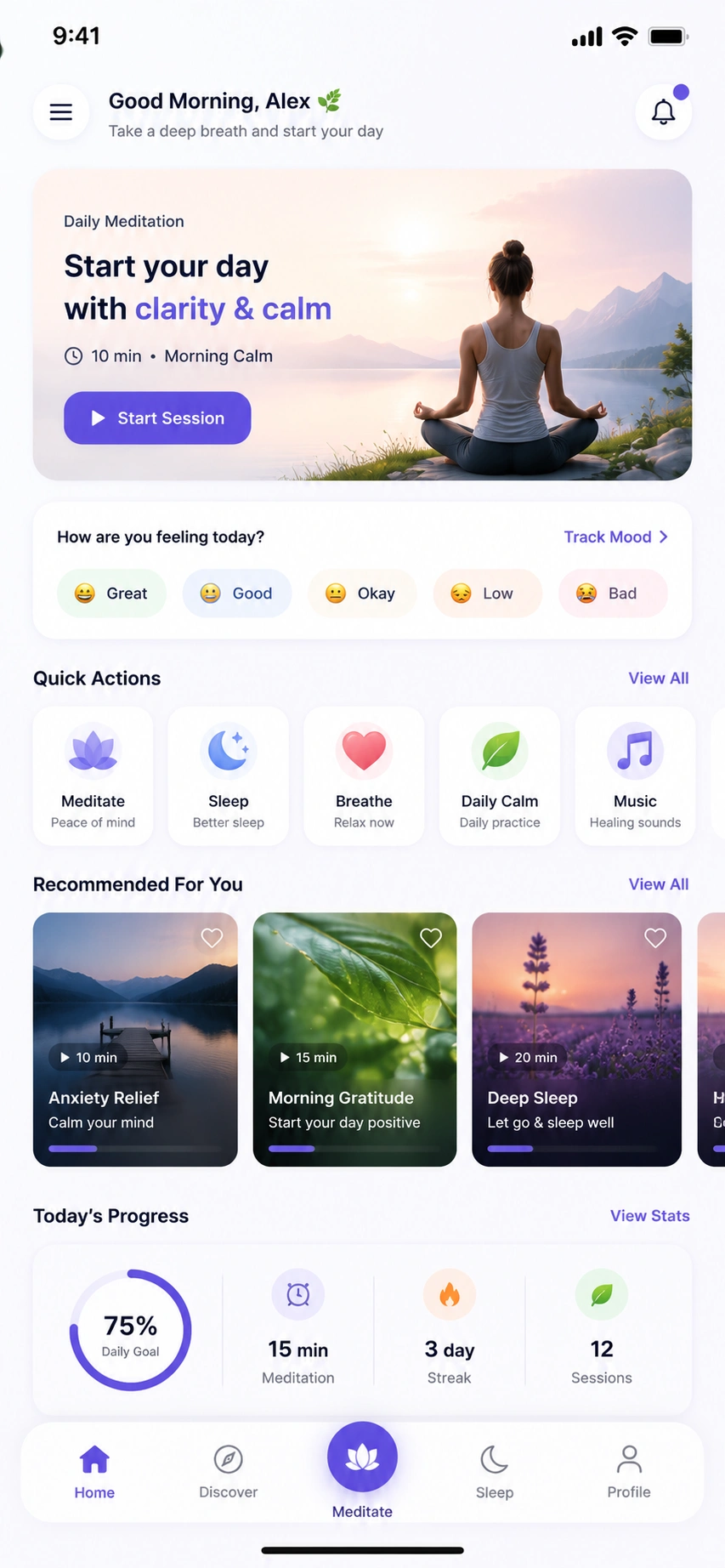
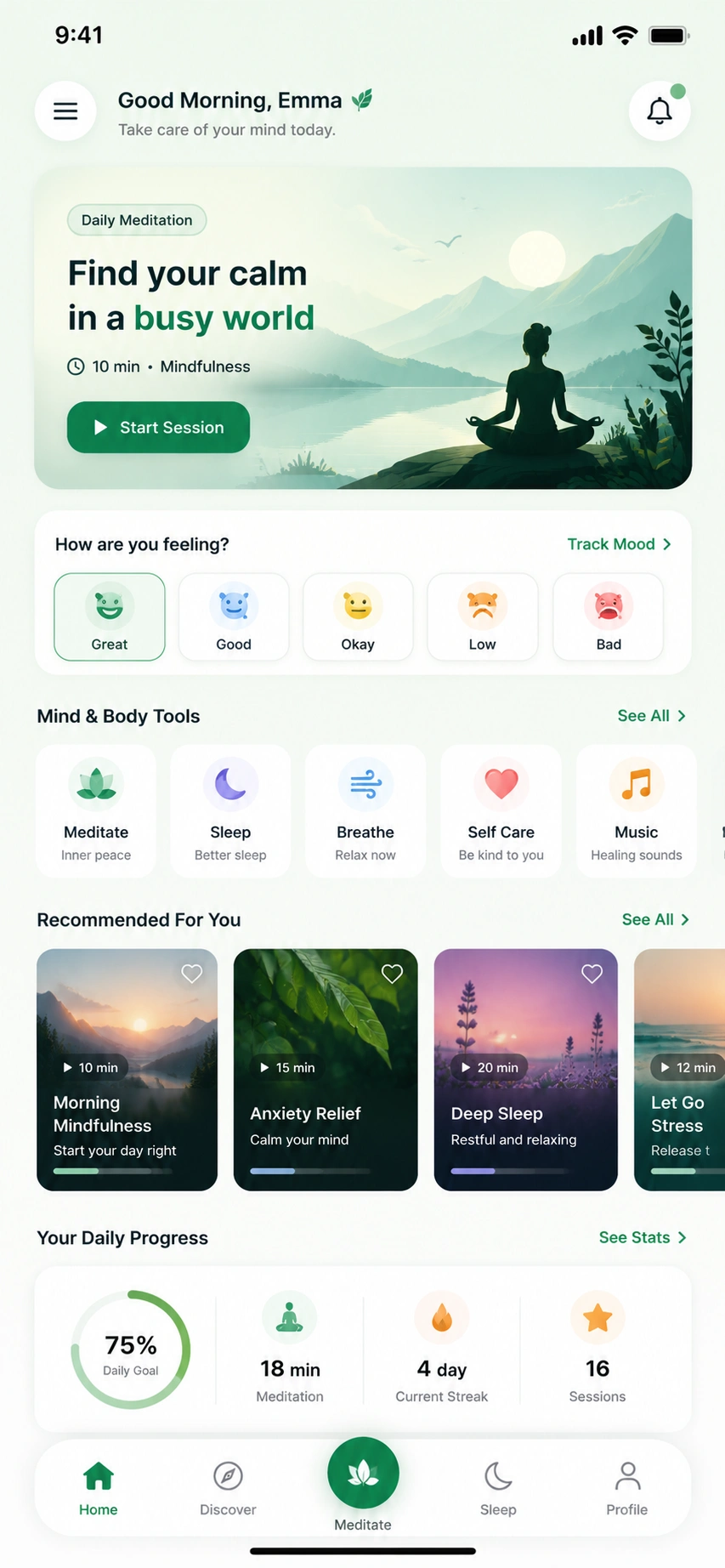


Then ship an MVP around onboarding, a content library or provider matching, progress tracking, reminders, and subscription billing. In the United States in 2026, a meditation or self-management MVP costs $25,000 to $80,000.
A mid-tier app with AI personalization and a large content library runs $80,000 to $150,000. A HIPAA-compliant teletherapy platform with secure video reaches $150,000 to $400,000 and beyond.
This guide covers the full path from idea to a launched US mental health or meditation app. It includes clinical-scope decisions, features, HIPAA and FDA considerations, tech stack, cost, timeline, and content strategy.
The meditation app market is large and still expanding, with tens of millions of Americans using these apps regularly. The evidence bar has risen sharply. Clinical credibility now separates winners from the thousands that fail. The full market figures follow in the next section.
This guide is written for wellness founders, clinicians, healthtech entrepreneurs, product managers, and CTOs. Clinical scope is the master decision. It sets cost, the evidence bar, and the entire regulatory load. Those early decisions shape every stage of custom mental health app development, from architecture to launch. Cross-platform frameworks like React Native make the build more accessible from day one.
What Is a Mental Health / Meditation App?
A mental health or meditation app is a mobile or web application that supports psychological wellbeing. It ranges from low-clinical self-care tools to clinically anchored platforms. Self-care tools include guided meditation, breathing, sleep stories, mood tracking, and journaling, as in Calm and Headspace.
Clinically anchored platforms include CBT programs, teletherapy with licensed providers, and crisis support, as in BetterHelp and Talkspace. The clinical end handles Protected Health Information (PHI) and falls under HIPAA.
These apps operate across a wide functional spectrum. Content delivery covers audio and video sessions. They also handle mood and symptom tracking, journaling, and habit and streak loops. Other features include AI coaching, provider matching, scheduling, secure messaging, and teletherapy video.
The regulatory line is critical. Non-clinical self-care apps face lighter but real privacy duties. Apps that handle PHI or connect users to licensed providers are HIPAA-regulated. Apps making specific therapeutic claims may trigger FDA SaMD review.
The main sub-types are meditation and mindfulness apps and mood and self-management trackers. Other sub-types include CBT and digital therapeutic apps, peer-support communities, and teletherapy platforms. Insight Timer is a strong example in the mindfulness-only tier.
Why Build a Mental Health / Meditation App in 2026? (US Market & Opportunity)
You build a mental health app in 2026 because demand is large, recurring, and increasingly reimbursed. Industry estimates put the meditation app market at $4.2 billion in 2024, projected to reach $11.8 billion by 2032. Over 52 million Americans use meditation apps regularly, and that user base keeps growing.
$11.8B
Meditation app market by 2032 (from $4.2B in 2024)
52M+
Americans use meditation apps regularly
~14%
CAGR growth, per industry estimates
$2B / $3B
Calm valuation; Headspace–Ginger merger
Calm reached a $2 billion valuation and Headspace merged with Ginger in a $3 billion deal. The fast-growing B2B channel lets new apps build sustainable revenue beyond individual subscriptions.
The market signals are concrete. Growth is running at roughly 14% CAGR, per industry estimates. Calm Health and Headspace for Work now drive significant revenue through employer wellness programs.
Employer wellness programs are a structured B2B channel where companies pay per seat for employee access. Smaller apps can replicate this model by targeting HR managers and benefit buyers from the start.
The white space is niche and clinical credibility
The consumer meditation space is crowded. The white space sits in niche and clinical credibility. That includes specific conditions, teen and young-adult peer support, condition-specific CBT, faith-based wellness, and B2B employer wellness.
Evidence-based, clinician-advised products with AI personalization are pulling ahead in 2026. Founders entering the consumer meditation tier in 2026 without a clinical angle face steep competition. Calm and Headspace already offer catalogues with thousands of sessions, which is hard to match at any budget.
What Types of Mental Health Apps Can You Build? (and How Clinical Each Is)
The main types of mental health apps are meditation and mindfulness apps, like Calm. Other types are mood and self-management trackers and CBT and digital therapeutic apps. Peer-support community apps and teletherapy platforms, like BetterHelp, round out the list. They sit on a regulatory ladder, with meditation and self-management at the lowest-regulation entry point. Teletherapy and crisis intervention sit at the highest point, where HIPAA and clinical-evidence requirements apply in full.
Meditation & Mindfulness Apps
These apps deliver guided audio, breathing exercises, and sleep stories. Regulatory load is low. The build is content-heavy, and library depth determines retention. Calm, Headspace, and Insight Timer define this tier. Estimated 2026 build range is $25,000 to $80,000.
Mood & Self-Management Trackers
Mood tracking and symptom logging, journaling, and wearable sync via Apple HealthKit sit here. Regulation is low but sensitive-data architecture is required from the start. Daylio is a strong reference example. Apple HealthKit integration is common at this tier. That means health data passes through Apple's privacy framework, which shapes both architecture and policy.
CBT & Digital Therapeutic Apps
Structured evidence-based programs using CBT or ACT frameworks define this tier. These apps may face FDA SaMD review for specific therapeutic claims. Digital therapeutics represent a growing regulated segment. Clinical advisory and evidence validation are not optional at this level.
Peer-Support Community Apps
Moderated communities, anonymous support, and shared journaling are the core features here. Anonymity and moderation are the two design pillars that define this sub-type. This model is strong for teens and young adults. Moderation infrastructure is the dominant cost driver at this tier. It combines automated tools and human review, and scales with active user volume.
Teletherapy Platforms
Licensed-provider video and chat, provider matching, scheduling, and PHI handling define this tier. This is the highest-cost and highest-compliance category. BetterHelp and Talkspace are the reference platforms. Full HIPAA requirements, BAAs with PHI-handling vendors, and secure video apply throughout.
How Clinical Should Your App Be? (The Decision That Sets Cost & Compliance)
You should choose your clinical scope first, because it determines everything downstream. A self-care app covering meditation and mood tracking avoids HIPAA and clinical evidence requirements. It is the cheapest and fastest entry point.
A clinical app covering teletherapy, digital therapeutics, or anything handling PHI or making therapeutic claims triggers HIPAA. It also triggers possible FDA SaMD review, clinical validation, and a far higher build cost. Define how clinical you are willing to go before writing any code.
Clinical scope maps against four downstream consequences.
HIPAA applicability
HIPAA is triggered by PHI and provider connections, not by wellness content. An app delivering guided meditation to anonymous users has no HIPAA exposure. An app scheduling sessions with a licensed therapist carries it immediately.
FDA SaMD applicability
Specific therapeutic or diagnostic claims can bring a product under FDA Software-as-a-Medical-Device review. An app claiming to treat generalized anxiety disorder may trigger SaMD review. The same applies to insomnia claims, depending on how the wording appears in store listings. Clinical decision support tools are another trigger.
The clinical evidence bar
Serious mental health apps in 2026 are expected to be evidence-based. CBT, ACT, and mindfulness research should underpin clinical products. Clinical validation is the process of testing a product against measurable outcomes. This is expected, not optional. Digital therapeutic products face the highest validation burden of any sub-type.
Cost and timeline
Cost and timeline tie everything together. Both scale directly with clinical depth.
Start at the lowest scope that still delivers your core value proposition. Climb the clinical ladder only deliberately. Involve a licensed mental health professional as an advisor from day one.
Clinical scope decisions made here determine the HIPAA path. HIPAA architecture becomes part of the initial build spec, or an expensive addition later.
What Features Does a Mental Health / Meditation App Need? (Must-Have + Advanced)
A mental health app needs, at minimum, simple onboarding with goal-setting. It also needs a content library or provider-matching flow. Progress and mood tracking, gentle reminders and notifications, are required too. Secure user accounts and subscription billing round out the core list. Advanced builds add AI-personalized recommendations and teletherapy video with secure messaging. CBT and journaling tools, wearable integration, and crisis-support pathways extend this further.
Two category-specific design imperatives apply across every feature. Calm, safe UX comes first on this list. That means muted tones, accessible typography, dark mode support, and no surprise paywalls mid-crisis. Calm palettes and safe crisis handling are non-negotiable design decisions. Gamification must never undermine therapeutic goals. Crisis handling matters just as much.
Clear, always-available pathways to emergency resources are not optional. They build trust into the infrastructure itself. Meditation apps live or die on content depth and personalization.
Teletherapy apps live on secure video, scheduling reliability, and provider tooling. Health data integrations via Apple HealthKit and Google Fit deepen personalization across both app types.
Core / MVP
Onboarding with goal-setting captures user intent from the first session. It also feeds personalization logic downstream. A content library or provider-matching flow is the primary value delivery mechanism.
Mood and progress tracking with dashboards keeps users engaged across sessions. Reminders and streaks are delivered via Firebase Cloud Messaging and Apple Push Notification service. Registration and authentication via Firebase Auth, including social login, reduces onboarding friction.
Subscription and paywall management runs through Stripe and RevenueCat. Crisis-resource access is not a feature tier. It must be available at every subscription level, including free, with no paywall blocking access.
Clinical / Teletherapy (if in scope)
Provider profiles and matching give users a structured path to the right therapist. Scheduling integration lets users book and manage appointments without leaving the app. HIPAA-compliant video via Twilio Video or Daily.co handles live sessions. Both tools offer BAA-backed infrastructure suitable for PHI.
Secure messaging keeps provider-patient communication inside a compliant channel. Clinical note-taking, patient records, and provider documentation support everyday clinical workflows. These operational capabilities are typically included when building mental health software and CRM platforms.
Advanced / Differentiating
AI-personalized recommendations and coaching built on the OpenAI API surface the right content at the right moment. CBT tools and journaling modules add evidence-based structure that generic apps cannot replicate. Wearable and sleep data integration via Apple HealthKit deepens personalization without requiring manual input.
Voice-based check-ins via Whisper reduce friction for users who prefer speaking over typing. Community features including moderated peer forums and shared journaling add social accountability. Gamification should reinforce therapeutic goals. Streak tracking for a breathing practice qualifies; leaderboards tied to session volume do not. Multi-language support extends reach across the US market.
How Do You Build a Mental Health / Meditation App? Step-by-Step
You build a mental health app in seven stages. Define the clinical scope and MVP first. Map applicable regulations, including HIPAA, FDA SaMD, and privacy, before coding. Involve a clinical advisor and design calm, safe UX next. Choose a cross-platform tech stack and HIPAA-eligible cloud if clinical. Develop the frontend in React Native or Flutter and the backend in Node.js. Build content or provider systems to match the Stage 1 scope. Test for usability, safety, and compliance if clinical. Deploy to the App Store and Google Play, then iterate and expand content.
Define Clinical Scope & MVP
Decide whether the product is a self-care app or a clinical platform before anything else. Narrow the MVP to one or two core features. A focused app that does two things extremely well outperforms a sprawling app at launch. This stage produces the scope decision document every downstream step depends on.
Map Regulations Before Coding
Run HIPAA, FDA SaMD, and privacy assessments at the architecture stage. Do not wait until after the build. Regulatory rework after development is complete can cost six figures. Document which data is PHI. Identify which vendors need BAAs. Determine whether any feature triggers SaMD classification. This stage produces the regulatory map that governs the entire build.
Involve a Clinical Advisor & Design Calm, Safe UX
A licensed mental health professional as an advisor adds credibility no engineering effort can replicate. UX must prioritize calm palettes, accessible typography, and zero surprise paywalls. Crisis-escalation pathways must be tested as rigorously as any other user flow. This stage produces the clinical advisory plan.
Choose Tech Stack & Cloud
React Native or Flutter delivers cross-platform mobile with 30 to 40% cost savings over native builds. Clinical apps require cloud infrastructure with BAA eligibility. AWS, Google Cloud, and Microsoft Azure all offer HIPAA-eligible environments. This decision shapes every integration that follows.
Develop App, Backend, Content & Provider Systems
The core build covers the frontend in React Native or Flutter. The backend runs on Node.js. The database is PostgreSQL. Content or provider systems are built to match the clinical scope. Third-party integrations covering video, wearables, payments, and notifications are added in this phase. This stage produces the content plan and integration architecture.
Test for Usability, Safety & Compliance
Accessibility testing must cover the full session flow. Crisis-handling flows require dedicated test scenarios. HIPAA compliance testing and security audits belong in QA for clinical builds. This phase produces the compliance documentation needed for store submission and future audits.
Deploy & Iterate / Expand Content
Submission to App Store Connect and Google Play Console requires health-category documentation and compliance disclosures. Analytics inform the content and feature roadmap post-launch. This stage produces the release build and the ongoing content roadmap. Building 500-plus sessions can take 18 to 24 months of sustained effort. Feature bloat is the most common launch mistake. Discovery-first ordering is the single biggest cost-saving decision in the build. Skipping it causes 30 to 50% timeline overruns.
What Tech Stack Is Used to Build a Mental Health App?
The dominant 2026 tech stack for a US mental health app starts with React Native or Flutter. Both support efficient mobile app development across iOS and Android. Node.js or Python, via Django or FastAPI, power the backend. PostgreSQL handles the data layer. A HIPAA-eligible cloud, AWS, Google Cloud, or Microsoft Azure with a BAA, applies if clinical. Twilio Video or Daily.co handle teletherapy video. Apple HealthKit and Google Fit cover wearable data. Stripe with RevenueCat manages subscriptions. An LLM stack covers AI coaching, combining the OpenAI, Claude, or Gemini APIs with LangChain. A vector store and Whisper round out that LLM stack.
The stack forks at clinical scope. Clinical builds require BAA-backed video and HIPAA-eligible infrastructure throughout. Flutter and React Native cut mobile build cost 30 to 40% versus native.
Most mental health platforms include two separate interfaces. Patients interact through the mobile application, while clinicians and administrators work through a web application that manages appointments, patient records, and reporting.
| Layer | Recommended Tools | Why / Compliance Note |
|---|---|---|
| Frontend (Mobile) | React Native · Flutter | Cross-platform; 30 to 40% cost saving over native |
| Backend | Node.js · Python (Django, FastAPI) | Scalable APIs; Python preferred for AI workloads |
| Database | PostgreSQL | Relational; encrypted at rest for PHI |
| HIPAA-Eligible Cloud | AWS · Google Cloud · Microsoft Azure (with BAA) | Required for any PHI-handling clinical app |
| Video (Teletherapy) | Twilio Video · Daily.co | Both offer BAA-backed infrastructure for HIPAA |
| Wearable / Health Data | Apple HealthKit · Google Fit | Native health data integration for personalization |
| Subscriptions & Billing | Stripe · RevenueCat | RevenueCat handles cross-platform subscription logic |
| Notifications | Firebase Cloud Messaging · APNs | Push notification delivery for iOS and Android |
| Content Delivery (CDN) | AWS CloudFront · Cloudflare | Low-latency audio and video delivery at scale |
| AI Layer | OpenAI API · Claude · Gemini · LangChain · LlamaIndex · Pinecone · pgvector · Whisper | LLM and RAG via LangChain or LlamaIndex, vector store via Pinecone or pgvector, voice via Whisper |
What AI & Automation Features Belong in a 2026 Mental Health App?
The AI features that strengthen a 2026 mental health app start with personalized recommendations. AI-personalized session and content recommendations lead this list. Conversational AI coaching and journaling companions come next. These run on LLMs like GPT-4o, Claude, or Gemini, using RAG over vetted content. Claude and Gemini offer strong alternatives depending on existing infrastructure.
AI mood and sentiment analysis add another layer. Voice-based check-ins, via Whisper, extend this further. Adaptive program personalization rounds out the list. All of this operates within strict safety guardrails. Clinical disclaimers and crisis-escalation rules apply throughout.
AI personalization is the engagement and retention lever. RAG over vetted content is the safety pattern. A curated, clinician-reviewed knowledge base prevents the model from generating unsupported medical claims. LangChain handles orchestration. Pinecone or pgvector provides the retrieval layer. Sentiment analysis flags mood trends over time. It can surface gentle prompts or escalation triggers based on user input patterns.
Voice-based check-ins via Whisper give users a faster, more natural way to log how they're feeling. Adaptive personalization adjusts content sequencing based on session history, engagement signals, and self-reported progress.
Safety guardrails
An AI companion must not give clinical advice it is not cleared to give. It must include crisis-escalation pathways and clear disclaimers. It must not reinforce harmful thought patterns. Any AI feature touching PHI operates under a BAA and within HIPAA. Framing AI as an AI therapist is an overpromise that creates regulatory exposure. An AI coaching feature in a self-care app carries no HIPAA overhead. The same feature in a teletherapy platform needs a BAA with the LLM provider and per-interaction audit logging.
How Much Does It Cost to Build a Mental Health / Meditation App in the US? (2026)
In the United States in 2026, a meditation or self-management MVP costs $25,000 to $80,000. A mid-tier app with AI personalization and a substantial content library runs $80,000 to $150,000. A HIPAA-compliant teletherapy platform with secure video and provider tooling reaches $150,000 to $400,000 and beyond.
The biggest cost drivers are clinical scope and HIPAA compliance, real-time video, AI integration, and the often-overlooked recurring cost of professional content production.
Cost by Type & Clinical Scope
| App Type / Scope | Typical US Range | Timeline | What's Included | What's Excluded |
|---|---|---|---|---|
| Meditation / Self-Care MVP | $25,000 to $80,000 | 3 to 5 months | Content library, mood tracking, onboarding, subscriptions, basic AI | HIPAA compliance, video, clinical provider tooling |
| Mid-Tier with AI & Content | $80,000 to $150,000 | 5 to 7 months | AI personalization, larger content library, wearable sync, journaling | Full HIPAA, teletherapy video, clinical notes |
| HIPAA Teletherapy Platform | $150,000 to $400,000+ | 6 to 12 months | Twilio Video or Daily.co, provider tooling, PHI handling, BAAs, AI personalization | EHR integration, custom clinical reporting |
What Drives Mental Health App Cost the Most?
Clinical scope and HIPAA compliance work adds $15,000 to $50,000 to any clinical build. That includes BAAs, encryption, and audit logging. Real-time video via Twilio Video or Daily.co adds infrastructure cost and ongoing per-minute charges. LLM APIs such as the OpenAI API carry both development cost and recurring usage fees. Those fees scale with active users. Cross-platform builds via React Native or Flutter cut mobile cost 30 to 40% versus native.
Content library depth is the most variable line item. Wearable integration adds engineering time. Compliance testing and QA extend timelines for clinical apps. US development rates run higher than offshore.
Ongoing & Content Costs (the Under-Budgeted Line)
Professional content production and licensing is the most consistently under-budgeted line in this category. A competitive library comparable to Calm Sleep Stories can cost $200,000 to $1,000,000 or more annually. That covers production and licensing fees.
Maintenance runs 15 to 25% of build cost per year. Cloud and CDN costs via AWS scale with the user base. OpenAI API usage fees scale with AI feature adoption. Compliance upkeep adds recurring cost for any clinical app.
A simple planning estimator adds scope cost, content depth, AI integration, and video costs. Include a 15 to 25% contingency buffer plus a separate annual content budget. Plan that line item before development starts, since it recurs every year.

Estimate Your App Development
Cost in Seconds
Discover your project budget with our interactive AI-powered app cost calculator.
How Long Does It Take to Build a Mental Health / Meditation App?
A mental health app takes about 3 to 5 months for a meditation or self-management MVP. A mid-tier app with AI personalization and a larger content library takes 5 to 7 months. A HIPAA-compliant teletherapy platform with video and EHR-style integrations takes 6 to 12 months. Skipping discovery is the top cause of 30% to 50% timeline overruns.
Phase breakdown for a standard MVP runs as follows. Discovery and UX research takes two to three weeks. It produces the scope document and regulatory map. UI and UX design takes three to four weeks.
Front-end and backend development takes eight to twelve weeks. QA and compliance testing takes two to three weeks for an MVP. For clinical builds, HIPAA compliance testing extends this phase significantly.
Content production runs in parallel with development and continues well beyond launch. A library of 500 or more sessions typically takes 18 to 24 months of sustained effort to build. Plan the content roadmap before the first line of code is written.
Clinical scope extends every phase
Clinical scope extends every phase. The six-to-twelve-month range for teletherapy platforms reflects this in full. Submission to App Store Connect and Google Play Console adds one to two weeks for health-category review.
What Are the Biggest Challenges & Mistakes When Building a Mental Health App?
The biggest mistakes when building a US mental health app start with feature bloat instead of a focused MVP. Skipping the discovery phase is another, causing 30% to 50% timeline overruns.
Under-budgeting content production and building without a clinical advisor also rank high. Retrofitting HIPAA instead of designing it is a costly mistake too. Mishandling safety, through surprise paywalls or missing crisis pathways, rounds out the list.
Feature Bloat
Trying to launch with too many features dilutes quality across all of them. A mental health app built without focus risks becoming a generic tracker with a wellness theme bolted on. A product that does guided audio and mood tracking extremely well beats a sprawling app at every stage. A tightly scoped MVP outperforms a broad one almost every time.
Skipping Discovery
The discovery phase produces the scope document, the regulatory map, and the clinical advisory plan. Skipping it causes scope creep and timeline overruns averaging 30 to 50%. No build should begin without it.
Under-Budgeting Content
Content production is a recurring engine, not a one-time build cost. Teams that budget for development but ignore the content library arrive at launch with nothing to deliver.
Missing Clinical Credibility
A clinical advisor should be on board before the first feature ships, not after. Clinical credibility cannot be retrofitted after the product is live. It is the real differentiator in a crowded market.
Retrofitting HIPAA
Designing HIPAA compliance into the architecture from the start costs a fraction of adding it after the build. Teams that skip this step face significant rework costs later.
Safety Failures
A surprise paywall mid-crisis erodes user trust permanently. Missing crisis-escalation pathways create real-world harm exposure. Safe design is a foundation requirement for any mental health product.
Each of these mistakes is solvable. Focused scoping reduces these risks significantly before a line of code is written. Clinical advisory from day one and an experienced development partner round out the protection.
What Compliance, Safety & Privacy Rules Apply to US Mental Health Apps?
US mental health apps must protect sensitive data under CCPA and CPRA. The FTC Act and the FTC Health Breach Notification Rule also apply. HIPAA compliance is required when handling PHI or connecting users to licensed providers. FDA Software-as-a-Medical-Device (SaMD) clearance may apply if making specific therapeutic claims. Apps must also meet App Store and Google Play health policies. Safety obligations around crisis handling apply throughout. COPPA applies if the app serves minors. Encryption, consent, and BAAs for PHI-handling vendors back all of this.
Requirements group clearly by clinical scope.
All apps — privacy by design
All apps face privacy-by-design obligations regardless of type. Mental health data is inherently sensitive. CCPA and CPRA apply to California users and set the de facto national bar. The FTC Health Breach Notification Rule reaches many consumer health apps. It is not limited to HIPAA-covered entities. Encryption and explicit consent are required even for non-clinical apps.
Clinical apps — HIPAA
Clinical apps carry the full HIPAA Privacy, Security, and Breach Notification rules. BAAs with all PHI-handling vendors are mandatory. That includes Twilio Video and Daily.co for teletherapy.
Therapeutic claims & minors — FDA SaMD, COPPA
Therapeutic-claim apps face FDA SaMD review if the product diagnoses or treats or provides clinical decision support. This is triggered by specific language in app store listings and in-app copy. Apps serving minors carry COPPA obligations. They also carry a heightened duty of care for teen mental health content.
App Store & Google Play policies
Both the Apple App Store and Google Play enforce health-category policies. These cover clinical accuracy, crisis resource availability, and age gating. HIPAA built from day one costs far less than retrofitting it.
This is not legal advice, so verify compliance obligations with counsel before launch.
How Do Mental Health Apps Make Money? (Monetization Models)
Mental health apps make money primarily through subscriptions and freemium upgrades. This is the dominant model, seen in Headspace at $12.99 per month or $69.99 per year. Calm follows at $14.99 per month.
Per-session fees for teletherapy form another revenue stream, with BetterHelp at $240 to $600 per month. B2B sales to employers and insurers are increasingly the highest-value channel. Calm Health and Headspace for Work represent this model. Premium content and partnerships add further revenue on top.
Subscriptions & freemium
The dominant model, and the best fit for consumer meditation apps. Headspace runs $12.99 per month or $69.99 per year; Calm follows at $14.99 per month.
Per-session teletherapy
Per-session fees for teletherapy form another revenue stream, with BetterHelp at $240 to $600 per month. Per-session and subscription hybrid models fit teletherapy platforms.
B2B employer & insurer
Increasingly the highest-value channel. Calm Health and Headspace for Work represent this model, and it now drives a major share of Calm's and Headspace's total revenue.
Premium content & lifetime access
Premium content and lifetime access extend monetization beyond monthly billing. Calm offers a lifetime subscription option, and celebrity sleep stories have added meaningful revenue on top of that model.
Subscription and freemium models work best for consumer meditation apps. Per-session and subscription hybrid models fit teletherapy platforms. Premium content and lifetime access extend monetization beyond monthly billing.
Calm offers a lifetime subscription option. Celebrity sleep stories have added meaningful revenue on top of that model. The B2B employer and insurer channel now drives a major share of Calm's and Headspace's total revenue. It often delivers better unit economics than fighting for individual consumers.
Smaller apps can enter the B2B channel by targeting HR managers and benefits buyers directly. That can happen before acquiring significant consumer volume. Stripe handles payment processing across all models. RevenueCat manages cross-platform subscription logic.
One paywall rule
One paywall rule applies regardless of revenue model. Crisis resources must stay accessible without payment, since gating them creates liability and erodes trust. That decision protects user safety and long-term product credibility at the same time.