
Welcome to Blogs
Discover actionable insights, in-depth research, and expert perspectives, all in one place.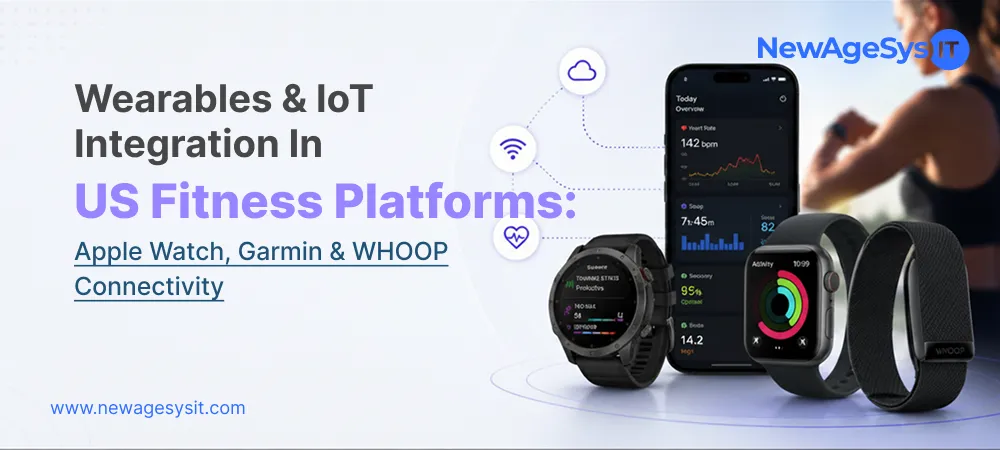
Fitness 8 min read
Wearables & IoT Integration in US Fitness Platforms: Apple Watch, Garmin & WHOOP Connectivity

| This article is part of our series on Digital Transformation in US Fitness: AI, Automation & Scalable FitTech Innovation For Startups and Enterprises |
Wearable integration fitness platforms in the USA are now a critical competitive strategy for modern fitness businesses. Fitness brands using real-time health data deliver elite coaching, stronger retention, and dynamic member experiences.
These advantages are difficult for non-integrated competitors to match. Wearable users are also the highest-LTV members, making retention investments more valuable.
The wearable ecosystem is fragmented by design. Apple Watch, Google Health Connect, Garmin Connect IQ, and Whoop APIs use different integration architectures. Each platform uses a unique data model, making comprehensive connectivity a genuinely complex engineering challenge.
Connecting wearables with gym equipment requires fitness mobile and web app development services and fitness software and CRM development services specialized expertise that eliminates data silos and delivers a consistent member experience across every touchpoint. This software eliminates data silos and delivers a consistent member experience across every touchpoint.
| Note: Health data privacy is equally non-negotiable. HealthKit, Health Connect, and fitness wearable APIs each impose strict governance requirements. This prohibits advertising use and third-party sharing without explicit consent and non-compliance risks. These dangers include App Store removal and regulatory exposure under CCPA or HIPAA. |
This article will cover how wearable and IoT integration is the data foundation of digital transformation in US fitness.
Wearable data powers AI coaching recommendations. The AI layer that acts on this data is covered in AI & Automation in US Fitness. It covers important aspects such as Virtual Coaching, Predictive Analytics & Automated Member Journeys. Specialized fitness software, CRM integration.
Apple Watch and HealthKit Integration for US Fitness Platforms
Integrating Apple Watch via HealthKit gives US fitness platforms the most comprehensive health data ecosystem available today. Platforms gain access to high-fidelity performance metrics, including workout activity records, active energy burned, heart rate, and heart rate variability (HRV). The ecosystem extends further into recovery-critical data: cardiorespiratory fitness estimates (VO2max), sleep analysis, blood oxygen levels, and respiratory rate.
HealthKit’s architecture is inherently permission-driven, requiring specialized custom iOS app development expertise to implement correctly. Users grant or deny access per individual data type. Apps must handle partial permissions gracefully without degrading the user experience.
A key advantage for fitness businesses is HealthKit write-back capability. Completed workout records written to HealthKit populate the user’s Apple Health summary. They also contribute directly to Activity rings, extending the gym’s presence into the native iOS health experience.
For high-performance applications, HKWorkoutSession enables native Apple Watch workout tracking. It streams real-time heart rate, calorie, and duration data directly to the paired iPhone app. This requires native Swift and watchOS engineering.
Data governance at this layer is non-negotiable. HealthKit data cannot be used for advertising purposes. It cannot be sold or shared with third parties without explicit user consent. Non-compliance risks immediate App Store removal and significant regulatory exposure.
Google Health Connect Integration for Android Fitness Platforms
Google Health Connect has officially succeeded the deprecated Google Fit API. For Android fitness platforms, integration with Health Connect is now essential.
Professional Android development teams gain access to a wide array of standardized data types. These include steps, heart rate, and heart rate variability (HRV). Calories burned, workout sessions, sleep stages, nutrition, and hydration are also supported.
Health Connect uses a granular, per-data-type permission model. Users maintain individual control over each category of shared information. Apps must request permissions contextually at the moment each feature is first used. This approach maintains user trust and platform transparency.
Cross-platform data normalization is a primary technical challenge. iOS and Android health data models differ in field names and measurement conventions. Fitness platforms must map both into a unified internal schema. This ensures consistent and accurate cross-platform workout analysis.
Health Connect enforces strict privacy policies equivalent to Apple HealthKit. Health data cannot be used for advertising under any circumstances. Transparent data handling and user-controlled sharing are mandatory requirements. Non-compliance creates significant regulatory risk and potential platform removal.
Garmin Connect IQ Integration for Fitness Platforms
Garmin is the definitive ecosystem for serious athletes. Marathoners, triathletes, and cyclists represent the highest-engagement, highest-retention users in fitness. Integrating Garmin unlocks the most detailed workout performance data available from any consumer wearable.
Active training metrics include GPS routes, power output, cadence, and VO2max estimates. Beyond performance, Garmin delivers deep physiological insight. Training load, Body Battery scores, and recovery time advisement are all accessible. These signals replace subjective check-ins with objective, high-fidelity analysis.
Technical execution requires a clear architectural distinction. Connect IQ is used for building on-device watch faces and apps. The Garmin Health API enables server-side access to user data. Managing this correctly demands a professional custom mobile app development approach: OAuth 2.0 authorization, token refresh management, and webhook delivery patterns require experienced implementation.
OAuth 2.0 authorization and token refresh management must be implemented securely. Garmin does not use real-time SDK streaming like other wearables. Instead, it operates on a server-to-server webhook delivery pattern. Data updates are pushed to platform webhooks each time a user syncs their device.
For performance-focused platforms, this integration is essential. It eliminates data silos across the coaching experience. Coaches gain objective recovery and strain signals in one place. Programs can be proactively adjusted to prevent injury and maximize athlete readiness.
Whoop API Integration for Recovery-Focused Fitness Platforms
Whoop captures a high-engagement, premium fitness demographic. These are dedicated enthusiasts paying $30+ monthly for a screenless, recovery-focused wearable. This segment overlaps directly with premium fitness platform users.
Whoop’s data model is uniquely recovery-first. Recovery scores (0–100) and strain scores (0–21) form its core output. Additional metrics include heart rate variability (HRV), resting heart rate, and respiratory rate. Granular sleep performance, sleep stages, and cumulative day strain are also provided.
Technical integration is achieved through the Whoop developer API. OAuth authorization governs user data access. REST API endpoints deliver member workout, sleep, cycle, and recovery data. Because Whoop’s API evolves with platform updates, ongoing maintenance must be budgeted. Shifting schemas requires proactive engineering attention to avoid integration failures.
The core value lies in recovery-informed workout adaptation. Whoop recovery scores fed into AI coaching engines create genuine exercise science value. Platforms move beyond fixed programs to dynamically adjusted training. Workout intensity adapts to a member’s real-time physiological readiness.
Coaches gain the ability to identify declining recovery trends early. Training volume can be adjusted before burnout or injury occurs. Fragmented manual methods like client screenshots are replaced entirely. The result is a unified, objective, data-backed coaching narrative.
Connected Gym Equipment and Facility IoT Integration
Modern US fitness platforms are extending data collection beyond personal wearables. The physical gym environment is now an active data source. This expansion is enabled through specialized custom software development, API agreements, firmware compatibility, and unified schema normalization across connected equipment manufacturers.
Leading smart equipment manufacturers now provide APIs for workout data extraction. Concept2, Stages, and select treadmill brands are among them. These integrations enable automatic workout logging without any manual user entry.
Wearable heart rate data can also be streamed to class display screens. Real-time Bluetooth connectivity powers live intensity overlays for group fitness; the model Orangetheory has commercialized at scale. This creates high-engagement performance experiences during spin, circuit, and group training sessions.
Facility-wide IoT delivers critical operational intelligence. Door access logs, equipment usage sensors, and occupancy detectors all feed the platform. Gym management gains real-time visibility into actual facility flow. Staffing and programming decisions become data-driven rather than assumption-based.
Premium facilities are increasingly integrating AI-enabled strength platform APIs. Tonal and Tempo provide granular resistance training data for member profiles. This adds a layer of performance insight beyond cardio-focused wearable data.
However, this level of integration carries significant engineering complexity. Vendor-by-vendor API agreements must be negotiated and maintained individually. Equipment firmware updates require ongoing compatibility testing and maintenance.
Normalizing these fragmented inputs into a unified schema is essential. Without it, data silos persist, and member experience suffers.
Building a Unified Wearable Data Architecture for Fitness Platforms
A unified wearable data architecture is essential for eliminating data silos. It forms the foundation for advanced cross-platform workout analytics. Without it, fragmented integrations undermine every downstream coaching and analytics capability.
Unified health data schema: The first requirement is a unified health data schema. This normalizes metrics from every connected wearable into one consistent internal representation. Garmin’s total sleep seconds and Apple’s sleep analysis categories are a clear example. These must be mapped to a single internal data model.
Consent management layer: A consent management layer tracks granular authorizations and sharing preferences per user and per source. This ensures every data use remains compliant with applicable platform policies.
Data freshness architecture: Data freshness architecture must handle asynchronous arrival gracefully. Apple Watch syncs in near real-time. Garmin delivers data when the device connects. Whoop pushes updates via webhook. The platform must reconcile all three without breaking analytics consistency.
Privacy compliance enforcement: Privacy compliance must be enforced at the data layer itself. Automated retention limits, deletion request propagation, and data use policy controls are mandatory. This architecture keeps fitness platforms legally defensible under CCPA and HIPAA. Businesses can then focus on delivering personalized, high-fidelity coaching. Fragile, individually maintained API connections become a thing of the past.
Conclusion
Wearable and IoT integration are the essential data foundations for modern fitness platforms. AI coaching, predictive analytics, and personalized member journeys all depend on it. Without it, advanced fitness experiences remain commercially unviable at scale.
A compliant, multi-wearable architecture with a unified health data schema changes that. It creates the technical framework that makes premium experiences scalable. US fitness platforms that build this foundation gain a compounding competitive advantage.
Designing the unified schema and consent management layer before implementation matters. It ensures the resulting architecture is both scalable and legally defensible. Retrofitting compliance after launch is significantly more costly and complex.
The platforms that will lead the US fitness market are building this foundation now. They are not waiting for scale to force the decision. Wearable data is already determining which platforms retain their highest-value members.
The architecture decisions made today define the ceiling of tomorrow’s fitness platform. Teams that have navigated multi-wearable integration understand this better than anyone. Getting the data foundation right from the start is what separates scalable platforms from ones that stall. Learn more about wearable integration and digital transformation solutions from a US FitTech platform development company specialising in multi-wearable architecture, unified health data schemas, and compliant fitness platform engineering.
Core Development
Keep exploring the custom services.

AI Software Development
Custom AI Software Development
Build intelligent, production-ready software from machine-learning models to AI-driven automation designed around your business goals.
Learn more
Mobile App Development
Custom Mobile Application Development
Native and cross-platform mobile apps that are fast, secure, and built to scale across iOS and Android.
Learn more
Web App Development
Custom Web Application Development
Scalable, secure web applications, from customer portals to complex dashboards, tailored to how your business actually works.
Learn more



