
Welcome to Blogs
Discover actionable insights, in-depth research, and expert perspectives, all in one place.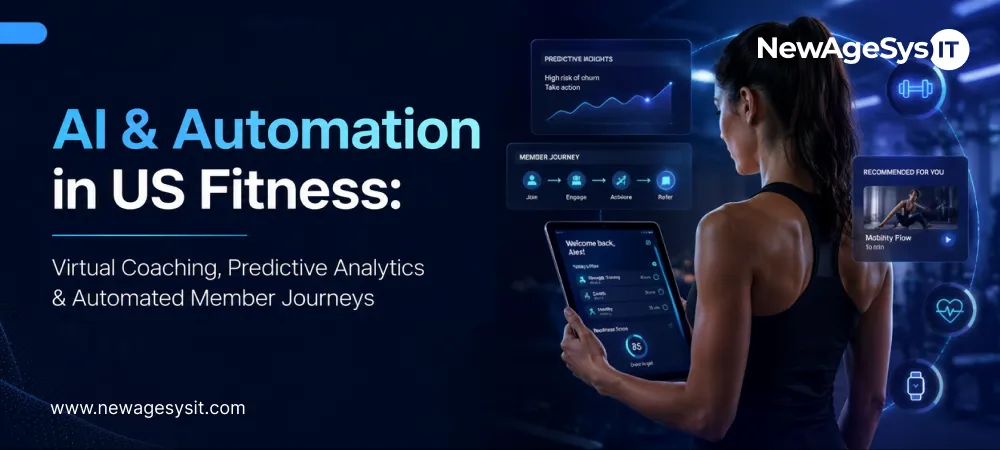
Fitness 7 min read
AI & Automation in US Fitness: Virtual Coaching, Predictive Analytics & Automated Member Journeys

| This article is part of our series on Digital Transformation in US Fitness: AI, Automation & Scalable FitTech Innovation For Startups and Enterprises |
AI automation in US fitness has moved well past early adopter territory; it’s now the competitive baseline. As covered in our pillar guide, AI and automation are the intelligence layer of digital transformation in US fitness. Platforms that don’t offer AI-powered member engagement, predictive churn analytics, and automated member journey management are visibly losing ground to those that do.
Apps like Future, Whoop Coach, and Apple Fitness+ Personalization have made AI coaching a consumer expectation. Members who experience adaptive, personalized digital fitness don’t settle for static gym software.
For fitness businesses, predictive churn prevention is often the highest-ROI entry point into AI. These systems identify at-risk members 30–60 days before a cancellation decision is made. This allows operators to intervene proactively before member loss occurs.
Operators investing in fitness mobile and web app development services and fitness software and CRM development services are building the infrastructure that makes this possible.
| Note: AI workout recommendations are not a substitute for qualified fitness professional guidance. Always include appropriate medical disclaimers. |
Virtual Coaching and AI-Powered Workout Personalization
AI is shifting fitness from static templates to adaptive performance systems. Machine learning (ML) models now generate trainer-quality programs tailored to individual goals, fitness level, equipment availability, and injury history. These models deliver elite personalized programs at a subscription cost.
These capabilities are increasingly built through custom mobile app development, giving fitness platforms a scalable coaching layer
Building custom AI coaching allows gyms to activate deload phases automatically when fatigue or performance decline is detected. Buying AI-enabled SaaS follows the same buy vs build framework used across US fitness technology decisions
Adaptive Progression: Algorithms automatically adjust workout difficulty based on real-time performance data. When members exceed targets, progressive overload is triggered. When AI detects fatigue or decline, deload phases activate automatically.
Recovery-Informed Training: Wearable data such as HRV, sleep quality, and resting heart rate feed directly into intensity recommendations. Platforms like Whoop and Garmin have normalized this data-driven coaching model. Members now expect their workout to respond to their recovery.
Wearable data powers AI coaching recommendations and predictive analytics covered in Wearables & IoT Integration in US Fitness Platforms.
AI Form Feedback: Computer vision analyzes movement and delivers real-time corrective cues. This technology is moving from research into product-stage deployment. It’s a growing feature priority in Android fitness app development across premium platforms.
Exercise Science Validation: AI coaching models must be validated against established exercise science principles. Models that violate progressive overload or recovery fundamentals create injury risk. They also damage gym’s reputation and member trust.
| Note: AI workout recommendations carry exercise safety responsibilities. Applications providing workout recommendations must include appropriate medical disclaimers and physician consultation prompts. AI fitness coaching is not medical advice. Consult qualified fitness and legal professionals before deploying AI coaching features. |
Predictive Analytics for US Fitness Member Retention
Retention is more profitable than acquisition. AI transforms it from a reactive struggle into a proactive strategy. AI systems analyze member behavior, engagement signals, and operational data to predict retention outcomes. These systems identify churn risk, improve onboarding, forecast member lifetime value, and optimize class utilization.
For many US fitness operators, predictive churn prevention is the highest-ROI AI use case. It enables intervention before cancellation intent becomes permanent.
Churn Prediction Model: ML models analyze visit frequency, booking patterns, and communication engagement. Each member receives a churn probability score. Staff is alerted to at-risk members 30–60 days before cancellation. Early signals include declining app usage, missed sessions, and booking cancellations.
New Member Activation: AI identifies new members likely to churn within their first 30 days. Detection is based on early onboarding behavior patterns. High-risk newcomers trigger intensive outreach automatically. Intervention happens before the fitness habit is broken.
Lifetime Value Forecasting: LTV models predict long-term member value from acquisition channel and demographic signals. This informs smarter decisions on marketing spend. Retention investment gets directed where it generates the highest return.
Class Utilization Forecasting: AI predicts attendance patterns for optimal staffing decisions. Underperforming class formats are identified early. New formats can be demand-tested before a full scheduling commitment.
Staff Performance Analytics: Trainer assignment patterns are correlated with long-term retention outcomes. This identifies which professional behaviors drive the strongest member loyalty. Coaching quality becomes measurable, not assumed. Every strategic decision, from staffing to acquisition, is backed by behavioral evidence, and assumptions are replaced by data.
Automated Member Journey Management
The automation paradox in US fitness is straightforward. The best automated messages never feel automated. Personalization depth, timing accuracy, and authentic voice make the difference. Done right, automation feels like high-touch manual outreach.
New Member Onboarding Automation
The onboarding sequence converts trial members into committed long-term participants.
- Day 1: Welcome message with first-class recommendation and app download prompt.
- Day 3: Check in on the first-class experience.
- Day 7: Goal-setting prompt with trainer introduction offer.
- Day 14: Milestone celebration if the attendance target is met.
Each message references the specific class attended and the trainer involved. It makes automation feel personal rather than generic.
At-Risk Member Re-Engagement
Triggered when visit frequency drops below a set threshold, the sequence runs at 7, 14, and 21 days of absence.
- Day 7: Personal check-in from the member’s primary trainer or front desk contact.
- Day 14: Targeted offer based on previously attended classes.
- Day 21: Escalation to a direct call.
Messages reference the member’s last class and their interrupted attendance streak. Relevance drives re-engagement.
Milestone and Retention Communication
Automated recognition strengthens the gym-member relationship. Triggers include the 10th class, 50th class, the first anniversary, and personal records.
Renewal prompts run at 90, 60, and 30 days for annual members. Early renewal incentives create urgency without pressure. Revenue stability follows from consistent, thoughtful journey management.
AI-Powered Operational Efficiency for Fitness Businesses
AI is shifting gym management from reactive guesswork to proactive precision.
Dynamic Class Scheduling: Historical attendance data optimizes class times, formats, and instructor assignments. High-demand sessions expand, and underperforming ones get reallocated. This intelligence is delivered through custom software development that integrates with existing management platforms
Predictive Equipment Maintenance: IoT sensors monitor motor strain, vibration patterns, and mechanical signals. Machine learning models flag anomalies before failures occur. Equipment downtime is reduced and member frustration is avoided before it starts.
Waitlist and Capacity Management: Automated tools optimize space utilization in real time. No-show prediction maximizes class occupancy. Last-minute booking fills gaps intelligently without overbooking.
Staff Scheduling Optimization: AI-generated schedules balance labor costs against predicted member volume. Historical attendance patterns and booking data inform every shift decision. This way, staffing becomes precise, not estimated.
AI-Generated Member Communications: Weekly newsletters, class highlights, and personalized fitness tips are drafted automatically. Fitness professionals focus on coaching, not copywriting. For businesses using custom iOS app development for member-facing apps, automated workflows create a seamless front-end experience backed by smarter operations
Health Data Compliance for Fitness AI Systems
Health data compliance builds member trust. It also protects long-term business security.
Apple HealthKit Requirements: Wearable data accessed through HealthKit must serve stated health purposes only. It cannot be sold to third parties. It cannot be used for advertising.
Explicit user consent is required before any data use. AI coaching models must comply with these restrictions without exception.
CCPA Obligations: Member activity data used as AI training input often qualifies as sensitive personal information. CCPA requires clear data use disclosures. Appropriate consent mechanisms must be in place before AI model training begins.
HIPAA-Applicable AI Systems: Fitness businesses with HIPAA obligations must apply technical safeguards. End-to-end encryption is required for all Protected Health Information. These safeguards apply equally to AI systems processing PHI. No exceptions exist based on how the data is used.
AI Model Bias: Models trained on limited demographic data produce uneven recommendations. Certain member populations receive less accurate or appropriate guidance. This is both an equity concern and a product quality issue. Training data diversity directly impacts AI effectiveness across all member segments.
The Compliance Baseline: Consent, transparency, and data diversity are not optional additions. They are the architecture. Fitness AI systems built on compliant foundations earn member trust faster. They also avoid costly regulatory exposure.
Conclusion
AI and automation in the US fitness industry deliver a genuine competitive advantage. Virtual coaching, predictive churn prevention, automated member journeys, and operational efficiency are no longer optional. They are the new baseline.
Long-term success requires more than deploying AI features. Exercise science accuracy matters, appropriate safety framing matters, and compliant health data handling matters. Platforms that treat these as core architecture, not afterthoughts, consistently achieve higher retention and better member outcomes.
The distinction is clear. Fitness businesses that validate AI against scientific principles outperform those treating AI as a feature checkbox. Member experience design, compliance, and exercise science are not constraints. They are competitive advantages.
If your fitness business is planning AI and automation investments, start from the architecture stage. Ground virtual coaching in exercise science principles. Implement predictive churn prevention early. Build health data compliance into every layer of your system.
The fitness platforms winning in the US market aren’t just using AI. They are using it responsibly, accurately, and strategically. That combination produces the most effective and legally defensible fitness AI experience available today. Learn more about digital transformation solutions from a US FitTech AI development company specialising in virtual coaching architecture, predictive analytics, and compliant health data systems.
Core Development
Keep exploring the custom services.

AI Software Development
Custom AI Software Development
Build intelligent, production-ready software from machine-learning models to AI-driven automation designed around your business goals.
Learn more
Mobile App Development
Custom Mobile Application Development
Native and cross-platform mobile apps that are fast, secure, and built to scale across iOS and Android.
Learn more
Web App Development
Custom Web Application Development
Scalable, secure web applications, from customer portals to complex dashboards, tailored to how your business actually works.
Learn more



