
Welcome to Blogs
Discover actionable insights, in-depth research, and expert perspectives, all in one place.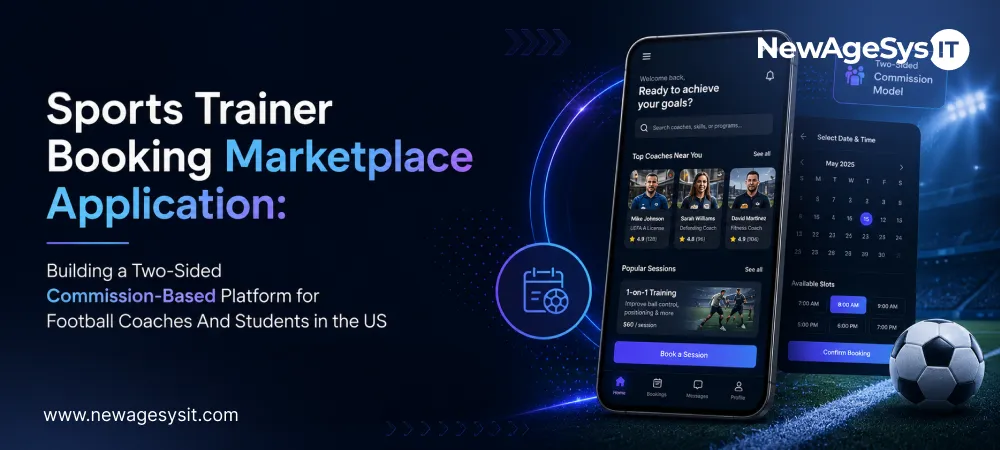
Application Development 9 min read
Sports Trainer Booking Marketplace Application: Building a Two-Sided Commission-Based Platform for Football Coaches And Students in the US

Why a Sports Trainer Booking App is a Two-Sided Commission Marketplace, Not a Single App
Most founders building a football coaching platform frame it as a booking app. That framing misses the architecture. A platform where students discover and book trainers, trainers manage availability and receive payouts, and an admin operator sets commission rates and handles disputes is a two-sided, commission-based marketplace with a cold-start problem and a three-role architecture.
Building a sports trainer marketplace in the US requires designing three roles that only create value together. Students need qualified trainers to book. Trainers need student demand before investing in profiles. Neither side works without the other. The operator monetizes through a configurable commission deducted automatically from every booking before the trainer’s payout is processed.
That commission engine is the business model. It is also a technical architecture decision that must be made on day one. Founders who build a simple booking flow and plan to add commission logic later discover the retrofit is expensive.
This guide covers the three-role feature set, the Stripe Connect integration stack, the payments and tax compliance layer, the cost by build stage, and the cold-start problem every two-sided marketplace must solve before writing code.
Founders building this platform typically begin with custom mobile app development treating the three-role architecture as the core product. The admin panel requires deliberate web application development that puts commission configuration in the operator’s hands from launch.
The Student App (Demand Side): Discovery, Booking & Reviews
The student app is the demand side. It must make the path from finding a trainer to completing a booking frictionless enough that a first-time user completes it without confusion.
The core student feature set includes trainer discovery with search and filters by location, specialization, rating, and price. Detailed trainer profiles show credentials, session types, availability calendar, and verified reviews. The booking flow lets the student select a session type, choose a date and time slot, and confirm payment in-app through Stripe. The slot is locked immediately on payment confirmation, with the platform commission deducted behind the scenes.
Post-booking, the student receives confirmation and session reminders through push notifications. A session history view tracks past and upcoming bookings. After each session, a post-completion review prompt collects verified ratings that build trainer’s reputation.
Discount code redemption is part of the student checkout flow. The platform must decide at the architecture stage whether a promotional discount reduces the platform commission or the trainer payout. That decision affects the commission engine design and cannot be retrofitted cleanly later.
The Trainer App (Supply Side): Profiles, Calendar & Earnings
The trainer app is the supply side, and it must be won first. A marketplace with no trainers cannot attract students. The trainer onboarding experience and earnings visibility determine whether good coaches commit to the platform.
The core trainer feature set includes profile creation covering photo, credentials, specializations, and session types with pricing. Availability calendar management lets trainers set open windows and block time. Incoming booking notifications and a confirmation flow keep trainers in control of their schedule.
The earnings dashboard is where trust is built or lost. Trainers see gross booking value, the platform commission deducted, and their net payout transparently. Opaque or incorrect earnings displays drive trainer churn faster than almost any other platform failure.
Before a trainer can receive any payout, Stripe Connect KYC must verify their identity and bank account details. This is a US Bank Secrecy Act requirement. The onboarding flow must satisfy KYC without causing trainer drop-off, a design challenge covered in the integration cluster.
The custom software development backend handles commission calculation, payout routing, and KYC status tracking. iOS app development and Android app development teams must both build against this backend consistently.
The Admin Panel & the Commission Monetization Engine
The admin panel is the operator’s control center and the platform’s financial integrity layer. Making commission rates admin-configurable, changeable without a developer deployment, is what separates a professional marketplace from a brittle prototype.
The core admin feature set includes a configurable commission-rate engine the operator controls per session type, trainer tier, or promotional period. Additional capabilities include discount and promo-code management, trainer verification and approval workflows, user management for both students and trainers, platform-wide booking and revenue analytics, a dispute and refund management dashboard, and exportable financial reports.
The admin panel is also where per-trainer payment data required for 1099-K tax reporting is tracked. Gross payment volume and transaction count per trainer must be accurate and exportable before tax season arrives. Building this tracking as an afterthought creates reconciliation problems that are expensive and time-consuming to resolve.
A clear refund and dispute policy managed through the admin panel is also required for App Store and Play Store approval. The operator must be able to action disputes from a single dashboard, not across disconnected systems.
Stripe Connect & the Commission Split
A commission-based booking app is defined by its payment architecture. Stripe Connect lets the platform accept a student’s payment, automatically deduct the platform commission, and route the trainer’s net amount to their connected account. That multi-party money flow is architecturally different from a standard checkout and must be designed as such from day one.
Account types determine onboarding experience and platform control. Standard connected accounts cost the platform nothing because Stripe bills the trainer directly. Express accounts are the common marketplace MVP choice: lighter onboarding, platform oversight, with a small monthly fee plus a per-payout fee for active accounts. Custom accounts offer maximum platform control but require the most implementation work.
Webhooks keep booking and payout status accurate in real time. The platform listens to Stripe events: booking paid, payout initiated, payout failed. Webhooks, not polling, are the correct architectural pattern for maintaining financial integrity across concurrent bookings.
The configurable commission calculation, split payment routing, and per-trainer payment tracking must be designed together. Building any one independently and connecting them later produces financial reporting inconsistencies that undermine trainer trust.
The Integration Stack: Booking Calendar, Notifications & Reviews
The non-payment integrations determine whether the marketplace feels polished or fragmented. Each carries a design decision that affects platform quality.
The booking calendar stores trainer availability windows and displays them to students in real time. Confirming a booking locks the slot immediately and prevents double-booking. Optional sync with Google Calendar and Apple Calendar keeps trainers’ external schedules consistent with platform availability. Conflict detection is the make-or-break detail: a double-booking discovered after a student has paid destroys trust faster than almost any other failure.
Push notifications run on Firebase Cloud Messaging for Android and Apple Push Notification Service for iOS. Triggers span the full booking lifecycle: new booking request, confirmation, 24-hour session reminder, session completion, review request, and payout processed. Over-notification drives uninstalls; under-notification causes missed bookings.
Reviews are triggered by the session-completion timestamp, not by user initiative. Aggregating them into trainer profile scores and giving the admin team moderation tools to remove fraudulent content are both required for review integrity. A review system that can be gamed destroys the trust architecture the marketplace depends on.
Compliance: Marketplace Payments, 1099-K Tax Reporting, Minor Data & Classification
A two-sided sports marketplace carries compliance obligations that generic app development content ignores.
Payments KYC and AML: every trainer must be identity-verified before receiving any payout. Stripe Connect handles the KYC flow, but the platform ensures no payout is released to an unverified account.
Tax reporting: US marketplaces must issue a 1099-K when the federal threshold is met, gross payments exceeding $20,000 AND more than 200 transactions to a single payee in a calendar year, restored by the One Big Beautiful Bill Act signed in 2025. The previous $600 threshold no longer applies at the federal level. Several US states impose lower thresholds, so the platform must track both per trainer. Collect SSN or EIN at trainer onboarding. All income is taxable regardless of whether a 1099-K is issued. This is educational content, not tax advice, consult a qualified CPA.
Minor athlete data: football students skew young. Under-13 users trigger COPPA verifiable parental consent obligations. For 13 to 17 users, App Store and Google Play minor-protection policies and state minor-privacy laws apply. Assess the minor population explicitly and consult qualified privacy counsel.
Additional compliance layers include CCPA and state privacy law for booking history, location, payment data, and reviews. Trainer worker classification under California AB5 is a real risk if platform controls are too prescriptive, consult qualified employment counsel.
Cost & the MVP to Full to Advanced Build Sequence
Build cost scales with scope, and scope must be decided before development begins.
A lightweight MVP covering trainer profiles, basic booking, Stripe payment, student reviews, and a simple admin panel runs approximately $45,000 to $80,000. This is a working marketplace with commission deducted at payment but without a configurable commission engine or full payout architecture.
Full Football Factory scope, configurable commission engine, availability calendar with conflict detection, Stripe Connect payouts, push notifications, promo codes, and a full admin dashboard, runs approximately $80,000 to $150,000.
An advanced marketplace adding AI trainer matching, video sessions, multi-sport expansion, and an analytics suite runs approximately $150,000 to $300,000 or more.
What drives cost upward: Stripe Connect split-payment and payout architecture is more complex than standard checkout. The configurable commission engine, availability calendar, trainer KYC onboarding, 1099-K tax-reporting infrastructure, and React Native iOS and Android build all add scope.
What keeps the MVP manageable: a fixed commission rate before building a configurable engine; Stripe Connect Express before Custom; phasing the promo-code engine; and launching iOS before Android. Dedicated Android app development can follow as a second-phase build once the iOS marketplace validates demand.
The Two-Sided Cold-Start Problem
The cold-start problem is the defining strategic risk of any two-sided marketplace. Solving it must happen before architecture decisions, not after launch.
Trainers Need Demand; Students Need Supply
Trainers will not invest time building detailed profiles without visible student demand. Students will not download an app with no trainers available to book. The two sides only create value together. Most sports marketplaces stall in the first 90 days because the cold-start problem was treated as a marketing challenge rather than a product architecture requirement.
Seed the Supply Side First
Most successful two-sided marketplaces launch by seeding trainer supply first. Free trainer onboarding, admin-seeded profiles, and an invitation-based launch ensure the first students find coaches available to book immediately. Density of trainers in one geographic market beats thin coverage across many markets.
Why Architecture Must Support the Launch Motion
Free trainer onboarding, profile seeding, and invitation flows are product features that must exist at launch. The architecture must support standing up supply, measuring demand conversion, and saturating one market before expanding. The cold-start strategy is a build plan, not a post-launch marketing campaign.
Final Thoughts
A build a trainer booking app 2026 project that succeeds treats the platform as the two-sided, commission-based marketplace it is from the first architecture decision. Designing three roles together, building Stripe Connect split payments and a configurable commission engine from day one, tracking per-trainer payment data for 1099-K reporting, assessing the minor-athlete population, and solving cold-start through supply-first seeding determine whether the platform monetizes reliably.
Founders who scope these decisions before development build platforms that survive tax season and scale. Those who defer them build prototypes that break at the first compliance question or the first commission rate change.
If you are planning a commission-based sports coaching marketplace, mapping the three-role feature set, the Stripe Connect commission architecture, and the cold-start launch sequence as one coherent plan before development begins is what determines whether the platform reaches the trainer density it needs.
Learn more about digital transformation solutions from a leading AI software company in the United States.
Core Development
Keep exploring the custom services.

AI Software Development
Custom AI Software Development
Build intelligent, production-ready software from machine-learning models to AI-driven automation designed around your business goals.
Learn more
Mobile App Development
Custom Mobile Application Development
Native and cross-platform mobile apps that are fast, secure, and built to scale across iOS and Android.
Learn more
Web App Development
Custom Web Application Development
Scalable, secure web applications, from customer portals to complex dashboards, tailored to how your business actually works.
Learn more



