
Welcome to Blogs
Discover actionable insights, in-depth research, and expert perspectives, all in one place.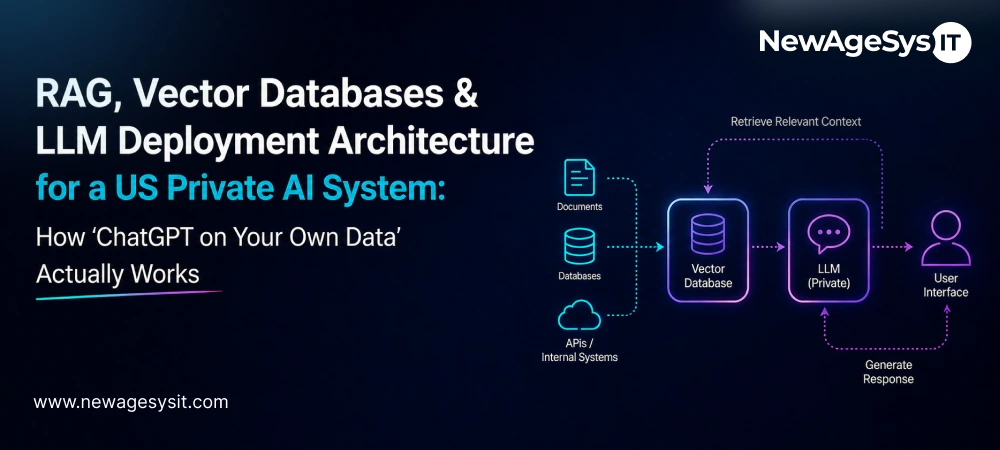
AI integration 5 min read
RAG, Vector Databases & LLM Deployment Architecture for a US Private AI System: How ‘ChatGPT on Your Own Data’ Actually Works in 2026

| This article is part of our series on Closed AI System And Solutions for US Companies: Building a Secure ‘Private ChatGPT’ on Your Own Documents, Data And Knowledge Base in 2026 |
Introduction: Demystifying ‘ChatGPT on Your Own Data’
‘ChatGPT on your own data’ sounds like magic. It is neither magic nor marketing. The RAG architecture private AI relies on is understandable. A decision-maker who understands it evaluates vendors well. They can tell a real partner from an API wrapper.
The article walks the whole machine. RAG grounds answers without retraining. The ingestion pipeline matters more than the model. Vector databases enforce your permissions. Three deployment models carry honest trade-offs. Engineering controls hallucination.
Vendor specifics evolve, so verify capabilities and pricing during scoping. The architecture below is the durable part. AI integration and adoption guide the build, and the private AI platform development team engineers the platform.
The architecture is the engineering layer of the full guide: Private AI Solutions for US Companies.
RAG Explained for Decision-Makers (and Why Not Fine-Tuning)
The Retrieval Loop
The orchestrator takes the user’s question. It searches an index built from enterprise files and databases. It retrieves the most relevant passages. It supplies them to the model in the prompt. The model answers, grounded in that retrieved knowledge, include citations to the source passages. The documents inform the answer. They never become the model.
Why RAG Beats Fine-Tuning for Internal Knowledge
Three structural reasons stand out. Freshness comes first. Retrieval reflects today’s documents. Fine-tuned knowledge freezes at training time. Permissions come second. Retrieval filters per user. A fine-tuned model cannot un-know a document. Citations come third. Only retrieved passages can be cited. Fine-tuning still serves tone, format, and domain behavior. Knowledge, though, belongs in retrieval.
What This Means for Buyers
A vendor offering to ‘train a model on your documents’ proposes the wrong architecture. The approach runs slower, costs more, and stays uncitable. Ask about their retrieval and ingestion. Skip the training pitch.
The features of this architecture power live in the Features cluster: Private AI Platform Features.
The Ingestion Pipeline (Where Projects Are Won)
Ingestion decides outcomes more than any model. The pipeline runs in clear steps. Documents are split into chunks. Sizing and overlap preserve enough context. Each chunk embeds into a vector. A vector represents the chunk’s meaning. Vectors get indexed for semantic search. Source, page, and permission metadata attach to every chunk.
Real-world documents fight back. Tables lose meaning when flattened to text. Scanned PDFs need OCR before they are text. Version sprawl raises a hard question. Which of the four copies is authoritative? Permission metadata must travel with every chunk. Otherwise, the access model breaks.
One thesis bears repeating to every buyer. Ingestion quality beats model choice. A frontier model on a garbage index gives confident garbage. A modest model on a clean index gives citable answers. Budget the pipeline accordingly. Custom software development for the ingestion pipeline determines retrieval quality more than any other component in the build.
Vector Databases & Permission-Aware Retrieval
The choice of vector database follows the deployment model. Pinecone offers a managed, purpose-built option. Azure AI Search fits the Microsoft stack and tenants. pgvector keeps vectors inside Postgres that you have already run. Self-hosted engines suit air-gapped deployments. Ops appetite matters more than benchmark charts. Verify current capabilities and pricing.
One feature separates enterprise-grade from demo-grade. Permission-aware retrieval does the work. Every chunk carries its source document’s ACLs. Every query gets filtered by the user’s entitlements first. Permission changes propagate to the index. The AI must never retrieve a forbidden document, even in context.
A corollary follows. The vector database joins the security and compliance perimeter. Tenant isolation, encryption, and per-query audit logging all apply. Treat it like any system of record.
The Three Deployment Models & Live-System Connections
Managed Cloud Tenant / VPC / On-Premise
A managed tenant uses Azure OpenAI or AWS Bedrock. Enterprise data agreements bring no-training commitments. The data stays in your tenant. The path is fastest and fits most regulated buyers. A VPC-isolated build runs inside your network perimeter. You gain control and accept more ops. A fully on-premise stack runs open-source LLMs. Llama and Mistral keep everything in the building. A Closed AI system like this suits manufacturers and government contractors. Trade-offs include model capability, GPU cost, and self-run inference. Match the model to real risk, not anxiety.
Connecting Live Systems, Not Just Documents
SharePoint, Google Drive, Salesforce, and databases connect in. Document stores sync on a schedule with freshness guarantees. Volatile data needs a live query instead. Inventory and account status go stale fast. One design question repeats across sources. How stale is acceptable? The answer decides sync versus live.
Deployment model and ingestion complexity drive cost, covered in the Cost cluster: Cost to Implement a Private AI System.
Hallucination Control as Engineering
Hallucination is not a model mood. It is a controllable failure mode. Architecture keeps it in check.
Retrieval grounding leads. The model answers only from retrieved passages. The passages sit in the prompt.
Confidence thresholds follow. Weak matches trigger an honest ‘I don’t know.’ In regulated work, a correct ‘I don’t know’ is a feature.
Citation enforcement comes next. Answers must cite retrieved sources. Uncited claims get suppressed or flagged. Citations let humans verify and improve the audit quality.
Feedback loops close the system. Flagged answers route to knowledge-base fixes. Most ‘AI errors’ trace to wrong or outdated documents. Together, these controls make the assistant trustworthy for regulated work. AI chatbot development services deliver that employee-facing chat experience.
Final Thoughts
Decision-makers who understand the machine evaluate any vendor well. Retrieval grounds answers, not retraining. Ingestion decides quality. The index enforces the organization’s permissions. The deployment model matches real risk. Engineering controls hallucination. With that grasp, a buyer judges proposals on substance.
A real private platform separates cleanly from a demo with a logo. Private AI Solutions reward buyers who ask architecture questions. Learn more about digital transformation solutions from one of the leading AI software companies in the United States.
Are you evaluating private AI architectures? Pressure-test a partner on ingestion, permission-aware retrieval, and ‘I don’t know’ behavior. Such a conversation reveals more than any model name. Learn more about digital transformation solutions from one of the leading AI software companies in the United States.
Core Development
Keep exploring the custom services.

AI Software Development
Custom AI Software Development
Build intelligent, production-ready software from machine-learning models to AI-driven automation designed around your business goals.
Learn more
Mobile App Development
Custom Mobile Application Development
Native and cross-platform mobile apps that are fast, secure, and built to scale across iOS and Android.
Learn more
Web App Development
Custom Web Application Development
Scalable, secure web applications, from customer portals to complex dashboards, tailored to how your business actually works.
Learn more



