Welcome to Blogs
Discover actionable insights, in-depth research, and expert perspectives, all in one place.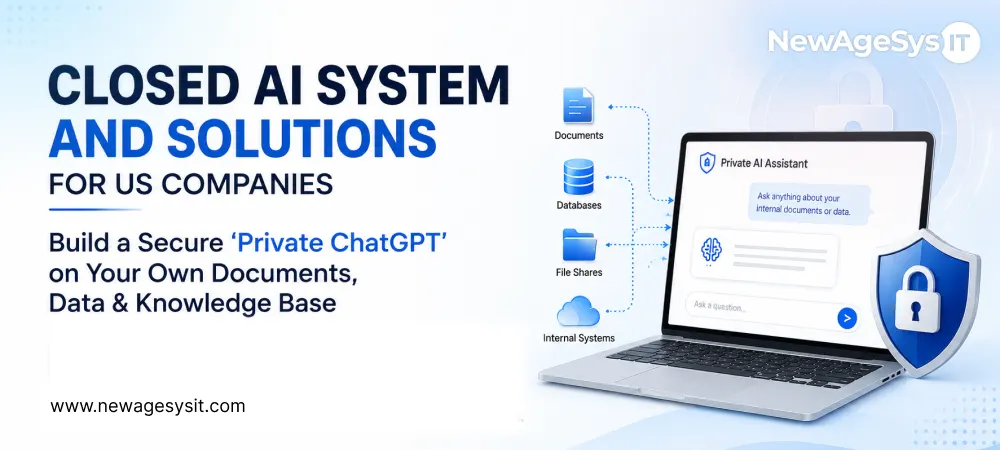
Real Estate 9 min read
Closed AI System And Solutions for US Companies: Building a Secure ‘Private ChatGPT’ on Your Own Documents, Data And Knowledge Base in 2026

Introduction: The Question Every Organization is Now Asking
Every American organization has now tested public AI. Teams tried ChatGPT, Claude, Gemini, and Copilot. The question has shifted in 2026. Leaders no longer ask whether AI helps. They ask how to use it on their own data safely. Private AI solutions for companies answer that exact concern. A Closed AI System Build keeps confidential information inside your walls.
Meanwhile, the risk is already alive. Employees paste contracts, patient notes, and financials into public tools. Shadow AI is the status quo today. A private platform replaces it, instead of preventing a hypothetical. Every vertical shares one anxiety. Boards want AI on their data without exposure. They now demand a governed answer, not a blanket ban.
The answer is a private AI platform. It works like ChatGPT, grounded only in approved company sources. It deploys in your tenant or your data center. It carries your permissions and your audit trail. AI integration and adoption guide the rollout, and the private AI platform development team builds the platform itself.
The guide ahead covers the full journey. It explains platform features and the real architecture. It maps HIPAA, GLBA, and records compliance. It breaks down the cost from pilot to enterprise. It shows why discovery comes first. Healthcare, finance, staffing, and manufacturing buyers all find their path here.
What a Private AI Platform Actually Is (and Isn’t)
Clarity matters before any budget conversation. A private AI platform is a secure assistant. It offers the ChatGPT experience employees already know. Chat, history, and follow-ups all feel familiar. Familiarity drives adoption faster than any feature list. Answers come only from approved company sources. Internal documents, databases, SharePoint, wikis, and email archives feed it. The open internet never does.
Now, the common confusions. A private platform is not a public chatbot with a policy memo. It is not an enterprise SaaS license either. A license rents someone else’s governance. A Closed AI System Build is not a model retrained on your files. Your data informs the model without becoming the model.
Three properties define the category. Answers cite their sources, naming the document and the page. Access mirrors existing permissions. The AI never shows a file that an employee cannot open. Every query and retrieval gets logged. Citations, permissions, and audit separate private AI from AI used privately.
The Employee Experience & the Trust Layer
Adoption depends on ‘the surface employees’ touch. A familiar chat interface carries conversation history. Document upload enables instant question and answer. Multi-format ingestion runs behind the scenes. PDFs, Word files, Excel sheets, SharePoint, email archives, and wikis all load. Knowledge stays department-scoped. HR sees HR, and finance sees finance.
A trust layer makes the tool usable for real work. Source citations appear on every answer. Citations form the anti-hallucination contract with the user. Role-based access control mirrors existing document permissions. The assistant says ‘I don’t know’ when sources fall short. Chatbot development powers the familiar employee assistant.
Admins get their own surface. Web application development services build that admin console as a secure web product. Knowledge-source management lets them connect, sync, and retire content. Usage analytics show what employees ask. Answer-quality feedback loops sharpen results. An audit log records every query and document touched.
Buyers often miss one insight. Usage analytics quietly become a knowledge-management instrument. The questions employees ask map what the documentation fails to answer.
The complete feature checklist lives in the Features cluster: Private AI Platform Features.
How It Works: RAG, Not Retraining
Architecture sounds technical, yet decision-makers can grasp it. The pattern is Retrieval-Augmented Generation, or RAG. A user asks a question. The system searches an index built from enterprise data. It retrieves the most relevant passages. It supplies them to the model with the question. The model answers from that retrieved content, with citations. Your documents inform the answer. The model never re-trains on them.
Why choose RAG over fine-tuning for internal knowledge? Three reasons stand out. Knowledge changes daily, while fine-tuned knowledge freezes at training time. Retrieval respects per-document permissions. A fine-tuned model cannot un-know a document for an unauthorized user. Citations only work when answers trace to retrieved passages. Fine-tuning still earns its place for tone, format, and behavior. Knowledge, though, belongs in retrieval for most use cases.
One unglamorous truth decides outcomes. Ingestion quality drives answer quality more than model choice. Tables, scanned PDFs, and permission metadata all matter. Custom software development for the ingestion pipeline determines retrieval quality more than any other component in the build. Budget the pipeline accordingly, not just the model. Ask vendors about retrieval, not training. The pipeline is where private AI projects are won or lost.
The full architecture lives in the Integration cluster: RAG, Vector Databases & LLM Deployment Architecture.
The Three Deployment Models & Who Needs Which
Deployment is a strategic choice, not a default. Three models cover the field.
Model 1 is a managed private cloud tenant. Azure OpenAI and AWS Bedrock run under enterprise data agreements. Data gets processed under contractual no-training commitments inside your tenant. The path is the fastest. Most regulated buyers start here for good reason. It suits those who already trust their cloud provider. Verify current data-use terms before signing.
Model 2 is a VPC-isolated deployment. The platform runs inside your own cloud network perimeter. You gain more control and accept more operational work.
Model 3 is a fully on-premise, open-source LLM. Llama, Mistral, and peers keep everything in the building. The model fits IP-cautious manufacturers, engineering firms, and government contractors. Trade-offs include model capability, hardware cost, and self-run inference.
Honesty should guide the pick. The right model matches real risk posture and obligations. Anxiety level should not drive it. Many buyers demand an air-gapped on-premise without needing it. A properly contracted cloud tenant often serves them better. A consultant makes that case with evidence. Evidence beats anxiety in every deployment decision.
Compliance: BAAs, Records & the Audit Posture
Compliance shapes the entire build. Treat the section as educational, not legal advice. Qualified counsel should review every obligation.
Healthcare comes first. Any vendor handling PHI on your behalf becomes a Business Associate. Creating, receiving, maintaining, or transmitting PHI all count under HIPAA. A signed BAA is required before PHI touches its infrastructure. The duty flows down the chain. The LLM provider, vector database, and analytics tooling all fall under it. Consumer AI products are not BAA-covered by default. Enterprise cloud AI services offer HIPAA-eligible configurations. Verify the chain rather than assuming it.
Financial services carry their own weight. GLBA safeguards, NYDFS Part 500, and FFIEC expectations all apply. Recordkeeping gains real architectural teeth. Some AI prompt-and-response exchanges count as regulated communications. Retention must be tamper-evident, complete, and retrievable. Periods map to record types. Business communications run three years under SEC Rule 17a-4. Core books and records run six years. The 2022 amendments allow an audit-trail alternative to WORM storage. FINRA equivalents apply to member firms.
Everyone faces the audit posture regulators now expect. Log what data the AI accessed. Record which decisions it influenced and who authorized it. Document the human oversight clearly. SOC 2 adds useful evidence of controls. SOC 2 is a voluntary attestation, not a law. Write ‘SOC 2 attested,’ never legally ‘compliant.’ It supports HIPAA and GLBA postures without replacing them. Counsel should map every period and obligation to your entities. ‘HIPAA-compliant’ is a legal status with ongoing obligations, never a checkbox.
The full BAA-chain and records guide lives in the Compliance cluster: HIPAA, GLBA & SOC 2 Compliance for Private AI Systems.
Vertical Use Cases (Healthcare, Finance, Staffing, Manufacturing)
Use cases make the value concrete. Each vertical buys for its own reasons.
Healthcare teams summarize patient documentation and search clinical procedures. Hours of chart and policy hunting collapse into one cited answer. Clinicians reclaim time for patients, not paperwork.
Finance and insurance firms analyze reports and search compliance records. Policy lookup becomes instant. The regulated firm’s institutional memory turns queryable.
Staffing and recruiting agencies mine candidates and contract intelligence. Years of placements and agreements become searchable. Recruiters surface the right history in seconds.
Manufacturers and government contractors run an IP-protected specification search. Data sovereignty drives the architecture here.
A buying-logic split shapes every engagement. Healthcare and finance buy compliance first. The BAA chain and audit trail are the product. Manufacturers and contractors buy IP protection first. On-premise deployment and sovereignty drive their decisions. Same platform pattern, different first conversation. Private AI solutions for companies flex across all four verticals from one core.
Cost & the Pilot → Department → Enterprise Path
Cost scales with scope, and the range is wide. All figures are 2026 planning ranges, not quotes.
A small-firm deployment runs roughly $8K to $30K. It covers discovery, a private cloud tenant, and one knowledge base. Security controls and up to about 25 users complete the tier.
A mid-market deployment runs roughly $30K to $90K. It adds multiple sources and SharePoint, Drive, and CRM connectors. Role-based access, audit logging, and 25 to 250 users round it out.
An enterprise platform runs roughly $90K to $250K and up. It includes multi-department knowledge and compliance workflows. A redaction layer, immutable audit retention, SSO, and 250-plus users complete it.
Several factors move the number. Source messiness matters most. Clean SharePoint differs from fifteen years of scanned PDFs. Compliance depth, deployment model, and permission complexity all push it. Each driver becomes a discovery question, answered up front.
Sequencing protects the budget. Start with one high-value pilot. Expand to a department, then the enterprise. A paid two-to-four-week discovery is the highest-ROI line item. Building the right system on the wrong data is the costliest failure.
The full tier breakdown lives in the Cost cluster: Cost to Implement a Private AI System.
Private Platform vs ChatGPT Enterprise / Copilot
Subscriptions deserve a fair comparison. ChatGPT Enterprise and Microsoft Copilot are credible products. Rollout is fast, and the brands feel familiar. They fit organizations whose needs match their connectors. They also fit when vendor terms match your governance. Both tools earn their place in the right shop.
Where do the subscriptions stop? Generic connectors often miss your systems of record. Per-seat costs continue forever at every headcount. Data governance follows the vendor’s terms. Redaction depth rarely meets a regulated firm’s bar. Control over retrieval, redaction, and audit stays limited.
A table clarifies the trade-off.
| Dimension | Enterprise AI subscription | Custom private deployment |
| Data governance control | Vendor’s terms | Your terms |
| Permission mirroring | Generic and limited | Mirrors your ACLs |
| Compliance architecture (BAA chain, retention) | Vendor-defined | Built to your obligations |
| Connector depth | Generic connectors | Into your systems of record |
| Economics at 50 / 200 / 1,000 employees | Per-seat, compounding | Usage-based, owned |
| Vendor independence | Locked to vendor | Portable as markets shift |
The pattern is simple. Subscriptions rent AI on the vendor’s terms. A private platform owns AI on your own. Verify current vendor offerings before making any decision.
Final Thoughts
Private AI answers the post-experimentation question well. Ground answers in approved sources with citations. Mirror existing permissions everywhere. Verify the BAA chain before PHI moves. Match the deployment model to the real risk posture. Prove value in one pilot before scaling.
Organizations that move deliberately gain real productivity. They skip the exposure that shadow AI guarantees. Private AI solutions for companies turn curiosity into a governed advantage. A Closed AI system delivers it without leaking your data.
Has your organization finished experimenting with public AI? Map the use cases, the data readiness, and the compliance obligations. Add the deployment model to one plan. Doing that before any build matters. It separates a platform employees rely on from a tool abandoned in week three. Learn more about digital transformation solutions from one of the leading AI software companies in the United States.
Core Development
Keep exploring the custom services.

AI Software Development
Custom AI Software Development
Build intelligent, production-ready software from machine-learning models to AI-driven automation designed around your business goals.
Learn more
Mobile App Development
Custom Mobile Application Development
Native and cross-platform mobile apps that are fast, secure, and built to scale across iOS and Android.
Learn more
Web App Development
Custom Web Application Development
Scalable, secure web applications, from customer portals to complex dashboards, tailored to how your business actually works.
Learn more