
Welcome to Blogs
Discover actionable insights, in-depth research, and expert perspectives, all in one place.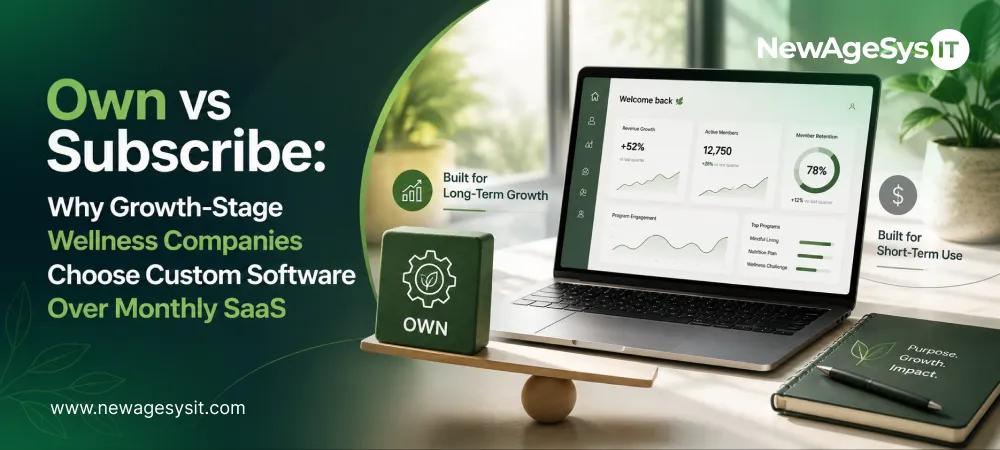
Wellness 8 min read
Own vs Subscribe: Why Growth-Stage Wellness Companies Choose Custom Software Over Monthly SaaS

| This article is part of our series on Wellness CRM Software for US Startups: Member Lifecycle Management, Mobile Apps And Web Platforms for USA Businesses |
The SaaS Subscription Ceiling Every Growing Wellness Business Hits
Most wellness businesses do not outgrow SaaS platforms on day one. They outgrow them when workflows, integrations, reporting needs, and client engagement models become too complex for a standard subscription tool.
The own-vs-subscribe decision for US wellness software is one of the most consequential strategic choices a growth-stage wellness business makes. Mindbody, Jane App, Practice Better, SimplePractice, and Vagaro have genuine reasons to be the starting point for US wellness operations.
They are fast to deploy, require no engineering team, and handle booking, billing, and client communication adequately for early-stage needs. The question is not whether these platforms are good, but whether they remain the right tool as the business scales. Choosing a custom wellness CRM development partner becomes relevant when a SaaS platform’s constraints cost the business competitive ground, not as a technology preference but as a documented response to specific structural limits.
The SaaS ceiling arrives in predictable forms. The brand experience is shared with every other business on the platform. The integration surface is limited to the vendor’s API connectors. Pricing escalates with staff counts and feature requirements.
The data structure cannot accommodate proprietary intake protocols, care plan templates, or progression tracking formats the practice has developed internally. The client app carries the vendor’s brand, not the practice’s.
For a wellness business whose differentiation depends on the quality and consistency of the client experience, these are not minor inconveniences. They act as structural limits. Purpose-built custom wellness mobile and web app development removes each of those limits individually, delivering a branded client app, an unrestricted integration surface, and a data model built around the practice’s own methodology rather than the vendor’s template, delivering a branded client app, an unrestricted integration surface, and a data model built around the practice’s own methodology rather than the vendor’s template
This article frames the own vs subscribe decision as a growth-stage strategic question, not a technology preference. The right answer depends on where the business is, not on a blanket preference for custom software over SaaS.
The full wellness CRM member lifecycle management guide provides the broader context for understanding the own vs subscribe decision.
The Subscribe Case: Where SaaS Wellness Platforms Genuinely Excel
In custom wellness software vs SaaS, SaaS wellness platforms are the correct choice in several clearly defined scenarios. A business that is pre-product-market fit and still validating that its core offering generates sustainable revenue should not commit capital to a custom platform.
A practice with under 150-200 active clients and 2-3 practitioners has needs within the operational range of major SaaS platforms. Booking, billing, and client communication workflows can be standard and require no meaningful customization beyond platform configuration. In this context, the SaaS platform delivers full functional value without custom development overhead.
The financial case for SaaS at an early stage is straightforward. Mindbody or Jane App may cost $100 to $500 per month as a 2026 planning estimate. A custom platform may cost $100,000 to $200,000 to build and launch as a 2026 planning estimate. For an early-stage business with uncertain revenue, the calculation is simple.
SaaS remains the rational choice until client volume, revenue stability, or specific capability requirements reach the threshold that justifies custom investment.
SaaS platforms also provide compliance infrastructure that a custom build must replicate from scratch. PCI-DSS compliance for payment processing and HIPAA Business Associate Agreement options for clinical wellness operators cover the enterprise SaaS tiers.
A custom platform requires deliberate architecture and legal review to achieve the same compliance posture. This is a real consideration at the early stage, when the founding team’s engineering bandwidth is typically limited.
The Own Case: When Custom Software Becomes the Strategic Advantage
The Brand Experience Ceiling
A wellness business whose competitive differentiation is the quality and consistency of the client experience can experience certain constraints. This could be the client app that looks, feels, and behaves like every other business on the same SaaS platform.
The app icon, notification language, and the booking flow are the vendor’s. The moment the client app experience becomes a competitive disadvantage rather than a neutral delivery mechanism, custom software becomes necessary. A branded, purpose-built client app is not a luxury feature for growth-stage wellness businesses. It is a retention tool.
The Data and Customization Ceiling
Many wellness businesses develop proprietary intake protocols, progression frameworks, or care plan structures. These businesses will find that SaaS platforms enforce their own data models rather than accommodating the practices.
Custom software development accommodates any data structure the practice has developed, whether that means proprietary intake protocols, progression frameworks, or care plan structures that no SaaS data model was designed to represent, whether that means proprietary intake protocols, progression frameworks, or care plan structures that no SaaS data model was designed to represent. Sometimes, SaaS platforms’ fields and templates cannot fully represent the clinical or coaching methodology the business is built on.
This is the data ceiling. Workarounds, supplementary tools, and manual documentation processes are the operational cost of staying on a platform misaligned with the methodology.
The Integration Ceiling
A wellness platform may need to integrate with a specific EHR system or proprietary wearable data source. It may also need corporate wellness program tools or research data collection systems. At that point, most SaaS platforms hit the practical limits of their API surface area.
Vendors build integrations for the most common use cases and the largest market segments. Specialised integration requirements are not on their roadmap. A custom platform has no integration ceiling. Every integration is an engineering specification, not a vendor approval.
The Cost Inflection Point
The monthly SaaS subscription cost is only one part of the ownership calculation. Missing features often add extra tools, manual processes, and staff time. When those combined costs approach the amortized monthly cost of a custom platform, ownership becomes the stronger economic case.
For most mid-scale wellness businesses, this cost inflection point typically occurs within 24-36 months of a custom platform launch. This is particularly relevant to the businesses operating with 300 or more active clients and five or more practitioners.
The comparison is not custom development cost versus SaaS subscription cost. It is the total cost of ownership, including operational friction and staff overhead. It also covers the competitive cost of running on a constrained platform.
The cost model comparison is covered in How Much Does Custom Wellness Software Cost?
The Transition: Moving From SaaS to Custom Without Disrupting Operations
The most common objection to custom wellness platform development among businesses already operating on a SaaS platform is transition risk. Moving active clients and practitioners from an established system to a new platform carries real operational risk. It is manageable when the right transition architecture is planned from the start of the project, not retrofitted at completion.
Data migration is a well-defined engineering task, not a source of uncertainty, when scoped early. Client records, appointment history, package balances, and payment methods can be exported from most major SaaS platforms. Further, these are imported into a custom CRM.
The scope of the migration work depends on the data volume and the quality of the source platform’s export capabilities. Both are accessible before the custom development project begins.
A parallel operation window of 4-8 weeks allows practitioners and clients to onboard to the new platform progressively. The admin and scheduling layer of the new platform, built through web application development, should be operational and tested before the parallel window opens so practitioners experience no workflow disruption during the transition period. During this window, new bookings are taken on the new platform while existing commitments expire on the old one. This approach eliminates the hard cutover risk that most transition objections are actually concerned with.
The client communication strategy for the transition matters as much as the technical execution. The new platform should be presented to clients as a branded upgrade with improved features. Client communications should also offer full continuity of their booking and progress history.
Many clients experience the transition as a seamless improvement, not a disruptive migration. This makes them more likely to engage with the new app consistently from launch.
The technical depth of a custom wellness platform is covered in the Wellness Software Tech Stack.
Conclusion
The ‘build or subscribe’ decision is a growth-stage strategic question with a defined set of criteria. SaaS is the right starting point for most US wellness businesses. Custom software development is ideal when the SaaS platform’s brand experience becomes a documented competitive constraint, not an acceptable limitation. It can also be the right choice when these roadblocks include data structure, integration capability, or total cost of ownership.
US wellness businesses should base this decision on specific, documented platform limitations, not general technology preference. Custom development makes sense at the stage where it produces measurable competitive advantage. These businesses also execute the transition without disrupting the client relationships that made the investment worthwhile in the first place.
Your wellness business may outgrow the brand experience, data structure, or integration capability of its current SaaS platform. Document those specific limitations before evaluating custom development options. This produces a more accurate scope definition and a more reliable cost-benefit comparison.
To see how an AI-driven wellness software development company approaches the SaaS-to-custom transition, data migration scoping, and branded client app development for growth-stage US wellness operators, explore our work with wellness platform teams
Core Development
Keep exploring the custom services.

AI Software Development
Custom AI Software Development
Build intelligent, production-ready software from machine-learning models to AI-driven automation designed around your business goals.
Learn more
Mobile App Development
Custom Mobile Application Development
Native and cross-platform mobile apps that are fast, secure, and built to scale across iOS and Android.
Learn more
Web App Development
Custom Web Application Development
Scalable, secure web applications, from customer portals to complex dashboards, tailored to how your business actually works.
Learn more



