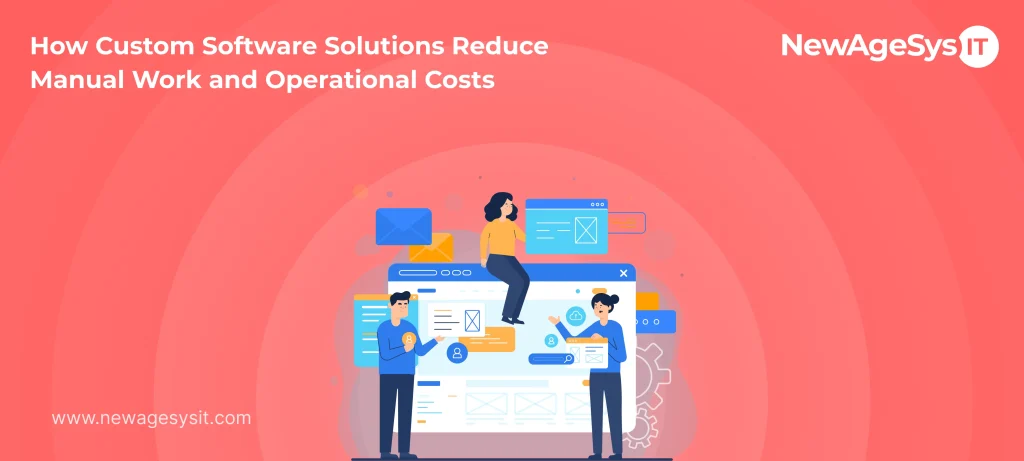
Modern businesses are under constant pressure to achieve more with less. As operations scale, manual and repetitive tasks quietly turn into hidden cost centers by draining energy, repeating errors, and limiting scalability. These inefficiencies directly reduce productivity and inflate operational costs.
This is where custom software development solutions step in to provide long-term strategic advantage. Custom software solutions allow companies to cut down on labor costs by automating processes, thereby creating a platform for long-term business operations cost savings. This article examines how custom software delivers measurable operational and financial benefits for growing businesses.
The Real Cost of Manual Work in Modern Business Operations
Manual workflows seem easy to handle initially. But these processes actually pose a significant problem as business complexity increases. Employees spend hours on repetitive tasks such as data entry, approvals, report writing, and follow-ups – the time could actually be invested in higher-value work.
In addition to the loss of productivity, manual processes make the systems more prone to human error. For instance, incorrect entries of data or failure to comply with certain business processes may cause an organization to be stuck or slowed down. This, in effect, carries into real financial consequences, especially in industries where accuracy and compliance are critical.
There’s also a human cost. This constant tedium results in employee burnout and disengagement, leading to increased turnover and training costs. Most importantly, manual operations don’t scale well. As transaction volumes or teams grow, the businesses are forced to hire more staff to help out, rather than increasing efficiency, which results in raising operational costs again.
What Are Custom Software Solutions and How Do They Work?
Custom software solutions are built specifically around your business workflows, goals, and operational challenges. Unlike off-the-shelf tools, custom software has been developed with your business workflow in mind, not generic software that has been designed to meet the workflow of many different users.
These solutions integrate with systems like CRM, ERP, and accounting tools, thus avoiding the concept of data silos completely. Also, businesses gain flexibility to add features, automate processes, and scale without being restricted to the traditional SaaS limitations to grow further.
Although ready-made tools might be economical to use at first, custom software development provides higher long-term ROI by removing the need for repeated costs associated with subscription models and eliminating inefficient workarounds.
Key Ways Custom Software Reduces Manual Work
Automation is the primary driver of efficiency in custom software. By embedding business rules directly into digital systems, organizations can streamline workflows and significantly reduce manual intervention.
1. Workflow Automation and Process Streamlining
Custom workflows automate approval, notification, entry, and reporting. This removes redundant touchpoints in a workflow and minimizes process cycles.
2. System Integration and Data Synchronization
Custom software connects CRM, ERP, and accounting tools into a single operational ecosystem. Automated data synchronization also eliminates duplication of entries, ensuring that all departments have access to accurate and updated information.
3. Intelligent Dashboards and Real-Time Reporting
Manual spreadsheet work and static reports are replaced by live dashboards that can automatically update. This gives decision-makers real-time visibility into KPIs, allowing them to make quick and data-driven decisions without having to spend numerous hours compiling reports.
4. Role-Based Access and Task Automation
Custom software allows tasks to be automatically assigned based on roles, rules, and triggers. The teams experience fewer follow-ups, less micromanagement, and clearer accountability, thus improving the way operations are conducted.
How Custom Software Helps Reduce Operational Costs
Reducing manual work contributes to cost control, but the benefits of custom software go much further. By reducing errors through these systems of automated validations and rule-based processes, businesses can avert costly errors that lead to re-work, violations, and system downtime. Also, these technology systems can help managers make better decisions regarding resource utilization by allocating budgets, inventory, and manpower based not on assumptions but on real-time data.
Another significant cost advantage is consolidation. Fundamentally, a business will not have to pay for multiple SaaS solutions that respective departments within the business use. Instead, a business can choose a single unified platform built through custom software development. This reduces licensing fees, training costs, vendor dependency, and security overhead.
Custom software also offers more predictable long-term maintenance costs compared to subscription-based pricing models that increase over time. For businesses operating at scale, this predictability supports better financial planning and sustained cost control.
Real-World Business Functions That Benefit Most from Custom Software
Certain functions could achieve faster ROI from custom software development due to their reliance on repetitive workflows and data-intensive processes:
- Operations & Supply Chain Management: Procurement processes and inventory management can be automated to eliminate unnecessary delays.
- Finance & Accounting: Invoice processing, reconcile accounts, and compliance checks with minimal human intervention.
- HR & Employee Onboarding: Improved documentation, hiring, and payroll processes cut administrative overhead.
- Customer Support & Service Management: Ticket routing, auto-responses, and service dashboards help with faster responses.
- Sales & CRM Workflows: Automation of lead management and follow-up leads to a higher conversion rate.
Most of these workflows can be extended to mobile environments through custom mobile application development, enabling real-time access for the businesses.
Custom Software vs Off-the-Shelf Tools: Cost and Efficiency Comparison
Off-the-shelf software is designed for a wide range of use cases, making it easy to deploy, but fundamentally misaligned with complex operations. It also leads to a loss of efficiency because the business cannot customize the software to meet its needs, causing the business to operate as the software requires.
Though SaaS tools initially seem economical, unseen costs can add up quickly, especially for growing businesses. Every year, operating costs rise due to costs associated with licenses, additional features, add-ons, and third-party integrations. Moreover, not only do SaaS tools create a dependency on a third-party roadmap, but they limit flexibility and control as well. Businesses are able to own the system, secure it, and update it as needed, without recurring license pressure.
As the complexity of operations increases, custom software development has been found to become more cost-efficient as it lowers spending in the long run, increases the efficiency of workflow automation, and yields a significant ROI, particularly as the off-the-shelf limitations start to impede business operations and decision-making efficiency.
When Should a Business Invest in Custom Software Solutions?
If scaling operations requires hiring more people instead of improving systems, operational costs rise without proportional efficiency gains. Having multiple tools that do not communicate with one another also increases the overall costs of software applications.
Custom software becomes a strategic investment when organizations need better insight, automation, and control to support growth without increasing overhead.
How NewAgeSysIT Helps Businesses Build Cost-Efficient Custom Software
At NewAgeSysIT, custom software development is approached as a business transformation initiative. The process begins with a detailed analysis of existing workflows to identify inefficiencies and automation opportunities.
Solutions are designed to be scalable, secure, and automation-centric, driving cost efficiency over the long term. NewAgeSysIT, having experience across industries and complex workflows, offers custom software development with real operational goals.
Turning Manual Processes into Scalable Systems
Manual processes might feel familiar, but they’re subtly restricting your business growth and increasing operational costs. Custom software solutions help businesses overcome this with the power of efficiency, simplicity, and control, all within systems designed to last in the future rather than merely serving today.
Ready to turn manual workflows into scalable systems? Get Your Free Custom Software Audit Today.