An increased demand for digital healthcare has led more patients to expect standard healthcare with advanced technologies, tailored to their requirements and suited to their personal lives. The U.S. healthcare IT software market is expected to grow at a CAGR of 15.46% over the period 2025-2030, reflecting shifts in healthcare and rising demand for technology. The increased adoption of Electronic Medical Records (EMRs) and Electronic Health Records (EHRs), powered by federal mandates and standards such as the HITECH Act, has considerably expanded the market.
Rising considerations for interoperability, a transition towards value-specific healthcare, and population health management have significantly increased adoption of healthcare analytics software. Additionally, emerging healthcare digital trends, including Machine Learning and AI trends in healthcare, are being integrated into patient management systems, diagnostic tools, and administrative techniques, further accelerating growth. In this blog, let’s deep dive into the most advanced healthcare technology trends you must watch out for if you’re looking to expand your healthcare services and internal operations with the best technologies in the market.
The Role of Technology in the Healthcare Industry
The world has moved towards experiencing the outcomes of technology, increasing demand for digital transformation services in the healthcare segment as well. Technology can offer a vast range of communication tools to:
- Reduce errors by preventing prescribing mistakes caused by incomplete or illegible forms for routes, allergies, dosages, etc.
- Improve outcomes through post-op engagement efforts to train patients on procedures, build confidence in their providers, and shorten stay lengths.
- Facilitate healthcare by reaching out to patients through their preferred channels (SMS, email, phone, etc.) and prompting them to take relevant action.
- Offering providers a holistic view of the patient’s medical history to cut out inefficiencies.
- Enhance the workflows and internal healthcare and IT technology operations.
- Simplify scheduling, billing, and claims processing, and reduce costs through automation and efficiency.
- AI trends in healthcare have been significantly enhancing patient engagement and satisfaction.
Strengthen data security and regulatory compliance.
Top Healthcare Technology Trends to Watch Out For
Healthcare and IT technology, also called healthcare tech, refers to IT tools or software designed to enhance administrative and healthcare productivity, gain new insights into treatments and medicines, or improve overall care quality. The healthcare industry is continuously searching for ways to enhance technology, and that’s why we’ve come up with the top healthcare technology trends for you to check out:
AI Clinical Agents
AI autonomous agents have proven to work better than usual chatbots, making them one of the most trending digital healthcare tech trends. These agents have evolved into autonomous copilots steering administrative and clinical workflows. According to a recent survey, 59% of respondents state that AI trends in healthcare have been efficiently incorporated into their product and service development.
Practically speaking, these agents are transforming healthcare with AI to classify patients, schedule follow-ups, evaluate diagnostic results, and guide you on subsequent steps in healthcare, while embedded within clinical systems, for instance, EHRs. AI trends in healthcare have transitioned beyond a mere buzzword, thereby minimizing the administrative workload for healthcare professionals by creating a noticeable difference.
Hospital-at-Home & Hybrid Healthcare Models
Gone are the days of visiting the hospital and waiting in long queues; virtual healthcare has got your back with the new ways of managing patients. According to the Deloitte 2026 Life Sciences & Healthcare industry insights report, health systems could lose over $54.5 billion over the next decade if they refuse to adopt virtual health options. The survey also found that only 15% of healthcare professionals have adopted governance structures to keep pace with evolving AI and digital transformation trends.
Compared with recent healthcare and IT technology trends, virtual health has been shifting toward a foundational care delivery model. Virtual hospital models and hybrid care setups combine virtual consultations, remote monitoring, and online clinical experts that ensure care for patients at the convenience of their homes.
Multimodal AI Systems
Multimodal AI trends in healthcare have been rising as systems that don’t rely on a single data source but merge imaging, genomics, EHR data, and clinical notes to offer greater diagnostic insights. The global multimodal AI market value was USD 1.6 bn in 2024 and is estimated to grow at a 32.7% CAGR from 2025 to 2034.
These kinds of AI systems are being deployed in real-world healthcare and IT technology setups. Additionally, predictive analytics continuously monitor patients and actively detect signs of clinical deterioration, including readmission risk, using real-time data streams.
Generative AI For Drug Discovery & Research
Another one of the promising future technology trends in healthcare industry is Generative AI, which most pharmaceutical companies are likely to adopt to make drug discovery effortless. These companies use the advanced Gen AI technologies to design candidate molecules, simulate clinical scenarios, and predict biological processes.
Here’s how it works: Generative AI helps researchers bring new drug molecules with properties that meet their needs, such as actively binding to a particular protein or remaining stable in the body. By learning large amounts of chemical and biological data, the systems can also detect new drug targets and recommend additional uses for existing compounds.
By creating synthetic patient data that acts like real clinical data, Gen AI helps researchers test algorithms, simulate clinical trials, and adopt treatment strategies while ensuring patient privacy. The approach helps accelerate early-stage drug research, making it faster, safer, and more flexible, especially for smaller biotech companies without access to extensive lab resources.
Human Digital Twins
With the evolution of digital healthcare systems, digital twins, or virtual clones of patients, are gaining traction as a significant tool supporting personalized healthcare. As one of the best trends in healthcare technology, this simulation can help predict how people would respond to various treatments.
You can build these healthcare digital trends with real-time data from ambient sensors and wearables. They learn continuously from the patient’s data, helping it evolve as changes occur in everyday habits, lifestyle, and health. This enables clinicians to explore various treatment options virtually, viewing how therapy, medication, and lifestyle changes would affect an individual before making real-world decisions. This ensures healthcare teams can custom-tailor interventions with focus, anticipate potential complications, and develop custom care plans rooted in the patient’s distinct physiology.
From a market perspective, the digital twin in the healthcare industry is steadily growing, with recent reports estimating a CAGR (Compound Annual Growth Rate) of 30% over the 2025-2035 forecast period, reaching USD 33.4 billion by 2035.
Data Interoperability
For many years, healthcare data interoperability has been cumbersome due to proprietary systems and methodologies that restrict compatibility and integration among various parties. Many healthcare systems are still struggling with siloed EHRs (Electronic Health Records), isolated systems, and imaging databases. AI has strong potential; however, its value grows only when information flows freely across departments, organizational structures, and healthcare settings.
These data platforms build value ecosystems. Through data integration across community health, front-line healthcare, and back-office operations, organizations can gain access to lower costs, greater outcomes, and coordinated healthcare. To earn this, healthcare systems should modernize their infrastructure, integrating cloud AI capabilities with reliable on-premises systems to improve performance, compliance, and scalability.
As healthcare interoperability increases, GDPR compliance becomes essential to ensure secure, lawful, and transparent data exchange across systems. You can refer to our GDPR compliance guide to know more about GDPR and its significance among businesses.
Interoperability platforms rely on standardized frameworks such as FHIR (Fast Healthcare Interoperability Resources), helping clinics, hospitals, and payers securely and intelligently exchange patient data. With this unified data layer, these platforms let AI models work across collective datasets rather than being confined to individual silos. This results in improved predictive analytics, highly efficient care coordination, and real-time decision-making support. They also encourage cross-organizational collaboration, enabling research experts, care providers, and clinical operations to share insights while ensuring patient privacy.
Telemedicine & Telehealth
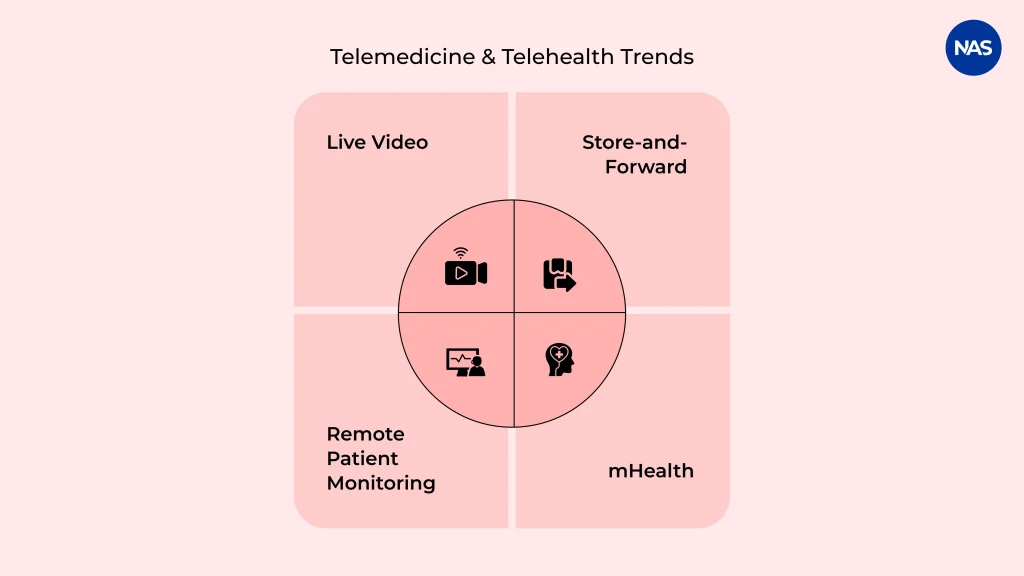
The expansion of telehealth services has enabled patients to receive remote medical consultations through virtual care platforms that integrate AI to improve treatment and diagnosis. This is one of the healthcare tech trends broadly categorized into:
- Live video: Ensures patients can directly connect with providers in real-time, enabling them to take advantage of virtual visits that replicate the in-person office experience.
- Store-and-Forward: This feature helps most healthcare providers implement electronic transfer of healthcare data anywhere in the world. For instance, a provider may send diagnostic images to a specialist for review.
- Virtual/Remote Patient Monitoring (RPM): Mainly used in healthcare to monitor patients’ real-time progress and adjust their treatment plans accordingly.
Mobile Health (mHealth): These mobile apps streamline health communication among patients and healthcare providers.
AI-Driven Mental Healthcare
Heyy app, a mental health support application, is a perfect example of a well-built app that has helped thousands of patients engage, interact, and connect, improving accessibility and scaling care while complementing human therapists. You can read more about the Heyy app from the detailed case study.
With AI-powered personalization, mental health apps are evolving. Artificial Intelligence analyzes user behavior, mood patterns, and engagement data to deliver highly customized mental health support. Advanced apps now use AI chatbots, predictive analytics, and adaptive therapy modules to offer real-time coping strategies, personalized CBT exercises, and proactive check-ins, making them real, ever-available companions.

Wearable Health Devices
IoMT (Internet of Medical Things) is an interconnected network of medical devices that enables real-time communication of patient data. This technology is among the healthcare technology trends, as it scales patient outcomes, improves operational efficiency, and minimizes costs. The global IoMT market is expected to reach 242.72 billion USD in 2029, with a CAGR of 25.8% over the period 2024-2029, according to Business Research Company.
Advanced wearable devices, such as health trackers and smartwatches, can continuously track vital signs, including blood pressure, heart rate, and blood glucose levels, providing real-time data to support better patient management. Wearable health devices are rapidly expanding to provide nurses and other healthcare professionals with detailed data. Additionally, these devices can now be embedded in clothing, making them more comfortable to use.
Robotic Surgery
Robotics and Artificial Intelligence-led surgical tools are one of the most stunning healthcare tech trends, creating more minimally invasive and precise processes, thereby minimizing recovery times and enhancing patient outcomes. The number of robotic surgeries performed every year has grown significantly over the past decade, especially in procedures like cardiothoracic, gynecological, etc.
Though these technologies don’t replace the need for surgeons, they enable them to perform more complex surgeries in less time with better outcomes. In robot-assisted surgeries, surgeons control robots equipped with tiny instruments, making much more precise incisions than the human hand. This minimizes the risk of infection, reduces the length of hospital stays, and reduces recovery times.
Virtual Reality (VR) in Healthcare
As one of the popular healthcare digital trends, VR is being used creatively in the healthcare industry. Various providers keep finding that this changing technology can offer immersive pain relief by distracting patients and letting them manage anxiety during procedures or recovery. Healthcare professionals use Virtual Reality to rehearse complex procedures, train their staff, and simulate surgeries.
This ability to practice in risk-free circumstances is essential to enhancing surgical outcomes and minimizing the risk of errors. VR has also revolutionized rehabilitation and pain management. For instance, according to a recent study, Virtual Reality has minimized discomfort to 30% for patients with fibromyalgia, lower back pain, etc. You can partner with a reliable healthcare mobile app development services provider to help build a VR app for your business.
Augmented Reality (AR) in Healthcare
AR is stepping into a crucial healthcare technology trend, transforming how healthcare providers engage with medical data and patients, overlaying digital data onto the physical world. This technology is primarily used in hospitals to improve treatment planning, diagnostics, and surgical processes. For instance, AR helps surgeons to access real-time 3D patterns of a patient’s anatomy during surgery, ensuring precise incisions and minimizing the risks associated with invasive procedures.
AR-driven tools also improve patient interactions. Symptom-checker chatbots with AR let patients define their symptoms and receive prompt feedback, minimizing the load on healthcare staff and streamlining triage. Nevertheless, integrating AR solutions with artificial intelligence can help physicians improve diagnoses by leveraging alternative possibilities derived from real-time analysis of medical data.
Blockchain
Blockchain technology improves data privacy and data security by creating tamper-proof patient data records, minimizing the risk of data breaches. Blockchain technology could become a key aspect of the industry’s infrastructure, ensuring healthcare facilities can securely store patient data while remaining compliant with HIPAA and other industry-specific regulations.
Healthcare 3D Printing
Currently, 3D printing technology is used in healthcare to create custom prostheses, surgical equipment, and patient-specific implants, enabling more personalized care. The number of hospitals with creative solutions in healthcare, like 3D printing capabilities, has increased significantly in recent years, allowing hospitals to improve medical production while minimizing healthcare costs.
Gene Editing & CRISPR Technology
The rise of healthcare industry trends such as gene-editing technologies, including CRISPR (Clustered Regularly Interspaced Short Palindromic Repeats), offers the potential to cure genetic diseases and customize treatments based on genetic profiles. A child recently became the first person in the world to receive a gene-edited treatment successfully using CRISPR. The child received treatment after being diagnosed with carbamoyl phosphate synthetase I deficiency. After receiving personalized gene-editing treatment, the child has recovered, highlighting the best aspect of advanced gene-editing technology.
Challenges to Take Care Of While Adopting Advanced Healthcare Technology Trends
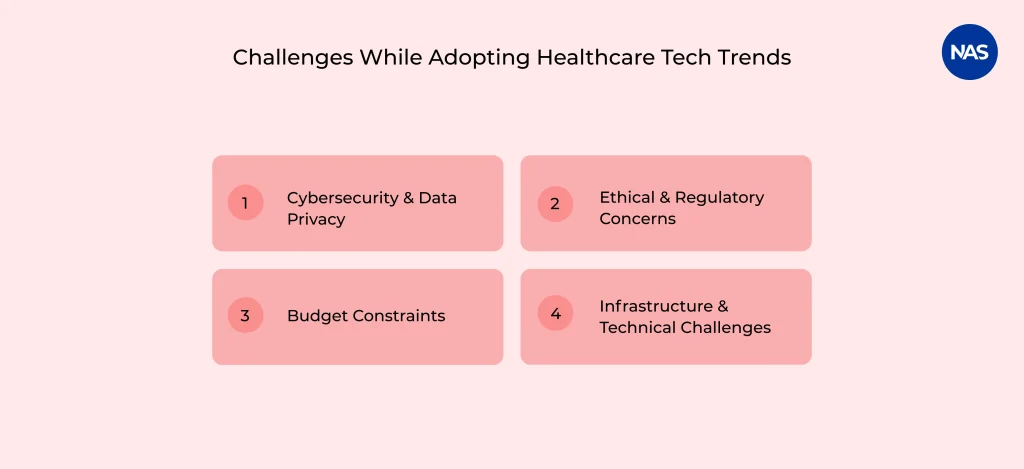
While the technology trends in healthcare industry are stunningly promising, the healthcare providers will still need to overcome hurdles as they incorporate new technologies into their facilities. Let’s learn the challenges you would need to keep in mind and alleviate while adopting the latest healthcare technology trends:
1. Cybersecurity & Healthcare Data Privacy
AI in healthcare future relies heavily on data analysis and collection, underscoring the importance of cybersecurity measures in the healthcare sector. While storing large amounts of private healthcare and financial data in healthcare databases, healthcare organizations and providers are obligated to rely on the latest cybersecurity measures to ensure data security and privacy. Using AI is an efficient way to reduce cybersecurity costs and help organizations comply with complex regulations, including GDPR and HIPAA, while keeping security measures up to date.
2. Ethical Considerations & Regulatory Challenges
The biases that often occur in AI algorithms require healthcare professionals to be aware of the ethical considerations of leveraging advanced technology. By collaborating with key stakeholders, data scientists, insurance firms, and AI engineers, healthcare providers can create regulatory standards and ethical guidelines to secure patients.
3. Budget Constraints
Healthcare organizations face multiple challenges due to consistent budget constraints that force them to align digital innovation with cost management. For instance, a health system that builds a digital front door might need resources and adopt the latest Gen AI solutions to improve efficiency. When you need to adopt complex healthcare systems with the latest technologies, it is always ideal to consult a healthcare software development services provider that can provide the services you need within the budget.
4. Infrastructure & Technical Concerns
Challenges such as interoperability issues and limited technical expertise can affect healthcare authorities’ attitudes towards digitalization. These challenges primarily minimize system reliability and access. Authorities need to prioritize investing in robust infrastructure and in end-to-end training programs to alleviate these problems.

The Future of Healthcare Technology: How to Start Building Your Healthcare Software?
Healthcare technology has seemingly boundless opportunities. To improve efficiency throughout the industry and make the patient experience less painful, healthcare technology is being adopted across the industry, including administrative processes, making diagnoses more accurate and complete. Rising technologies in healthcare, including applications that help your patients detect potential health threats and enable you to examine digital information from lab results, also serve the healthcare industry.
As new technologies take shape, it is crucial for you, as a healthcare service provider, to familiarize yourself with the latest healthcare technology trends. If you have a small team, lack expertise, or need to focus on other core activities, seeking assistance from a healthcare software development company is an ideal move. The AI in healthcare future is full of possibilities—if you wish to explore building your healthcare software or app and staying relevant in the modern healthcare era, reach out to us.
FAQ
1. How can I ensure HIPAA compliance in my future healthcare software?
Ensuring HIPAA compliance in future health software begins with focusing on privacy and security in the architecture. This includes access controls, encryption measures, audit logs, etc. As part of health innovations: transforming healthcare for the future, you should treat compliance as a consistent process with ongoing risk assessments and updates.
2. How will generative AI reduce administrative costs for hospitals?
Gen AI automates processes such as scheduling, coding, documentation, and patient engagement, further reducing manual workloads. This allows hospitals to reduce operational expenses and free up the workforce to focus on other core clinical operations.
3. What is the role of AI in predictive patient risk stratification?
AI evaluates the real-time patient data to detect risk patterns, if any. This is more helpful than traditional techniques, as it ensures improved outcomes, proactive interventions, and optimal use of healthcare resources.
4. How long does it take to implement a new enterprise health software system?
Implementing an enterprise healthcare software system, adopting very complex healthcare technology trends, can take months to years, depending on the complexity. However, developing a generic-to-mid-complex system can take from a few months to a year, depending on your requirements. To get a detailed estimate of your project cost, you can reach out to us.
5. How do you calculate the ROI of a new healthcare IT platform?
ROI can be calculated by comparing cost savings, productivity gains, reduced errors, and enhanced patient outcomes against factors such as implementation/maintenance costs. Quicker workflows and greater data utilization usually bring lasting financial returns.
6. Can new healthcare software integrate with our legacy systems?
Yes. Advanced healthcare platforms are built to integrate with legacy systems by using APIs, middleware, and HL7/FHIR standards. This ensures continuity of operations without replacing existing infrastructure.