
Welcome to Blogs
Discover actionable insights, in-depth research, and expert perspectives, all in one place.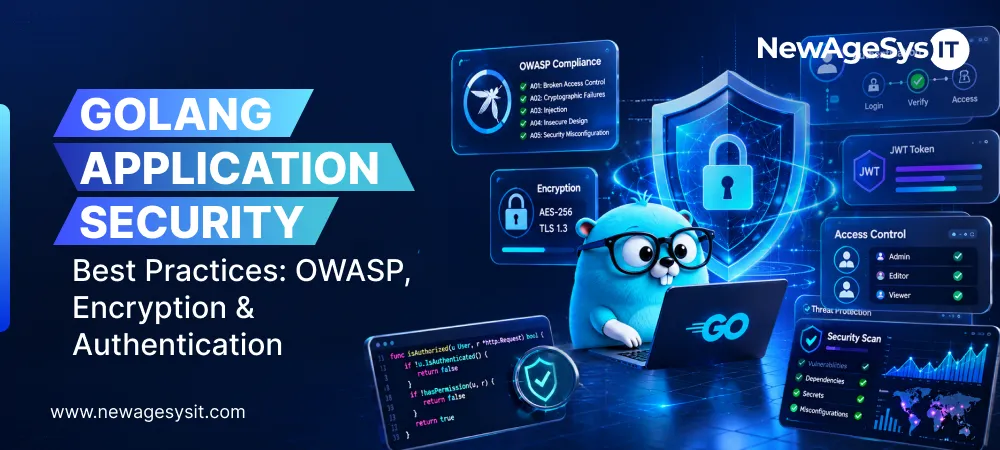
Golang 8 min read
Golang Application Security Best Practices: OWASP, Encryption & Authentication

| This article is part of our series on Golang Security And Compliance in the US: Best Practices for Production-Grade Applications in 2026 |
Introduction: Go’s Security Baseline and What It Doesn’t Cover
Go eliminates an entire class of memory safety vulnerabilities: buffer overflows, use-after-free errors, and dangling pointer dereferences that account for a significant share of C/C++ CVE disclosures. That is a genuine baseline security advantage. But Golang application security best practices extend well beyond what the language runtime provides by default. Production Go services require an application-layer security architecture.
OWASP’s most prevalent web application vulnerabilities are fully language-independent, including broken access control (A01), cryptographic failures (A02), injection (A03), and identification and authentication failures (A07). Go services are equally vulnerable to broken access control, misconfigured JWT libraries, and SQL injection vulnerabilities. Python or Node.js services face no greater risk. The Go type system does not protect against application-layer security failures Many teams hire dedicated Golang developers for this layer.
Engineering teams building production Go services need an application-layer security architecture. It must not be assumed from the language alone. Professional Golang development services can support this. Teams seeking a security-first delivery process also benefit from custom software development services.
Security practices embedded from sprint one are essential. OWASP Top 10 (2021) mitigations and Go cryptography patterns form the focus here, along with authentication architecture for production Go services.
Application security patterns are the foundational security layer of this guide. They span the full Golang security, compliance, and best practices landscape.
Access Control Architecture in Go Services
OWASP A01:Broken Access Control is the most common web application vulnerability category in the 2021 edition. Access control failures are also the most prevalent production vulnerability found in Go web services. The implementation pattern matters as much as the intent to implement it.
Middleware-Based Access Control
Authentication middleware validates the JWT or session token, then populates the request context with the authenticated user’s identity and roles. Executing middleware before any business logic handler is mandatory. Placing authentication validation after the handler logic creates an authorization bypass by construction, a design flaw, not an edge case.
Authorization middleware checks whether the authenticated user’s role permits the requested operation. It validates access to the specific resource in question. Gin and Echo both support per-route middleware chains that enforce this separation clearly.
The critical gap in many Go access control implementations is the lack of resource ownership validation. Role validation alone is not enough. The system must confirm that the authenticated user can access the specific record being requested. Holding a permitted role does not automatically grant access to every record of that type.
Every data access operation must verify the user’s ownership of the resource. Verifying user-to-role membership alone is insufficient. A valid customer must not retrieve another customer’s records, even if their role permits reading customer data generally.
Context-Based Identity Propagation
Go’s context.context is the correct mechanism for propagating authenticated identity. It carries identity through the call chain from the HTTP handler to the service layer to the database query layer. Middleware extracts identity from the validated token and stores it in context. All downstream functions read identity from context. They do not accept it as additional function parameters passed through multiple layers.
The context-based identity propagation pattern concentrates identity handling in one location, making security auditing cleaner and ensuring identity cannot be accidentally bypassed by downstream functions that ignore parameters.
For web application development, this middleware execution sequence is non-negotiable: authentication middleware → authorization middleware → resource ownership check → handler logic.
Golang Cryptography: Encryption, Hashing & TLS
Go’s standard library provides a production-grade cryptography stack. Using it correctly requires knowing which algorithm and configuration choices are secure. It also means knowing which ones must never appear in production Go services.
TLS configuration: Go’s crypto/tls package defaults to a secure configuration in modern Go versions. For production Go services, explicitly set MinVersion: tls.VersionTLS12. Prefer TLS 1.3 for all new service deployments. Use ACME (Let’s Encrypt) or an internal PKI for certificate management.
The InsecureSkipVerify: true configuration option disables certificate validation entirely. It has no place in any production service. It is a development shortcut that creates a trivially exploitable man-in-the-middle attack surface.
Data encryption: AES-GCM is the correct Go pattern for authenticated symmetric encryption. It uses crypto/aes combined with crypto/cipher to provide both confidentiality and authenticity in a single operation, eliminating the need for a separate HMAC while also preventing tampering with the encrypted ciphertext. AES-GCM directly addresses OWASP A02:Cryptographic Failures in Go applications.
Password hashing: The correct standard for password storage is golang.org/x/crypto/bcrypt at a cost factor of 10 or higher. SHA-256, MD5, and SHA-1 are general-purpose hashing functions that remain computationally cheap to brute-force at scale—precisely the wrong property for a password store and therefore unsuitable for security-sensitive credential storage.
Secrets management: Never hardcode secrets in Go source code. Do not commit them in configuration files to version control either. Use os.Getenv, Kubernetes Secrets, or a secrets manager for production secrets. Supported options include HashiCorp Vault SDK and AWS Secrets Manager SDK for Go.
Cryptographically secure random values: Use crypto/rand for all security-sensitive random generation, including tokens, nonces, session identifiers, and CSRF values. Never use math/rand.
JWT Authentication in Go Services
JWT implementation errors are a recurring source of authentication failures. They appear repeatedly in production Go services. The golang-jwt/jwt library (v5) is the standard Go JWT implementation. It has specific configuration requirements that must be met for secure operation.
Always specify the expected algorithm explicitly at parse time. JWT parsers that accept the signing algorithm from the token header are vulnerable to manipulation into accepting tokens signed with weak algorithms or no signature at all—the so-called ‘alg:none’ vulnerability. golang-jwt/jwt v5 requires explicit algorithm specification at parse time, preventing the attack class by construction. Never configure a JWT parser to accept whatever algorithm an incoming token declares.
HS256 versus RS256 signing: HS256 uses a shared secret. It suits single-service authentication scenarios where the signing key never needs to leave the service. RS256 uses RSA key pairs. It suits multi-service environments or OAuth provider integrations where the verification key must be distributable. The signing key is never exposed to all verifying parties.
Validate expiry, issuer, and audience claims on every request. Token expiry (Claims.ExpiresAt) prevents indefinite session validity from a stolen token, while issuer and audience validation prevent tokens from crossing service boundaries. Such misconfiguration is common in Go microservice deployments and must be avoided.
Token refresh and rotation: The standard Go authentication architecture uses short-lived access tokens (15–60 minutes) combined with longer-lived refresh tokens (7–30 days). Refresh token rotation on each use prevents a stolen refresh token from providing indefinite access.
Input Validation & Injection Prevention in Go
OWASP A03:Injection vulnerabilities remain fully applicable to Go services. Go’s type safety advantages offer no protection here. The prevention patterns are well-established. They should be the default practice in every production Go service from the first sprint.
SQL injection prevention: Go’s database/sql parameterized queries prevent SQL injection by construction. Use ? or $1 placeholders; never interpolate user input into query strings. sqlc generates type-safe Go query code directly from SQL definitions. It provides the same injection protection at the code generation layer. Raw string concatenation to build SQL queries is the antipattern to eliminate.
HTML template injection: Use html/template, not text/template, for all HTML rendering, as it automatically escapes user input in Go web applications. The html/template package is the correct choice for any service rendering HTML to users. Never concatenate user input directly into HTML strings. Upstream validation does not make such concatenation safe.
Command injection: exec.Command arguments must never be constructed from user input without explicit whitelist validation. Prefer Go library implementations over shell commands wherever possible. The shell is an injection surface. Library calls eliminate it at the architecture level.
gosec static analysis: The gosec Go security linter catches SQL injection (G201), command injection (G204), and hardcoded credentials (G101). It also detects weak random generation (G404) and unsafe TLS configurations (G402). It flags all of these in static analysis before they reach production. gosec should run as part of golangci-lint in every Go CI pipeline. Security-focused static analysis tools are covered in Golang Code Quality & Testing: Unit Testing, Benchmarking & Static Analysis Tools.
Security patterns addressing SQL injection, command injection, and hardcoded credentials form the technical foundation for HIPAA and SOC 2 compliance architecture, as covered in Building HIPAA & SOC 2 Compliant Applications with Golang.
Final Thoughts
Go’s memory model is a meaningful security foundation. But OWASP’s most prevalent web application vulnerabilities are language-independent. They are fully applicable to Go services. Production Golang application security best practices require several key controls: RBAC middleware with resource ownership validation, AES-GCM encryption for sensitive data, bcrypt password hashing at a cost factor of 10 or higher, explicit JWT algorithm specification at parse time, and parameterized database queries. These are non-negotiable elements, and gosec must be integrated into the CI pipeline.
US Go engineering teams that implement these patterns as default practices, not pre-launch additions, consistently pass enterprise security reviews. They also complete compliance audits without significant remediation work. Learn more about digital transformation solutions from a leading AI software company in the United States.
If your Go application is approaching a security review or compliance audit, implement these controls from the start. Correct RBAC middleware execution order, AES-GCM data encryption, and bcrypt password hashing are all essential, as are explicit JWT algorithm specification and parameterized database queries. Combined, such controls create a security posture that withstands enterprise due diligence without last-minute remediation work.
Core Development
Keep exploring the custom services.

AI Software Development
Custom AI Software Development
Build intelligent, production-ready software from machine-learning models to AI-driven automation designed around your business goals.
Learn more
Mobile App Development
Custom Mobile Application Development
Native and cross-platform mobile apps that are fast, secure, and built to scale across iOS and Android.
Learn more
Web App Development
Custom Web Application Development
Scalable, secure web applications, from customer portals to complex dashboards, tailored to how your business actually works.
Learn more



