
Welcome to Blogs
Discover actionable insights, in-depth research, and expert perspectives, all in one place.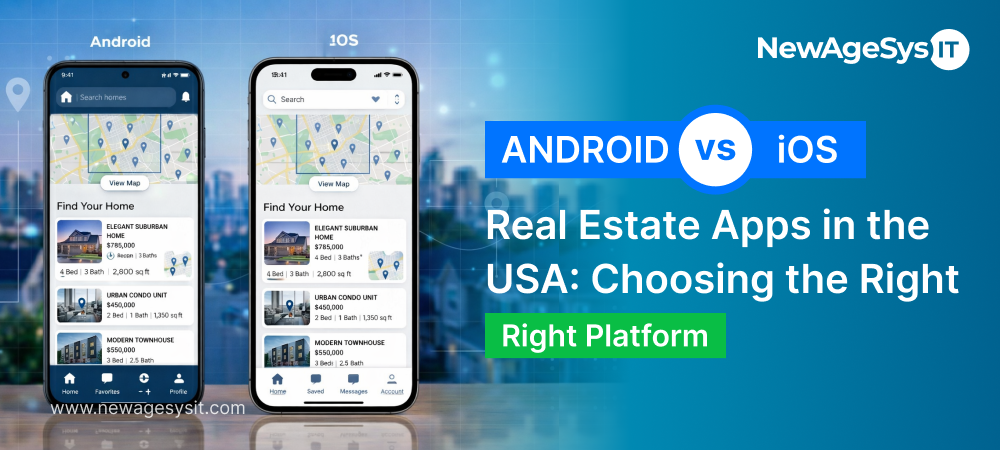
App Development 8 min read
Android vs iOS for Real Estate Apps in The USA: Choosing The Right Platform

In the high-stakes American property market, the Android vs iOS real estate app USA decision is rarely about developer preference; it is a strategic product choice that dictates your market reach, security posture, and integration capabilities.
For US real estate founders and brokerage owners, picking the wrong architecture early leads to expensive technical debt down the road. Rebuilding an iOS-only property app for Android post-launch often burns through up to 80% of the original budget.
Navigating the complexities of real estate mobile and web app development services requires a clear-eyed understanding of how platform demographics line up with your specific business model.
Whether you’re optimizing real estate software and CRM development services for on-field agents or building a consumer portal, the framework below helps you align your platform strategy with where the 2026 US market actually stands.
US Real Estate App Demographics: Beyond General Market Share
General smartphone statistics are a poor proxy for real estate product strategy. While Android dominates globally, the United States is an outlier where iOS commands a solid 55% to 60% of the total user base. But for a real estate professional, the “average user” simply doesn’t exist.
Making the right real estate app platform choice early on determines your initial ROI, and it demands a surgical strike based on the specific socioeconomic segment you’re going after. Identifying the best platform real estate app for your business means going beyond the headline numbers.
Luxury and Premium Segments
Research consistently shows that high-income US households skew significantly toward iOS, with the gap most pronounced in households earning above $125,000. In high-net-worth corridors like Manhattan’s Upper East Side or Miami’s Brickell district, an iOS app isn’t just a tool; it’s a baseline expectation.
If your brokerage is focused on $2 million-plus listings, your clients are almost certainly living inside the Apple ecosystem. They’re using iPads to review floor plans and Apple Watches to catch instant showing notifications. Launching a high-end brand without a native iOS app experience creates a friction gap that can alienate high-value leads before the first walkthrough even happens.
Mass Market and Renters
A reliable iOS Android property app that serves both ecosystems equally is essential for capturing the mass-market opportunity across the near 55/45 platform split. For startups aiming to become the next Zillow or Redfin, a dual-platform approach isn’t optional. Interestingly, the renter demographic tends to show the highest parity between platforms.
Young professionals in emerging tech hubs like Austin or Charlotte are spread across both ecosystems, meaning a one-size-fits-all strategy will likely leave close to half your potential lead volume sitting on the table. A well-built property app that iOS and Android users can both rely on is essential for capturing that mass-market opportunity.
Business Impact: Aligning your platform with these demographic realities ensures your initial marketing spend reaches the highest-value users first, rather than throwing capital at a platform your target audience isn’t using.
Android Real Estate Apps: Powering Scale and Property Operations
For organizations focused on the rental market or large-scale property management, Android app development is often the primary strategic choice, largely because of its open architecture and enterprise-level customization.
The Problem: Hardware Fragmentation and Fleet Management
Managing large, distributed maintenance teams or reaching the massive mass-market renter demographic requires versatile, cost-effective hardware. In the US, property management companies routinely handle thousands of units across multiple states, and specialized hardware costs add up fast. iOS devices offer limited hardware variety and a higher entry price point, which can seriously slow down operational scaling.
The Solution: Android Enterprise and Custom Deployments
Android Enterprise enables firms to deploy managed devices with standardized configurations for field staff. This platform lets IT departments lock devices down to kiosk mode, running only the company’s proprietary CRM or maintenance software, which prevents data leakage and keeps field agents focused while they’re on the clock. Android’s compatibility with a wide range of peripheral hardware, from portable document scanners to thermal imaging cameras for home inspectors, makes it the workhorse of the property industry.
The Advantage: The Open NFC and Smart Lock Ecosystem
Android allows companies to select purpose-built rugged devices for maintenance crews and mid-range smartphones for leasing agents, all within a unified software environment. Android’s open NFC (Near Field Communication) ecosystem is uniquely suited for keyless property access and smart lock management.
Unlike the walled garden limitations found in iOS, Android gives developers deeper access to hardware triggers. In the American build-to-rent sector, that flexibility enables seamless self-guided tours at scale.
Business Impact: By leveraging Android’s flexible hardware ecosystem, companies can cut device overhead by up to 40% while keeping 100% operational efficiency in the field.
iOS Real Estate Apps: The Choice for Luxury and High Performance Teams
In the premium US brokerage space, iOS remains the undisputed standard for both clients and top-producing agents. The platform’s emphasis on design consistency maps perfectly onto the aesthetic demands of luxury real estate.
The Problem: The Inconsistency Factor in High-End Visuals
Luxury clients expect a flawless visual experience. Any inconsistency or lag in the user interface undermines the premium feel of a luxury real estate brand. High-stakes transactions also demand robust mobile security, and affluent clients are notoriously protective of their financial data.
The Solution: Hardware-Accelerated Security and Performance
Building on iOS gives real estate apps access to the Secure Enclave for hardware-isolated credential storage, the gold standard for digital keys and sensitive client financial data. In the US, where wire fraud remains a persistent threat, an app that leverages Face ID and Touch ID backed by the Secure Enclave delivers the peace of mind that luxury clients expect as a given.
The Advantage: ARKit and the Future of Virtual Staging
Apple’s ARKit offers the most mature augmented reality property staging available today. With LiDAR sensors built into Pro models, real estate apps can execute room scanning with inch-perfect accuracy.
Premium real estate users demonstrate consistently higher session depth on iOS apps optimized for Apple Human Interface Guidelines, a pattern reflected in engagement metrics across luxury-segment proptech platforms. A buyer sitting in New York can virtually walk through a villa in Florida, placing their own furniture in the rooms to scale all within a high-quality property app that iOS and Android users both notice.
Cross-Platform Strategy: Maximizing Efficiency for US Startups
By 2026, cross-platform frameworks like Flutter and React Native will have become the default for most consumer property search apps and for good reason.
The Problem: The Speed-to-Market vs. Budget Dilemma
Launching a national real estate startup means you need immediate presence on both the Apple App Store and Google Play. Dual native development, however, can be prohibitively expensive. For US real estate startups under timeline pressure, cross-platform development compresses the path to market presence on both iOS and Android.
The Solution: Unified Codebases and Rapid Iteration
A unified codebase delivers 30-50% lower development costs while ensuring that critical updates go out to all users at the same time. That simultaneity matters enormously for real estate apps that need to respond quickly to shifting IDX (Internet Data Exchange) rules or Fair Housing technical flags across both platforms.
Business Impact: The 30-50% development cost saving over dual native builds allows real estate startups to reallocate capital toward MLS data integration and lead generation, the two highest-ROI investments in the early platform growth stage.
Security Architecture and Compliance: Non-Negotiables for US Real Estate
Regardless of platform, US real estate apps must handle sensitive MLS data and client information with real discipline.
Data Protection: Keychain vs. Keystore
MLS access tokens, the credentials that authorize an agent’s app to query live listing data, must be stored in hardware-backed secure storage on both platforms. On iOS, the Keychain with Secure Enclave backing provides the right isolation level.
On Android, the Keystore with a hardware-backed TEE meets the same requirement, but security levels vary across device manufacturers. Real estate apps that require consistent MLS token security should define a minimum Android API level and a hardware security certification standard upfront.
Fair Housing Risks and AI Bias
AI recommendation algorithms and geographic search features carry Fair Housing enforcement risk regardless of the platform. Both iOS and Android implementations require the same compliance logging architecture and disparate impact testing.
Your engineering team needs to flag these risks consistently, making sure search filters stay grounded in objective criteria, price, school districts, square footage, rather than demographic markers that create legal exposure.
Platform Decision Framework
Choosing the right US real estate app platform strategy means balancing immediate market needs against long-term scalability. Here’s a straightforward breakdown:
- Targeting Luxury? Start with iOS Native to meet aesthetic and security expectations.
- Targeting Rental Operations? Start with Android Enterprise for fleet management.
- Targeting National Search? Use a cross-platform real estate app framework like Flutter to maximize reach.
- Budget Constrained? Cross-platform is your clearest path to dual-store presence.
- High Security or Fintech Features? Native is usually the safer call for complex escrow or digital signature integrations.
Development Cost and Planning Framework
Budgeting for a real estate platform means looking well beyond the initial lines of code.
Cost Range: The Reality of US Development
A typical mid-scope real estate app in the US runs between $100,000 and $300,000. Dual native builds carry a 60-80% premium over cross-platform approaches, a gap that can be decisive for early-stage companies.
The MLS Factor: Hidden Integration Costs
MLS integration costs, typically $20,000 to $60,000 per market, apply equally across all platforms. Founders also need to account for recurring MLS data access fees per market. Many brokerages also pair their mobile app with a full-featured web application for agents who manage listings from desktop. These vary significantly across the thousands of US MLS boards and represent an ongoing operational cost that accumulates with every new geography you enter.
Conclusion
The Android vs. iOS decision is ultimately a business strategy call, shaped by your target market and security requirements. There’s no universal right answer, only the right answer for your product, your users, and your growth stage.
If your organization is making a platform decision for a US real estate app, aligning that decision with your target user demographics, real estate product category, and security requirements before development begins significantly improves both product outcomes and cost predictability.
The NewAgeSysIT team supports US real estate founders and brokerage owners across the full platform strategy and development lifecycle.
Core Development
Keep exploring the custom services.

AI Software Development
Custom AI Software Development
Build intelligent, production-ready software from machine-learning models to AI-driven automation designed around your business goals.
Learn more
Mobile App Development
Custom Mobile Application Development
Native and cross-platform mobile apps that are fast, secure, and built to scale across iOS and Android.
Learn more
Web App Development
Custom Web Application Development
Scalable, secure web applications, from customer portals to complex dashboards, tailored to how your business actually works.
Learn more



