
Welcome to Blogs
Discover actionable insights, in-depth research, and expert perspectives, all in one place.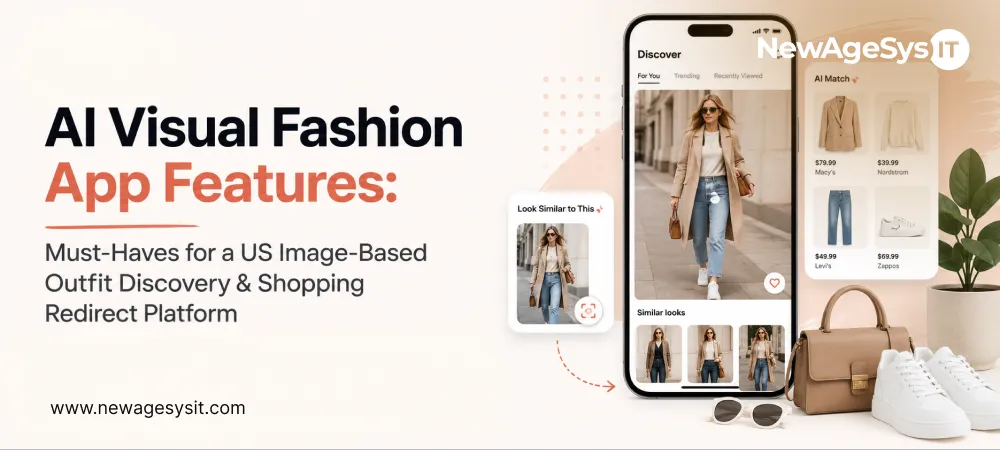
App Development 8 min read
AI Visual Fashion App Features: Must-Haves for a US Image-Based Outfit Discovery & Shopping Redirect Platform

| This article is a part of our series on: AI-Powered Visual Fashion Discovery App Development for the US Market in 2026 |
In the United States, AI visual fashion app features are usually less complicated than what most founders think, especially after catalog assumptions have been dropped. Many consumers want an app where they upload a picture and receive shoppable results. There’s a need for a super admin panel that allows the operator to monitor usage and track the cost of the SERP API. Other than that, there isn’t much else that’s important in the rest of the build, and it’s intentionally that way.
This document outlines the various features of an image-based outfit finder and the resulting experience designed to integrate these features, as well as the reasons for the no-catalog fashion app and most of the supporting infrastructure. It finishes with a comparison of the no-catalog fashion app against white-label visual search SDKs, particularly where custom SERP builds justify the costs at scale and where they do not.
There is one guiding principle for each of the features discussed: all user-facing features are designed to support the upload-results-redirect loop, and the admin features support the app’s overall health and monitoring cost. Everything beyond that has no purpose. Rather, the focused strategy is the actual strategy.
Two components carry the entire product: the consumer-facing app and the operator dashboard behind it. The consumer side upload, preprocessing, results, redirect, and search history is the AI fashion app development layer. Super admin dashboard development covers SERP API cost monitoring, user activity tracking, latency alerts, and account management, the financial control room that determines whether the unit economics hold at scale. The admin panel is the web layer. The former focuses on the consumer side application, while the latter focuses on the admin panel that runs behind the app.
The Mobile Features That Actually Carry the Product
Most visual search app features fail not because they’re missing from the build, but because they’re built without understanding which one actually decides whether the product works.
Upload Has to Survive Real Phones, Not Demo Conditions
Camera capture and photo library selection need to be supported starting on Day 1, not as part of a v2. Client-side compression allows for capture of large photos (which can be 6MB to 12MB from a modern phone) and allows them to be sent from the phone. Showing upload progress prevents the screen from appearing frozen and/or inactive during the compression and upload. Users will abandon the feature with a long, confusing upload, regardless of how sophisticated the downstream matching may be.
The Feature Users Never See Is the One That Decides Everything.
Before any search request is made, the app removes the background from the photo and isolates the clothing item. This is a necessary and single preprocessing step to ensure that the matches are not among many that are close but are unrelated. This is an invisible step, but it is the most critical step to determining whether the product will be used again. Teams exploring this will find the most significant engineering investment in AI product and agent development garment isolation and background removal before the SERP API call is where match quality is won or lost, not in the UI layer most teams over-budget. , as opposed to the UI work which is most heavily budgeted for by teams.
The App Sells Nothing, It Just Points.
The search results are shown as a grid of images, with each item shown as an individual card which contains the item name, the source, and a link. The user is taken directly to the seller’s checkout. The platform does not facilitate sales directly, capture credit card details, or process sales. The app simply directs the user to where the item can actually be purchased.
Returning Users Need a Reason to Come Back
Search history lets users revisit previous searches instead of scanning the same jacket again that they happened to come across a few days ago. Profile and account management covers the essentials: saved preferences, login, and account deletion. First time users are shown a sample search so that they can understand the concept of see it, find it, buy it before they are too deep into the app.
What Turns a Search Result Into Something Worth Trusting
Most fashion app feature lists describe what features exist without explaining which one determines whether the product works
Utilizing Category and Style Filters can help narrow searches to find the items that users want, be it dresses, tops, or in a certain style, instead of sorting through many pages of items that are vaguely related. Instead of providing a meaningless raw number, a comparison tool can help users determine how similar a match is with a high, medium, or low signal confidence. This is important because users come to rely on search tools and will lose that trust if results are presented with many things that barely meet the criteria.
Multi-item outfit Deconstruction shows users full outfit photos and helps them find the top, bottoms, and shoes individually.
This mirrors how people actually shop for an outfit they spotted, piece by piece, brand by brand, not as one bundled item nobody sells as a single SKU anyway.
Fallback handling matters as much as strong matches do. When confidence is low, surfacing close alternatives beats an empty results screen every time. A near-miss that still leads somewhere useful is a far better outcome than a dead end, and users notice that difference immediately, often deciding right there whether the app earns a second use.
The Decision to Skip a Catalog Decides Everything Else
No UI design choice will ever have as much impact as the decision to omit an internal catalog. No cart. No checkout flow. No inventory pages. No SKU management. No spurious mental overhead from a catalog sync tool that will inevitably break when the retailers need to modify their product feeds.
Precision search will take the place of all that. There will be a sharp focus on the redirect, the results, and the search itself. The app’s job is done once it tells the user where to buy the product. There’s no need for a second appraisal from the platform to handle the transaction.
For a no-catalog discovery-based fashion app, this is the best option. This design keeps the app simple and removes the need to deal with inventory or PCI. This is the best use of design and engineering resources as it directly impacts the success of the product.
The Dashboard That Tells a Founder if the Business Model Still Works
The admin side does less visible work but carries real financial consequences if it’s skipped or under-built.
A user-activity dashboard tracks daily searches, active users, and popular categories giving a constant read on the app’s actual pulse. An advanced, dedicated dashboard monitoring the real unit economics of the app breaks SERP API usage and cost down to individual queries — showing the founder their real cost-per-search.
Latency in image processing and platform health monitoring catches problematic preprocessing or pipeline failures before users notice there’s an issue and start uninstalling. Account management, moderation, and exportable analytic reports are integrated into the dashboard for both day-to-day operations and those investor meetings where someone asks for the cost of acquisition out of nowhere.
This scope justifies its build cost because the spending is based on query volume. This is unlike infrastructure spending that does not change no matter how many users are on the platform. The dashboard is how a founder can monitor health and spending within a single interface. It can identify abuse or wasting spending. This is a lot better than being shocked by a high monthly SERP API cost.
Custom Build Vs. White-label Visual Search SDK
Some retailers may have their proprietary product catalog and want a straightforward way to integrate visual search. In this case, using Visenze, Syte, or Snap is a good option and can be implemented in a few weeks. However, this use case is not the one this guide is about.
White-label SDKs typically assume a catalog exists and become highly costly as the volume of searches increases. A no-catalog, web-wide consumer discovery app can not use these. This app would be trying to search for products through a multitude of retailers that it does not partner with.
| Capability | White-Label Visual Search SDK | Custom SERP API Build |
| Web-wide results | Limited, catalog-dependent | Built into the architecture |
| Per-query economics at scale | Expensive licensing tiers | Predictable, linear with volume |
| Control over preprocessing and ranking | Limited to vendor logic | Full control |
| Brand ownership of experience | Often vendor-branded | Fully owned |
| PCI scope | Depends on vendor setup | Out of scope entirely |
Every row represents the same fundamental idea. An SDK filters a catalog built by someone else. A custom build captures information from the open web that covers economics that remain predictable as volume increases, not economics that are designed to punish growth that a founder is trying to achieve.
Final Thoughts
These features are purposefully designed to be small, not because of a forced budget constraint. An admin panel designed to monitor the health of the application with a tight control on the budget spent on the search engine result page and is built to exactly fit requirements.
When founders step back and review the mobile application, paying special attention to the result experience and pair it with an admin panel that tracks cost control from the start, they get an application that accurately predicts, is scalable, and has a low operating cost. The alternative is a catalog application that is a very complex solution to an inventory problem that doesn’t exist and offers a worse experience at a higher cost to the users.
Starting with a no-catalog SERP design and a cost-tracking panel focuses engineering on the outcome that matters. This has a much greater value to the users than a catalog search framework. Learn more about digital transformation solutions from one of the leading AI software companies in the United States.
Core Development
Keep exploring the custom services.

AI Software Development
Custom AI Software Development
Build intelligent, production-ready software from machine-learning models to AI-driven automation designed around your business goals.
Learn more
Mobile App Development
Custom Mobile Application Development
Native and cross-platform mobile apps that are fast, secure, and built to scale across iOS and Android.
Learn more
Web App Development
Custom Web Application Development
Scalable, secure web applications, from customer portals to complex dashboards, tailored to how your business actually works.
Learn more



