
Welcome to Blogs
Discover actionable insights, in-depth research, and expert perspectives, all in one place.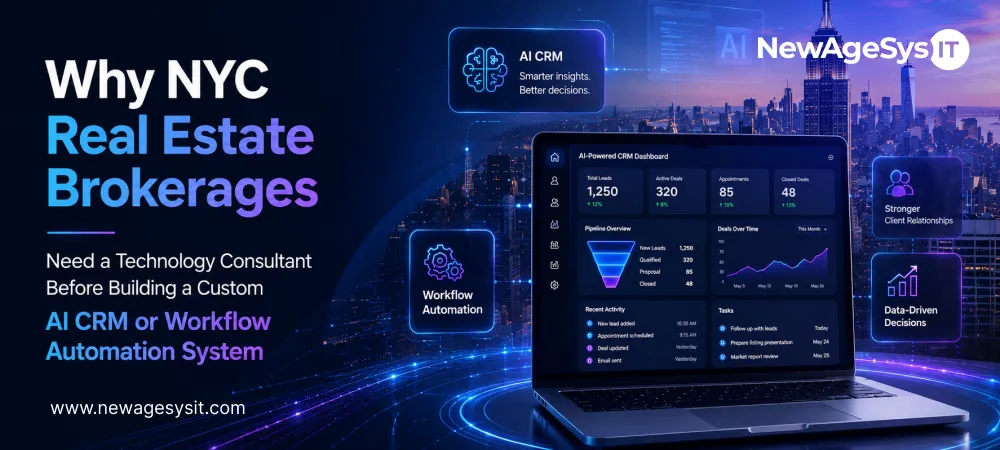
Real Estate 6 min read
Why NYC Real Estate Brokerages Need a Technology Consultant Before Building a Custom AI CRM or Workflow Automation System

| This article is part of our series on AI-Powered Custom CRM System for NYC Real Estate Brokerages: Building a Lead Automation And Workflow Orchestration Platform in 2026 |
The Decisions That Make or Break the Bridge Happen Before Coding
Most brokerage CRM projects don’t fail because of bad code. They fail because of bad decisions made too early in the process. A qualified partner in custom software development catches those decisions before they become expensive problems: scoping, API verification, and compliance review happening before a single line of code gets written.
Brokerages using Gmail, RealtyMX, and Rello face a specific challenge. The right build is a thin orchestration layer, not a full replacement. Getting there requires scoping, API verification, and compliance review before development starts.
Assuming RealtyMX or Rello APIs support things they don’t is a costly mistake. Underestimating Gmail’s verification requirements adds more risk. Shipping an AI assignment rule that violates Fair Housing rules isn’t a bug, it’s a liability.
These are architecture and compliance decisions, not coding problems. An NYC-focused real-estate CRM consultant gets this right — before the build starts, not after launch.
The 5 Operational Signs a Brokerage Has Outgrown Its Disconnected Stack
1. One Person Manually Routing All Leads
When one person reads the inbox and forwards every lead by hand, that’s a bottleneck. It’s also a single point of failure the moment that person is unavailable. Automation exists to eliminate exactly this kind of dependency.
2. Agents Switching Between 3+ Systems for One Deal
Closing a single deal shouldn’t require switching between Gmail, RealtyMX, and Rello. Every context switch costs time, and data falls through the cracks. A unified dashboard built through web application development removes that friction entirely — one interface where lead status, listing activity, and application progress are all visible without switching systems.
3. Showings Scheduled in Email Threads With No Conflict Visibility
Showings booked over email collide invisibly. Double-bookings and missed appointments happen before anyone catches them. A conflict-aware showing tracker makes these errors structurally impossible.
4. Application Status Only Visible in a System Agents Can’t Access
If application status lives only inside Rello, agents can’t advise clients accurately. Mirroring that status into the agent-facing dashboard closes the gap. The existing Rello system stays intact throughout.
5. No Way to See Which Agent Closed Which Deal Without Asking
When a broker has to ask around to find out who closed what, visibility is broken. Performance data doesn’t exist in any useful form. An admin dashboard with role-based access makes deal attribution answerable in seconds.
Why Off-the-Shelf CRMs Fail RealtyMX + Rello Brokerages
Generic CRM platforms like Follow Up Boss, kvCORE, and Salesforce weren’t built for this environment. They require replacing systems that already work well. Per-user fees also scale painfully at brokerage size.
None of these platforms resolve the Gmail → RealtyMX → Rello workflow gap either. Building without proper discovery produces three predictable failures. Each traces back to a decision made without expert input.
The first failure: an integration that breaks after every RealtyMX API update. That happens when API capability is assumed, not verified. The second: an AI assignment rule that violates Fair Housing standards because compliance was an afterthought.
The third failure is the most common. Agents refuse to use a dashboard that doesn’t match how they actually work. No amount of good code fixes a tool designed without studying the real workflow.
What ‘AI-Powered’ Actually Means in a Brokerage CRM in 2026
The term ‘AI-powered’ gets applied to a wide range of things. In a brokerage CRM bridge, the highest-value AI capability isn’t a chatbot. It isn’t predictive analytics either; those come later.
What moves the needle first is Gmail inbox parsing. It extracts lead data without any manual forwarding step. Building that parsing layer as a purpose-trained AI product and agent development component rather than a brittle regex pattern matcher is what lets it generalize across the hundreds of email formats a brokerage inbox actually receives. Automated assignment rules then route leads by listing area or agent capacity.
Compliance filters are the third piece. They flag Fair Housing risk in automated messages before anything is sent. The AI integration and adoption work connecting inbox parsing, automated assignment, and the Fair Housing compliance filter into one workflow removes the bottleneck and reduces legal exposure at the same time.
Those Fair Housing obligations are covered in the series’ compliance guide: Fair Housing Act, NYC Real Estate Data Privacy & AI Compliance. A consultant frames the AI lead-parsing layer around the actual operational problem. That framing keeps the build focused and the budget realistic.
What a Qualified Consultant Reviews Before Scoping
Before writing a scope document, a consultant verifies RealtyMX and Rello API capabilities directly. What each platform supports in 2026 gets confirmed, not assumed. Workarounds and hard limits both get documented before any build estimate is written.
Gmail account structure is the next review area. A consultant maps how leads arrive and what the Workspace setup looks like. Reading Gmail data from a third-party server triggers Google’s restricted-scope process.
That process includes an annual CASA security assessment and real recurring cost. Whether a domain-wide admin install changes that posture is part of the review. Getting this detail wrong before scoping adds a recurring budget line that was never planned for.
Current lead-assignment rules get mapped next. Agent count and role structure inform dashboard sizing and access tiers. The proposed automation logic gets reviewed for Fair Housing exposure next. That review covers lawful sources of income risk and involves fair-housing counsel.
What the First Conversation Should Cover
A strong development partner asks specific questions before offering anything. They want to know the existing RealtyMX, Rello, and Gmail setup in detail. They also ask about the real API capabilities of each platform, not the assumed ones.
They ask how leads are currently routed and what the agent count looks like. They ask about role structure and Fair Housing exposure. A partner who speaks fluently about orchestrate-don’t-replace and Gmail restricted-scope has built here before.
Red flags look different: proposing a full CRM replacement when a bridge would do. Treating Gmail API access as a trivial OAuth step is another. Skipping any mention of Fair Housing compliance is a third.
A dashboard designed without studying agent workflows also signals the wrong partner. The goal of the first conversation isn’t a fast feature quote. It’s alignment on scope, API reality, Gmail verification, and compliance first.
Why Discovery Determines Whether the Bridge Gets Built Right
The make-or-break decisions for a CRM bridge happen before any code is written. Scope versus replace, API capability, Gmail’s verification reality, Fair Housing exposure – all of it. A consultant’s pre-build discovery stops those decisions from going wrong silently.
NYC brokerage owners who invest in proper discovery improve the outcome significantly. Their CRM connects real systems and gets used by agents every day. It automates workflow without creating the compliance risk that sinks poorly scoped projects.
The full cost breakdown for scoping a bridge is detailed here: Cost to Build a Custom AI-Powered CRM Bridge for a NYC Real Estate Brokerage.
The right first step for any brokerage building a CRM bridge is structured discovery. That means scoping the bridge versus replacing before any development begins. Scope, API reality, Gmail verification, and Fair Housing review all come before any build. A custom software development team that specializes in NYC brokerage workflows is the right partner for that conversation. Learn more about digital transformation solutions from one of the leading AI software companies in the United States.
Core Development
Keep exploring the custom services.

AI Software Development
Custom AI Software Development
Build intelligent, production-ready software from machine-learning models to AI-driven automation designed around your business goals.
Learn more
Mobile App Development
Custom Mobile Application Development
Native and cross-platform mobile apps that are fast, secure, and built to scale across iOS and Android.
Learn more
Web App Development
Custom Web Application Development
Scalable, secure web applications, from customer portals to complex dashboards, tailored to how your business actually works.
Learn more



