
Welcome to Blogs
Discover actionable insights, in-depth research, and expert perspectives, all in one place.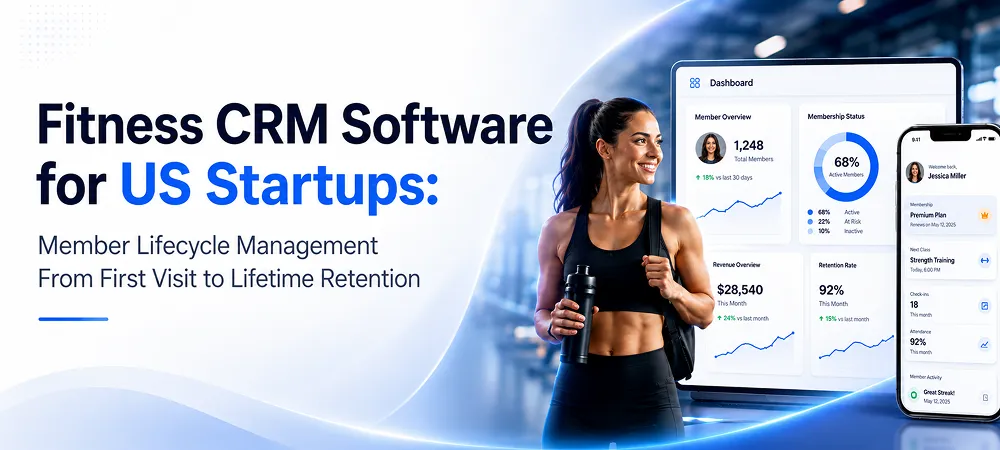
Fitness 8 min read
Fitness CRM Software for US Startups: Member Lifecycle Management From First Visit to Lifetime Retention

Why Member Lifecycle Management Is the Core Business Problem for US Fitness Startups
Member retention, not member acquisition, is the defining business challenge for US fitness startups and growing studios. Most fitness businesses direct the majority of their marketing budget toward attracting new members. Yet boutique studios and independent gyms lose an estimated 20-40% of their membership annually to quiet cancellations and declining attendance. Every dollar spent on new member acquisition is partially offset by the revenue lost through members who stop showing up.
Purpose-built custom fitness mobile and web app development addresses both sides of this equation. A fitness CRM software converts more leads into paying members and retains more existing members. This is done through personalized engagement, progress tracking, and timely re-engagement.
Operators who invest in custom fitness CRM development gain a single system that manages the full member lifecycle. It spans from the first inquiry through trial visit, membership activation, ongoing attendance, goal progress, and ultimately renewal or churn prevention.
This blog maps the complete landscape: member profiles and progress tracking, lead nurturing, and conversion automation. It also defines membership tier and billing architecture, wearable data integration, and custom development cost planning.
Member Profiles and Progress Tracking: The CRM Foundation
A fitness CRM member profile is more than a contact record. It is the longitudinal record of a member’s entire relationship with the business. This includes the initial inquiry source, trial visit date, membership start date, and classes attended. It also covers the personal bests, goal milestones, trainer notes, and full communication history.
This data structure forms the operational backbone of every personalized interaction the business will have with that member over time.
Progress tracking transforms raw attendance data into actionable engagement intelligence. A member attending 12 classes in their first month but only 3 in their fourth is a visible churn risk, but only to a CRM that tracks attendance trends over time. Members who set specific fitness goals and receive regular progress updates against those goals show significantly higher retention rates.
A CRM can record goals like weight targets, distance benchmarks, and strength milestones, and tie them to attendance and performance data. This gives coaches and automated systems the context to send relevant, timely encouragement.
Instructor and coach access matters at the point of delivery. Member profiles should be accessible to instructors on mobile during class check-in, enabling personalized acknowledgement. This differentiates boutique studio CRMs from generic gym experiences.
Lead Nurturing and Trial-to-Member Conversion
Most fitness businesses handle lead follow-up inconsistently. A prospect who inquired about a trial class but did not book immediately is contacted once and then lost. The industry standard conversion rate from first contact to paid membership is 20 to 30 percent for well-managed fitness businesses.
Operators with systematic follow-up automation convert at 30 to 45 percent, a meaningful difference at any membership price point.
Fitness CRM lead nurturing sequences follow up on inquiries with relevant content, trial class reminders, and social proof. They also follow up with personalized offers at the right cadence. The goal is to move more inquiries into trial visits and more trial visits into memberships. Automated sequences eliminate reliance on individual staff members’ memory and ensure consistent follow-up regardless of business volume or staff availability.
Win-back campaigns are a parallel lever. Members who cancelled or lapsed 3 to 6 months ago represent a warm reacquisition audience that already understands the product.
A CRM can segment former members and trigger re-engagement at predictable seasonal moments like New Year and post-summer. This CRM recovers memberships at a far lower cost than new acquisition. Note that automated SMS and push notification campaigns require TCPA-compliant opt-in under US federal law.
Membership Tiers, Freeze Rules & Billing Architecture
Fitness membership architecture is more complex than a subscription toggle. US fitness businesses operate multiple tiers: basic, unlimited, premium, family, corporate. Each has distinct billing cycles, access permissions, freeze policies, and auto-renewal rules. A CRM that cannot enforce these programmatically requires manual administration, which generates errors and escalations at scale.
Freeze functionality is operationally essential. Members who travel, are injured, or face financial hardship need the ability to pause memberships without cancelling. Freeze rules: maximum freeze duration, applicable fees, and access restriction logic during freeze periods must be configurable per membership tier. This configurability is a development architecture decision, not a cosmetic feature.
Auto-renewal architecture carries legal implications. US consumer protection laws vary by state on auto-renewal disclosure and cancellation requirements.
A web application development approach to the billing dashboard should generate pre-renewal notifications and enforce applicable cooling-off periods. They should provide a compliant digital cancellation mechanism. Operators should verify applicable state consumer protection laws with qualified legal counsel.
Dunning management includes automated payment-retry schedules, member-notification sequences, and access-restriction logic after failed payment attempts. This is a revenue-recovery mechanism that well-designed fitness CRM billing systems handle automatically.
Wearable Integration: Connecting Member Health Data to the CRM
US fitness CRM wearable integration connects member health and activity data from many sources. They are connected via Apple Health (HealthKit, iOS), Google Health Connect (Android), Fitbit, and Garmin to the member profile. Coaches, automated systems, and members themselves gain richer context for tracking fitness progression across every session and recovery period.
HealthKit data governance is non-negotiable. Data accessed from Apple HealthKit cannot be used for advertising purposes or shared with third parties without explicit user consent. Fitness CRM systems integrating HealthKit must implement a compliant data-handling architecture from the start, not as a post-launch retrofit. Note that Google Fit is deprecated; Google Health Connect is the current Android health data platform as of 2024.
The engagement benefit is measurable. Members who connect wearable data to their fitness CRM profile and see their activity trends, sleep, and recovery reflected in their fitness mobile app’s member dashboard consistently show higher app engagement rates.
Custom fitness CRM development requires higher upfront investment and longer build timelines. In return, the system is designed precisely to the business’s tier structure, workflow, wearable integration requirements, and brand experience..
CRM Development Cost and the Build vs Configure Decision
US fitness startups evaluating CRM infrastructure face a genuine choice. Either configure an existing platform: Mindbody, Wodify, Zen Planner, or PushPress. Otherwise, build a custom fitness CRM on modern software architecture. Both paths involve real tradeoffs that depend on the operator’s business model, competitive positioning, and growth trajectory.
Off-the-shelf fitness platforms deploy quickly, carry lower upfront cost, and are purpose-designed for fitness operations. Limitations include feature scope defined entirely by the vendor and integration surface area constrained to the platform’s API. It can also be a member-facing experience that cannot be fully customised, and subscription costs that compound significantly at scale.
Custom fitness CRM development requires higher upfront investment and longer build timelines. In return, the system is designed precisely to the business’s tier structure, workflow, wearable integration requirements, and brand experience.
Custom development is the right choice when the operator’s competitive advantage depends on the member experience. It allows businesses to create an experience distinct from every other studio running the same SaaS platform.
What a Complete Fitness CRM Lifecycle Looks Like
A production fitness CRM manages the member relationship across four distinct stages, requiring different data, different automations, and different touchpoints.
Stage 1: Lead
An inquiry arrives via web form, social ad, or referral. The CRM creates a lead record with source tracking and initiates an automated lead nurturing sequence. It involves trial class invitation, FAQ response, and social proof messaging. Every interaction is timestamped against the lead record for conversion attribution.
Stage 2: Trial
The trial visit is booked. A member profile is created with fitness goals, health history notes, and contact preferences. A post-trial automated follow-up triggers within 24 hours. The trial-to-membership conversion offer is presented at the optimal timing window based on engagement signals captured during the visit.
Stage 3: Active Member
The membership tier is assigned, billing is initiated, and access permissions are configured. Attendance is tracked against engagement thresholds, and progress milestones are acknowledged automatically. When attendance drops below a defined threshold, the CRM flags the member as a churn risk. This triggers a coach notification or personalized re-engagement touchpoint.
Stage 4: Retention or Re-Engagement
At-risk members receive personalized outreach from a coach or an automated re-engagement sequence that removes the friction barrier to returning. Seasonal campaigns target dormant former members at predictable re-engagement windows. Referral requests go to satisfied members at peak satisfaction moments, following a milestone achievement or a highly attended class streak.
Building a Fitness Business on Lifecycle Intelligence
US fitness startups and boutique studios that invest in CRM infrastructure designed around the member lifecycle consistently outperform competitors on both trial-to-member conversion rate and annual retention rate.
The compounding effect is significant. A business that retains 80% of its members annually builds a fundamentally stronger revenue base than one retaining 60%. The difference is not just growth but durability. Lower-retention businesses must spend more on acquisition just to replace lost members before they can grow.
A fitness CRM built for member lifecycle management addresses both sides of the business equation simultaneously. It converts more of the leads already being generated and extends the lifetime value of members already on the books.
Your fitness business might be managing member relationships in a system built for bookings rather than lifecycle management. Design a CRM architecture around the specific lifecycle stages where members are won and lost. This investment produces the most durable business growth. A reliable fitness CRM development company can help you explore what that architecture looks like for your specific operation. Learn more about digital transformation solutions from one of the leading AI software companies in the United States.
FAQ
What is fitness CRM software?
Fitness CRM software manages the relationship between a gym or studio and its leads, trial users, active members, and former members. Unlike a generic contact database, it can connect memberships, attendance, fitness goals, progress, trainer notes, billing, communications, and retention activity. This gives operators one system for managing the complete member lifecycle rather than separate tools for sales, scheduling, and engagement.
What stages of the member lifecycle should a fitness CRM manage?
A complete fitness CRM should manage four core stages: lead, trial, active membership, and retention or re-engagement. Leads need source tracking and nurturing. Trial members need follow-up and conversion workflows. Active members require billing, attendance, goals, and progress tracking. At-risk or former members need churn-prevention and win-back campaigns. Connecting these stages creates a continuous member record instead of disconnected interactions.
How can fitness CRM software improve trial-to-member conversion?
A fitness CRM can automatically follow up with new inquiries, send trial invitations and reminders, record lead sources, and trigger personalized post-trial communications. Staff can see every previous interaction before contacting a prospect. Automation also prevents leads from being forgotten when teams become busy. The goal is to systematically move prospects from inquiry to trial and from trial to paid membership using timely, relevant communication.
How can a fitness CRM help prevent member churn?
Fitness CRM software can identify churn risk by monitoring declining attendance, increasing time since the last visit, class cancellations, and changes in member engagement. When activity falls below configured thresholds, the CRM can alert a coach or trigger a re-engagement workflow. This gives staff an opportunity to intervene before the member formally cancels rather than discovering the problem only after recurring revenue has already been lost.
What information should a fitness CRM member profile include?
A fitness CRM member profile should include contact information, lead source, trial history, membership start date, attendance, fitness goals, progress milestones, trainer notes, communication preferences, and engagement history. It can also record personal bests and other performance information. Bringing these records together helps trainers understand each member’s history and gives automated systems enough context to deliver more relevant reminders, recognition, and retention communications.
How should fitness CRM software manage memberships, freezes, and billing?
Fitness CRM software should support multiple membership tiers with configurable billing cycles, access rules, freeze policies, renewal settings, and cancellation workflows. Freeze rules may include duration limits, fees, and temporary access restrictions. Billing automation can also handle failed-payment retries and member notifications. Because automatic-renewal and cancellation requirements vary across US jurisdictions, these workflows should remain configurable rather than being permanently hard-coded into the platform.
How can fitness CRM software re-engage inactive or former members?
A fitness CRM can segment members based on attendance history, cancellation status, last visit, previous membership, and engagement behavior. Former or inactive members can then receive targeted win-back campaigns, seasonal offers, class recommendations, or personalized coach outreach. Re-engagement works best when the CRM distinguishes between someone who cancelled recently, someone whose attendance is declining, and someone who has been inactive for many months.
Can fitness CRM software integrate with Apple Health, Fitbit, Garmin, and Android health data?
Yes. Fitness CRM applications can integrate health and activity information from platforms such as Apple Health, Fitbit, Garmin, and Android health services when users authorize access. Wearable information can enrich progress tracking with activity, recovery, or other permitted metrics. On Android, new integrations should consider Health Connect or the Google Health API because Google is ending support for Google Fit APIs at the end of 2026.
Core Development
Keep exploring the custom services.

AI Software Development
Custom AI Software Development
Build intelligent, production-ready software from machine-learning models to AI-driven automation designed around your business goals.
Learn more
Mobile App Development
Custom Mobile Application Development
Native and cross-platform mobile apps that are fast, secure, and built to scale across iOS and Android.
Learn more
Web App Development
Custom Web Application Development
Scalable, secure web applications, from customer portals to complex dashboards, tailored to how your business actually works.
Learn more



