
Welcome to Blogs
Discover actionable insights, in-depth research, and expert perspectives, all in one place.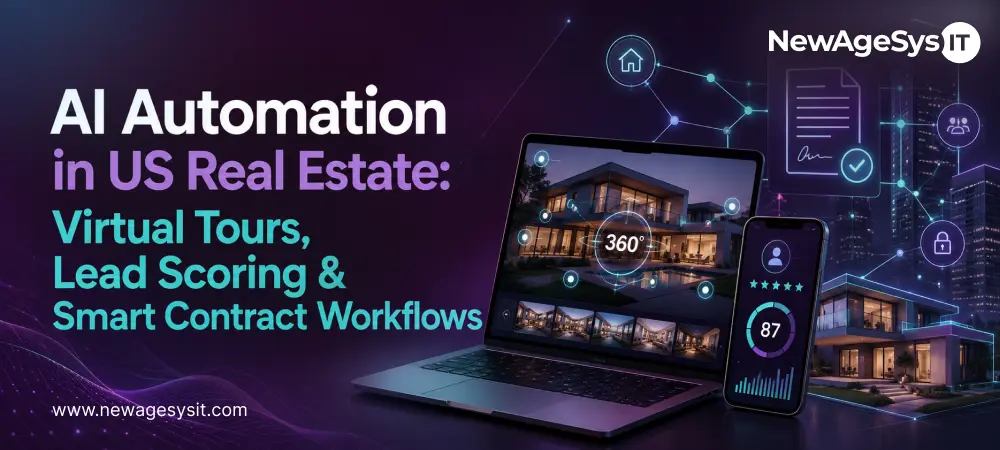
Real Estate 7 min read
AI Automation in US Real Estate: Virtual Tours, Lead Scoring & Smart Contract Workflows

AI has become the baseline of every industry, rather than just a technology upgrade.
Zillow’s Zestimate, Redfin’s AI search, and Opendoor’s pricing mean consumers now expect AI in every real estate platform. Industry data consistently shows that slow lead response drives potential buyers to competitors.
Platforms without virtual tour integration lose consumer engagement. The biggest challenge here is that real estate teams are confused between “AI exists” and “AI works for us”. They build impressive-sounding features that deliver zero ROI. They deploy real estate AI lead scoring that creates Fair Housing risk.
If you’re evaluating custom real estate app development or real estate CRM development services, or understanding which AI applications deliver actual competitive advantage, this article is for you!
Virtual Tours and Property Visualization Technology
Virtual tours in the real estate industry are considered to be the “price of entry” and a decision point for buyers. It provides a complete walkthrough of the property virtually, which does not need to be scheduled in advance or come to see it personally for further processing.
Matterport creates immersive 3D walk-throughs that help buyers explore properties from anywhere easily. The drawback here is that it comes with a plan of money per listing, where most of the agents do not use it consistently.
And here’s where alternatives come into the scene. AR space measurement on iPhone uses LiDAR to measure rooms and visualise the furniture placement. In a way, it helps buyers go from just “viewing” to making decisions towards active planning.
Building these visualization tools into custom mobile app development services ensures agents and buyers access virtual tours directly from their phones. Mobile apps like Zillow 3D Home and Ricoh Theta help agents to create 360-degree tours with no extra cost barring. It is one of the basic tools, but it is highly effective.
The goal is simple: more engaged buyers, fewer unproductive showings, and faster decisions. Platforms without virtual tour integration lose buyer engagement and conversion data to competitors.
Real Estate AI Lead Scoring for US Real Estate Brokerages
AI lead scoring is an accurate, data-driven method that uses machine learning and AI to evaluate the lead details according to how likely they are to convert into paying customers. Your agents are simply wasting time on the wrong lead if they are not using an AI lead score.
Without it, agents will tend to put equal energy into each type of lead, which is not needed. The agent will nurture the lead with a 3-year timeline, with 2 hours already spent on them. Here, the same agent could have closed almost three leads within 2 hours with the help of accurate real estate AI lead scoring details.
Real estate AI lead scoring helps to analyze the behavioural pattern, search frequency, property views, price range, saved searches, and more. Such signals predict which leads are more likely to convert, transact within 90 days, or are not at all potential.
These filters direct agent time toward leads that are most likely to convert.
Most brokerages make mistakes by deploying the generic lead score models. Such models are trained according to someone else’s data and market. Here, generic models will miss the conversion pattern specific to your brokerage, your agents, and your market.
To have a brokerage-specific model win all the time, invest in custom software development services. Train AI according to historical lead-to-close data, where the model will learn how and what your agents convert. Ensure to have real-time updates. For example, if a lead saves 10 properties in one evening, they have signaled readiness already. Here, your CRM needs to flag that immediately and not in 24 hours.
Before deploying any lead scoring models, they must be tested thoroughly. Routing high-quality leads away from agents working specific neighbourhoods will create regulatory exposure. Consult legal counsel first.
Smart Contract Workflows in US Real Estate Transactions
Smart contracts automate the parts of real estate deals that are wasting time if the process is done manually.
Earnest money escrow takes days to release manually. A smart contract releases it instantly when conditions are met. Contingency deadlines get missed because nobody tracks them across multiple systems. A smart contract tracks inspection, appraisal, and loan contingency deadlines, notifying all parties automatically. Commission splits get calculated wrong and disbursed late. A smart contract calculates and distributes them the moment funding is confirmed.
The ROI is obvious: faster closings, fewer disputes, reduced operational overhead.
The reality in the US real estate market is that smart contract applications are operational in selected marketplaces and not considered mainstream in US residential real estate.
But smart contracts don’t replace legal transaction infrastructure. They supplement it. State regulations vary. Legal and regulatory considerations are real. Before deploying smart contracts on your platform, consult qualified real estate legal counsel.
Don’t build assuming unlimited automation. Build knowing the constraints.
For the infrastructure layer behind title verification, smart contract workflows, and real estate data connectivity, visit Blockchain & Open APIs in US Real Estate Platforms: Title Management & Tokenized Property
Automated Valuation Models (AVMs) and Market Intelligence
The most important buyer’s question is knowing the worth of their home. An AVM (automated valuation models) answers all questions in 5 seconds.
If you consider AVM as magic, you are already raising a misconception. It is as good as their data.
Buyers want one answer: “What is my home worth?”
An AVM that answers that question in 5 seconds converts more seller leads than any other tool. That’s the ROI of AVMs. Instant home value estimates drive immediate seller engagement.
But AVMs aren’t magic. They’re only as good as their data. You get two options here: either build proprietary AVMs or integrate the third-party ones. ATTOM data solutions, CoreLogic, and HouseCanary provide the AVM APIs.
There are market trend dashboards that help in delivering the value. It helps with the real-time neighbourhood analytics, median price trend, days on market, inventory levels, and price-to-list ratios. This will easily help buyers, sellers, and property agents to make informed decisions.
You can do a smart amalgamation of all models. Integrate the third-party AVMs for lead capturing and build market dashboards for competitive advantage in your platform.
Budget planning for AVMs, AI recommendations, MLS data, and full-scale product scope is covered separately in PropTech Product Development Cost in the USA: MVP vs Full-Scale Platform in 2026
Workflow Automation for US Real Estate Operations
Why waste time in monotonous work that does not even help close deals? Weekly client updates, follow-up emails, reminders, and compliance checks will fill your calendar, not letting you grow in the right ways, where automation will reclaim these wasted hours on manual work.
Automated lead follow-up will help with the engagement of buyer cycles. From personalized property matches to property check-ins, everything can be automated on time without needing an agent.
Transaction milestone automation generates tasks and deadline alerts automatically, ensuring inspection, appraisal, and loan contingency dates don’t get missed. Stakeholder notifications update all parties in real time.
Workflow automation can reduce routine client communication time significantly, weekly activity reports, follow-up sequences, and milestone notifications that agents previously managed manually.
Post-close automation runs anniversary emails, market updates, and referral requests to past clients, the highest-ROI marketing touchpoint most agents execute inconsistently.
Building these automations into custom iOS real estate app development and Android development ensures agents have access to automation workflows from mobile devices, where they spend most of their time.
Automation reclaims 5–10 agent hours per week.
Fair Housing Compliance for AI Systems in US Real Estate
AI works according to the data given; it’s not magic that happens with the system. No matter how carefully operations are considered, AI can violate the Fair Housing Law without intending to.
Every AI model in real estate needs disparate impact testing, lead scoring, recommendations, marketing automations, and overall geographic targeting. Everything requires testing. If the model produces systematically different outcomes based on race, national origin, or sex, then you have a Fair Housing Problem.
AI systems make the lead routing and recommendations decisions, so make sure to log in as audit trails are non-negotiable. With the proper data input, it can defend you when needed.
HUD has taken enforcement action against the advertising systems in housing. This is an active regulatory priority and not some future risk. Before deploying AI, test for disparate impact. Consult qualified real estate legal counsel. Document everything.
For broader sequencing across MLS strategy, AI features, compliance review, and product investment, use the guidance in How to Plan a Real Estate Tech Product Roadmap for the US Market: Consultant-Led Strategy
Final Thoughts
Real Estate AI and automation have real competitive advantages that help in lead scoring, agent deals, virtual tours, and move inventory, where automation reclaims hours.
Surely, there will be competitive advantages observed when Fair Housing compliance is built from day one. Brokerages deploying AI with rigorous Fair Housing testing and practical automation achieve stronger productivity, higher conversion, and better consumer engagement.
Design for Fair Housing compliance from the development stage, not post-deployment. That creates the most defensible AI-powered real estate experience.
If your organization is planning AI and automation investments in US real estate, designing for Fair Housing compliance from the model development stage, not as a post-deployment review, creates the most defensible and most competitive AI-powered real estate experience. Learn more about digital transformation solutions from one of the leading AI software companies in the United States.
Core Development
Keep exploring the custom services.

AI Software Development
Custom AI Software Development
Build intelligent, production-ready software from machine-learning models to AI-driven automation designed around your business goals.
Learn more
Mobile App Development
Custom Mobile Application Development
Native and cross-platform mobile apps that are fast, secure, and built to scale across iOS and Android.
Learn more
Web App Development
Custom Web Application Development
Scalable, secure web applications, from customer portals to complex dashboards, tailored to how your business actually works.
Learn more



