
Welcome to Blogs
Discover actionable insights, in-depth research, and expert perspectives, all in one place.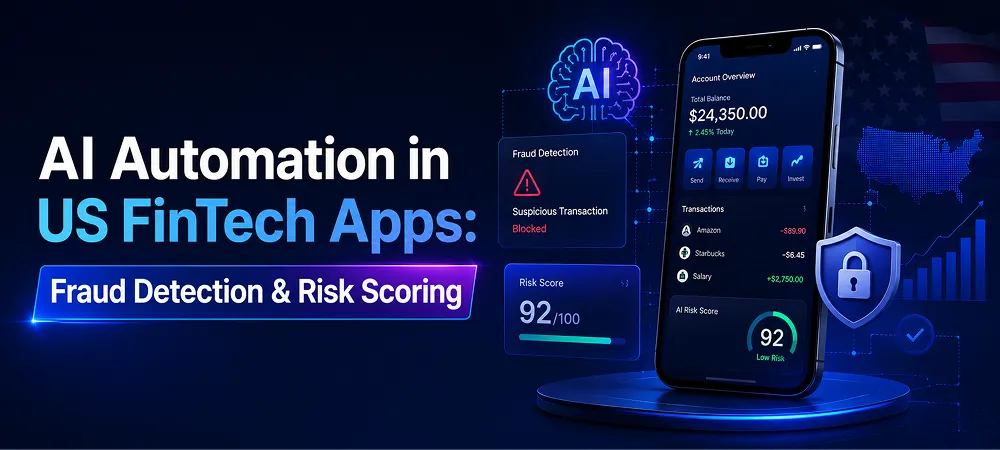
Fintech 10 min read
AI Automation in US FinTech Apps: Fraud Detection & Risk Scoring

AI and Automation are reshaping how US financial products manage fraud at scale. In modern FinTech environments, AI fraud detection FinTech app capabilities have become a baseline requirement rather than an advanced feature.
Teams building secure mobile financial experiences often prioritize FinTech mobile and web app development services early, since fraud architecture decisions made at the prototype stage are far cheaper to get right than ones retrofitted after a launch. This approach helps establish stronger risk controls through mobile product engineering services.
Fraud remains the fastest-moving operational threat for US FinTech platforms. Digital financial fraud losses across US channels now exceed $12 billion annually, and every new app expands the attack surface. Traditional rule-based detection models struggle because attackers learn patterns faster than compliance teams update controls.
AI-driven fraud detection improves decision speed and model adaptability. Real-time fraud scoring executes inside payment authorization workflows and commonly targets sub-200ms response windows.
This article explores real-time fraud detection, credit risk scoring, behavioral analytics, and automated compliance monitoring for US FinTech applications.
Real-Time Fraud Detection Architecture for FinTech Apps
Real-time fraud detection architecture has become a core requirement for modern financial products. In AI in FinTech USA, fraud prevention depends on decisions executed during live transaction processing. Teams building mobile payment experiences often align fraud architecture with broader custom mobile app development strategies, since the device fingerprint and behavioral signals fraud models depend on are only as reliable as the mobile app collecting them.
The feature engineering pipeline processes hundreds of signals for every transaction. Inputs include transaction amount, merchant category, geolocation, device fingerprint, velocity metrics, behavioral patterns, and network relationships. These features are transformed into model-ready inputs through low-latency data pipelines and pre-computed feature stores.
Model serving infrastructure must return fraud scores in under 50 milliseconds. High-throughput environments require optimized inference engines, model version control, A/B testing capability, and co-located payment processing services. Champion and challenger models receive limited live traffic before broader deployment decisions.
The decision engine combines fraud scores with transaction-specific thresholds and policy rules. Compliance teams can adjust risk tolerance without redeploying machine learning models. High-confidence alerts trigger blocking, medium-confidence events trigger step-up authentication, and low-confidence activity enters analyst review queues.
Analyst dispositions continuously feed the retraining pipeline and improve future detection accuracy. Feedback loops allow fraud models to adapt to changing attack behaviors and emerging transaction patterns. Continuous evaluation reduces drift and strengthens operational resilience across FinTech platforms.
Machine Learning Signals Used in FinTech Fraud Detection
Modern fraud platforms rely on multiple machine learning signal categories rather than isolated indicators. In a machine learning fraud detection financial app, signal diversity improves detection precision and reduces false positives. Teams designing fraud infrastructure often align these capabilities with broader US FinTech software development strategies for scalable transaction security.
Device intelligence identifies hardware and software characteristics across user sessions. Device fingerprinting detects emulators, virtual machines, rooted devices, and previously flagged environments. Mobile fraud controls are strengthened through custom Android app development that detects rooted devices and emulators at the platform level, paired with custom iOS app development that validates jailbreak status and Secure Enclave integrity before a transaction ever reaches the fraud model.
Behavioral biometrics analyzes typing rhythm, tap pressure, scroll behavior, and navigation sequences. Significant deviations from established interaction patterns indicate potential account takeover attempts. Behavioral signals add context that static credentials cannot provide.
Transaction velocity measures sudden changes in transaction frequency, value, and geographic distribution. In real-time fraud detection payments, abnormal velocity patterns often indicate card testing or account compromise. Velocity analysis supports earlier intervention before settlement occurs.
Network graph analysis detects relationships across accounts and fund movement paths. These models identify structured transfers and money mule activity designed to obscure transaction origins. Graph intelligence improves visibility across complex financial ecosystems.
Geolocation and account history strengthen risk scoring accuracy. IP address, GPS data, and cell tower signals expose impossible location combinations. Newly created accounts receive stricter thresholds because historical behavioral baselines are unavailable.
AI Risk Scoring for US Lending Apps
AI credit risk models are changing how US lending products evaluate borrowers. FinTech risk scoring AI expands beyond traditional bureau-driven decisions and improves assessment depth. Credit risk scoring is only one layer of a lending product, sitting alongside the disclosure timing, approval workflow, and digital authorization requirements that Must-Have Features in Modern US FinTech Apps covers in full.
Traditional credit scoring relies on limited historical credit attributes. Modern models combine cash flow patterns, rent payments, employment records, utility history, and behavioral signals. This broader input framework strengthens AI credit risk scoring for thin-file and underserved applicants.
Gradient boosting models, including XGBoost and LightGBM, are widely adopted for credit evaluation. These architectures deliver strong predictive performance with interpretable feature importance outputs. Model selection balances prediction quality with operational explainability requirements.
US lending regulations require AI decisions to remain explainable and auditable. ECOA adverse action rules require specific denial reasons in human-readable language. SHAP values and LIME explanations help convert model outputs into compliant adverse action notices.
FCRA obligations require transparent data usage and accurate applicant evaluation practices. Fair lending testing evaluates disparate impact across protected groups, including race, sex, and national origin. Governance programs validate model performance regularly and retrain models as economic conditions shift.
AI credit scoring models used in US lending decisions remain subject to ECOA, FCRA, and CFPB oversight. Organizations should seek qualified FinTech legal counsel for lending compliance requirements specific to their credit products.
Account Takeover Detection in FinTech Apps
Account takeover has become one of the fastest-growing fraud categories in US FinTech platforms. Modern detection programs combine behavioral analysis, authentication controls, and automated response mechanisms. Strong automated fraud prevention FinTech capabilities reduce account compromise and limit downstream financial exposure.
ATO detection begins with identifying abnormal account activity patterns. Common indicators include login attempts from unfamiliar devices and unusual access times. Rapid changes to email, phone number, address, followed by high-value transfers, increase account risk scores.
Step-up authentication activates when account risk exceeds predefined thresholds. Additional verification methods include biometric re-validation, one-time passwords, and knowledge-based authentication. Authentication controls increase confidence before sensitive actions proceed.
Session monitoring continues after successful login and evaluates user behavior continuously. Machine learning models analyze navigation flow, interaction speed, and behavioral consistency. Unusually rapid actions or abnormal movement patterns may indicate automated attack tools.
Device changes require additional verification before enabling transactions or payment actions. Adding a new payment method or registering a new device creates elevated fraud exposure. Social engineering attacks frequently attempt to exploit these account update workflows.
Confirmed account takeover triggers an automated containment and recovery process. The system locks the account, revokes active sessions, and delivers security notifications. Human-assisted recovery workflows then restore account access and validate user identity.
AI-Powered AML Transaction Monitoring in FinTech Apps
AI is changing how US FinTech platforms manage anti-money laundering operations. Traditional monitoring systems depend heavily on static rules and create excessive alert volumes. Analysts often spend more than 80 percent of investigation time reviewing legitimate activity.
Machine learning improves AML monitoring by learning normal transaction behavior across customer groups. The model flags meaningful anomalies instead of broad rule violations. This approach reduces false positives and improves investigation efficiency.
Network graph analysis expands visibility beyond individual accounts and transactions. Connected account relationships reveal structuring behavior and coordinated money movement patterns. These techniques identify money mule networks that appear legitimate in isolated reviews.
AI also accelerates Suspicious Activity Report preparation through natural language processing. Automated SAR narrative generation converts investigation findings into structured draft reports. This reduces analyst preparation time from hours to minutes while improving reporting consistency.
Cash transaction reporting can also benefit from workflow automation. Transactions reaching the $10,000 reporting threshold trigger automated CTR creation and FinCEN submission. Automated processing reduces manual effort and supports more consistent regulatory execution.
AI enhances AML monitoring but does not replace compliance oversight responsibilities. Human investigators remain responsible for validation, escalation decisions, and regulatory accountability. Effective AML programs combine machine intelligence with controlled governance and review processes.
Model Governance and Explainability in FinTech AI
Model governance and explainability have become foundational requirements for AI systems in US FinTech apps. Governance supports regulatory readiness and improves long-term operational performance. Evaluating a development partner’s fraud model governance maturity is one of the technical due diligence steps Choosing the Right FinTech App Development Partner in the USA walks through, alongside PCI-DSS implementation experience and regulatory delivery history
AI models used for credit, fraud, and AML decisions require independent validation. Validation measures predictive performance, model stability, and discriminatory impact across production scenarios. Mature governance frameworks also align implementation practices with custom software engineering services for controlled deployment.
Performance monitoring ensures models continue operating within approved risk thresholds. Teams track fraud catch rate, false positive rate, AUC, and operational outcomes. Threshold breaches trigger formal review processes, retraining cycles, or model replacement.
Bias testing evaluates model outcomes across different demographic populations. Fraud models must avoid disproportionately flagging legitimate activity from specific communities. Biased decisions create legal exposure and weaken customer trust.
Audit documentation creates traceability across the complete model lifecycle. Teams document development methodology, training data provenance, validation evidence, approval records, and deployment history. Regulatory examinations increasingly expect complete documentation and reproducible decision processes.
Model governance should function as an ongoing operational discipline rather than a compliance exercise. Continuous monitoring and documented controls improve accountability and support more reliable AI outcomes.
Final Thoughts
AI fraud detection and risk scoring have become competitive requirements across US FinTech products. A modern AI fraud detection FinTech app depends on real-time decisioning, explainable models, and controlled governance practices. Organizations that delay these capabilities increase fraud exposure and weaken operational resilience.
Real-time AI controls reduce fraud losses and strengthen transaction confidence. FinTech apps with mature fraud programs achieve stronger sponsor bank assessments and better regulatory examination outcomes. Explainability, validation, and continuous monitoring support sustainable model performance.
Model governance should be treated as foundational infrastructure from the beginning. Organizations often engage an experienced AI development company to improve implementation outcomes.
If your organization is building fraud detection or risk scoring capabilities for a US FinTech app, invest early in governance and explainability. This approach supports stronger regulatory outcomes and improves operational performance through digital product engineering and app development services.
FAQ
How does AI fraud detection work in FinTech apps?
AI fraud detection analyzes transaction, device, behavioral, location, and account signals before approving or challenging financial activity. Machine learning models generate fraud risk scores, while decision engines apply thresholds and policy rules. High-risk activity may be blocked, medium-risk transactions may require additional authentication, and uncertain cases can enter human review. Confirmed outcomes can then improve future model performance.
What data does AI use to detect FinTech fraud?
FinTech fraud detection systems can analyze transaction amounts, merchant categories, device fingerprints, IP addresses, geolocation, transaction velocity, and account history. Advanced systems may also examine behavioral biometrics and relationships between connected accounts. Combining multiple signals helps identify card testing, account compromise, unusual fund movements, and coordinated fraud patterns that individual rules may overlook.
How fast should real-time fraud detection work in a FinTech app?
Fraud checks should operate quickly enough to protect transactions without creating noticeable delays for legitimate customers. Sub-200-millisecond decisioning is a common target, and model-serving infrastructure often aims lower still. Actual requirements depend on payment architecture and risk controls. Teams should optimize feature retrieval, model inference, and decision logic together instead of treating model speed as an isolated performance metric.
Can AI replace rule-based fraud detection in FinTech?
AI does not necessarily need to replace rule-based fraud detection completely. A hybrid approach can be more practical. Machine learning identifies complex or changing patterns, while rules enforce clear business policies, thresholds, and known fraud controls. A FinTech platform can combine model-generated risk scores with policy rules to block high-risk activity, request stronger authentication, or send cases for investigation.
What is AI risk scoring in FinTech?
AI risk scoring uses machine learning to estimate the likelihood that a borrower, account, or transaction presents financial risk. Lending models may combine traditional credit information with cash-flow patterns, payment history, employment information, and permitted alternative data. The resulting score can support underwriting, pricing, approval, or manual-review workflows. US lenders must also consider explainability, fairness, data governance, and applicable credit regulations.
Can US FinTech lenders use alternative data for AI credit scoring?
Alternative data can support credit assessment, but lenders should evaluate whether each data source is lawful, accurate, relevant, and properly governed. Cash-flow information, rental payments, and other nontraditional signals may provide additional insight into thin-file applicants. However, artificial intelligence does not create an exemption from fair-lending requirements. Creditors must still provide specific reasons when applicable adverse-action requirements are triggered.
How does AI detect account takeover in FinTech apps?
AI can detect account takeover by comparing current activity with established user behavior, devices, and account history. Warning signs can include unfamiliar devices, unusual login times, rapid profile changes, abnormal navigation, and unexpected transfers. When risk increases, the platform can trigger stronger authentication, restrict sensitive actions, revoke suspicious sessions, or escalate the account for investigation and recovery.
How is AI used in AML transaction monitoring?
AI can strengthen AML transaction monitoring by identifying unusual behavior across customers, accounts, transactions, and connected financial networks. Machine learning can prioritize anomalies for investigation, while graph analytics can expose relationships and suspicious movement patterns. Automation may also assist investigation and reporting workflows. Human compliance professionals should remain involved in validation, escalation decisions, and regulatory accountability rather than treating AI as a replacement for AML oversight.
Core Development
Keep exploring the custom services.

AI Software Development
Custom AI Software Development
Build intelligent, production-ready software from machine-learning models to AI-driven automation designed around your business goals.
Learn more
Mobile App Development
Custom Mobile Application Development
Native and cross-platform mobile apps that are fast, secure, and built to scale across iOS and Android.
Learn more
Web App Development
Custom Web Application Development
Scalable, secure web applications, from customer portals to complex dashboards, tailored to how your business actually works.
Learn more



