

Your customers already order dinner, groceries, and household basics from their phones, and they expect beer, wine, and spirits to work the same way. For US liquor stores, regional chains, and startup founders, that habit creates a clear opportunity: a liquor delivery app that turns casual browsing into same-day sales and repeat orders, without handing a slice of every basket to a national marketplace.
An alcohol delivery app is not simply a food delivery app with bottles in the catalog, though. Every order must follow state and local rules, every customer must be confirmed as 21 or older, and every driver must know when to walk away from a handoff. Build those safeguards into the software from day one and the app becomes a durable sales channel. Treat them as an afterthought and a single failed compliance check can put a license at risk.
This guide explains what it takes to plan a compliant, profitable app for the US market, drawing on the process we follow in custom mobile app development projects for American businesses. You will learn how alcohol delivery works, which laws your software must respect, which features customers and regulators expect, and what to budget in time and money.
Quick answer: To build a liquor delivery app in the US, pick a launch state and a business model, map that state's delivery rules, and then build four connected products: a customer app with age verification, a driver app with ID scanning, a retailer dashboard, and an admin panel with a compliance rules engine. A focused MVP typically takes 4 to 6 months and costs about $40,000 to $80,000.
What Is a Liquor Delivery App?
A liquor delivery app is a mobile and web platform that lets adults aged 21 and older order beer, wine, spirits, and extras such as mixers, ice, and snacks from a licensed retailer, then receive the order at their door within the hour or during a scheduled window.
Customers see a simple storefront. Behind it, the business runs four connected products that share one set of data:
| Product | Who uses it | Main job |
|---|---|---|
| Customer app (iOS, Android, and web) | Shoppers aged 21 and older | Browse, verify age, order, pay, and track deliveries |
| Driver app | Store employees or licensed delivery partners | Accept orders, navigate, scan IDs, and complete or refuse handoffs |
| Retailer dashboard | Store owners and staff | Manage inventory, prices, orders, delivery zones, and promotions |
| Admin panel | The platform owner | Control licenses, compliance rules, payments, payouts, and reports |
The customer and driver apps live on phones, but the retailer dashboard and admin panel usually run in a web browser. That is why web application development deserves as much attention as the mobile build: if store staff cannot update stock and accept orders quickly, shoppers feel the delay.
Why Build an Alcohol Delivery App in 2026?
Online alcohol sales have moved past their pandemic spike into steadier, more predictable growth. Five trends make 2026 a smart time to invest.
- On-demand delivery is the fastest-growing part of online alcohol. In its E-commerce Strategic Study 2025, which covers 16 key markets including the US, drinks research firm IWSR projected that on-demand alcohol sales will grow about 8% a year in value from 2024 to 2029. That outpaces omnichannel retail (3%) and marketplaces (2%), while direct-to-consumer shipping is expected to stay flat. IWSR also found that online alcohol shopping held up better than in-store buying in 2025 and that online baskets remain significantly larger than offline ones.
- Alcohol makes orders bigger. DoorDash has estimated that adding alcohol may raise average order values by up to 30% for restaurants and grocers and by more than 50% for convenience stores.
- The specialist gap is still open. Drizly, once the largest online alcohol marketplace in North America, was shut down by Uber at the end of March 2024, roughly three years after Uber acquired it for $1.1 billion. Many alcohol shoppers now order through all-purpose delivery apps, which leaves room for retailers and focused platforms that offer deeper selection, smarter search, and genuine product expertise.
- More states keep opening the door. Arkansas authorized third-party delivery from retailers to customers in wet counties in 2025. Montana created a third-party delivery license for beer and table wine that took effect on January 1, 2026. Virginia made third-party delivery permanent in 2025, and in July 2026 Delaware's governor signed SB 168, which the Adult Beverage Alliance says makes Delaware the 37th state to allow delivery from off-premises retailers. That law takes effect in January 2027.
- You own the customer relationship. On a marketplace, the platform controls the customer data, the search rankings, and the fees. A branded alcohol delivery app lets you build loyalty, set your own delivery pricing, and market directly to your best customers.
How an Alcohol Delivery App Works
A compliant order passes through seven checkpoints:
- Sign-up and age check. The customer enters a date of birth and verifies a government-issued ID before placing a first order.
- Address and time check. The app confirms the delivery address sits inside a legal zone for the store and that the order falls within legal delivery hours.
- Shopping and checkout. The customer browses live inventory from licensed stores that serve that address and pays in the app.
- Store fulfillment. The licensed retailer accepts the order and packs it, using sealed original containers where the state requires them.
- Pickup and transport. A qualified driver collects the order and carries it according to state rules.
- Doorstep verification. The driver scans the recipient's ID, confirms the person matches it, and checks for signs of intoxication before completing or refusing the handoff.
- Records and payouts. The platform logs each step for audits, captures payment, and pays the retailer and the driver.
Each checkpoint is a place where software either protects your license or exposes it, which is why compliance planning comes before screen design.
US Alcohol Delivery Laws Your App Must Handle
There is no single national rulebook for alcohol delivery. After Prohibition ended, the 21st Amendment gave each state control over alcohol sales, and most states use a three-tier system that separates producers, distributors, and retailers. A local delivery app operates at the retail tier: a licensed retailer makes the sale, and the app, sometimes working with a separately licensed delivery company, handles ordering and the last mile.
This section is general information, not legal advice. Confirm requirements with the alcohol regulator in every state you plan to serve and with an attorney who focuses on beverage alcohol law.
1. Licenses and Delivery Permits
The retailer always needs a valid state license, and in many states the delivery company needs its own permit as well. Texas created a Consumer Delivery (CD) permit that lets third-party companies pick up alcohol from licensed businesses and deliver it to consumers. New Jersey introduced a Third-Party Delivery Permit in 2022. Maryland launched a Local Delivery Service Permit in 2024, but third-party delivery is allowed only in jurisdictions whose local liquor boards opt in. Delaware's new law goes further: deliveries must be made by licensed third-party vendors rather than package store employees, and each vendor must charge every package store the same delivery rate.
2. Age Verification at Sign-Up and at the Door
Every state sets 21 as the minimum age to buy alcohol, so your app should check age twice. The national platforms set a useful benchmark. DoorDash requires drivers to scan the front of the customer's ID in its app before handing over an alcohol order and to check for signs of intoxication. Uber Eats asks drivers to scan the barcode on the back of the ID, allows manual entry when a scan fails, and starts a return when the customer cannot show valid ID. Uber also notes that acceptable ID types vary by state, so your app should store those rules state by state.
Regulators do test these safeguards. As part of a state work group, Virginia ABC's law enforcement bureau ran more than 200 underage decoy delivery operations, and the Adult Beverage Alliance reports that deliveries passed 90% of the time. Design your flow so drivers have no easy way to skip the check.
3. Where You Can Deliver
Delivery zones are rarely a simple circle on a map. Texas allows delivery only to places where selling that type of alcohol is legal, which rules out dry areas. Arkansas limits third-party delivery to consumers in wet counties. In Delaware, the Adult Beverage Alliance reports that package store deliveries are limited to a 3-mile radius, and the law bars deliveries to locations such as schools, hospitals, state buildings, storage facilities, locker mailboxes, and undergraduate college housing.
4. When You Can Deliver
Legal delivery hours usually follow local sales hours, which can differ by day of the week and around holidays. In Maryland, for example, third-party deliveries can happen only while the retailer is open for in-store sales, and Montana's new law restricts deliveries to licensed hours.
5. Who Can Deliver
Driver requirements vary as well. Texas requires drivers working under a CD permit to be at least 21 and to hold a valid driver's license. Maryland requires third-party delivery drivers to be 21 or older and to complete an alcohol awareness program. Your driver app should prevent anyone who has not met these requirements from accepting alcohol orders.
6. What You Can Deliver
Some states limit delivery by product or packaging. Montana's third-party delivery license covers beer and table wine, while Texas package stores must deliver alcohol in unbroken containers sealed by the manufacturer. Restaurant alcohol often comes with extra conditions, such as the Texas rule that restaurants with a mixed beverage permit and food and beverage certificate can deliver alcohol only alongside a food order prepared on site.
7. Local Delivery Is Not Interstate Shipping
Delivering from a local store follows a different legal path than shipping alcohol across state lines. Interstate direct-to-consumer shipping, which is mostly open to wineries, runs on separate state permits, volume caps, and adult-signature requirements, and spirits shipping remains far more restricted. If shipping is on your roadmap, treat it as its own compliance project.
Turning Legal Rules Into App Features
| Legal requirement | What your app needs |
|---|---|
| Sell only to adults aged 21 and older | A date-of-birth gate, ID verification at sign-up, and a second ID check at handoff |
| Sell only through licensed retailers | License records for every store, expiry alerts, and automatic pausing of stores with lapsed licenses |
| Deliver only to legal areas | Geofenced zones for each store (virtual boundaries on a map), wet and dry area data, and address validation |
| Avoid banned destinations | Screening for P.O. boxes, lockers, campuses, schools, and hospitals where the state prohibits delivery |
| Respect legal hours | Delivery windows by state, county, day of week, and holiday |
| Use qualified drivers | Age checks, license checks, background check status, and training certificates |
| Refuse unsafe handoffs | A handoff checklist, refusal reason codes, and a return-to-store workflow |
| Keep records for regulators | Tamper-evident logs of every order, ID check, handoff, and refusal |
| Follow product limits | Rules that hide or block items by license type, alcohol content, container, or state |
These rules change with almost every legislative session, so hard-coding them is a costly mistake. The most resilient platforms use a configurable rules engine that your compliance team can update without releasing a new app version.
That flexibility is where custom software development pays for itself compared with off-the-shelf delivery templates, which rarely model state-by-state alcohol rules in enough detail.
Choose the Right Business Model
Single-Store or Chain App
A licensed liquor store or regional chain launches its own branded app. You keep the customer data, set your own fees, and control the whole experience. Your staff handle delivery where the state allows retailers to self-deliver, and a licensed third-party partner handles it where the state does not. This is the fastest model to launch and the simplest to keep compliant.
Multi-Vendor Marketplace
Your platform connects shoppers with many licensed stores, and each store remains the legal seller. Drizly used this model and never employed its own couriers; instead, it gave local stores the technology to run their own deliveries. Marketplaces scale well but carry heavier compliance work, including delivery permits in some states and rules on how platforms may charge retailers.
Restaurant and Bar Delivery
Restaurants and bars add sealed beer, wine, or to-go cocktails to food orders where state law allows. The rules vary widely, and many states, including Texas, tie restaurant alcohol delivery to a food purchase.
Delivery-as-a-Service or White-Label Platform
A licensed delivery company runs the drivers and technology for several retailers, often under each store's own brand. This model suits operators who want recurring revenue from many stores without holding inventory.
Not sure which model fits your market? Our on-demand app development team can compare each option against the rules in the states you plan to serve.
How Alcohol Delivery Apps Make Money
Most successful alcohol delivery apps combine several revenue streams:
- Delivery fees charged on each order, often reduced for larger baskets.
- Service fees that help cover payment processing and customer support.
- Retailer fees, either a commission or a flat fee per order, structured to fit state rules on how delivery companies can be paid.
- Memberships that offer free or discounted delivery for a monthly fee.
- Premium retailer tools such as advanced analytics or featured store placement.
- Corporate and gift orders for events and holidays, with the same 21-and-over ID check at delivery.
Be careful with brand-funded promotions. Federal and state "tied-house" rules limit what alcohol producers and distributors can pay or give to retailers, and paid brand placements on a retail platform can fall into that territory. Get legal sign-off before selling advertising to alcohol brands.
Must-Have Features of a Liquor Delivery App
Customer App Features
| Feature | What it does |
|---|---|
| Age gate and ID verification | Confirms the shopper is 21 or older with a date-of-birth check and a government ID scan before the first order |
| Location-aware catalog | Shows only the stores and products that can legally be delivered to the chosen address |
| Smart search and filters | Lets shoppers filter by category, brand, price, bottle size, region, and occasion |
| Real-time inventory | Syncs stock with the store's point-of-sale (POS) system so shoppers never buy a bottle that is not on the shelf |
| Fast checkout | Supports cards, Apple Pay, Google Pay, saved addresses, tips, and promo codes |
| Scheduled delivery | Lets shoppers book a delivery window within legal hours |
| Live order tracking | Shows the driver on a map with an arrival estimate, plus push and SMS updates |
| ID-ready reminders | Reminds the customer to have a valid ID in hand before the driver arrives |
| In-app chat and calling | Connects customers with the store and driver without exposing personal phone numbers |
| Reorder and favorites | Rebuilds a past order in one tap |
| Ratings and reviews | Collects feedback on products, stores, and drivers |
| Gifting | Sends an order to another adult, who must show valid ID at delivery |
| Loyalty rewards | Rewards repeat orders where state law allows alcohol promotions |
| Alcohol opt-out | Lets users pause alcohol offers or ordering and links to responsible drinking resources |
Build the customer app to WCAG 2.1 AA accessibility standards as well. Accessible design widens your audience and reduces ADA-related legal risk for US businesses.
Driver App Features
| Feature | What it does |
|---|---|
| Driver onboarding | Collects license, age, background check status, and alcohol training certificates before alcohol orders unlock |
| Order queue | Shows nearby orders with pickup and drop-off details |
| Navigation and route optimization | Plans efficient routes, including multi-stop runs |
| ID scanning | Reads the barcode on US driver's licenses and state IDs, then flags under-21 customers, expired IDs, and name mismatches |
| Handoff checklist | Walks the driver through the photo match and intoxication check before the delivery can be completed |
| Refusal and return flow | Records the refusal reason and guides the driver back to the store with the product |
| Proof of delivery | Captures a timestamp, GPS location, and a signature where required |
| Hours lockout | Blocks alcohol handoffs outside legal delivery hours |
| Earnings dashboard | Shows pay, tips, and payout history |
Collect only the ID data you truly need. Storing full ID images for longer than necessary raises the stakes if your systems are ever breached.
Retailer Dashboard Features
| Feature | What it does |
|---|---|
| Store and license profile | Stores license numbers and expiry dates, with renewal reminders |
| POS and inventory sync | Keeps stock and prices consistent between the app and the shelf |
| Order management | Accepts or rejects orders, prints pick lists, and handles substitutions with customer approval |
| Zones and hours | Lets each store fine-tune its delivery area and hours inside the legal limits set by the admin |
| Promotions | Creates discounts and bundles that follow state rules |
| Staff roles | Controls what cashiers, managers, and owners can see and change |
| Reports | Tracks sales, taxes, refunds, best sellers, and delivery times |
| Customer messaging | Resolves questions, disputes, and cancellations |
Admin Panel Features
| Feature | What it does |
|---|---|
| Compliance rules engine | Manages zones, hours, product limits, accepted ID types, and driver rules by state and county |
| Store verification | Approves retailers and pauses any store whose license lapses |
| Driver management | Tracks eligibility, training, ratings, and refusal history |
| Payments and payouts | Splits each payment between the retailer, the platform, and the driver, with fee settings by state |
| Audit logs and reports | Produces regulator-ready records of orders, ID checks, and refusals |
| Fraud monitoring | Flags fake IDs, shared accounts, unusual order patterns, and chargebacks |
| Marketing tools | Runs push campaigns, banners, and promo codes while honoring alcohol opt-outs |
| Analytics | Tracks order volume, basket size, delivery time, and refusal rate |
Advanced Features That Set Your App Apart
Once the core platform runs smoothly, these upgrades help a specialist app compete with national players.
AI shopping assistants and recommendations. Shoppers increasingly ask AI for buying advice. IWSR found that 16% of online shoppers across its markets asked an AI tool for a recommendation the last time they bought something online, with the highest rates among younger adults and in the US and Brazil. Among people who picked their last alcohol brand while browsing a retailer's site, 22% said an AI tool such as a chatbot or virtual sommelier influenced the choice, a factor IWSR flagged as especially important in the US.
Machine learning models can power food pairings, "customers also bought" suggestions, and a conversational sommelier that knows your real inventory. Experienced AI product and agent development is what turns these tools into sales drivers instead of novelties.
Demand forecasting. Models that learn from past orders, seasons, holidays, and local events help stores stock the right products before a busy weekend.
Smarter fraud and ID checks. Computer vision can detect altered or fake IDs and compare the ID photo with a live selfie. When the system flags a risky order, it should send the order to a human review queue instead of silently blocking it.
Connecting those flags to the tools your compliance team already uses is a job for careful AI integration, so every alert has a clear owner and a documented outcome. Keep in mind that face matching involves biometric data, and laws such as Illinois' Biometric Information Privacy Act require clear notice and written consent before you collect it.
Route optimization and batching. Grouping nearby orders shortens delivery times and lowers the cost of each drop.
Party planners and bundles. Calculators that suggest how much to buy for a guest count, along with curated cocktail kits, raise basket size.
Delivery memberships. Free-delivery tiers encourage repeat orders and create predictable monthly revenue.
Keep your AI responsible: never show alcohol offers to users who have opted out, and never market to anyone who has not passed age verification.
How to Build a Liquor Delivery App in 8 Steps
Step 1: Pick Your Launch Market and Map Its Rules
Start with one state, or a few metro areas within one state. List the license types, delivery permits, legal hours, zone limits, product limits, and driver requirements that apply, and review them with the state alcohol regulator and a beverage alcohol attorney.
Step 2: Choose Your Business Model and Revenue Plan
Decide whether you are a single store, a chain, a marketplace, or a delivery service, and make sure your fee structure fits state rules on how delivery companies can be paid.
Step 3: Define a Lean MVP
Your first release needs age verification, a location-aware catalog with live inventory, checkout, live tracking, a driver app with ID scanning, a retailer dashboard, and an admin rules engine. Save AI features, memberships, and gifting for later releases unless they are central to your business case.
Step 4: Design for Trust and Speed
Keep the age gate clear and friendly, remind customers to have ID ready, and make reordering effortless. Test prototypes with real shoppers, store staff, and drivers before development begins.
Step 5: Plan the Architecture and Integrations
Choose your POS integrations, identity verification provider, payment processor, maps, messaging, and tax engine early. Payment providers often review alcohol merchants more closely than other businesses, so confirm approval before you build around one.
Step 6: Build and Test Against Compliance Scenarios
Develop in short sprints and test the cases regulators care about most: an under-21 ID, an expired ID, an address outside the zone, an order after legal hours, a dry-area address, and a recipient who appears intoxicated.
Step 7: Launch a Pilot, Train, and Monitor
Go live with a handful of stores, train every driver on ID checks and refusals, set the correct age rating in the App Store and Google Play, and watch refusal rates, delivery times, and reviews closely.
Step 8: Scale State by State
With a configurable rules engine, adding a state becomes a configuration and testing project rather than a rebuild. Prioritize new features based on real usage data.
Recommended Tech Stack for an Alcohol Delivery App
| Layer | Common choices |
|---|---|
| Customer and driver apps | React Native or Flutter for cross-platform builds; Swift (iOS) and Kotlin (Android) for native builds |
| Web dashboards | React.js or Angular |
| Backend | Node.js with NestJS, Python, or Java |
| Databases | PostgreSQL or MySQL, MongoDB for flexible catalog data, and Redis for real-time updates |
| Cloud hosting | AWS, Google Cloud, or Microsoft Azure |
| Maps and routing | Google Maps Platform or Mapbox |
| Payments | Stripe, Braintree, or Authorize.net, after confirming alcohol eligibility |
| Identity verification | Providers such as Veratad, Jumio, or Persona that read US ID barcodes and check document authenticity |
| Messaging | Twilio for SMS and masked calls, and Firebase Cloud Messaging for push notifications |
| Tax | A sales and excise tax engine such as Avalara |
| DevOps | Docker, Kubernetes, GitHub Actions, or Jenkins |
Native or cross-platform? For most MVPs, a cross-platform framework such as React Native or Flutter is the practical choice, because one codebase serves both app stores and lowers build and maintenance costs.
The driver app is the exception worth weighing. It relies on the phone's camera for fast ID scans, tracks location in the background, and must log handoffs reliably even with a weak signal.
- If your drivers carry company-issued iPhones, native iOS app development gives you the tightest control over camera performance and background location behavior.
- If your fleet runs on a mix of Android phones, including rugged handhelds with built-in barcode scanners, native Android app development makes that hardware far easier to support.
How Much Does It Cost to Build an Alcohol Delivery App in the USA?
The cost to build an alcohol delivery app depends mostly on how many states you serve, how many apps and integrations you need, and how advanced your features are. The ranges below are planning estimates for typical US projects.
| Project scope | What is included | Estimated cost | Typical timeline |
|---|---|---|---|
| MVP for a single store or small chain | Cross-platform customer app, driver app with ID scanning, retailer dashboard, and basic admin panel for one state | $40,000 to $80,000 | 4 to 6 months |
| Growth platform for multiple stores | Everything in the MVP plus POS integrations, scheduled delivery, gifting, loyalty, advanced reports, and a configurable rules engine for one to three states | $80,000 to $150,000 | 6 to 9 months |
| Multi-state marketplace | Everything above plus multi-vendor payouts, AI recommendations, fraud detection, route optimization, and regulator-ready audit tools | $150,000 to $300,000 or more | 9 to 12 months or more |
What Drives the Cost Up or Down
Each new state adds rules to configure and scenarios to test. Separate native apps for iOS and Android cost more than one cross-platform codebase. Every integration, whether a POS system, an identity verification service, or a tax engine, adds build and testing time. Custom design, AI features, and stricter security requirements raise the budget, while a tightly scoped MVP keeps it lean.
Ongoing Costs to Plan For
Budget for cloud hosting, per-check ID verification fees, maps and SMS usage, payment processing fees, developer accounts for the app stores, and regular maintenance. Many teams set aside roughly 15% to 25% of the initial build cost each year to keep the app secure, compliant, and current.
Typical Project Timeline
| Phase | Typical duration |
|---|---|
| Discovery and compliance mapping | 2 to 4 weeks |
| UX and UI design | 3 to 6 weeks |
| Development and integrations | 10 to 24 weeks |
| Testing, including compliance scenarios | 3 to 6 weeks |
| Pilot launch and refinement | 2 to 4 weeks |
Design, development, and testing overlap, so the total timeline is shorter than the sum of the phases.
Common Challenges and How to Solve Them
- Rules that change by state and county. Assign a compliance owner, review your rules after every legislative session, and keep them in a configurable rules engine rather than in code.
- Failed deliveries. Verify age at sign-up, remind customers to have ID ready, and give drivers a clear refusal and return flow. Track refusal rates by store and zone to catch problems early.
- Inventory mismatches. Sync stock with each store's POS in near real time and ask customers to approve substitutions before the driver leaves.
- Payment approvals. Payment providers often apply extra review to alcohol merchants. Confirm eligibility, chargeback policies, and any age verification requirements before development begins.
- Data security and privacy. ID data is highly sensitive, and Drizly shows what is at stake: a 2020 breach exposed information on about 2.5 million customers and led to a Federal Trade Commission order requiring stronger data security. Encrypt personal data, keep only what you need, limit staff access, and follow state privacy laws such as the California Consumer Privacy Act.
- Driver supply and training. Alcohol orders can be attractive work, and DoorDash reported that its US drivers earned almost 30% more on average on alcohol deliveries than on other deliveries in late 2021. Pair competitive pay with short, mandatory training on ID checks, intoxication signs, and refusals.
- Competing with national apps. You will not outspend Uber Eats, DoorDash, or Instacart on reach, so win on curated selection, product knowledge, fast delivery from your own stores, and loyalty perks the generalists cannot match.
- App store approval. Set an appropriate age rating, avoid content that promotes excessive drinking, and review Apple and Google policies before you submit.
How NewAgeSysIT Helps You Launch a Compliant Liquor Delivery App
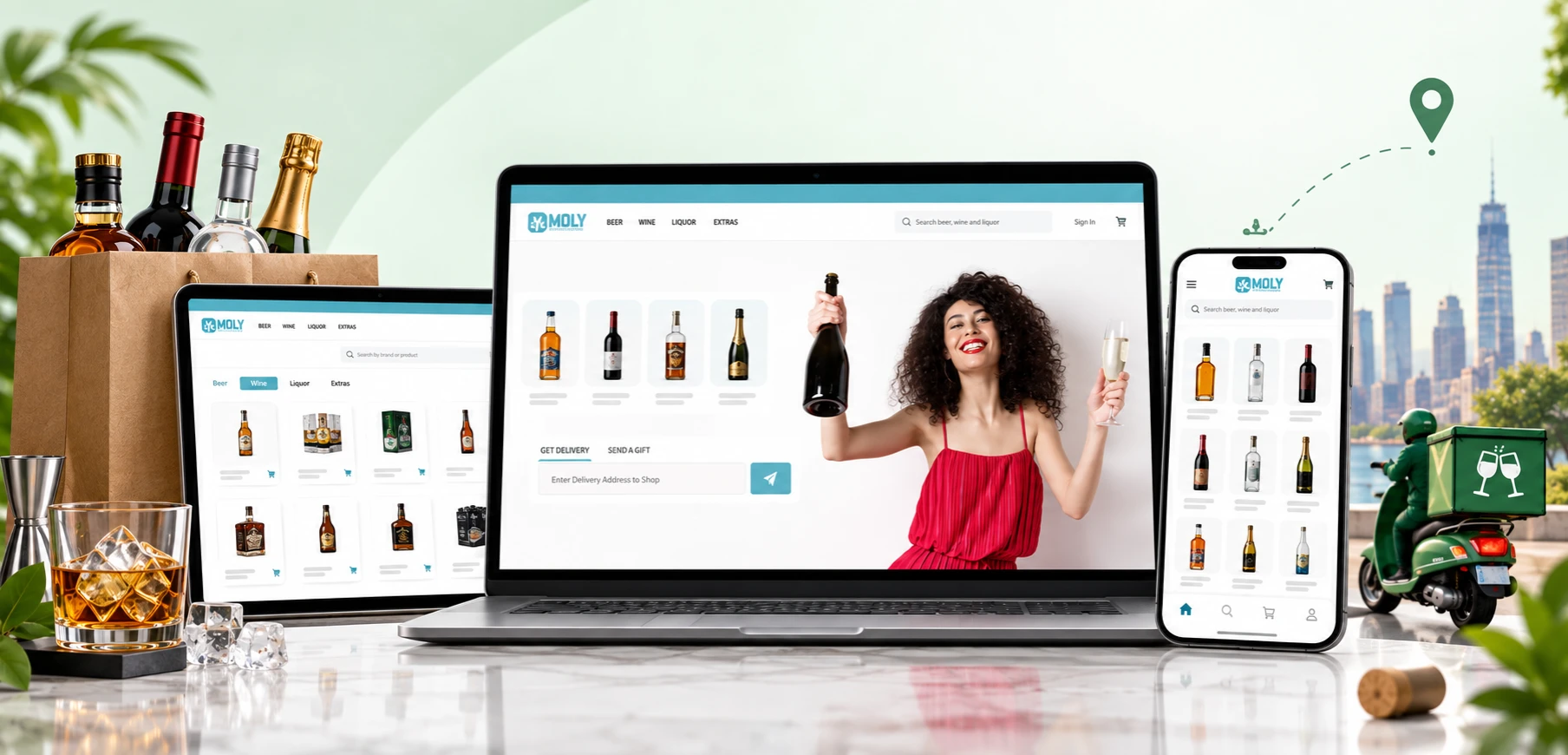
We have built this kind of platform before. With the Moly on-demand liquor delivery app, we helped an entrepreneur whose liquor business relied entirely on in-store visits move to online ordering and doorstep delivery. The platform combines a customer app with real-time driver tracking, gifting, and direct messaging, a store web app for inventory and order processing, and a delivery agent app that makes sure orders reach verified customers. Secure age verification and location-based restrictions were designed into the architecture from the start, and the app passed 1,000 active users shortly after launch.
Based in Princeton, New Jersey, our team brings more than 30 years of software experience to every engagement. For alcohol delivery clients, that means a discovery phase that maps your launch state's rules before any code is written, apps built for real driver conditions, browser-based dashboards for store teams, and ongoing support as laws and features evolve.
Final Thoughts
A liquor delivery app can become one of your most valuable sales channels, but only when compliance is part of the product rather than a patch added later. Start with one state, verify age at sign-up and again at the door, build a rules engine that grows with you, and launch a focused MVP before layering on AI and loyalty features.
Ready to plan your alcohol delivery app? Talk to the team at NewAgeSysIT for a free consultation on features, timeline, and budget. Learn more about digital transformation solutions from one of the leading AI software companies in the United States.
Frequently Asked Questions
How much does it cost to build a liquor delivery app in the USA?
Most US projects fall into three bands: about $40,000 to $80,000 for a focused MVP, $80,000 to $150,000 for a multi-store platform, and $150,000 to $300,000 or more for a multi-state marketplace. The biggest cost drivers are the number of states you serve, native versus cross-platform apps, integrations, and AI features.
How long does it take to build an alcohol delivery app?
A focused MVP usually takes 4 to 6 months from discovery to launch. A multi-store platform takes about 6 to 9 months, and a multi-state marketplace often needs 9 to 12 months or more. Mapping state rules during discovery adds a few weeks but prevents expensive rework later.
Is alcohol delivery legal in every US state?
No. Rules vary by state and often by county. According to the Adult Beverage Alliance, Delaware became the 37th state to allow delivery from off-premises retailers when its governor signed SB 168 in July 2026, with the law taking effect in January 2027. Even where delivery is legal, dry areas, product limits, and hour restrictions still apply.
Do I need a license to start an alcohol delivery business?
The retailer that sells the alcohol always needs a state license. Depending on the state, the delivery company may also need its own permit, such as the Texas Consumer Delivery Permit, the New Jersey Third-Party Delivery Permit, or the Maryland Local Delivery Service Permit. Always confirm requirements with the state regulator.
How do alcohol delivery apps verify a customer's age?
Well-built apps check age twice. At sign-up, the customer confirms a date of birth and verifies a government-issued ID. At the door, the driver scans the ID in the app, confirms the recipient matches it, and checks for signs of intoxication before handing over the order.
What happens if the customer cannot show a valid ID?
The driver must not hand over the alcohol. The app should record the reason, guide the driver to return the order to the store, and apply your refund or restocking policy. Clear ID reminders before the driver arrives help reduce these failed deliveries.
Do alcohol delivery drivers have to be 21 or older?
In many states, yes. Texas requires drivers working under a Consumer Delivery Permit to be at least 21 with a valid driver's license, and Maryland requires third-party delivery drivers to be 21 or older and to complete an alcohol awareness program. Check the rules in each state you serve.
Can a liquor store build its own app instead of relying on DoorDash or Uber Eats?
Yes. A branded app lets a store keep its customer data, set its own delivery fees, and reward loyal shoppers. Many stores use both, with their own app for regulars and marketplaces for discovery. Check whether your state lets store staff deliver or requires a licensed third-party partner.
Can an alcohol delivery app ship to other states?
Local delivery apps generally serve customers near the licensed store. Shipping across state lines is a separate model with its own state permits, volume limits, and adult-signature rules, and spirits shipping is far more restricted than wine shipping. Plan it as a separate compliance project.
Should I build a native or cross-platform liquor delivery app?
Cross-platform frameworks such as React Native or Flutter suit most MVPs because one codebase serves both iOS and Android. Consider native development for the driver app if fast camera-based ID scanning, background location tracking, or rugged Android hardware is central to your operations.
How do alcohol delivery apps make money?
Common revenue streams include delivery fees, service fees, retailer commissions or flat fees where state law allows, delivery memberships, premium retailer tools, and corporate or gift orders. Any brand-sponsored promotion needs legal review because of federal and state tied-house rules.
How can AI improve an alcohol delivery app?
AI can recommend products, power a virtual sommelier, forecast demand, and flag suspicious IDs or orders. IWSR found that 22% of shoppers who chose their last alcohol brand while browsing a retailer's site were influenced by an AI tool, especially in the US. Keep AI marketing away from anyone who has opted out or has not verified their age.
Sources
- IWSR E-commerce Strategic Study 2025, summarized by Global Drinks Intel (December 2025): https://drinks-intel.com/cross-category/why-alcohol-brand-owners-should-trust-in-resilient-e-commerce-channel-category-intel/
- DoorDash, "DoorDash Launches Industry-Leading Safety Features for Alcohol Delivery" (July 2022): https://about.doordash.com/en-us/news/doordash-launches-industry-leading-safety-features-for-alcohol-delivery
- Uber Help, "Alcohol Delivery with Uber Eats": https://help.uber.com/en/driving-and-delivering/article/alcohol-delivery-with-uber-eats?nodeId=8f556ef3-add4-4280-8c86-af0787bb39d4
- CBS News, "Uber to shut down Drizly, the alcohol delivery service it bought for $1.1 billion" (January 2024): https://www.cbsnews.com/news/uber-drizly-closing-march-2024/
- NACS Daily, "Uber Shuts Down $1.1 Billion Alcohol-Delivery Company" (January 2024): https://www.convenience.org/Media/Daily/2024/Jan/17/3-Uber-Shuts-Down-$1-Billion-Alcohol-Delivery_Ops
- Texas Alcoholic Beverage Commission, "Alcohol Delivery and Pickup": https://www.tabc.texas.gov/texas-alcohol-laws-regulations/alcohol-delivery-pickup/
- Texas Alcoholic Beverage Commission, Consumer Delivery Permit course: https://www.tabc.texas.gov/static/sites/default/files/2020-08/consumer-delivery-permit-course-cd_0.pdf
- New Jersey Division of Alcoholic Beverage Control, Special Ruling SR 2022-15: https://www.nj.gov/oag/abc/downloads/SR-2022-15_3rd-Party-Delivery-Permit.pdf
- Maryland Alcohol, Tobacco, and Cannabis Commission, Local Delivery Service Permit: https://atcc.maryland.gov/resources/updates/newsletter/permit-now-required-for-local-alcohol-delivery-by-a-third-party-contractor/
- Adult Beverage Alliance, Arkansas SB 98: https://www.adultbeveragealliance.org/arkansas-expands-alcohol-delivery/
- KTVH, "Montana greenlights third-party alcohol delivery" (April 2025): https://www.ktvh.com/news/montana-greenlights-third-party-alcohol-delivery
- Adult Beverage Alliance, Virginia HB 2058: https://www.adultbeveragealliance.org/virginia-third-part-alcohol-delivery-law-permanent/
- Adult Beverage Alliance, Delaware SB 168 (July 2026): https://www.adultbeveragealliance.org/montana-residents-can-now-get-beer-and-wine-delivered-to-their-door-2/
- WDEL, "Delaware approves wide-ranging alcohol law changes for businesses": https://www.wdel.com/news/delaware-approves-wide-ranging-alcohol-law-changes-for-businesses/article_83374d7f-2778-5c74-907a-517624fa9e56.html


